“130°F Blaze Out of Control — Single Father Saves Officer in Last-Ditch Rescue!”
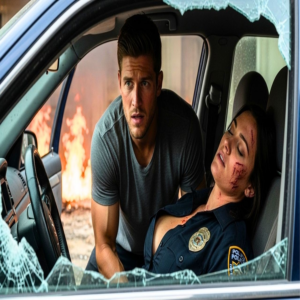
Jack Dawson didn’t stop because he was brave. He stopped because the little girl in the backseat of that locked car, the one with her face pressed against the glass, eyes wide and unblinking, turned out to be a badge, a federal badge, and the woman holding it wasn’t a little girl at all. She was dying. One decision, that’s all it took to pull Jack Dawson out of his quiet, invisible life and drop him straight into a war he never signed up for.
But here’s the thing nobody tells you about men like Jack. They were never really out.
The engine of the old Ford F-250 ticked and grumbled the way it always did when Jack pushed it past 80 on the open highway. Not that there was much highway left out here between Tonopah and nowhere. The Nevada desert stretched in every direction like God had ironed the earth flat and forgotten to come back for it.
The sun had long stopped being a sun. It was something else now. A white furnace nailed to the top of the sky and every surface beneath it was paying the price. Jack had the AC cranked to max. It barely mattered. The heat pressed against the windows like something alive and the truck cab felt like a slow oven even at 70 miles an hour.
The thermometer on his dash read 112. The radio weatherman, 3 hours back outside of Las Vegas, had called it historically extreme. Said the ground temp in some parts of the basin had spiked past 130° Fahrenheit. Said it with the casual cheerfulness of a man who was definitely sitting inside an air-conditioned studio.
Jack had clicked the radio off. His son Tyler, 12 years old and already built like a young tree, was asleep in the passenger seat with his baseball cap pulled over his face and his sneakers propped on the dash. They were driving home from Tyler’s travel league tournament in Henderson. Two wins, one loss. Tyler had pitched five innings in the second game and thrown a curveball that even the other team’s coach had stopped to applaud.
Jack had watched from the bleachers with his arms crossed and his jaw tight and his chest full of something he hadn’t had a name for in a long time. Pride, maybe. The clean kind. The kind that doesn’t ask for anything back. He glanced at Tyler now. The boy’s chest rose and fell slow and steady. One arm dangled off the seat.
His fingers were still wrapped loosely around the half-eaten granola bar he’d been chewing when sleep took him somewhere around the Nye County line. Jack eased off the gas just slightly, rolling through a long, sweeping curve in the highway. On the left side of the road, nothing. On the right side, a gravel pullout.
The kind of forgotten strip that used to serve as a vista point before the sign blew away and nobody replaced it. And parked in that pullout, angled badly, half off the gravel and onto the cracked earth, sat a dark blue, government-issue sedan. Jack saw it and didn’t think anything at first. Then he saw the sun hammering off the roof, the windows rolled up tight, the car sitting absolutely still.
No dust trail from arriving, which meant it had been sitting for a while. No one standing outside it. No emergency flashers. Nothing. He passed it, got maybe 300 yards down the road before something, not a thought exactly, more like a sensation at the base of his neck, the same one that had kept him alive in Fallujah and Kandahar and a dozen places whose names he never spoke out loud anymore, made him ease off the gas.
Dad? Tyler stirred, pulling the cap off his face. Why are we slowing down? Stay away from me a minute, Jack said. He pulled a U-turn on the empty highway. No other cars in sight. Nothing for miles in either direction and drove back to the pullout. He eased the F-250 alongside the sedan, close enough that their shadows touched on the ground.
He looked through the passenger window of the sedan and his stomach dropped six floors. She was slumped sideways against the steering wheel, arms slack, face turned toward the passenger seat like she’d tried to reach for something and couldn’t make it. Her skin was the wrong color, flushed and dark across her cheekbones, the deep red that Jack had seen once before on a Marine named Holloway who’d gone down in the Helmand Valley with heatstroke and almost didn’t come back.
Her lips were cracked and white at the corners. Her eyes were closed. On the dashboard in front of her, an empty water bottle on its side, a federal badge clipped to her belt, a holstered weapon, and a phone, face down, screen cracked. The car’s engine was off. The windows were sealed. Jack was out of the truck before he consciously decided to move.
His boots hit the gravel and he had his hand on her door handle in two strides. Locked. He tried the other doors. All locked. Dad! Tyler was leaning out of the truck window, suddenly wide awake. Stay in the truck, Jack said. Not loud, not angry. The voice he used when he meant it, when there was no room for back and forth.
Tyler knew that voice. He stayed in the truck. Jack stepped back, looked at the sedan’s window, calculated. He grabbed the steel flashlight from the storage pocket behind his seat. Not the little penlight, the big one, the Maglite, the one he’d carried since he got out of the army and refused to leave in storage because old habits are old habits.
He brought it around in a short, controlled arc and drove the butt of it into the bottom corner of the passenger-side window. The glass shattered inward in a shower of pebbles and immediately the heat from inside the car hit him like opening an oven door. It was hotter inside the sealed vehicle than outside in the direct sun.
Maybe 20 or 30° hotter. Maybe more. He reached through the broken window and unlocked the door from inside. The woman almost fell out when he pulled it open. He caught her, one arm under her shoulders, one hand cradling her head, lowering her to the ground instead of letting her hit the gravel. Her skin beneath his hands was burning.
Not warm, not hot, burning. Like she’d been running a fever for days. Except this wasn’t a fever. This was her body shutting down from inside out. Ma’am, he said, can you hear me? Nothing. Ma’am. He put two fingers to her neck, found the pulse. Weak, fast, thready, like a watch with a dying battery. I need you to hear me right now.
Her eyelids twitched, didn’t open. Tyler, Jack called, controlled and clear. In the back of the truck, there’s a blue cooler. Bring me the water bottles. Not the sports drinks, the water. And the cloth bag behind my seat, the one with the first aid kit. Tyler was out of the truck in seconds, moving fast, no questions.
He’d grown up watching his father operate with quiet confidence. He didn’t know the specifics, but he understood the frequency. When Jack’s voice went flat and clear like that, Tyler matched his speed to it. Jack got the woman onto her back on the gravel, checked her airway, clear, and started doing the things his training had drilled into him so deep they lived in his hands rather than his head.
He tilted her head back slightly, checked her pupils as best he could, unequal, one slightly dilated, which wasn’t good. Poured cold water across the back of her neck, her wrists, her temples. Poured more over her chest and arms. Come on, he said quietly, not pleading, just willing it. Tyler appeared at his elbow with the water bottles and the bag.
Jack noted without comment that the kid had also grabbed the windshield sunshade from the back of the truck cab and was holding it up to block the direct sun from falling on the woman’s face. He hadn’t been asked to do that. He’d thought of it on his own. Jack made a mental note to tell him later that that was good thinking.
Right now, there wasn’t time. He kept working. Wet the cloth from the first aid kit, applied it to her neck, her pulse points. Cracked an ammonia capsule from the kit and held it briefly near her nose. Gently, not directly, just enough to let the vapor reach her. She pulled in a sharp breath. Her eyes cracked open.
Unfocused at first. Then slowly she found him. Her lips moved. Easy, Jack said. Don’t talk yet. You’ve got heatstroke. You’re on the ground outside a car on US 95. I’m going to get you stabilized and get you help. She blinked. Her mouth worked again. The word that came out was barely a sound. No. Jack paused. No what? No hospital.
Her voice was like gravel and dust, like something dragged up from the bottom of a well. They’ll find me. Jack looked at her steadily. Who will find you? Her hand, trembling, found his forearm and gripped it with a strength that seemed impossible given the state of the rest of her. Her fingers dug in.
Her eyes, red-rimmed and glassy, fixed on his with an intensity that he recognized the way a combat veteran recognizes another combat veteran. Not by what they’re saying but by what they’re not saying. My name is Rachel O’Connor, she said. I’m a detective. Federal contractor, Task Force Echo, assigned to She coughed, a deep rattling cough that took something out of her.
To a joint investigation. Financial crimes. Domestic arms distribution. The people I was investigating She stopped. Swallowed. They left me here. Jack’s jaw tightened. He kept his expression level. Left you here to die. Locked me in. Took my second phone. Took the flash drive. A beat. Then barely a whisper. They don’t know I have a backup.
Where’s the backup? Her other hand, the one not gripping his arm, moved to her left side. To a flat inner pocket he hadn’t noticed, sewn into the lining of her jacket. She pressed her hand against it and looked at him. I need to know who you are, she said. Before I tell you anything else. I need to know who you are.
Jack was quiet for a moment. Behind him, Tyler had set up the sunshade as a lean-to using the truck door and was sitting close by watching with wide steady eyes that were too old for his face. Good kid. Always had been. My name is Jack Dawson, Jack said. I’m a mechanic. I live in Reno. I’m driving my son home from his baseball tournament.
Rachel looked at him. Looked past him at Tyler for a moment, then back at Jack. She searched his face the way people search for something they desperately need to find and aren’t sure is there. Were you military? She asked. Yes. Branch? Army, Special Forces. Two tours Afghanistan, one Iraq. I got out 8 years ago.
A long silence. The desert heat pressed down on all of them like a weight. Somewhere far off nothing moved. No cars, no planes, nothing. You have no idea, Rachel said slowly, what you just walked into. Jack made a decision in the next 30 seconds. He decided that whatever Rachel O’Connor was mixed up in, however dangerous, however complicated, he was not going to drive away.
That wasn’t a heroic decision. It wasn’t a noble one. It was a simple one. The same simplicity that had made him stop in the first place. The same simplicity that had once made him throw himself on a communications wire in a Kandahar compound while his team extracted a wounded interpreter through a door on the other side.
Not because the math worked out. Because the alternative was to let something happen that shouldn’t happen. And he didn’t know how to do that. He didn’t explain any of this. He just said, We’re not leaving you here. Then he looked at Tyler. I need you to go back in the truck. Lock the doors. Keep the AC on.
Don’t get out unless I tell you to. And if anyone other than me comes to that window, you take the truck and you drive. Do you understand? Tyler met his eyes. Where do I drive to? Tonopah. It’s 40 miles east. You know how to get there. Dad. Tyler. The boy held his father’s gaze for one more second. Then he nodded, got in the truck and locked the doors.
Jack saw the lock button light up through the window. He turned back to Rachel. Can you sit up? Give me a second. She pressed her palms to the ground and pushed herself upright with a visible effort. She was shaking, but the color was coming back. Not great. Not healthy. But better.
The ammonia and the cold water had pulled her back from the edge. She still needed a hospital. She needed an IV. She needed to be somewhere cool and horizontal. But she was conscious and she was forming sentences and her pulse, when he checked it again, was stronger. The backup drive, Jack said. What’s on it? Rachel’s jaw tightened. Everything.
Financial records going back 4 years. Wire transfers from a DOD contractor called Meridian Group to three domestic cell organizations that the FBI has been trying to nail for two decades. Names of eight federal agents who were paid to look the other way. And the operational brief for something they’re calling Prophet.
Jack went still. Prophet. A scheduled domestic arms delivery. 700 rifles. Suppressors. 12,000 rounds of .308. Staged to look like a federal training exercise. She looked at him hard. It’s not a training exercise. Jack said nothing for a long moment. Then, when? 72 hours. Her voice was flat and steady now. The voice of someone who had been carrying something enormous for a long time and was finally, carefully, conditionally putting it down in front of another person.
The upload point is a server relay in Las Vegas. If I can get there and push the drive’s contents through an encrypted uplink before the operation goes live, the whole thing collapses. Every name, every transfer, every order, it all goes public through a dead man’s channel I set up 6 weeks ago. And the people who left you here? They think I’m dead.
Her eyes were clear now. Even through the heat damage and the exhaustion. Which is the only advantage we have right now. And it won’t last long. Jack looked at the sedan. Looked back at her. Your car’s useless. The heat’s probably cooked the electronics. And even if it hadn’t, it’s tagged. They’ll have a GPS trace on it.
I know. We take my truck. We’re mobile. But if they’re running any kind of surveillance net out here, there’s a secondary route, Rachel said. Off 95. Unpaved. It was a military logistics road during the Cold War. Runs parallel to the highway, but about 12 miles north of it. Takes longer, but it doesn’t touch any traffic cameras or toll systems between here and the outskirts of Vegas.
Jack looked at her. How do you know about an old Cold War logistics road? Because I grew up 40 miles from here, she said. And for just a moment, one fractured second, the professional steel in her face gave way to something quieter and more human. My father was a range officer at the test site. I used to ride dirt bikes on that road when I was 14.
Jack almost smiled. Almost. He stood. Checked the horizon in a slow full rotation. North, east, south, west. The kind of unconscious perimeter assessment that never fully left certain men after certain deployments. Heat shimmer in every direction. Nothing moving. But the nothing moving had a quality to it now that put him on edge.
The quiet felt occupied. Can you stand? Help me up. He did. She swayed once, grabbed his arm, found her balance. She was taller than he’d expected. Close to his height, which was 6’1. She had the lean, economical build of someone who’d spent years doing physical work without thinking of it as exercise. A scar along the left side of her jaw, old and faded.
Another on the back of her right hand, newer. She reached into the inner pocket of her jacket and drew out what looked like an ordinary USB drive. Black. No markings. She held it in her palm and looked at it for a moment. The way someone looks at something that has cost them more than it appears to be worth. “If something happens to me,” she said, “you get this drive to a man named Frank Caruso.
He’s a journalist with the Nevada Tribune. He’s been waiting for this for 2 years. He knows how to handle it.” She paused. “He also knows what it means if it comes to him through someone he doesn’t know. He’ll ask you a question. The answer is September 9th. That’s the date the original task force was formed. He’ll know what it means.
” “Nothing’s going to happen to you,” Jack said. Rachel looked at him with an expression that was not quite skepticism and not quite hope. “You’ve been out of this world for a while, Jack Dawson. It doesn’t let go of people as clean as you’d think.” Jack took that without comment. He looked at the USB drive in her palm.
“Keep it. You know what to do with it better than I do.” She closed her fingers around it. “All right. Can you walk to the truck?” “Watch me.” She walked to the truck. It took her twice as long as it should have. And at one point, she put her hand against the side of the truck bed and stopped for 3 seconds with her eyes closed.
Just 3 seconds before she opened them again and kept moving. But she made it. Jack knocked on the passenger window. Tyler rolled it down, his face carefully neutral. Doing that thing he did where he mirrored his father’s composure even when he was scared. “Tyler,” Jack said, “this is Rachel. She’s hurt. She’s going to sit up front.
I need you in the back seat.” Tyler looked at Rachel. Rachel looked at Tyler. “Hey,” Tyler said. “Hey,” Rachel said, and her voice, for just that single word, was completely different from every word she’d said to Jack. Softer. Careful. The way adults talk to children when they’re aware that the child is scared and they don’t want to make it worse.
Tyler climbed over the center console into the back seat without complaint. Jack got in, started the engine, cranked the AC again. He pulled the F250 back onto the highway heading east. “How far to the turnoff for your road?” he asked. “7 miles,” Rachel said. Her eyes were closed. Her head was back against the headrest.
“There’s a cattle guard with a faded orange marker post. No other sign. You’ll almost miss it.” “I won’t miss it.” A long silence. The highway rolled ahead of them, empty and wide and absolutely merciless under the white Nevada sun. “Jack,” Rachel said without opening her eyes. “Yeah?” “Why did you stop?” He didn’t answer immediately.
He looked at the road, thought about Tyler’s baseball game the day before, thought about the way the kid had thrown that curveball, the clean mechanics of it, the follow-through that Jack had spent two summers teaching him in the backyard at 6:00 in the morning before work. Thought about the fact that the world Tyler was going to grow up in was made quietly and incrementally out of the small choices of people who had the option to keep driving and chose not to.
“Because you were in the car,” Jack said. Rachel was quiet for a moment. “That’s it?” “That’s it.” Another silence. Longer this time. Then, from the back seat, Tyler’s voice, low and steady like his father’s. “Dad?” “Yeah, bud?” “There’s a black SUV about a mile back. It’s been there since we turned around.” Jack checked the mirror.
The boy was right. A dark shape keeping distance, keeping pace. Jack’s hands tightened on the wheel. His face didn’t change. “Rachel,” he said quietly, “how far to that turnoff?” She opened her eyes, checked the mirror herself. Something shifted behind her expression. Not fear, exactly, but a recalibration. A warrior checking her math.
“4 miles,” she said. “How fast can I take the cattle guard without bottoming out?” “In a truck like this? 30 miles an hour easy.” Jack pressed the gas down smooth and steady. The F250 climbed to 80 without complaint. “They’ll close the distance if you accelerate,” Rachel said. “I know.” He checked the mirror again.
The SUV was accelerating, too. Not matching his speed yet, but moving. “But I’d rather hit that turnoff with them behind me than beside me.” Rachel reached to her hip, checked the weapon at her side. Still there. Still holstered. “You should know they won’t identify themselves. They’re not going to badge up and ask us to pull over.
” “I figured. They’ll try to force us off the road first. Make it look like an accident.” “How many in the vehicle do you think?” “Standard op for a cleanup team like this? Three, maybe four.” “Armed?” “Extensively.” Jack nodded once, very slowly. The nod of a man filing information into the correct drawer without letting it change the temperature of the room.
>> [clears throat] >> “Then we don’t let them get alongside us,” he said. He pressed harder on the gas. The desert blurred. The black SUV, 1 mile back, accelerated. And somewhere ahead, 4 miles, 3, closing. An unmarked cattle guard with a faded orange post waited on the right side of the highway. A road that didn’t appear on any map.
A road that a 14-year-old girl had ridden her dirt bike on 40 years ago, not knowing that the memory would one day matter. Tyler had stopped talking. He was watching the side mirror with the quiet, focused attention of a kid who’d grown up learning that when his father went silent, the right thing to do was stay sharp and stay close.
Jack Dawson drove. The thermometer on the dash read 114° Fahrenheit. The sky was white and vast and completely without mercy. And somewhere behind them, the men who had locked a woman in a car to die in the Nevada heat were coming to finish what they started. This story is far from over. Part two is coming. And what happens when Jack hits that unmarked road with a tail closing fast will test everything he’s got left.
Drop your city below and let me know you’re watching. And if you haven’t subscribed yet, don’t wait. This one goes deep. Jack hit the cattle guard at 32 miles an hour and the F250 bucked hard over the steel rails, the chassis groaning, the suspension taking the shot like a linebacker absorbing a block. Rachel’s hand went to the dash.
Tyler grabbed the back of the front seat. Nobody said anything. The orange marker post flashed past on the right side, faded, half-buried in blown sand, invisible unless you were looking for it. And then the highway disappeared behind them and they were on the old road, unpaved, two tracks of hard-packed caliche with a spine of scrub grass down the middle.
The kind of road that isn’t maintained because nobody is supposed to know it exists. Jack cut his headlights. “They saw us turn,” Tyler said from the back seat. He was watching through the rear window, his voice flat and matter-of-fact in the way that scared Jack more than crying would have. A scared child who sounds calm is a child working too hard.
“I know,” Jack said. In the side mirror, he could see the highway. The black SUV had reached the spot where they’d turned off and it was slowing. Not stopping. Slowing. The way a predator slows when it’s reading ground sign. Jack kept the truck moving, pushing the speed to 40 on the rough surface, which was probably too fast, but too fast was survivable and stopped was not.
“They’re pulling over,” Tyler said. “Are they on the road yet?” A pause. “No. They stopped on the shoulder. Someone got out.” Jack processed that. Someone on foot checking the cattle guard for tracks. That bought maybe 90 seconds, maybe 2 minutes if they were careful and methodical. Professional, then. Which meant they were bad, but they were also predictable.
Professionals operated from playbooks and playbooks had gaps. “Rachel.” He kept his eyes forward on the twin tracks unspooling in front of them. “This road, how far does it run before there’s any kind of cover?” Rachel had straightened in her seat. She wasn’t leaning anymore. Whatever reserve she’d been drawing on since he’d pulled her off that gravel had consolidated into something tighter and more controlled.
She was running her own calculations. He could see it. The same kind of parallel processing he remembered from the best people he’d served alongside. The ones who could be hurt and afraid and still thinking straight lines. About 6 miles ahead, there’s a dry wash that cuts north-south across the road. 12-15 ft deep. There’s an old culvert.
It was put in during the ’60s for the supply convoys. If we can get into that wash and position the truck below the road grade, we’re invisible from ground level unless they’re directly on top of us. Is the culvert passable? I don’t know. I haven’t been on this road in over 20 years. Best guess? She thought about it for a second.
It was solid concrete construction. Military spec. The desert doesn’t do much to concrete. “6 miles,” Jack said. At 40 miles an hour on this surface, that was 9 minutes. He didn’t know if they had 9 minutes. “They’re on the road,” Tyler said. Jack pressed harder on the gas. The F250 fishtailed slightly on a soft patch, the rear tires spinning for just a moment before catching again.
Jack corrected without over-correcting. Something that was all in the wrists. Something that came from years of driving in conditions that weren’t designed for driving. He felt Rachel watching him do it, and he felt her not relax, exactly, but recalibrate. Reassess. The way you reassess a person when they show you something true about themselves through their hands.
“How are you feeling?” he asked. “Don’t worry about how I’m feeling.” “I’m not worried. I’m asking because I need to know if you’re going to be useful or if I need to plan around you.” A beat of silence. Then, unexpectedly, something almost like a laugh. Brief. Mostly air. “I’m functional,” she said.
“My head’s still swimming a little, but I can think and I can shoot straight. What I can’t do is run a quarter mile in this heat without going down again. So, keep that in the math.” “Noted.” “How about you? What are we working with here?” “In the truck?” “A Maglite, a full first aid kit, one hunting knife, and a .
45 in the lockbox behind my seat.” “One weapon.” “One weapon,” he confirmed. “And Tyler’s aluminum baseball bat in the back. But that’s a last resort.” “It’s not funny,” Tyler said from the backseat. And somehow, the flatness of his delivery, the complete absence of any 12-year-old lightness, settled something in all three of them. It clarified the room.
“No,” Jack agreed. “It’s not.” The road dipped and rose, dipped and rose, the desert rolling under them in long, slow undulations that were deceptive. You couldn’t see more than a hundred yards ahead because of the way the terrain folded. That was good. It meant the SUV behind them couldn’t see them, either. Assuming the SUV was on the road, which Tyler confirmed it was 30 seconds later when headlights, bright, full beam, swept the dust column that the F250 was throwing up behind it.
“They’re using lights,” Rachel said. “Full beams,” Tyler confirmed. “Moving fast.” Jack did the math. If the SUV was making 60 on this surface, and a purpose-built vehicle with upgraded suspension could, they were gaining. The headlights in his dust trail would close to his position in roughly 4 minutes. The wash was 6 miles ahead.
He didn’t have 6 minutes. “Rachel,” he said, “is there anything between here and the wash? Anything I can use?” She closed her eyes for 2 seconds. He could see her walking the road in her memory, the way she’d ridden it at 14. The markers, the features, the places that stood out. “There’s a junction,” she said slowly.
“About 2 miles ahead. The main road continues north, but there’s a branch that goes west. It was a dead end even then. Led to an old radar installation that was decommissioned in the ’70s. The branch is barely distinguishable from the main track. If we take the main track, but they take the branch, we buy time,” she said.
“But only if they can’t see which way we went.” “How long is the branch before it dead ends?” “Half a mile, maybe a little more.” Half a mile at speed was 30 seconds of confusion, maybe 45. It wasn’t much, but it was something. “I’ll need about 20 seconds of darkness,” Jack said. Rachel understood immediately.
“You want to go dark before the junction.” “If they lose our dust and our lights at the same time, and I take the turn tight, they might not see the branch in time to distinguish which way we went.” “And if they do see it?” “Then we’re back where we started. But we’ve still got the wash 2 miles further.” Rachel turned and looked at Tyler.
“Can you get down on the floor back there? Flat, on your stomach.” Tyler looked at his father. “Do it,” Jack said. He heard the seat creak as Tyler slid off it. Heard the soft thump of him settling on the floor of the cab. Good kid. No argument. Jack watched the headlights in his mirror. They were maybe a mile back.
Bright columns cutting through the dust he was throwing. He needed them at exactly the right distance when he killed his lights. Too far, and they’d see the darkness and slow down. Too close, and they’d see the turn. “Ready?” he said. “Ready,” Rachel said. “Tell me when the junction’s a quarter mile out.” “I’ll tell you.
” He drove. The headlights behind him swelled in the mirror. Closer. Closer. He could hear the engine note of the SUV now, faintly, above the sound of his own. A higher pitch, pushing hard. “Quarter mile,” Rachel said. Jack killed the lights. The darkness hit them like a wall. No moon yet.
The stars were out, but they were stars, not illumination. The road in front of them was nothing. A black suggestion of itself. The twin tracks barely distinguishable from the ground beside them. Jack went on feel and memory. On the drift of the steering wheel and the sound of the tires. He slowed from 40 to 25. Not by braking, brake lights, but by easing off the gas and letting the terrain work.
The junction appeared as a slightly lighter absence in the darkness. A split in the texture of the ground ahead. Jack took it at 25 miles an hour. Tight. Cutting the wheel smooth and clean. Not touching the brakes. Behind them, the bright columns of the SUV’s headlights swept the dust cloud, and then nothing. The dust was settling.
Already dispersing. He’d gone dark too recently for them to track it cleanly. He counted in his head. 1 1,000. 2 1,000. 3. “They slowed down,” Tyler said from the floor. He must have been watching somehow, craning his neck. 4 1,000. 5. “They’re taking the branch,” Tyler said. “I can see the lights. They went right.” Jack kept driving.
Dark, slow, feeling the road. He switched the lights back on at low beam. Not full, just enough. And pressed the speed back up to 40. The wash had to be less than 2 miles now. “That buys us 2 minutes,” Rachel said. She didn’t say it with satisfaction. She said it like a woman marking items off a list that was longer than the time available.
“I’ll take 2 minutes,” Jack said. Rachel turned to face forward. Her profile against the darkness outside was still, composed. Then she said something he didn’t expect. “How old were you when you enlisted?” The question caught him sideways. “18,” he said. “Why’d you do it?” He thought about it. “My dad was a mechanic,” he said.
“His dad was a mechanic. I looked at that line and decided I wanted to find out what else I was first before I went back to it.” “And after you got out?” “You went back to it.” “I went back to it.” A pause. “Is it enough?” He glanced at her. “What kind of question is that?” “An honest one.” Jack looked at the road ahead.
He thought about the shop in Reno. The smell of engine oil and cold coffee. The rhythm of it. The clean physicality of diagnosing a problem with your hands. Of fixing something broken and having it run again. He thought about Tyler at the kitchen table every night doing homework. The sound of pencils on paper. The way the kid hummed slightly when he was concentrating.
A habit he’d had since he was 4 years old and had never lost. He thought about the quiet of the early mornings before the world started moving. “Yeah,” he said. “Most days.” Rachel nodded slowly. Like that was an answer she needed to hear. Though he couldn’t have said why. Then Tyler said, “Dad, they’re back on the main track.” The 2 minutes were up.
The wash came up faster than Jack expected. The road dipped sharply and his headlights suddenly caught the far wall of the arroyo, sandy and vertical, 12 ft below the road grade. The culvert was there, set into the near bank, a concrete arch, dark and wide, old military construction, exactly where Rachel had said it would be.
It looked passable, barely. “Can I fit?” he said. Rachel leaned forward, squinting. “It’s tight.” “Can I fit?” “Go slow and cut hard left as you enter. The arch is offset.” He took it at 5 miles an hour, felt the truck nose drop as the front wheels went over the edge and down into the wash. Felt the frame groan as all four wheels dropped below road grade.
He cut left, heard the right side mirror scrape concrete, a sound like a fingernail on a chalkboard, and then they were through, inside the wash, tucked under the overhang of the arroyo bank. He killed the engine, killed the lights. Absolute dark. Absolute quiet. The three of them sat without moving or speaking.
40 seconds passed. Then they heard it, the engine of the SUV passing above them on the road, the sound moving over them and then ahead, north, fading, not slowing, not stopping. Tyler exhaled from the floor of the back seat. The sound of it was the most honest thing Jack had heard all day. “Stay down,” Jack said quietly.
“Another 30 seconds.” The engine sound was gone. Nothing replaced it. The desert at night was different from the desert in the daytime. It had sounds, small and careful, the sounds of things living close to the ground. Right now, even those were quiet. Jack got out of the truck. He stood in the arroyo and listened to the darkness for a full minute.
Nothing. No light on the road above. No sound of an engine doubling back. He got back in the truck. “They’ll figure it out,” Rachel said. “They’ll reach the end of the road and they’ll backtrack and they’ll be more careful the second time.” “I know.” “How long do you think we have?” “10 minutes. 12 if they’re methodical.
” “Then we move in eight.” She reached inside her jacket and took out the USB drive again, turned it between her fingers. In the near total darkness, he could barely see her face. “Jack, I need to tell you something.” “Tell me.” “The man who ordered the operation, Prophet, his name is Haverford.” “Colonel David Haverford?” “He ran special operations procurement for the DOD for 11 years.
He knows how these situations are contained. He knows how people like me disappear, how the paperwork gets written, how the narrative gets built afterward.” She paused. “He also knows that the only person who can make this stick is someone outside the federal system, someone who has no connection to any of it.
” Jack was quiet. “Someone,” Rachel continued, “who stopped on a highway because a car was sitting wrong.” He looked at her in the dark. “You’re saying I’m the only person who can do this without being neutralized first?” “I’m saying you’re outside the architecture. Haverford’s whole operation is built around controlling people who are inside it.
You’re not a federal agent. You’re not a contractor. You don’t have a clearance to revoke or a career to threaten or a family member they can get to through official channels.” She stopped. “Well, you have Tyler.” The word landed between them like a stone in still water. Jack felt it. He felt the full weight of it, the way it connected to the boy on the floor of the back seat, the boy who had pitched five innings the day before and thrown a curveball that made a stranger stop and applaud, the boy who had grown up learning to
match his father’s frequency, the boy who was 12-years-old and lying flat on the floor of a truck in a dry wash in the Nevada desert because his father had stopped on a highway. Jack’s jaw worked. He breathed in once through his nose, breathed out. “Nobody gets to Tyler,” he said. It was not a statement of intent.
It was a statement of physics, a declaration of natural law. Rachel heard it and understood it. She nodded once. “Then here’s what we do,” she said. “We get Tyler somewhere safe, somewhere outside the reach of anyone connected to this before we move on Vegas. Is there someone you trust? Someone completely off the grid of this?” Jack thought of one person, one person in the world he’d trust with Tyler’s life without a second thought.
“My sister,” he said. “She lives in Beatty, 20 miles from here. She’s a nurse, off the books, no social media, nobody knows she’s connected to me.” “Can you reach her?” He pulled out his phone, looked at the screen. One bar of signal, maybe enough. He opened the messages app and typed fast, keeping it short, keeping it clean, the way he’d been trained to communicate in environments where brevity was survival.
“Coming to you. 20 minutes. Don’t ask. Keep the lights off.” He hit send and watched the spinning circle. It went through. Rachel was watching him. “You trust her completely?” “She’s the one person I’d die for besides Tyler,” Jack said. “And she knows how to keep a door locked and a mouth shut.” “All right.
” Rachel straightened, tucked the drive back into her pocket. “Then we move in five.” “Three,” Jack said. She looked at him. “They’re methodical,” he said. “Which means they’re faster than I said.” He started the engine. From the floor of the back seat, without being asked, Tyler said, “I’m ready.” And Jack Donaghy pulled the truck forward out of the culvert, back up the bank, back onto the dark road, heading north toward a house with the lights off, toward the one person in the world he’d put between his son and everything coming for them.
Behind them, somewhere on the road, headlights were turning around. Diane Dawson was 49-years-old, 5’4″, and had the kind of stillness about her that people sometimes mistook for gentleness. It wasn’t gentleness. It was control, the deep, practiced control of a woman who had spent 22 years as a trauma nurse and knew that panic was a luxury that cost more than it was ever worth.
When the lights of Jack’s truck swept across her front window at 11:40 at night, she was already standing at the door. She had the porch light off. She had the front room dark. She had her phone face down on the kitchen counter and the back door unlocked and a bag packed because Diane Dawson had known her brother for 47 years and when he sent a message that said, “Don’t ask and keep the lights off,” she didn’t ask and she kept the lights off.
Jack pulled the truck around the side of the house rather than into the driveway. Old habit. Diane watched him do it and felt the knot in her chest pull tighter. He was out of the truck before it fully stopped. Tyler came out of the back seat and Diane felt something release in her chest at the sight of the boy, safe, upright, moving under his own power.
Then the passenger door opened and a woman got out, tall, moving carefully, one hand briefly on the side of the truck for support before she let go. Diane held the door and they came inside. “How bad?” she said, looking at the woman. Nurse’s eyes. She was already reading the flushed skin, the careful way she moved, the slight tracking lag in her pupils.
“Heatstroke,” Jack said. “Two, maybe three hours of exposure in a sealed vehicle. I stabilized her on the road. She needs IV fluids.” “I have a line kit,” Diane said. She was already moving toward the back room. “Sit her down.” “I’m fine,” Rachel said. “You’re not fine,” Diane said without looking back. “Sit down and let me work.
” Rachel looked at Jack. He almost smiled. “Don’t fight her,” he said. “It doesn’t work.” Rachel sat. Diane worked fast and quiet, the way she did everything. IV line in Rachel’s left arm inside of 90 seconds. Saline bag hung from a hook on the wall that Jack suspected had been installed for exactly this kind of purpose.
Because Diane’s life had a way of requiring exactly this kind of purpose. She took Rachel’s pulse, checked her eyes, pressed two fingers to her neck and counted silently. “You’re dehydrated and your core elevated,” she said. “You need at least an hour on this line before you go anywhere.” “We may not have an hour,” Rachel said.
“Then we start with 30 minutes and see where we are.” Diane’s tone left no room for negotiation. She turned to Tyler, who was standing by the kitchen doorway with his arms crossed and his baseball bag still over one shoulder. Because nobody had told him to put it down. “Tyler, there’s food in the re- frigerator. Eat something.
” “I’m not hungry.” “I didn’t ask.” She put her hand briefly on the side of his face. Just for a second. A gesture so quick and complete that it said everything without saying anything. And then she turned to Jack. “Kitchen,” she said. He followed her in. She pulled the door partially closed behind them. “Talk,” she said.
He talked. He kept it short. Federal corruption. Arms deal. Three days out. Mercenaries in a black SUV who were currently somewhere on a dark road 12 miles away rethinking their approach. He told her about the drive in Rachel’s pocket and the journalist in Las Vegas named Frank Caruso and the 72-hour window. He told her about Haverford.
Diane listened without interrupting. Her arms were crossed and her face was still. And she was doing the same thing she always did when he laid something impossible in front of her. She was measuring it. Not panicking. Not pushing back. Measuring. When he finished, she was quiet for a moment. “Tyler stays here,” she said.
“That’s why I brought him.” “No. I mean, Tyler stays here with me. And you two continue without him. You don’t take him to Las Vegas. You don’t take him anywhere near this.” “That was already the plan, Diane.” “I know it was already the plan. I’m saying it out loud so it’s real.” She looked at him hard. “And I’m saying something else, too.
If this Haverford knows how to make people disappear, if he’s as connected as she says, then bringing this to a journalist might not be enough. You understand that? One journalist can be silenced, too. One upload can be intercepted.” “Rachel has a dead man’s channel set up.” “What does that mean, exactly?” “It means if the upload doesn’t complete within a set window, a second trigger goes to five separate recipients simultaneously.
Media, federal oversight, two congressional offices, and an international press association.” Diane absorbed this. “And you trust her? You met her 4 hours ago in a parking lot.” “I didn’t meet her in a parking lot. I pulled her out of a car she was locked in to die.” “That’s not an answer to the question.” Jack leaned against the kitchen counter.
He was quiet for a moment. “Yeah,” he said. “I trust her.” “Why?” He thought about it honestly. The way Diane always made him think about things honestly. Because she had never once in her life accepted a convenient answer from him. “Because she’s not asking me to believe her,” he said. “She’s not asking me to trust the story.
She’s asking me to be useful. And the people trying to stop her already tried to kill her once tonight. Which means she’s real and what she’s carrying is real.” Diane looked at him for a long moment. Then she uncrossed her arms and turned back toward the sink. “There’s a map in the second drawer,” she said. “Old paper one, not digital.
Take it.” “Why do I need a map?” “Because if they’re tracking phones, and they are, you’re going to need to ditch yours before you get 20 miles from here.” She opened the drawer and put the folded map on the counter beside him. “There’s also $300 in the coffee can above the refrigerator. Take that, too.” “Diane.
” “Don’t argue with me about money right now, Jack. Just take the money.” He took the money. He put it in his shirt pocket and then he stood there for a second in his sister’s kitchen with the lights off and felt the weight of the last 4 hours settle on him all at once. Not crushing him. Just landing. The way weight lands on a structure that was built to hold it.
He felt it and he held it and he didn’t let it show. “He did good today,” he said. “Tyler. His curveball.” Diane’s voice softened by exactly 1°. “I know. He called me after the game.” “He called you?” “He calls me after every game.” She glanced at him. “He wants me to tell you things are okay even when they’re not.
He’s been doing it since he was nine.” A pause. “He’s more like you than you know, Jack. And I mean that as both a compliment and a warning.” Jack stood with that for a second. Then he picked up the map and went back to the front room. Rachel was sitting with her eyes open, the saline running steady into her arm.
And she had Tyler in conversation. That surprised him. Not that she was talking, but what she was talking about. She was asking him about the curveball. The mechanics of it. Tyler was explaining the grip, the wrist rotation, the way you had to commit to the release point or the ball would flatten out. And there was something in the way he explained it. Specific. Technical.
Proud. That made Rachel listen with what looked like genuine interest. Jack stood in the doorway and didn’t interrupt. “Your dad teach you that?” Rachel asked. “Yeah. He used to pitch, too, back in high school. He says he wasn’t as good as he remembers, but I think he was probably better than he says.” Rachel smiled.
It changed her face completely, briefly. The hard professional lines softened and she was just a person for a second. Tired and in pain and smiling at a 12-year-old’s loyalty to his father. “Those are the best kind of teachers,” she said. “The ones who say they were worse than they were.
” Tyler looked up and saw Jack in the doorway. His eyes went to the map in Jack’s hand. Then to his father’s face, reading it the way he always read it. Carefully. Looking for what was underneath. “You’re leaving,” Tyler said. Not a question. “In about 20 minutes,” Jack said. He came into the room and sat down on the edge of the coffee table directly in front of his son.
“You’re staying with Diane. You don’t leave this house. You don’t use your phone. You don’t tell anyone where you are.” Tyler’s jaw tightened. He was 12, not six, and the part of him that was already halfway to being his father’s equal wanted to push back. Jack could see the push forming. He let it form. “I should come,” Tyler said.
“I could No.” “Dad, I’m not a kid.” “You’re my kid,” Jack said. “That’s a different thing.” He held his son’s eyes. “The best thing you can do for me tonight, the most useful, the most important, is to stay in this house, stay safe, and be here when I come back. That’s not a small thing, Tyler. That’s the thing.
You understand?” Tyler looked at him. Held the eye contact the way Jack had always taught him to hold it. Steady. Don’t look down. Don’t look away. Because the eyes are how two people tell each other the truth without words. Then Tyler nodded. One small, tight nod. Jack put his hand on the back of his son’s neck and held it there for a moment.
Then he stood. Diane came in and disconnected Rachel’s IV line. “32 minutes,” she said. “Your color’s better. Don’t push it.” Rachel stood, steadier than before. Measurably steadier. She looked at Diane with a direct, unadorned respect that one competent professional extends to another. “Thank you,” she said. Diane met her eyes.
“Bring him back,” she said. Rachel didn’t flinch from it. “That’s the plan.” Jack was checking the .45 from the lockbox. Magazine full. Chamber loaded. Safety on. He tucked it into his waistband at the small of his back and pulled his shirt over it. He picked up the hunting knife and clipped it inside his belt on the left side.
He looked at the flashlight. Considered it. Put it in his jacket pocket. He looked at the map. Confirmed the route. Beatty to Las Vegas. 2 hours on US 95. but not on US 95, on the back roads, on the roads that didn’t show up on the traffic monitoring systems Rachel had mentioned. “There’s one more problem,” Rachel said.
She was standing by the window, careful not to get close enough to be seen from outside. “The upload point in Las Vegas?” “It’s a server relay at a tech co-op on Fremont Street. The building closes at midnight. It’s 11:53.” Jack looked up. “We can’t make it by midnight.” “No, but there’s a contact there. A man named Webb, Danny Webb.
He runs the co-op. He’s been holding a relay node open for me for 6 weeks on a rotating access code. If I can reach him, he’ll keep the building accessible.” She paused. “The problem is reaching him. His number is clean, no federal flags, but if I use my phone, I’m broadcasting our location.” “Use mine,” Diane said from the hallway.
She held out an old flip phone, the kind that hadn’t been in common use for 15 years. “Prepaid, no data, no GPS. I keep it for exactly the kind of situation where I don’t want to be findable.” Rachel took it without comment and dialed from memory. The phone rang four times, and Jack was already calculating alternatives when someone picked up.
“Danny?” Rachel’s voice was level, professional. “It’s Night Watch.” A pause. “I know what time it is. I need the relay node held open.” Another pause, longer. Rachel’s jaw tightened slightly. “Danny, listen to me. I know what I’m asking. I know what it costs you. But what’s on this drive is going to” She stopped, listened.
Something in her expression shifted. “How long ago?” She turned and looked at Jack. Her eyes were flat and steady and telling him something he didn’t want to hear. “Okay. Don’t go back in. Don’t go anywhere near it. Do you hear me? Get out of the area now.” She closed the flip phone. The room was very quiet. “They got to the co-op,” she said.
Jack said nothing. “Two men, 40 minutes ago. Danny came back from dinner and saw them through the front window before he went in. He’s been sitting in his car two blocks away waiting for them to leave.” She set the phone on the table. “They know the upload point, which means Haverford got to someone inside Task Force Echo who knew about the relay, which means our window is closing faster than I thought.
” “Is there a backup point?” “There’s always a backup point.” She pressed her hand to the pocket where the drive was. “But it’s not in Las Vegas. It’s in Henderson. A broadcasting antenna array at an old radio relay station. It was decommissioned, but the hardware is still live. I installed a hard uplink adapter there 6 weeks ago, same time I set up Danny’s node.
If I can get physical access to the antenna room and hardwire the drive, it bypasses the internet entirely. Direct satellite relay to the dead man’s channel.” “Henderson,” Jack said. He unfolded the map, found Henderson southeast of Las Vegas proper, did the math. “That’s 2 and 1/2 hours from here.” “A little more on back roads, which means we arrive around 2:30 in the morning.
” “Yes. And the 72-hour window on Prophet started running from when I last verified the operational brief. That was yesterday at 6:00 p.m.” She was precise. She was certain. “Which means we have until 6:00 p.m. the day after tomorrow.” “That’s enough time,” Jack said. “It’s enough time if nothing else goes wrong.
” He looked at her. “Something else will go wrong.” “I know. That’s not me being negative, that’s experience. I know that, too.” She picked up the map from the table and looked at the route he’d traced. She studied it for a moment, then put her finger on a different road, further south, smaller, looping wide around the main corridor.
“This one,” she said. “It adds 20 minutes, but it doesn’t cross any county lines with active camera infrastructure. Haverford’s network is deep, but it’s not infinite. He can’t cover every back road in southern Nevada.” Jack looked at the route, looked at her. “You know this desert,” he said. “I grew up in it,” she said.
“And I spent the last 18 months mapping every route in and out of it on the assumption that one day I was going to need them.” “Smart.” “I’m still alive,” she said, “so far.” Jack folded the map along her route. He put it in his jacket pocket with the flashlight. He looked at his son one more time. Tyler, sitting on the couch now, elbows on his knees, watching his father with an expression that was the most adult thing in the room.
“Hey,” Jack said. “Hey,” Tyler said. “I’ll be back before morning.” Tyler looked at him for a long moment, then “Dad, be careful.” Not come back safe. Not I love you. Just be careful. The way Jack himself always said it. The economy of it. The compression of everything that mattered into two words that both of them understood at full depth.
“Always am,” Jack said. He and Rachel went out the back door into the dark. Diane stood in the doorway and watched them go. She stood there until the truck started and the tail lights moved away around the side of the house and disappeared. And then she stood there a little longer after that, in the doorway of her darkened house, listening to the Nevada night.
Tyler appeared beside her. He stood close but didn’t lean, the way Jack stood close but didn’t lean. And the similarity of it made something ache behind her sternum. “He’s going to be okay,” she said, not because she was certain, because some things need to be said into the dark, whether you’re certain or not.
Tyler said nothing for a moment, then “She’s going to keep him focused,” he said. “Rachel. She thinks like he thinks. I could tell.” Diane looked down at him. He was watching the empty road where the tail lights had been. His jaw was set. His eyes were his father’s eyes. “Yeah,” Diane said quietly. “I could tell, too.
” She put her arm around his shoulders, and they stood there in the doorway together, the nurse and the 12-year-old boy, while out there in the dark, on roads that didn’t show up on maps, Jack Dawson drove south towards something he’d only half prepared for and fully committed to, with a flash drive full of evidence that powerful men were spending considerable resources to bury, and a woman beside him who had been left in the desert to die and had decided against every reasonable assessment of the situation that she was not going to.
The night stretched long and flat and absolute in every direction. The thermometer in the truck read 94° even after midnight. The desert didn’t forget what it was. Jack drove with both hands on the wheel and the map on the dash and the .45 at his back and said nothing. And Rachel sat in the passenger seat with her eyes forward and the drive in her pocket and said nothing.
And between the two of them, in the silence, something settled. Not comfort. Not certainty. Something older and simpler than either of those things. The kind of understanding that forms between two people when they’ve both decided, separately and completely, that they’re not turning back. They made it 40 miles before the first checkpoint.
It wasn’t a real checkpoint. No uniforms, no official signage, nothing that would hold up to any kind of scrutiny. Just a pickup truck parked sideways across the narrow road with its hazard lights blinking, and a man standing in front of it holding a flashlight, waving them down. The kind of thing that looked, at a distance, like a breakdown or a road crew situation.
The kind of thing designed to look exactly like that. Jack saw it and didn’t slow down. He took his foot off the gas, but he didn’t brake. He let the truck coast, and he looked at the setup. The angle of the blocking vehicle, the single man visible, the darkness on both shoulders of the road. And he said quietly, “How many do you think?” Rachel had already read it.
“Two in the truck, possibly one on each shoulder in the dark. Standard funnel formation.” She reached to her hip, unsnapped the holster, didn’t draw, not yet. “They’re expecting us to stop.” “I know. The road’s too narrow to go around the driver side. The The on the right drops off. I see it. Jack, “I’m going through.
” he said, not loud, not angry. The flat, decided voice. Rachel looked at the blocking truck ahead, then back at him. She braced her right hand against the dash. “Hit it on the passenger corner.” she said. “Their truck is lighter than yours. If you catch the front corner at speed, it’ll spin rather than stop you.” “That’s what I was thinking.
” Aim for the gap between the front bumper and the road shoulder. “I know how to do this, Rachel.” She nodded once and held on. Jack pressed the gas. The man with the flashlight had been doing a slow wave-down gesture that turned as the F250 accelerated instead of slowed into a sudden backward scramble. Jack heard him shout something, a word, a name, a warning. It didn’t matter.
And then the F250 hit the front corner of the blocking truck at 45 mph, and the impact came through the chassis like a body blow, sharp and hard and brief. And the lighter truck spun 30° on the asphalt, and Jack was through the gap, straightening, accelerating. The right mirror gone and the front right corner crumpled, but the engine running clean and the wheels tracking straight.
“Down.” he said. Rachel was already low in the seat. 3 seconds passed, then the back window of the truck cab exploded inward. A single shot, high, going through glass and out through the roof panel above the back seat. And then they were around a curve, and the darkness closed behind them, and the shots stopped.
Jack’s hands were rock-steady on the wheel. His heart was running fast, and he let it run. The body did what the body did. The hands stayed steady. He’d learned that separation a long time ago in places that had required it, and it had never fully gone away. “You hit?” he said. “No.” Rachel came back up in the seat.
She had her weapon drawn now, held low, checking the side mirror. “They’re not following. Not yet. They’ll call it in first.” “Which means Haverford knows exactly where we are.” “He knew approximately where we were the moment they set up that checkpoint. Now he knows our direction and our speed.” She holstered the weapon.
“We have maybe 20 minutes before the next layer moves.” “Next layer.” Jack said. “Haverford doesn’t run single-point operations. There will be a secondary team already repositioning.” She looked at the map on the dash. “How far to Henderson?” “40 minutes on this road.” “We need to be off this road in 10.” Jack looked at the map without taking his hands off the wheel.
He knew these roads well enough by now, having run his eyes over the section twice since they’d left Diane’s. There was a turn coming up, a county road that cut east, running along the base of a ridge that would add 15 minutes to the route, but would take them completely off any corridor that a repositioning team could reasonably anticipate.
He took the turn without announcing it. Rachel looked at the new road, then at the map, orienting. “That adds time.” “It adds 15 minutes and removes the next checkpoint.” Jack said. She looked at him, then at the map, then she put the map down. “Okay.” she said. They drove in silence for a while. The road was narrow and rough, and the desert on either side was nothing but darkness and the occasional pale shape of a rock formation catching the starlight.
The truck’s crumpled front corner made a faint metallic sound at speed, not structural, just bodywork, that Jack had already cataloged and set aside. The engine was fine. The wheels were fine. Everything else was details. “Tell me about Haverford.” Jack said. Rachel was quiet for a moment, deciding how much of it to carry back out into the open.
Then she said, “He’s 61. 30 years of government service. If you looked at his file, which I did for 6 months before the task force shut down my access, you’d see a model career. Procurement, logistics, interagency coordination, commendations. One formal reprimand in 2009 that was quietly expunged. She paused. What you wouldn’t see is what I found in the secondary financial records.
The shell companies, the routing accounts in Cyprus and Singapore, the invoices from Meridian Group that don’t correspond to any real contract deliverables. “How long has he been running it?” “At minimum, 9 years, possibly longer. The earliest transaction I can definitively trace is 2015, but the architecture of it, the way the accounts are layered, the way the cutouts are structured, that’s not something you build in a year.
That took time to design. And nobody caught it.” “Two people caught it before me.” Rachel said. Her voice shifted, flatter, more careful. “The first was an analyst named Briggs at the DOD Inspector General’s office. She filed an internal report in 2019. The report was reclassified within 48 hours, and Briggs was transferred to a posting in Anchorage.
She resigned 6 months later.” A beat. “The second was a task force agent named Marcus Cole. He was my partner for the first 8 months of the investigation.” Jack heard the change in her voice. He didn’t push. He waited. “Marcus went to meet a source in Phoenix last April.” Rachel said. “He was found in his car in a parking garage.
They called it a cardiac event.” She stopped. “Marcus was 38 years old and ran a half marathon every spring. He had no cardiac history.” The road rolled under them. The darkness held. “I’m sorry.” Jack said. “He had a daughter.” Rachel said. “7 years old. Her name is Sophia.” She said the name the way you say the name of something you’re keeping close, something you’re carrying as fuel.
“He used to show me her drawings. She drew horses mostly. She was really into horses.” She stopped again. “After Marcus died, I thought about walking away. I thought about it seriously for about 2 weeks. And then I thought about Sophia growing up knowing that the men who killed her father were still out there, still running it, and that the one person who had everything needed to stop them decided it was too hard.
” She didn’t say anything else. She didn’t need to. Jack drove. He thought about Tyler. He thought about the specific, particular weight of being responsible for a child, not the obligation of it, which was easy, but the love of it, which was enormous and sometimes almost unbearable in its enormity. He thought about what it would mean to Tyler if Jack had kept driving past that sedan on US-95, what it would mean to the boy in 20 years to know that his father had seen a car sitting wrong and done the math on whether it was his problem and driven
on. He thought about the kind of man he wanted his son to grow up knowing. “We’re going to get it done.” he said. Rachel looked at him. “You keep saying that.” “I keep meaning it.” She was quiet for a moment. Then, with a different quality to her voice, quieter, less armored, “Do you believe in what you’re doing right now? Actually believe in it? Or are you running on training and habit?” Jack thought about it honestly.
“Both.” he said. “Training gets you moving when belief isn’t enough. Belief keeps you moving when training runs out.” He glanced at her. “Right now, I’ve got both, so I’m in good shape.” She almost smiled. Almost. “That might be the most soldier answer I’ve ever heard.” “I’m a mechanic.” “You’re a mechanic the way I’m a bureaucrat.
” He did smile at that, briefly, and the smile changed his face the same way hers had changed hers. Softened it, made it briefly and completely human. Then it was gone, and he was back on the road, and the road was taking them down toward the lights of the valley, distant and orange on the horizon. Las Vegas and Henderson spreading south like a circuit board someone had lit from beneath.
The radio relay station was in the industrial fringe of Henderson, the part of the city that wasn’t shown in any promotional material, where the warehouses and the utility infrastructure and the forgotten municipal equipment all lived together behind chain-link fences. Rachel directed him from memory, turn by turn, and Jack noticed she never hesitated.
She’d walked this route in her head so many times that the directions were automatic, the way his hands were automatic on the wheel. He pulled the truck to a stop half a block from the station’s perimeter fence and killed the lights. The building was a squat concrete structure, maybe 40 years old, with three antenna towers on the roof and a utility yard on the south side.
The fence was 8 ft of chain link with barbed wire at the top. The gate on the access road had a padlock that Rachel said she had a key for, assuming the key still worked, assuming nobody had changed the lock in the last 6 weeks. “How do you have a key?” Jack asked. “The station is owned by a telecommunications trust that was folded into a larger holding company in 2018.
The new company never updated the access credentials. I found the key record in their archive documentation during the investigation.” She pulled a small key from her inside pocket, the same pocket as the drive. “The lock hasn’t been changed because nobody’s been inside this building in 3 years, except me. And now, possibly Haverford’s people.
” “Possibly, but they would have had to find it first, and the only way they find it is through the investigation files, which they would need my specific access level to decrypt.” She paused. “Or through someone who knew me well enough to know how I built my contingencies. Is there someone like that?” She was quiet for a second too long.
“There might be,” she said. Jack turned and looked at her directly. “Rachel.” “There was a supervising agent on the task force,” she said, her voice careful and controlled. “Agent named Reeves. Philip Reeves. He was read in on the investigation at the 6-month mark. He knew about the backup infrastructure in general terms.
I had to brief him for oversight purposes. I didn’t give him locations.” A pause. “But Philip is very good at extrapolating from general terms. Is Reeves dirty?” “I don’t know. I genuinely don’t know. 6 hours ago I would have said no. Now I don’t know what I’d say.” Jack looked at the building, looked at the fence, looked at the dark utility yard and the three antenna towers rising above the roofline.
He went through the geometry of it in his head. Entry points, sightlines, the time it would take to get from the gate to the antenna room, the time it would take for a position team to react if one was inside. “How long does the upload take once you’re hardwired?” he asked. “The drive has 12 GB of encrypted data.
At the antenna relay’s transmission rate, roughly 4 minutes to complete the uplink.” “4 minutes.” “If the hardware is functioning and the uplink code is still active and if it isn’t?” “Then we’re out of options and Prophet goes forward at 6:00 p.m. tomorrow and eight federal agents keep their careers and Colonel David Haverford retires to his ranch in Montana with 11 years of someone else’s money in his pocket.
” She said it absolutely flatly. No drama. Just the math. Jack got out of the truck. He stood in the dark and looked at the building for a moment, running the assessment one more time with his eyes instead of his head. Then he came back to Rachel’s window. “Here’s how we do this,” he said. “You go to the gate. You open it.
You go to the antenna room. You do the uplink. I stay outside on the perimeter and I manage whatever comes.” He held her eyes. “If I tell you to abort and run, you take the drive and you run. You don’t wait for me. You don’t come back for me. You run and you find another way.” Rachel looked at him. “Jack, that’s the plan,” he said.
“You can’t hold a perimeter alone against a full team.” “I can hold it long enough.” She stared at him. “You know what you’re describing?” “I know what I’m describing,” he said, “and I know it’s what needs to happen. So let’s stop talking about it.” A long moment passed between them. The kind of moment that happens when two people are standing at the edge of something real and they both know it and neither of them is going to pretend otherwise.
“4 minutes,” Rachel said. “That’s all I need. 4 minutes and it’s done.” “4 minutes is nothing,” Jack said. She got out of the truck. She checked her weapon, checked the drive, checked the key. Jack watched her and saw the same thing he’d seen on the ground beside that highway, the consolidation, the drawing in, the person reducing themselves to their essential function because the situation required nothing else.
They moved. The gate opened. The key worked. They crossed the utility yard in the dark, close to the fence line, moving quickly and quietly. Jack went left to the outer wall of the building while Rachel went to the service entrance on the south side. She had a second key for that lock. He watched her use it, watched the door open, watched her go inside.
He turned and put his back to the wall and faced the yard. 30 seconds passed. A minute. The only sounds were the faint electric hum of the antenna towers and something moving in the scrub beyond the fence. An animal. Small. Nothing. Then, on the access road beyond the gate, a car turned in without its headlights on.
Jack pressed flat against the wall. He watched the car ease through the open gate. He hadn’t relocked it. No time. And stopped 20 yards into the yard. The engine cut. Two doors opened. Two figures got out, moving with the deliberate, low-profile efficiency of trained operatives. Not running. Not crashing in. Methodical.
They hadn’t seen him yet. He had the .45 in his hand now, safety off. He was counting angles, counting distances, running the same math he’d run in a hundred compounds and corridors in places far from here. Two targets, armed, moving toward the service entrance. He couldn’t let them reach the door. He stepped away from the wall.
“Federal contractor,” he said, loud and clear. Not bluffing. Rachel was a federal contractor. The words were technically true, which was the kind of thing that mattered in these situations, even when it didn’t matter. “Step away from the building and put your hands where I can see them.” Both figures stopped, turned, assessed.
Then one of them said quietly to the other, “It’s the mechanic.” And Jack understood in the specific and complete way that combat experience lets you understand things before your conscious mind catches up, that these two were not amateurs and they were not here to negotiate. And the next several seconds were going to require every one of the 22 years he’d spent learning how to do things he’d hoped he’d never have to do again.
He moved left, hard, as the first shot came. Not away from them, but lateral, changing the angle, because moving straight back was what they expected and what they expected was what would get him killed. The shot hit the concrete wall where his center mass had been a half second earlier. And Jack was already low, closing the distance rather than opening it, because at close range a man with training negated a man with a gun in ways that distance did not big, professional, and fast.
He was also not prepared for someone closing on him. Jack took the gun hand at the wrist with his left, drove the man’s elbow up and in with his right forearm, and used the leverage to redirect the weapon before the second shot could fire. The gun hit the ground. Jack drove a short, hard strike to the man’s solar plexus.
Not a movie blow, an effective one. Targeted and correct. And the man folded. The second operative was already raising his weapon. Jack used the first man as a pivot, pulled him around and forward, put him between himself and the second man in the same motion that brought him to one knee. The second shot went into the first man’s shoulder instead of into Jack.
The first man went down and didn’t get up. Jack came up from the knee with the .45 level, both hands, front sight on the second operative’s chest. “Down,” he said, “right now. On your face.” The operative looked at him, made the calculation, and went down. Jack was on him in two steps, weapon to the base of the skull, knee in the small of his back.
He reached under the man’s jacket and found the weapon, a compact 9 mm, and tossed it across the yard. Then he found the radio on the man’s belt and crushed it under his boot. He put a zip tie from his jacket pocket on the man’s wrists. He’d taken them from Diane’s utility drawer before they left. Old habit. The kind of habit that looked paranoid until it didn’t.
And pulled it tight. He stood. He checked the first operative. The shoulder wound was bleeding, but not arterially. The man was alive, unconscious from shock and the strike. Down for the immediate future. Jack zip-tied his wrists, too. Because unconscious was not the same as finished. He looked at the service entrance, still closed.
Somewhere inside, Rachel was hardwired to an antenna relay, uploading 12 GB of evidence to a dead man’s channel that would scatter it to five separate recipients simultaneously the moment the transfer completed. He looked at his watch. 1 minute and 40 seconds since she’d gone in. 2 minutes and 20 seconds remaining.
He took a position beside the service door, back to the wall, weapon up, and he waited. Somewhere in the distance, a siren. Still far. Getting less far. 2 minutes and 20 seconds. Jack breathed slow and even, and watched the gate. The siren was closer now. Maybe 90 seconds out, maybe less. Jack counted in his head.
Rachel had been inside for 3 minutes and 10 seconds. He needed 50 more seconds. 50 seconds was nothing. 50 seconds was everything. A third vehicle came through the gate. Not quiet this time. Full headlights, moving fast. A black SUV that he recognized by its profile as the same model that had followed them on US 95, or one exactly like it.
It skidded to a stop in the yard, and three men got out. And Jack was already behind the engine block of the disabled car that the first two operatives had arrived in, using it as cover, weapon up. The three men saw him, saw their two colleagues zip-tied on the ground. The one in front, taller than the others, moving with the specific authority of someone who gave the orders rather than took them, held up a fist, and the other two stopped.
“Dawson,” the tall man said. Jack said nothing. “My name is Reeves, Philip Reeves.” The man’s voice was calm, controlled. The voice of someone accustomed to being the most composed person in any room. “I’m a supervisory agent with Task Force Echo. I need you to stand down.” Jack kept the front sight level. “Show me a badge.
” A pause, then Reeves reached slowly inside his jacket and produced a credentials wallet. Held it out at arm’s length, open. Jack couldn’t read it from this distance, and both of them knew it. “Rachel told me about you,” Jack said. “She’s not sure you’re dirty. I’m less generous.” “Rachel is compromised,” Reeves said.
“She’s been operating outside her authorization for 4 months. The data on that drive has been partially fabricated. It’s been seeded with altered records to implicate agents who are clean.” “That’s a very specific story,” Jack said. “It’s the truth.” “See, the problem with that,” Jack said, keeping his voice even, “is that the men who tried to run us off the road tonight didn’t identify themselves as federal agents conducting a lawful operation.
They shot out my back window. And the two men you sent ahead of you tonight also didn’t identify themselves. They just moved on the building.” He paused. “Legitimate federal operations don’t run that way. You know that. I know that.” Reeves was quiet for a moment. Something shifted in his posture. Almost imperceptible.
But Jack had spent 22 years reading bodies in the dark, and he caught it. A recalculation. The story pivoting. “You’re a mechanic from Reno,” Reeves said. “You have a son. You stopped to help someone in distress, and you got pulled into something that has nothing to do with you. I understand that. And I’m telling you that if you walk away right now, you and your son, this ends tonight.
No charges, no follow-up. You go home.” Jack looked at him steadily. “And Rachel?” Silence. “That’s what I thought,” Jack said. The service door behind him opened. Rachel came out. She had the drive in her hand and her weapon drawn, and she took in the scene in 1 second flat. The two men down, Reeves and his team across the yard, Jack behind the car.
And she moved to Jack’s position without breaking stride, and came down beside him behind the engine block. “It’s done,” she said. Her voice was shaking slightly. Not from fear. From the specific, particular release of someone who has been carrying an enormous weight for a very long time, and has just set it down.
“Confirmed transfer?” Jack said. “Complete. All five recipients. The dead man’s channel triggered automatically the moment the uplink finished.” She looked at him. Her eyes were bright and fierce and exhausted all at once. “It’s out. It’s all out. Every name, every transfer, Prophet, Haverford, all of it. It’s sitting in the inboxes of two Senate oversight staffers, the editor of the Nevada Tribune, an International Press Freedom Bureau in Geneva, and a federal whistleblower attorney in Washington, D.C. right now.”
Jack looked across the yard at Reeves. Reeves had heard it. His composure was still intact. The man had real discipline. But something behind his eyes had changed. The calculation was different now. The story he’d been running had just lost its ending. “It’s over, Reeves,” Rachel said, standing up from behind the car so he could see her clearly.
“Whatever Haverford told you about controlling this, it’s gone. The data is in five places simultaneously, and it’s encrypted with keys I don’t even have anymore. There’s no version of tonight where you put it back in the box.” Reeves looked at her for a long moment. The two men flanking him were watching him, waiting for direction.
Their hands still near their weapons, but not on them. The siren was very close now. Multiple sirens, Jack realized, coming from two directions, which meant this was not Haverford’s people. This was actual law enforcement responding to shots fired in an industrial area at 2:00 in the morning. “You understand what you’ve done,” Reeves said.
Not a threat. Almost something sadder than a threat. “I understand exactly what I’ve done,” Rachel said. “I finished what Marcus Cole started.” The name landed on Reeves differently than any of the other words had. Jack saw it. A contraction, brief, across the man’s face. Whatever Reeves was, whatever compromises he’d made or been forced into, the name Marcus Cole cost him something genuine.
The sirens were at the gate. Reeves looked at his two men, then he holstered his weapon, slowly and deliberately, and held both hands slightly out to his sides. His men followed his lead after a moment’s hesitation. When the first Henderson PD cruiser came through the gate, with its lights cutting the yard into hard blue and white angles, Philip Reeves was standing in the open with his hands visible, which was either the decision of a man who had just chosen a side, or the decision of a man who knew the math had changed, and was cutting his
losses. Jack never fully determined which. What he knew was that Reeves did not run. And when the officers came out of their cruisers, shouting and ordering everyone down, Reeves went to the ground without resistance and said, clearly and loudly, his credentials identifier and the words “I am requesting federal oversight, and I am cooperating.
” Jack put the .45 on the ground and put his hands up and went to his knees. Beside him, Rachel did the same. She put the USB drive carefully on the ground in front of her, in plain sight, deliberately, so no one could claim it had been concealed. And she said her name and her Task Force designation. And then she said, calmly and clearly, “I am the complainant.
I have completed an authorized evidence uplink under federal whistleblower statute. I am requesting immediate contact with the Office of the Inspector General.” The next 2 hours were loud and procedural and exhausting in the specific way that the aftermath of real things is always exhausting. Not dramatic, not cinematic.
Just the grinding, necessary machinery of institutions trying to catch up to events that have already happened. More police. Federal units arriving. Men in suits who’d been pulled out of beds and were unhappy about it, asking questions and being given answers and going away to make calls and coming back with different questions.
Rachel talked. Jack answered what he was asked and nothing more, which was the right approach. And the officer who interviewed him, a tired, precise woman named Lieutenant Garza, who’d been on the job for 19 years and had the eyes of someone who could tell a story from its details without being given the headline, seemed to understand that Jack Dawson was not the story here and treated him accordingly.
At some point, somewhere in the second hour, a man arrived whom Jack didn’t recognize. Mid-50s, gray at the temples, wearing a jacket over a collared shirt with no tie, moving through the procedural chaos with the unhurried confidence of someone whose authority didn’t require announcement. He went to Rachel. They spoke for 4 minutes.
At the end of the 4 minutes, Rachel looked across the yard at Jack and gave him one small, deliberate nod. Jack understood that the nod meant it’s holding. The walls are going up around it. It’s going to stick. He leaned against the truck and let out a long, slow breath and looked up at the sky, which was beginning to lighten at its eastern edge.
Not dawn yet, but the suggestion of it. The first reluctant concession of the dark. He thought about Tyler. He thought about Tyler so completely and specifically, the baseball cap, the curveball, the granola bar half-eaten when he fell asleep, the way he’d gone down on the floor of the cab without hesitation when asked, that the thinking of it was almost physical.
He pulled out his phone, powered [clears throat] it back on for the first time since Beatty, and typed a single message to Diane. Done. Coming home. The reply came in 30 seconds. A single letter. K. Which, from Diane, was a paragraph. It was nearly 5:00 in the morning when Lieutenant Garza told Jack he was free to go, but to remain reachable.
Jack said he would. He walked to where Rachel was standing with the gray-templed man and two others he didn’t know, and he waited until there was a pause in the conversation. Rachel looked at him. The professional armor was still there. It would probably always be there. It was load-bearing. But underneath it, she looked like a person who had been through something enormous and had come out the other side and was only now beginning to fully feel the dimensions of it.
“You need a ride somewhere?” Jack said. She almost laughed. “I have 17 people who want to put me in a car right now.” “I meant somewhere you actually want to go.” She looked at him for a moment. Then she said quietly to the gray-templed man, “Give me 5 minutes.” The man nodded and moved away. Rachel and Jack walked to the far edge of the utility yard, away from the lights and the activity, and stood together in the last of the dark.
“Haverford?” Jack said. “They moved on him 40 minutes ago.” Rachel said. “He was at his residence in McLean. He went quietly, apparently. The kind of man who always knew this day was possible and had a plan for it that turned out not to matter.” She paused. “Six of the eight identified agents are in custody or being picked up.
The other two are cooperating.” “Profit?” “Canceled. The arms staging point in Elko was raided at 4:00 a.m. 700 rifles, just like I said. 12,000 rounds. All of it.” She said it without triumph, just the clean, flat satisfaction of a fact that had been made true through great effort. “It’s done.” Jack nodded. He looked at the sky.
The east was definitely lighter now, a thin line of gray-blue above the silhouette of the ridgeline that was slowly becoming a specific thing rather than just darkness. “Marcus Cole’s daughter,” he said. “Sophia.” Rachel looked at him. “The man with the gray hair,” Jack said. “The one you talked to. He looks like someone who can make sure she’s taken care of, that her father’s name gets attached to this correctly.
” Rachel was quiet for a moment. “I already asked him,” she said. “First thing.” “Good.” They stood there for a moment in the almost dark, the two of them, in the yard full of people and vehicles and the residue of a long night. And there was something in the quality of the silence between them that was different from the silences in the truck.
Less necessity in it. More space. “What happens to you now?” Jack asked. “Depositions, congressional testimony, probably. 6 months minimum of procedure and process and people asking me to repeat myself.” She said it without complaint. It was just the terrain ahead, the same way the desert roads had been terrain, and she would navigate it the same way she’d navigated those, by knowing them better than the people who were trying to stop her.
“And then, I don’t know. I haven’t thought past tonight for about 6 weeks.” “That’s a long time to live at the end of a runway.” “It is,” she said. She looked at him with an expression he hadn’t seen from her yet. Not professional, not tactical, not the fierce, concentrated focus of a person in danger, just a person, tired and real and present.
“What about you?” “I’m going to get my son,” Jack said. “I’m going to drive home to Reno. I’m going to open the shop on Monday morning.” He thought about it. “Tyler’s got a practice game next Saturday. He’s been working on his changeup.” Rachel smiled. The full one, not the almost one, the one that changed her face.
“The changeup is harder than the curveball.” “Everything worth doing is harder than it looks,” Jack said. She looked at him steadily. “Thank you, Jack Dawson.” He met her eyes. “You would have found another way.” “Maybe.” A pause. “But this was the way I found.” She held out her hand. He took it. They shook, and it was a handshake that held more in it than most conversations.
The weight of what they’d moved through together, the particular bond of people who had been afraid in the same direction at the same time and come out the other side still standing. Then she went back to the gray-templed man and the people who needed her, and Jack walked to the F250. The front right corner was crumpled.
The right mirror was gone. The back window was shot out, and the wind was coming through the opening in the cab. The truck looked like it had had a difficult night because it had had a difficult night. And Jack ran his hand along the damaged panel the way he ran his hand along any damaged thing he was about to fix, assessing, not lamenting.
He got in, started the engine. It ran clean. He drove out of Henderson as the sun came up, the desert going from black to gray to the extraordinary deep gold that the Mojave does in the early morning when the light is still low and everything is shadow and shine and the world looks like it was made yesterday and is still deciding what it wants to be.
The windows were down because the back one had no glass, and the air that came in was warm and dry and smelled like the particular clean emptiness of desert morning that Jack had known his whole life and never gotten tired of. He drove north on roads that were his again. No checkpoints. No headlights behind him.
No math to run. Just the road and the engine and the light building in the east. He called Diane at 5:40 from a stretch of highway where the signal was good. She picked up on the first ring. “I’m on my way,” he said. “Hour and a half.” “He’s asleep,” Diane said. “He fought it until about 4:00, and then he was out.
He’s on the couch.” “Let him sleep. I’ll be there.” “Jack.” Her voice had the quality it got when she was going to say something she meant completely. “You did right.” He was quiet for a moment. The desert ran golden enormous on both sides of the road. The sky above it was going from gray to blue with the specific Nevada blue that he’d grown up under and would die under.
And that was fine. That was more than fine. “I just stopped,” he said. “I know,” Diane said. “That’s what I mean.” He kept driving. The sun cleared the ridgeline and hit the windshield full and warm, and Jack put down the visor and drove into it with his hands easy on the wheel and his eyes on the long, straight road ahead.
An hour and 20 minutes later, he pulled up to Diane’s house. He turned the engine off and sat for a moment in the quiet. Then he got out and went inside. Tyler was on the couch exactly as Diane had said. Baseball cap on his face, one arm dangling, his breathing slow and deep, and completely at peace.
His baseball bag was on the floor beside him. Through the window, the desert morning was bright and wide and going about its business. Jack stood in the doorway and looked at his son for a long moment. He looked at the way he slept, unguarded, open, the way children sleep when they feel safe, and he felt the thing he’d felt watching him pitch 2 days ago in Henderson.
The clean, uncomplicated pride of it. The love of it that was too big to be named without diminishing it. He sat down on the edge of the coffee table directly across from the couch. Tyler, without waking, shifted slightly. His hand moved. The baseball cap slid off his face. His eyes opened, found his father. No alarm, no disorientation, just immediate, direct recognition.
The way Tyler had always woken up, fully present from the first second. “Hey.” Tyler said. “Hey, bud.” Jack said. Tyler looked at him for a moment, reading him the way he always read him, and apparently finding what he needed because his whole body relaxed, and he pushed himself up to sitting and rubbed his face with both hands.
“You okay?” Tyler said. “I’m good.” “Is she okay? Rachel?” “She’s good. She did what she needed to do.” Tyler nodded. He was quiet for a moment, processing. “Then, did it matter? What you did?” Jack thought about 700 rifles in a staging point in Elko that would not be moving. He thought about Sophia Cole, 7 years old, who drew horses, whose father had not died for nothing.
He thought about a USB drive that was sitting right now in the inboxes of five separate recipients, irretrievable, irrefutable, alive in the world in ways that no one had the power to undo. “Yeah.” He said. “It mattered.” Tyler looked at him with his old, young eyes and nodded once, satisfied. Then he stood up and stretched, a long, crackling, full body stretch, and reached down for his baseball bag.
“Can we go home?” he said. “Yeah.” Jack said. “Let’s go home.” He put his hand on the back of his son’s neck as they walked to the door, the same gesture as the night before, brief and complete, the kind of thing that doesn’t need words because it has never needed words. And they walked out into the Nevada morning together, father and son, into the bright, ordinary world that was still standing because someone had stopped on a highway when the easy thing was to keep driving.
Jack Dawson had not saved the world. He had done something smaller and harder and more real than that. He had seen what needed doing, and he had done it, and he had brought his boy home. And that, in the end, is the whole of it. That is everything.
Disclaimer : This content may be created by AI for entertainment purposes. Any resemblance to real persons, events, or places is coincidental.






