The Texan Shadow: Subterfuge, Blood, and the Dark Legacy of Lyndon B. Johnson
The air in the cabin of the B-26 medium bomber, “The Heckling Hare,” was thick with the smell of hydraulic fluid, sweat, and the electric hum of high-altitude tension. It was June 9, 1942. Outside, the tropical sun of New Guinea glinted off the twin engines of the Martin Marauders as they streaked toward the Japanese-held Lae aerodrome. In the belly of the beast sat a young Congressman from Texas, Lieutenant Commander Lyndon Baines Johnson.
According to the official legend he would polish for the next thirty years, this was the day LBJ became a war hero, earning a Silver Star for bravery under fire. But as the decades peeled back the layers of Texan myth-making, a darker reality emerged. His crewmates would later whisper that LBJ never even saw a Japanese plane that day. He was a passenger on a “fact-finding mission” who turned a few minutes of mechanical nerves into a lifetime of political capital.
This is the story of a man who didn’t just walk the halls of power; he haunted them. Lyndon Baines Johnson was a titan of contradictions: the architect of the “Great Society” and the Civil Rights Act, but also a man trailed by whispers of fraud, intimidation, and the cold, calculated scent of blood. From the dusty roads of Gillespie County to the blood-stained seat of Air Force One, the story of LBJ is the ultimate American Noir—a tale of how far a man will go to own the world, and what he’s willing to bury along the way.
Lyndon Johnson understood the currency of heroism. In the hyper-masculine world of mid-century Texas politics, a war record wasn’t just a resume; it was a shield. When he returned from his brief stint in the Navy in 1942, he didn’t just wear his Silver Star—the nation’s third-highest combat decoration—he brandished it. Biographer Robert Caro famously noted that Johnson wore the Silver Star pin on the lapels of his suit jackets for the rest of his life.
But the men who flew with him—the actual gunners and crew chiefs of the 22nd Bomb Group—remembered a different mission. Crew chief Woodrow W. Harrison and gunner Robert Marshall were adamant: no other crew member on “The Heckling Hare” received a medal. They didn’t even know Johnson had been awarded one until years later when books began to surface. Johnson would tell rapt audiences that he saw fourteen Japanese Zeros shot down in flames. In reality, “The Hare” turned back early due to mechanical trouble.
This was the LBJ “Treatment” in its infancy: the ability to bend the truth until it suited the silhouette of a leader. He was “Raider Johnson,” the combat vet, a persona that helped him narrow a 1948 Senate primary victory to just 87 questionable votes. In the Texas heat, where ballot boxes were known to “appear” late in the night, Lyndon was learning that in politics, as in war, the man who tells the best story—and controls the witnesses—wins.
Behind the impeccably pressed suits and the statesman-like posture lay a family secret that threatened to dismantle the Johnson dynasty before it could reach the White House. LBJ’s sister, Josefa Johnson, was the wild card. By the early 1950s, she was a twice-divorced woman struggling with drug addiction and living a life that was anathema to a rising political star.
The tension turned lethal when Josefa allegedly began sharing her brother’s illegal activities with an associate named John Kinser. Kinser attempted to use this information for a “shakedown,” pressuring LBJ for money. On October 22, 1951, the problem was “resolved.” Mac Wallace, a man who would become known in investigative circles as “Johnson’s Hitman,” shot Kinser dead.
The trial that followed was a masterclass in Texan judicial puppetry. Despite a jury voting 11-1 for the death penalty, Judge Charles O. Betts—a close friend of LBJ—overruled the collective will of the citizens. He handed Wallace a suspended five-year sentence, and the gunman walked out of the courtroom a free man. Years later, jurors would confess to the Texas Observer that they had only agreed to the judge’s decision because of credible threats made against their families. The message was clear: in Johnson’s Texas, the law was a suggestion, and loyalty was enforced by the barrel of a gun.
As Johnson’s sights moved toward the Vice Presidency in 1960, a new threat emerged in the form of Henry Marshall, an official with the U.S. Department of Agriculture. Marshall was digging into a vast scam involving federal agricultural subsidies and a flamboyant conman named Billie Sol Estes. Estes was reportedly funneling millions into Johnson’s political coffers for cotton crops that didn’t exist.
When Marshall refused a “promotion” to Washington meant to silence his investigation, the order was allegedly given. According to later testimony by Billie Sol Estes, Johnson told Mac Wallace to “get rid of him.”
On January 17, 1961, Marshall was found dead on his farm. He had been beaten unconscious and shot five times with a bolt-action rifle. In a feat of administrative magic that still boggles the mind, local law enforcement ruled the death a suicide. No fingerprints were taken. No photos were snapped. The pickup truck where the body was found was washed and waxed the very next day. It was a concrete silence, a murder scrubbed clean by the reach of a man who was now a heartbeat away from the Presidency.
The shadow reached its longest point in Dallas. By 1963, the relationship between LBJ and the Kennedys had soured into a poisonous rivalry. Robert Kennedy, the Attorney General, was actively investigating Johnson’s criminal associates. LBJ was being boxed in, his career teetering on the edge of a precipice.
Then came the motorcade.
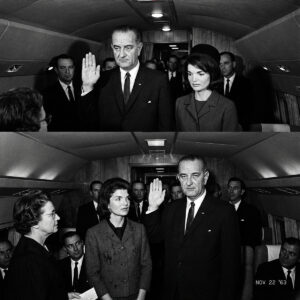
The image of Lyndon Johnson being sworn in as the 36th President aboard Air Force One, flanked by a shell-shocked Jackie Kennedy in her blood-stained pink suit, is etched into the American psyche. But the “Forgotten History” includes a more chilling detail. In 1998, forensic investigators analyzed a “fingerprint of unknown origin” lifted from a shipping carton on the sixth floor of the Texas School Book Depository—the very spot where Lee Harvey Oswald was said to have fired. The print was a positive match for Mac Wallace.
Whether Johnson orchestrated the hit or merely inherited its dark benefits remains the most debated mystery in American history. However, the result was undeniable: the investigations into LBJ’s corruption vanished overnight. The “Great Society” was born in the wake of a tragedy that saved its creator from prison.
As President, Johnson introduced a slate of reforms that promised to end poverty and racial injustice. To many, he is the hero who finally broke the back of Jim Crow. But even his most celebrated achievements were viewed through the lens of cold political math.
General Curtis LeMay once stated in an interview that Johnson never did anything that didn’t benefit himself politically. His “War on Poverty” expanded the government’s reach, but critics like Derek Green note that decades later, poverty rates remained largely stagnant. The programs—Medicare, Medicaid, and food stamps—created a safety net, but they also ensured a permanent voting bloc for the Democratic Party. As LBJ allegedly told his aides, he wanted to secure that vote “for the next two hundred years.”
Even the Gun Control Act of 1968 was shadowed by his internal motivations. While publicly a response to the assassinations of MLK and RFK, insiders claimed Johnson pushed the legislation to restrict access to firearms by minorities in the wake of the 1966 race riots. Every law was a maneuver; every act of “progress” was a brick in a fortress built to keep Lyndon Johnson at the center of the world.
Nothing reveals the soul of the Johnson era like the Vietnam War. While he told the public he would not “send American boys to do what South Vietnamese boys should be doing for themselves,” his personal investments suggested otherwise.
Johnson and his wife were heavy investors in Bell Aircraft, the manufacturer of the Huey helicopter, the ubiquitous symbol of the war. His Secretary of Defense, Robert McNamara, held massive stock in Ford Motor Company, which provided the military’s vehicles. The Gulf of Tonkin incident—a murky confrontation that many historians now believe was fabricated or exaggerated—gave Johnson the green light to go “full throttle.”
By the time he died in 1973, Lyndon Johnson was worth $100 million (nearly $900 million in today’s value). He had built a fortune on the construction of airbases in Thailand and the production of ammunition.Detractors even whispered that through third parties, the Johnson-owned manufacturing companies sold supplies that ended up in the hands of the North Vietnamese. The war wasn’t just a policy failure; it was a lucrative industry for the man in the Oval Office.
Lyndon Baines Johnson was a man who could hold the hand of a civil rights leader in the morning and allegedly order a “hit” in the afternoon. He was a master of the “Socialist facade,” using the language of compassion to mask the mechanics of a Texas warlord. He reminds us that history is rarely written by the saintly, but by those who are willing to inhabit the grey spaces between right and wrong.
He left behind a country transformed by his laws and haunted by his secrets. He was a man who feared the blackmail of the Mafia so much that he rejected their help in his rise, yet he employed a “stone killer” like Mac Wallace to keep his own house in order. LBJ’s life is a testament to the terrifying efficiency of American power when it is stripped of its illusions.
Call to Action: History often asks us to choose between the results a leader achieves and the methods they use to get there. Can a “Great Society” truly be built on a foundation of subterfuge and violence? Does the end ever justify the means when the cost is measured in blood and silence? Share your thoughts in the comments below—let’s dive into the dark side of the American Dream together.
Disclaimer : This content may be created by AI for entertainment purposes. Any resemblance to real persons, events, or places is coincidental.






