The Ghost in the Scope: How a Broken Medic’s Secret Past Saved a SEAL Team from a Deadly Trap
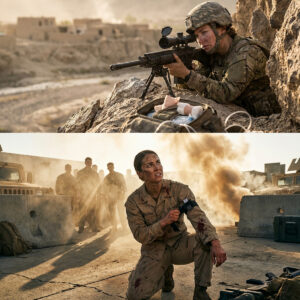
The desert outside Kandahar doesn’t just have a look; it has a weight. It is a monochrome landscape of tan earth stretching toward jagged, violet peaks, punctuated only by the occasional mud-brick compound or an irrigation ditch where the green seems almost unnatural. The air here tastes of fine alkaline dust, diesel fuel, and a metallic tang that veterans recognize as the signature scent of a combat zone.
For SEAL Team 3, the mission on that sweltering Wednesday in late June seemed like a standard “direct action” operation. But for Petty Officer Second Class Sloan Callahan, it was the day the walls she had built around her soul finally began to crumble. Sloan, a 5’4″ Navy Hospital Corpsman with a reputation for ghoulish calm, was a riddle even to the elite warriors she served. While they cleaned their rifles with practiced aggression, she checked her medical rig with a clinical, almost haunting detachment.
They called her “Doc.” They respected her speed with a tourniquet and her silence in the barracks. But none of them—not even the Commander who had requested her specifically—knew the true reason why Sloan Callahan had traded her sniper rifle for a medic’s bag three years ago. They didn’t know about the nine names she carried in her heart, or the forty-seven lives she had taken before deciding she could only live if she became a healer.
By the time the sun set over the wadis of Afghanistan, every man on that team would realize that the woman they were protecting was, in fact, the most dangerous person in the valley.
The road to that Afghan valley began three weeks earlier at Naval Amphibious Base Coronado, during a routine building-clearance exercise. Training for the SEAL candidates is a symphony of controlled chaos, but that morning, the conductor failed. A flashbang detonated three seconds early.
Sloan felt the impact before the sound registered. A shard of hot metal sliced into her left forearm, spinning her around. Blood immediately began to soak her tan uniform, painting dark, jagged streaks down her sleeve. The exercise screeched to a halt. Instructors shouted for a “ceasefire” and medical emergency protocols were activated. Two perimeter corpsmen began racing toward her.
Sloan didn’t flinch. She didn’t scream. She held up her right hand, palm out, a gesture of absolute command that froze the approaching medics in their tracks.
“Stop!” her voice cut through the ringing in her ears. “Continue the exercise. Candidates, you have wounded on the objective. What’s your next move?”
The SEAL candidates stared, paralyzed by the sight of the small woman applying a tourniquet to her own arm with one hand while her fingertips dripped crimson onto the concrete. She wasn’t just surviving; she was teaching. For the next seven minutes, Sloan Callahan used her own mangled arm as a practical demonstration of combat casualty care. By the time the proper medical team arrived, her vital signs were stable, and she had effectively turned a medical emergency into a masterclass in composure.
In the observation room, Commander John Barrett of SEAL Team 3 watched the monitors in stunned silence. He looked up her service record. It showed five years as a Marine-attached corpsman with “combat-proven” marks. But Barrett had been in the teams long enough to know what a “cover assignment” looked like. That level of calm wasn’t taught in a classroom; it was forged in a place where the light of the world had gone out.
When Sloan finally stood in the briefing room of SEAL Team 3 headquarters, her arm wrapped in a light bandage hiding sixteen fresh stitches, she was met with the cold, measuring stares of twelve men. To these operators, she was a variable they hadn’t accounted for—the first female corpsman assigned to an active SEAL team.
“Ma’am, welcome aboard,” grunted Gunny Kowalski, the team sergeant. “You got combat experience?”
“Yes, Gunny. Three deployments to Afghanistan with First Marine Expeditionary Force,” Sloan replied, her voice level and devoid of a need for approval.
“Which unit specifically?” asked a younger SEAL named Matthews.
“Reconnaissance Battalion. Attached to various Force Recon elements,” she said.
The room shifted. Force Recon operated in the deep shadows of the war, doing things that never made the nightly news. You didn’t survive thirteen months with them unless you were either very lucky or very skilled. But Master Chief Wade Sullivan, a man with twenty-three years of reading the souls of warriors, saw something deeper. He saw the way her hands moved—unconsciously checking the field of fire in the room, positioning herself near the exit.
“Petty Officer,” Sullivan’s gravelly voice broke through. “What’s the worst casualty situation you’ve handled?”
Sloan met his gaze without blinking. “Ambush outside Sangin. Twelve casualties over eighteen hours. Limited supplies. No air support. Stabilized seven with improvised gear under sustained fire. Lost nine when the position was overrun.”
The silence that followed was heavy with the weight of the dead. Every man in that room understood the arithmetic of that valley. They understood the sound of a position being overrun. They stopped seeing a “female corpsman” and started seeing a survivor.
The real integration began in the blistering heat of the California desert. The SEALs were on a long-range patrol, carrying pack weights exceeding 80 pounds. Sloan’s medical rig alone was 40 pounds, added to her personal weapon and comms gear. Total load: 70 pounds on a 120-pound frame.
Ten miles in, the sun reached its zenith, a white-hot hammer beating against the sand. Corporal Danny Hayes, a twenty-three-year-old new to the team, began to falter. His face went from a flushed red to a ghostly pale. His movements became uncoordinated.
Sloan noticed it before the veterans did. She studied his breathing pattern and the way his pupils were dilating despite the glare.
“Commander, request halt for medical check,” she transmitted.
Barrett halted the patrol. Hayes tried to protest—”Good to go, Doc!”—the reflexive lie of a man trained to endure.
“Answer honestly, Hayes,” Sloan said, her voice pitched low so as not to embarrass him. “You’re dizzy. Your hands are trembling. That’s not ‘pushing hard.’ That’s heat exhaustion approaching heatstroke. If I don’t treat you now, you’ll be brain-damaged or unconscious in thirty minutes.”
She didn’t ask. She commanded. She applied cooling packs to his major arteries and forced him to sip electrolytes while the rest of the team provided security. She wasn’t intimidated by the rank or the culture of toughness. She prioritized the life over the ego. That evening, the base surgeon confirmed her call: another hour in that sun and Hayes would have been a “body bag” mission.
Three weeks into the deployment, Barrett finally received the classified attachment to Sloan’s record. He read it alone in a secure facility, the light of a single desk lamp reflecting off the “Top Secret” stamp.
Sloan Callahan hadn’t just been a corpsman for Force Recon. That was her cover. For eighteen months, she had been a primary asset in a joint CIA/JSOC program using female operators for high-value target elimination.
She was a sniper.
The record was chillingly efficient: 47 confirmed eliminations at ranges between 800 and 1,400 meters. Zero failed missions. Specialist in urban and rural precision shooting. And then, the incident report: her spotter, Marcus Brennan, had been killed in Syria while she was taking a shot. Marcus had seen a threat she missed and stepped into the line of fire to save her. Sloan had finished the mission, eliminated the target, and then extracted Marcus’s body single-handedly under fire.
She had been offered the Distinguished Service Cross. She had turned it down, along with the sniper program, and requested a transfer to conventional medical duties.
Barrett sat back, the weight of the paper in his hand feeling like a lead weight. She was a healer because she couldn’t live with being a killer anymore. She was running from the ghost of her spotter, using the adrenaline of medical trauma as penance for the lives she had taken.
In late June, intelligence placed a high-value Taliban commander in a mud-brick compound northwest of the base. The plan was a standard direct action: insert by air, establish overwatch, eliminate the threat.
They inserted smoothly under the cover of a moonless night. But as dawn broke, painting the mountains in shades of gold and orange, the world exploded. The “commander” was bait. Taliban fighters, hidden in spider holes and reinforced positions, opened fire from three sides.
RPG rounds detonated against the rocks where the central element was pinned. Machine-gun fire raked the ridge where the overwatch team sat.
“I’m hit! Right shoulder!” screamed Ramirez, the team’s primary sniper.
Sloan’s training took over. She assessed the tactical geometry instantly. Ramirez was 100 meters away, pinned by a PKM machine gun at a range of 820 meters. Standard procedure dictated that Doc stay in cover. But standard procedure assumed someone else could take the shot.
“Doc, stay down!” Barrett yelled over the radio.
“Kowalski!” Sloan’s voice rang out, devoid of fear. “Can you reach Ramirez’s rifle?”
“Negative! It’s three meters in the open and we’re taking accurate fire!”
Sloan looked at the ridge. She could see the muzzle flashes of the PKM. She knew the ballistics. She knew the wind was eight miles per hour, left to right. She knew that if she didn’t act, her team would be systematically picked apart.
“Barrett,” she transmitted, her voice carrying an edge of command that made the Commander pause. “I can take that shot.”
“Doc, what are you—”
“The machine gun pinning down the ridge. 820 meters. Elevated position. Two shooters. I can eliminate it. Ramirez’s rifle is an M110 with a Leupold Mark V. I am familiar with the system. Give me authorization.”
Sullivan’s voice crackled through. “Boss, if Doc says she can make it, I believe her.”
“Move!” Barrett barked.
Sloan stripped off her heavy medical rig, keeping only her sidearm and two magazines. She visualized the route: 15 meters of open ground.
“Mark!”
Kowalski and Barrett laid down a three-second burst of suppressing fire. Sloan exploded from cover, her boots finding purchase on the rocky earth with a sureness that was almost rhythmic. She dove into the shallow cover beside Ramirez, ignoring the dirt kicked up by bullets.
She checked Ramirez first—through-and-through shoulder wound, non-arterial. “Stay down,” she whispered, then reached for the M110.
The weapon felt like an old, unwanted friend. Her hands moved with a ghostly muscle memory—checking the chamber, adjusting the scope for 820 meters. She settled into the rhythm: 4 seconds in, 7 seconds hold, 8 seconds out. Her heart rate dropped. The chaos of the firefight became a muffled, distant noise.
First shot. Crack.
She missed. The round kicked up dust six inches high and right. For a second, a flicker of panic touched her. She had been away too long. She had lost her edge.
Adjust lower. Less wind compensation. Trust the training.
Second shot. The primary gunner went down. The PKM fell silent.
“Holy shit,” Kowalski breathed. “Doc just made a cold-bore shot under fire.”
But Sloan wasn’t done. For the next forty minutes, she operated as a ghost. She eliminated a mortar spotter. She suppressed an RPG team. She scored 16 hits out of 19 rounds at ranges between 600 and 1,000 meters. With every trigger squeeze, she felt the promise she had made to her mother and the ghost of Marcus breaking. She was becoming the person she hated, but she was saving the people she loved.
They extracted under the cover of helicopter gunships. The flight back to the FOB was conducted in a heavy, contemplative silence. The SEALs looked at their corpsman not with skepticism, but with a form of awe that bordered on religious.
That night, Barrett called her into his office. He didn’t hide the classified file. It sat on the desk between them.
“I know why you left the program,” he said. “Marcus Brennan.”
Sloan’s hands stilled. “He took the round meant for me, sir. I requested a transfer to a place where success meant everyone came home, not just me.”
“And today?” Barrett asked.
“Today I realized that letting my team die because I was afraid of my own skills would make me responsible for their deaths,” Sloan said, her eyes finally welling with tears. “I missed the first shot, sir. I’m out of practice.”
“You made the adjustment and hit the second under the worst stress imaginable,” Barrett countered. “I’m not ordering you to be a sniper, Sloan. But I’m issuing you a precision rifle. I need you to be both. I need you to understand that protecting lives sometimes requires taking them.”
Sullivan found her later in the armory. He saw her staring at the M110 she had used.
“You’re using medical work as penance, Doc,” Sullivan said softly. “But you can’t outrun guilt by exhausting yourself. You can only outrun it by making peace with it.”
“How?” she whispered. “How do I be okay with being good at killing when all I want is to save people?”
“By realizing that they are the same thing,” Sullivan replied. “A scalp is a blade, and so is a bullet. It just depends on whose hands are holding them.”
Six months after the deployment, Sloan Callahan stood at a convention center in San Diego, presenting a new training program: Dual Role Medical Operations. She had been through mandatory counseling. She had started the long, agonizing process of looking at those nine Marines and Marcus Brennan not as failures, but as a foundation.
During the Q&A, a man in his late 20s wearing an EMT uniform stood up in the back of the room. He was tall, fit, with dark hair and a look of absolute recognition.
“Petty Officer Callahan… do you remember me?”
Sloan’s breath caught. “Elijah? Elijah McKenzie?”
He was one of the three who had survived that eighteen-hour hell in Sangin. He walked down the aisle, the room falling into a respectful hush.
“You wouldn’t quit on me,” Elijah said, his voice cracking. “Even when I begged you to. Even when the supplies were gone.”
He pulled out his phone and showed her a photo of a three-year-old girl with dark curly hair and a brilliant smile.
“This is my daughter,” Elijah said. “Her name is Sloan. We named her after you. Because of you, I have a future. I work for the Baltimore Fire Department now. I save lives every day because you refused to let mine go.”
Sloan collapsed into the chair behind her, the professional composure finally shattering into a thousand pieces of beautiful, healing grief. She wasn’t just a killer who had tried to hide. She was a ripple in the water. Every life Elijah saved was a life she had saved. Every laugh his daughter shared was a laugh she had made possible.
The narrative of Sloan Callahan is a profound meditation on the cost of excellence in a world of violence. We often want to divide our lives into neat boxes: the “good” parts of us and the “necessary” parts of us. We want to be the healer, but the world sometimes demands the warrior.
Sloan’s journey teaches us that the greatest form of integrity is not the absence of internal conflict, but the integration of our disparate selves. She learned that compartmentalization is a survival tactic, but integration is a life tactic. To honor those she lost, she didn’t have to stop being a sniper; she had to start being a whole human being who used every gift she had to tip the scales in favor of life.
The universal lesson is simple yet terrifying: We cannot choose our burdens, and we cannot choose our gifts. We can only choose whether we will run from them until they crush us, or walk with them until they become our strength.
Have you ever felt that your greatest strength was also your greatest burden? Have you ever had to reconcile two parts of yourself that felt contradictory? Share your thoughts and stories in the comments below. Let’s talk about the weight we carry and how we find the strength to keep moving forward.
Disclaimer : This content may be created by AI for entertainment purposes. Any resemblance to real persons, events, or places is coincidental.






