“Never go to the farm, Catherine. Promise me.”
Joshua spoke those words only twice in twenty-four years of marriage. The first was on our honeymoon, whispered against the backdrop of a Niagra sunset. The second was three years ago, during a quiet dinner where the air suddenly felt too heavy to breathe. Joshua was a man of gentle silences and engineering precision; he didn’t make demands. So, when he did, I obeyed. I buried my curiosity beneath the floorboards of our comfortable life in Minnesota, never questioning why my husband’s Canadian childhood was a locked room I wasn’t allowed to enter.
Then, the heart attack happened. A sudden, violent punctuation mark at the end of a long, beautiful sentence.
Two weeks after the funeral, I sat in the sterile, mahogany-scented office of Mr. Winters, the estate attorney. My daughter, Jenna, sat beside me, her grief having already curdled into a sharp, bitter resentment toward the father who had left us so abruptly.
“There is one more item,” Mr. Winters said, sliding a small box across the desk. Inside was an antique brass key on a maple-leaf keychain and a sealed envelope.
“Joshua repurchased a property in Alberta three years ago,” Winters explained. “Maple Creek Farm. His childhood home. He left strict instructions that you were only to be told of it now.”
My breath hitched. “The farm? He made me promise…”
“He has released you from that promise, Catherine,” Winters said softly. “But you should know—the property has become a battleground. Oil was discovered in the region eighteen months ago. Joshua’s brothers have already contested the will, claiming he wasn’t of sound mind when he bought it back.”
I opened the letter. Joshua’s elegant script filled the page:
My dearest Cat, if you’re reading this, I’ve left you too soon. I spent the last three years turning the broken place of my youth into something worthy of you. Go there once. Just once. The password for the laptop in the study is the day we met, followed by your maiden name. I love you more than the world.
Against Jenna’s protests, I flew to Calgary. I drove through the golden, frost-tipped prairies of Alberta until I reached the wrought-iron gates of Maple Creek. This wasn’t the “broken place” Joshua had described. It was a sprawling, pristine estate.
The farmhouse was a cathedral of light and cedar. But it was the entryway that broke me. Everywhere I looked, there were horses—sculptures, paintings, and photographs. Horses had been my singular passion, a dream I had shelved decades ago to support Joshua’s career and raise Jenna. He had built me a gallery of my own heart.
I found the laptop in the study. I typed the password: 05151998Mitchell.
Joshua’s face filled the screen. He looked healthy, his eyes sparkling with a secret joy. “Hello, Cat,” he said, and I felt the phantom touch of his voice against my skin. “I was diagnosed with a heart condition three years ago. I beat the clock for a while, but I knew I was on borrowed time. I didn’t tell you because I wanted our final years to be about living, not dying.”
I sobbed, clutching the edge of the desk.
“I bought back the farm because I wanted to give you the life you deserved,” he continued. “My brothers… they’ll come for it. They never wanted this dirt until it started bleeding oil. In the bottom drawer is a blue folder. It contains everything you need to fight them.”
A heavy knock at the front door interrupted the digital ghost. I looked out the window. Three men—Robert, Alan, and David Mitchell—stood on the porch. They were taller, harder versions of Joshua.
“Catherine! Open up!” Robert’s voice was a gravelly command. “We know about the mineral rights. You don’t belong here.”
I didn’t open the door. Instead, I called Ellis, the man Joshua had hired to manage the stables. He met me at the back barn, a rustic structure Joshua had left intentionally “ruined” to hide a secret.
Ellis pulled back a stack of hay bales to reveal a trapdoor. We descended into a concrete bunker—Joshua’s “War Room.” The walls were covered in geological surveys and maps.
“The oil companies think the wealth is in the east,” Ellis explained, pointing to a map. “But Joshua found a deeper, massive reserve under the western acres. He kept it secret from everyone.”
He then opened a filing cabinet. “And this is the real leverage. He spent three years documenting his brothers’ financial crimes—tax evasion, fraud, embezzlement. He knew they’d come for you. He made sure you had the weapons to ruin them if they tried.”
The next day, the drama escalated. Jenna arrived, but she wasn’t alone. She was with Robert. They had whispered in her ear, promising her a “fair share” and playing on her grief.
“Mom, be reasonable,” Jenna pleaded in the great room. “Uncle Robert says Dad wasn’t himself. We can settle this, sell the land, and be done with the Mitchell name.”
“Jenna, sit down,” I said, my voice cold. I turned the laptop toward her. “Listen to your father.”
She watched the video where Joshua revealed how his brothers had stolen his inheritance when he was nineteen, forcing him to flee to America and change his name just to survive. She saw the evidence of their cruelty. By the time the video ended, Jenna’s face was ashen.
“They lied to me,” she whispered.
The air in the formal dining room was so thick with tension it felt viscous. I had insisted on this room; the heavy oak table acted as a barricade, a physical reminder of the Mitchell family’s long history of cold, transactional dinners.
Robert sat at the far end, flanking himself with Alan—the “legal shark” of the family—and a man I’d never met: Harrison Wells, the silver-haired CEO of Northern Extraction. They looked like a wall of expensive wool and predatory confidence.
“Catherine,” Robert began, his voice practiced and paternal. “We appreciate you seeing us. But let’s be adults. You’re a high school teacher. You don’t have the stomach for the environmental lawsuits, the zoning battles, or the drilling logistics. We’re offering you a one-third split of the mineral rights. It’s a generous exit strategy.”
“One-third?” Jenna interjected, her voice wavering but her chin held high. “Dad bought this land. It belongs to Mom.”
Alan leaned forward, clicking his gold pen. “Jenna, dear, the deed is contested. We have testimony from the estate’s former caretaker—before Ellis’s time—suggesting Joshua’s cognitive decline began years ago. If we go to court, this property will be frozen in probate for a decade. By the time it clears, the oil market will have moved on. You’ll be left with a beautiful view and a mountain of legal debt.”
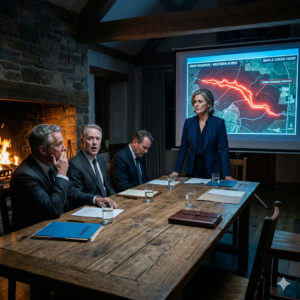
I didn’t speak. I simply adjusted the digital projector I had set up at the head of the table.
“Mr. Wells,” I said, addressing the oil executive directly. “I assume the Mitchells told you they have exclusive negotiating rights to the eastern acres?”
Wells nodded, looking bored. “They’ve provided the preliminary surveys.”
“Then they provided you with a lie.” I pressed a button.
The screen flickered to life, displaying the deep-core geological maps Joshua and Ellis had hidden in the bunker. The room went silent as a massive, vibrant red vein appeared on the map—not in the east, but deep beneath the “worthless” western scrubland the Mitchells had conveniently left out of their proposal.
“The eastern deposit is a pocket,” I explained, my voice echoing with a strength I hadn’t known I possessed. “It will run dry in eighteen months. The real wealth—the generational wealth—is here, in the west. And according to the deed my husband meticulously filed, the western acres are shielded by a private conservation trust that your brothers’ ‘inspection’ didn’t even cover.”
Wells turned to Robert, his expression darkening. “You told me the western acres were empty rock. You wasted my time with a pocket-play?”
“She’s bluffing!” Robert snarled, but the gray tint of his skin betrayed him.
“I don’t bluff, Robert. Joshua taught me that an engineer never presents a bridge without checking the stress points.”
I reached into my leather portfolio and slid three sealed, heavy envelopes across the table. One for each brother.
“Alan,” I said, “inside your envelope is the paper trail of the ‘consulting fees’ you took from the Vance merger. The ones that disappeared from the client’s escrow. Robert, yours contains the offshore routing numbers Joshua found while he was ‘mentally incompetent.’ David, yours is a simple record of the signature forgeries from your father’s final days.”
The sound of Alan’s pen hitting the table was like a gunshot.
“Joshua spent three years building a sanctuary,” I whispered, leaning in so they could see the cold fire in my eyes. “But he spent those same three years building a cage for the three of you. He knew you’d come for us. He knew you’d try to use Jenna. He didn’t want to destroy his brothers while he lived, but he gave me the keys to do it if you didn’t let him rest in peace.”
“This is blackmail,” Alan hissed, though his hand was shaking as he gripped the envelope.
“No,” my attorney, who had been silent until now, corrected firmly. “This is a settlement. You will sign a full, irrevocable waiver of all claims to Maple Creek Farm. You will resign from any board positions associated with Mitchell Family holdings. In return, these envelopes go into the fireplace. If you refuse, they go to the Royal Canadian Mounted Police and the Financial Services Commission before lunch.”
Robert looked at the map, then at the envelope, then at the CEO who was already standing up to leave, disgusted by the Mitchells’ incompetence.
“Sign it,” I commanded.
One by one, they did. The scratching of their pens was the only sound in the room. When they were finished, they stood up with the hollow look of men who had just seen their own ghosts.
“Get off my land,” I said. “And if you ever speak to my daughter again, I won’t need a map to find you.”
As they retreated to their SUV, kicking up the Alberta dust in a desperate hurry, Jenna let out a breath she’d been holding for twenty-four years.
“Mom,” she whispered, looking at the screen where her father’s secret empire was still glowing. “You were terrifying.”
“No, Jenna,” I said, feeling the weight of the antique brass key in my pocket. “I was just finally telling the truth.”
Winter settled over the farm. I stayed. Jenna stayed.
One morning, I opened the final video. Joshua was standing in a room I hadn’t yet explored—a sun-drenched art studio he’d built in the east wing, filled with the paints and canvases I hadn’t touched in twenty years.
“The farm isn’t the inheritance, Cat,” Joshua said, his voice soft. “The money isn’t the legacy. The legacy is possibility. I’ve given you the space and the freedom to find the woman you were before the world told you to be a teacher and a wife. Paint again, my love. For me. For you.”
I picked up a brush. I looked out the window at the six horses Joshua had bought for me—the Fian, the Andalusian, the Appaloosa. They weren’t just animals; they were reclaimed dreams.
I realized then that Joshua hadn’t forbidden me from the farm to keep me away from his past. He had kept me away until he could ensure the farm was no longer a place of secrets, but a sanctuary of truth.
The forbidden farm was now my home. And for the first time in fifty-two years, I wasn’t just Joshua Mitchell’s widow. I was Catherine, the artist. And the horizon was finally, beautifully, mine.
Disclaimer : This content may be created by AI for entertainment purposes. Any resemblance to real persons, events, or places is coincidental.






