Jeremy Walsh, a single father, confronts the father of his son’s school bully, expecting a fight. Instead, he discovers that the man, Eugene Thompson, is the disgraced firefighter who saved his son Ethan from a lethal apartment fire five years ago—and the man who has lived in a “prison of guilt” for failing to save Jeremy’s wife. As they bridge their shared trauma, they uncover that the bullying wasn’t random, but a symptom of a family being dismantled by a corrupt legal system.
In the world of forensic investigation, we talk about “Char Patterns.” These are the physical remains of a fire that tell the story of its origin, its heat, and its intent. For five years, I had been an expert in my own internal char patterns. I knew exactly where the fire started—the George Street apartment complex—and I knew exactly what it had consumed: my wife, Hannah, and my sense of peace.
My name is Jeremy Walsh. I am a structural analyst, a man who spends his days looking for cracks in foundations. But the crack I couldn’t fix was the one in my eight-year-old son, Ethan.
Ethan carries the fire on his skin. Burn scars cover thirty percent of his body—jagged, silver-pink maps across his arms and chest. He had been a champion of resilience until we moved to the new district. That was when Tyler Thompson entered our lives. Tyler wasn’t just a bully; he was an architect of cruelty. He told Ethan that he looked like a monster. He told him that “monsters don’t deserve mothers.”
The “Brittle Fracture” happened on a Friday afternoon. Ethan came home with his favorite dinosaur shirt shredded.
“Dad,” he whispered, his voice sounding like dry leaves. “Tyler says the fire didn’t just burn me. He says it turned me into a contagious monster. He says that’s why you don’t let anyone see my arms.”
I didn’t yell. I didn’t call the school—I’d already tried that, and Dr. Norris, the principal, had offered me nothing but “restorative justice” brochures. I walked to my truck, my knuckles white, and drove to the address on the school directory: 14 Oak Ridge.
The house was a ranch-style ruin, the paint peeling like sunburnt skin. I pounded on the door, my rehearsed speech about “parental responsibility” vibrating in my throat.
The door opened to a man who looked like he had been hollowed out by a storm. He was tall, mid-forties, with graying hair and hands that moved with a slight, rhythmic tremor.
“Jean Thompson?” I barked. “Your son is psychologically torturing mine. He’s calling him a monster because of his burn scars. I’m here to tell you that the next time it happens, I won’t be coming to your door—I’ll be coming with a lawyer.”
The man, Eugene “Jean” Thompson, didn’t react with anger. He didn’t even defend his son. He just looked at me with eyes that seemed to be watching a movie from ten years ago.
“Scars?” he asked, his voice a low, gravelly rasp. “You mentioned burn scars. On his arms?”
“Yes,” I snapped. “From a fire five years ago.”
Jean’s face went from weary to translucent. “George Street?”
My blood turned to ice. “How do you know that?”
“Mr. Walsh,” Jean said, leaning against the doorframe as if his legs had suddenly reached their “Material Fatigue” limit. “I know those scars. I’m the man who gave them to him.”
We sat in his sparse living room. Jean pulled up his sleeves, revealing a matching map of silver-pink tissue.
“I was the first through the door of Unit 4B,” Jean whispered. “The ceiling was already failing. I saw the boy—Ethan—pinned under a beam. I saw your wife, Hannah, further back in the kitchen. She was already down. Smoke inhalation.”
He looked at his shaking hands. “In firefighting, we perform a ‘Life-Safety Audit’ in seconds. I had oxygen for one. I had strength for one trip before the floor gave way. I chose the child. I carried Ethan out, and as I hit the hallway, the kitchen ceiling pancaked. I couldn’t go back for her. I’ve lived in that kitchen for five years, Mr. Walsh. Every time I close my eyes, the manifest says I left a passenger behind.”
The rage that had fueled my drive to Oak Ridge evaporated, replaced by a crushing sense of recognition. This wasn’t the father of a bully; this was the ghost of my wife’s last moment.
“Jean,” I said, my voice cracking. “The fire chief told me Hannah was gone before you even reached the door. You didn’t make a choice between two lives. You made a choice to save the only one that was still there. You gave me my son.”
But the “hitch” in the system remained: Tyler.
Jean called his son into the room. The boy trudged in, his face a mask of practiced defiance—a miniature version of the “Brittle Fracture” I saw in his father.
“Tyler,” Jean said, his voice firm but vibrating with an old pain. “Do you know who this is? This is the father of the boy you’ve been calling a monster. The boy I saved from the fire.”
Jean told Tyler the story—not the “hero” version, but the forensic truth. He told him about the heat, the choice, and the scars they both shared. He told him that every time Tyler mocked Ethan, he was mocking the very thing that made his father a hero—and a broken man.
Tyler’s defiance didn’t just crumble; it vanished. He began to sob, the deep, ugly sobs of a child who realizes he has been weaponizing his own father’s trauma.
“I didn’t know,” Tyler wailed. “I just thought… I thought because Mom left us when Dad got hurt, that scars meant you were broken. I wanted Ethan to feel as broken as we are.”
As the weeks passed, an unlikely alliance formed. Tyler became Ethan’s shadow at school, a fierce protector who redirected every “monster” comment with a lecture on “The Warrior’s Map.”
But Jean was still drowning. He had been fired from the department after the fire, his pension tied up in a “negligence suit” filed by the building’s owners to avoid their own liability for faulty wiring.
I looked at the documents Jean had been sent—the “Audit of Fault.”
“Jean,” I said, laying the papers out on his kitchen table. “I’m a structural analyst. I know these names. The firm that filed this suit is a shell company owned by Vanguard Real Estate. They’re the ones who owned the George Street complex.”
I began my own audit. I spent nights in the city archives, pulling the original blueprints and the inspection records from the year of the fire.
The Plot Twist hit me at 2:00 AM on a Tuesday.
The “Accident Report” had been altered. The original inspector had flagged the electrical grid in Unit 4B six months before the fire. That inspector? He was currently the “Safety Consultant” for Vanguard Real Estate. They hadn’t just sued Jean to stop his pension; they had framed him for “tactical errors” to cover up their own criminal negligence.
I didn’t take it to the school board. I took it to the District Attorney.
Working with a forensic accountant I’d met through my firm, we traced the “Consultancy Fees” paid to the inspector. It was a $1.1 million payoff, disguised as a retirement package, delivered the same month Jean was “honorably discharged” from the department.
We brought the “Black Ledger” of Vanguard Real Estate to the state court.
The takedown was a “Controlled Demolition” of the highest order. The negligence suit was tossed. Jean’s pension was not only restored but tripled with five years of back pay and emotional distress damages. The complex owners were indicted for manslaughter.
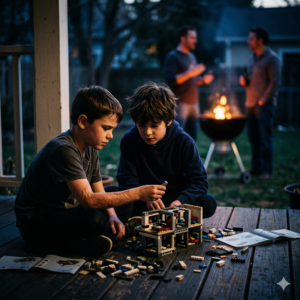
A year later, I stood in my backyard, watching two boys build a massive Lego fortress on the patio. Ethan was wearing a tank top, his scars visible in the golden afternoon light. Tyler was beside him, handing him blocks with the precision of a master builder.
Jean was at the grill, looking ten years younger, his hands steady for the first time since the George Street fire.
“You know, Jeremy,” Jean said, flipping a burger. “I spent five years thinking the fire was the end of the story. I thought the char patterns were all that was left.”
“Wood is carbon, Jean,” I replied, looking at our sons. “Under enough pressure, carbon doesn’t just stay ash. It becomes a diamond. You just have to be willing to look past the cracks in the foundation.”
Ethan looked up then, his eyes bright and clear. “Hey Dad! Tyler says we’re building the ‘Unsinkable Vault’. Want to see the blueprints?”
I smiled. The audit was closed. The foundation was finally, perfectly, sound.
Disclaimer : This content may be created by AI for entertainment purposes. Any resemblance to real persons, events, or places is coincidental.






