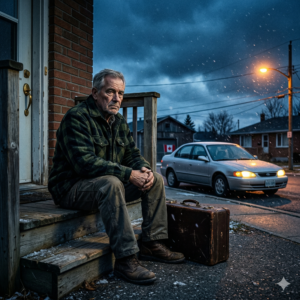
Walter Kowalski, a 67-year-old retired structural engineer, returns from a fishing trip to find his house locks changed. His son, Ryan, and daughter-in-law, Diane, have spent months gaslighting him into a retirement home to liquidate his $720,000 estate. Unbeknownst to them, Walter discovered a forged Power of Attorney six weeks prior and spent his “grief” quietly building a legal fortress.
In my profession, we talk about “Fatigue Life.” It’s the number of stress cycles a component can endure before it fails completely. There is no bending, no warning groan of metal; there is only the sudden, violent sound of a foundation failing. For thirty-eight years, my house on Martindale Road in Sudbury was the one structure I knew would never fail. I’d hung the doors, braced the joists, and raised my son, Ryan, within these brick walls.
The failure didn’t start with the lock. It started six weeks ago at my kitchen table.
Among the junk mail was an envelope from a Toronto law office I’d never heard of. It contained a summary of a Power of Attorney (POA). My name was the donor; Ryan’s name was the attorney. The document claimed I was “medically incapable” of managing my assets. I hadn’t signed a thing. I sat there in the silence of the house I’d shared with my late wife, Patricia, and I felt the rot.
I didn’t call Ryan. I didn’t scream. I called Beverly Tanaka, my lawyer for twenty years. She confirmed my worst fears: Ryan had not only forged the POA but had already signed a conditional agreement to sell my home for $695,000—a “fast sale” to a developer that was significantly below market value.
He had sold my life while I was still breathing in it.
Beverly told me to keep my mouth shut. She needed time to build a case that a judge couldn’t ignore—a “wall” so thick Ryan couldn’t argue his way through it. For six weeks, I played the role of the aging, confused father. I ate Sunday dinners at Ryan’s house. I let my daughter-in-law, Diane, refill my coffee and talk about “wonderful retirement communities in Barrie” where meals were included and “stairs weren’t an issue.”
I watched my grandchildren do their math homework at the kitchen island, knowing their father was counting the days until my “possession date” expired. Every time Ryan asked, “Dad, are you feeling okay? You seem a bit forgetful lately,” I just nodded. I let him believe the gaslighting was working.
I even installed a hidden, cloud-connected camera in my workshop. I watched on my phone as Ryan entered my private space without permission, showing a real estate appraiser my hand-crafted furniture and lumber as if they were already part of a liquidation manifest. I didn’t feel angry. I felt clinical. I was a structural engineer, and I was simply identifying a fatal flaw in the system.
To finalize his plan, Ryan needed me gone. I told him I was leaving for an 11-day fishing trip in Chapleau. It was the perfect window for him to change the locks and start the “transition.”
I returned two days early.
I stood on that porch in the biting October air, my suitcase at my side, and tried my key. It didn’t turn. I sat on the steps and waited. When Ryan and Diane pulled up twenty-two minutes later, their faces were a high-contrast study in high-stakes guilt.
“Dad, listen,” Ryan started, jumping out of the car with a frantic, rehearsed script. “The house is too much. The workshop is a hazard. We found a great place—it’s for your own safety—”
“Ryan,” I said, my voice as steady as a steel beam. “Who is the buyer?”
The silence that followed was longer than the thirty-eight years I’d lived on this lot. Diane began to cry—the quiet, sharp cry of someone who realized the bridge they were standing on had already been demolished.
“Beverly has filed the injunction,” I told them. “The fraudulent POA, the unauthorized sale, the camera footage of you trespassing—it’s all with the Law Society and the Ontario Crown. The sale is halted. The bank accounts are frozen. I didn’t go fishing to relax, Ryan. I went to give you enough rope to hang yourself.”
The investigation was a “Controlled Demolition.” The Toronto lawyer who helped Ryan surrendered his license to avoid criminal charges. Ryan was charged with Fraud over $5,000 and Breach of Trust. He didn’t go to prison—he took a plea deal—but he is permanently barred from ever acting as an estate trustee in Ontario.
My house is still mine. I’ve placed it into a Sovereignty Trust. When I’m gone, it won’t go to a son who tried to sell it from under me; it will go to a Northern Ontario conservation group Patricia always loved.
I still spend my days in the workshop. I just finished a blanket chest made of white ash with hand-cut dovetail joints. It’s solid. It’s built to last. I don’t have a relationship with Ryan anymore; the “fatigue life” of our bond reached its limit on that porch.
But as I stand in my garden and watch the Sudbury sun set, I want every homeowner over sixty to hear me: Your home is not a problem to be managed. Your age is not a medical condition.
Disclaimer : This content may be created by AI for entertainment purposes. Any resemblance to real persons, events, or places is coincidental.






