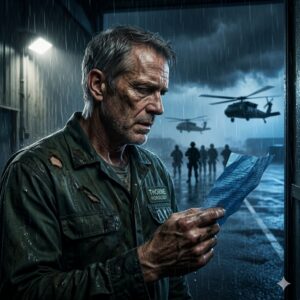
Elias Thorne, a veteran logistics supervisor, is falsely accused of stealing experimental military equipment after his daughter, Maya, gives him a high-end headset she bought from a “clearance” website. Unbeknownst to them, the gift is a trap set by his corrupt manager, Julian Vane, to cover up a criminal secret.
In the world of international logistics, we have a saying: “Inventory never lies, but people do.” For thirty-two years, I, Elias Thorne, was the man who ensured the inventory stayed honest. At the massive Port of Savannah distribution hub, I was the Shift Supervisor who knew every pallet, every seal, and every driver’s signature. My reputation was my only real currency. I was the “Old Guard,” a man who believed that if a manifest said there were 400 units, there had better be 400 units—not 399 and an excuse.
Since my wife, Sarah, passed away from a sudden heart ailment five years ago, my world had narrowed down to two things: the warehouse and my daughter, Maya. Maya is twenty-two, a dedicated nursing student who works double shifts at a greasy spoon diner just to keep her tuition checks from bouncing. She is the living image of her mother—kind to a fault and fiercely loyal.
The warehouse had been a second home until six months ago, when corporate installed Julian Vane as the new Regional Director. Vane was a “disruptor”—a man who smelled of expensive cologne and viewed safety protocols as mere suggestions. Under his watch, high-value electronics began to vanish from the system, always marked as “Damaged in Transit” or “Inventory Shrinkage.”
I raised concerns. I filed reports. Vane would just clap me on the shoulder, his eyes as cold as a marble floor, and say, “Elias, you’re a dinosaur. This is modern logistics. Focus on your retirement and stop counting the pennies.”
My fifty-fifth birthday arrived on a humid Tuesday. I came home with my back aching and my ears ringing from the constant roar of the forklifts. Maya greeted me with a small lemon cake and a wrapped box.
“I saved up for four months, Dad,” she said, her eyes gleaming with pride. “I know you hate the noise on the bus. These are the top-tier ‘Aegis-7’ wireless buds. Noise-canceling, military-grade range.”
I opened the box to find sleek, matte-black earbuds. They looked like they belonged in a cockpit, not a breakroom.
“Maya, honey, these must have cost a fortune,” I whispered.
“I found a liquidation sale online, Dad! An estate clearing. They were 80% off. You always told me to find the best value,” she teased.
I put them in. The world vanished. The silence was absolute. I felt like a king. I had no idea that at that very moment, I had just inserted a GPS beacon tied to a federal felony directly into my skull.
The next morning, I wore them to work. I felt a rare spring in my step. During lunch, I sat with Arthur, a grizzled warehouse veteran and a combat medic from the Gulf War.
Arthur was biting into a sandwich when his eyes locked onto my ear. His face didn’t just turn pale; it turned grey. He leaned in so close I could smell the stale tobacco on his breath.
“Elias,” he whispered, his voice trembling with a terror I’d never seen in him. “Take those out. Right now. Do not let Vane see them. Do not let the cameras see them.”
“Arthur, what are you—”
“Those aren’t ‘Aegis-7s’, you idiot,” he hissed. “Those are ‘Shadow-Link’ prototypes. They’re part of the DARPA comms shipment that went ‘missing’ from the secure cage last week. They have encrypted frequencies and active hardware trackers. If those are in your ears, you’re a walking target for a treason charge.”
I laughed it off. I thought Arthur’s PTSD was finally getting the better of him. I walked away toward the loading docks, thinking he was seeing ghosts in the machinery.
Four days later, the ghosts came for me.
The sound of a SWAT team breaching your front door is something you never truly recover from. It’s the sound of your life being torn in half. I was pinned to my living room floor, a heavy boot on my neck, while agents in tactical gear swarmed the house.
I watched in silent horror as they dragged Maya out of her bedroom in her pajamas, zip-tying her wrists.
“Grand Larceny. Trafficking in restricted defense technology. Conspiracy to commit wire fraud,” the lead agent barked.
Maya was sobbing, her face pressed against the cold glass of the police cruiser. “I just bought them for his birthday, Daddy! I didn’t know!”
The lead detective, a man named Silas Vance, held the earbuds in a gloved hand. He looked at me with a mixture of pity and disgust. “The digital paper trail is a mile long, Elias. Your daughter’s credit card bought these from a known black-market fence. The same fence who received the shipment that was checked out under your supervisor credentials at the warehouse.”
The realization hit me like a physical blow. Vane hadn’t just been stealing. He had been “fishing.” He knew I was a stickler for the rules. He knew I was the only person who could testify against his “shrinkage” numbers. So he had stalked my daughter’s IP address, planted a fake liquidation site, and waited for her to buy the bait. He didn’t just want me fired; he wanted me erased.
I was released on my own recognizance, but Maya was held in a federal detention center. Vane fired me the next day, citing “Theft for Cause.” He even offered me a deal: sign a confession admitting I acted alone, and he would “use his influence” to get the charges against Maya reduced.
I sat on a park bench, broken, until Arthur found me.
“He’s going to shred the evidence on Friday, Elias,” Arthur said, sitting at the other end of the bench. “I saw the shredder trucks scheduled. Vane thinks he’s scrubbed the digital logs, but he’s a suit—he doesn’t understand the ‘Ghost Manifest’.”
“The what?”
“The Driver’s Physical Log. The ‘Blue Sheet’. Every driver who enters the hub has to sign a physical clipboard. It’s 1970s tech, but it’s the only thing that proves the crates arrived empty. Vane signed for them. He authorized a ‘Blind Receipt’ because he knew the tech was already sitting in his private car.”
The Blue Sheet was in the basement archives. To get it, I had to break into a high-security facility that had my face on every “Banned” poster.
At 3:00 AM on Friday, the rain was a torrential downpour, masking the sound of my movements. Arthur had propped the fire exit near the cold storage. I wore my old uniform, a ghost returning to his haunt.
The warehouse was a labyrinth of steel and shadows. I moved through the blind spots of the cameras I had helped calibrate. I reached the archive room, my heart hammering like a piston. I used a tension wrench to pop the lock—a skill I’d learned as a locksmith’s apprentice forty years ago.
The room was filled with the smell of old paper and dust. I scanned the “Receiving – Military” shelf. Empty. Vane had already moved the binders.
But he was arrogant. He assumed that because the binder was gone, the truth was gone. He didn’t know that the Blue Sheets were often double-filed in the “Hazardous Weight” bin because of the battery types in the comms gear.
I found it. A single, crumpled sheet of paper at the bottom of a bin marked for destruction.
It was beautiful. The driver had written: “Shipment weight 50 lbs under. Site Manager Vane instructed Blind Receipt. No weigh-in performed.”
It was the smoking gun. It proved Vane knew the technology was missing before I ever clocked in for my shift.
“I told you he was a rat, Julian,” a voice boomed.
The lights flickered on. Vane stood at the end of the aisle, holding a suppressed pistol. Two of his “security contractors”—hired thugs in suits—stood beside him.
“You should have taken the deal, Elias,” Vane said, stepping over the piles of paper. “Now, you’re just a burglar who died in an industrial accident.”
I didn’t think. I grabbed a heavy fire extinguisher from the wall and hurled it through the glass window of the server room door across the hall. The alarm shrieked.
I dived into the server room and locked the heavy reinforced door just as a bullet sparked off the metal frame. I didn’t call the police. The local police were already part of the narrative Vane had built.
I looked at the server racks. I pulled out my phone and took a high-resolution photo of the Blue Sheet. Then, I dialed the Military Liaison Number on the emergency response board—a direct line to the Department of Defense contractors.
“This is Supervisor Thorne, ID 5581. I am at Distribution Hub 4. I have physical proof of ITAR violations and treason by Regional Manager Julian Vane. I am under fire. Secure the asset.”
The door buckled under the weight of Vane’s thugs. I curled into a ball behind the humming servers, clutching the Blue Sheet.
Vane kicked the door open, his face twisted in a snarl. “Give me the paper, Elias. It doesn’t matter who you called. I’ll be gone before they arrive.”
“You forgot one thing, Julian,” I said, blood trickling from a cut on my forehead.
“What’s that?”
“The Shadow-Link earbuds. You told the feds they were tracked to my house. But you forgot that the master unit—the one that controls the squad chatter—is still in your desk. And it’s been active this whole time.”
Vane froze. He reached for his pocket, but it was too late.
The roof of the warehouse didn’t just shake; it exploded. Two blacked-out military helicopters dropped from the sky, and tactical teams rappelled through the skylights. The “Aegis” tech wasn’t just a communication tool—it was a high-frequency homing device. By activating the server room’s localized Wi-Fi, I had boosted the signal of the unit Vane had hidden in his own office, effectively calling an airstrike on his position.
Vane was tackled to the floor by men in “Army CID” gear. They didn’t read him his rights; they treated him like an enemy combatant.
Three days later, Maya was released. The federal government didn’t just drop the charges; they issued a formal apology and a six-figure settlement for her “cooperation” in the investigation.
I stood in the driveway of our small house, watching the sun set. Maya walked up to me, her face still pale but her eyes bright again. She was holding a new box.
“Dad… don’t be mad. These are just regular, $20 wired headphones from the pharmacy. No tracking. No military tech.”
I laughed until I cried.
I never went back to the warehouse. I took my back pay and the settlement money and retired for real. Arthur and I meet every Friday at the diner where Maya used to work. We don’t talk about logistics. We talk about the Blue Sheet and how, in a world of digital lies, a single piece of paper can still bring a titan to his knees.
Justice isn’t a system, I realized. It’s a choice. And sometimes, it’s a choice you have to break into a warehouse at 3:00 AM to make.
Disclaimer : This content may be created by AI for entertainment purposes. Any resemblance to real persons, events, or places is coincidental.






