ACT 1: THE STERILE KINGDOM OF ASH AND MARBLE
I have spent a lifetime observing the apex predators of industry, the men who build monuments of glass and steel upon the crushed, silent bones of the vulnerable. Arthur Noah was the undisputed king of this concrete jungle. His empire, a sprawling real estate conglomerate, was forged in the absolute, freezing silence of a boardroom where empathy was considered a terminable offense. The air in his penthouse always tasted faintly of filtered ozone, expensive leather, and the dusty, suffocating atmosphere of unchecked power. He was a man whose eyes held the cold, metallic sheen of a freshly loaded revolver. He did not live; he acquired.
When his veteran housekeeper suffered a sudden, catastrophic stroke, the agency scrambled to replace her, terrified of Noah’s legendary wrath. The replacement, Maya, arrived on a Tuesday smelling of cheap detergent, damp wool, and sheer, unadulterated terror. But she did not arrive alone. Clinging to her frayed skirt was a little girl with wide, perceptive eyes and shoes that had been repaired with glue.
“Sir, this is my daughter, Nova,” Maya stammered, her voice vibrating with the frequency of a cornered prey animal. “Her school is on break… I promise she will be invisible, sir. She won’t disturb you.”
Noah stared at the child. To him, children were not miracles; they were liabilities. They were noisy, unpredictable variables that disrupted the immaculate geometry of a focused life. He had spent fifty years ensuring nothing tied him to the messy, bleeding reality of human connection. He turned away, the bespoke wool of his suit catching the dim light. “Keep her out of my office,” he commanded, his voice dropping like an anvil on a frozen lake.
I look at this trembling woman and her child, and I feel nothing but the dull ache of inconvenience, Noah’s internal monologue roared in the sterile silence of his mind. They are the collateral damage of a world they do not understand. I built this empire by cutting away the rotting flesh of sentimentality. My own father died with a heart full of love and a pocket full of absolutely nothing, crushed by the debts of his own kindness. I swore on his grave I would never be weak. This child, with her worn shoes and wide eyes, is an infection of weakness trying to breach my fortress. I will tolerate her existence because I require clean floors, but she will remain a ghost.
As he walked away, the heavy oak doors of his study sealing him in, he caught a fleeting, peripheral glimpse of the girl’s face. Nova was not crying. She was not terrified. She was smiling at him. It was a terrifyingly pure, genuine expression, utterly devoid of the transactional sycophancy that infected every other smile he encountered. It was a smile that demanded nothing and offered everything.
Innocence is merely a disease that power has yet to cure.
ACT 2: VANDALISM ON THE ALTAR OF CHROME
The days bled into a rhythm of silent cohabitation. Maya moved through the sprawling mansion like a frightened specter, erasing dust and leaving behind the faint scent of lemon pledge. But the house was fundamentally altering. The absolute, terrifying order of Noah’s existence was being quietly subverted by a guerrilla war of primary colors. It started with crude, joyful crayon drawings of a happy family left on the immaculate, veined marble of the kitchen island. Then, the ultimate transgression: a streak of violent, unapologetic cerulean blue wax dragged across the polished hood of his vintage, three-hundred-thousand-dollar Aston Martin in the garage.
Maya discovered it first. She hyperventilated, her hands shaking violently as she frantically tried to scrub the wax away with her apron, tears of impending ruin streaming down her face. “I’m so sorry, sir! She didn’t mean to, I will pay for it, I swear!” she sobbed, waiting for the executioner’s blade to fall.
Noah stood in the dim, metallic light of the garage, staring at the blue streak. It was chaos. It was destruction. It was the very thing he had spent his life annihilating. He looked down at Nova, who was clutching a broken blue crayon, her lower lip trembling as she realized the gravity of her crime. Noah opened his mouth to unleash the fury that had bankrupted rival CEOs. Instead, a strange, phantom warmth bloomed in the dead space of his chest. “It’s fine,” he whispered, the words tasting completely foreign on his tongue. Maya stopped breathing, staring at the cold billionaire as if he had just sprouted wings.
What is happening to the architecture of my mind? Noah questioned, his internal voice echoing with profound, unsettling confusion as he retreated to his study, pouring three fingers of neat, peaty whiskey to steady his nerves. I should have fired the mother. I should have billed them for the damages and cast them back into the freezing streets. Yet, when I looked at the crude wax rendering on my car, I didn’t see vandalism. I saw proof of life. I saw a vibrant, unapologetic stain on the sterile canvas of my existence. I am fifty-five years old, sitting on a throne of gold, and I realize I have not smiled a genuine smile since I was a boy. I am a perfectly preserved corpse ruling over an empire of ghosts. This child’s crayon is the only thing that has made my heart beat in two decades.
Slowly, the ice age of his soul began to thaw. He started returning home earlier, abandoning multi-million dollar negotiations just to stand quietly in the kitchen doorway, watching Nova paint on scattered sheets of paper. One evening, sipping espresso, he finally breached the silence. “Who taught you how to draw?” he asked.
Nova beamed, pointing proudly at her mother. “My mom. I can teach you if you want.” Noah chuckled—a dry, rusted sound that startled them all. He offered her a deal: immunity for the vandalism, provided she drew him something new every single day. Nova nodded fiercely.
A fortress impenetrable to artillery can still be brought down by a piece of colored wax.
ACT 3: THE GEOMETRY OF A MASSACRE
The operatic tragedy of Arthur Noah’s life was that his newfound humanity existed concurrently with his professional brutality. His study, once a solitary confinement cell, had become a shared sanctuary. Nova now sat on the imported Persian rug, quietly sketching, while Noah sat behind his massive mahogany desk, orchestrating the financial ruin of entire zip codes. It was a Tuesday when the executioners arrived. Three business partners, men who smelled of expensive Cuban cigars, aggressive cologne, and the dusty, metallic scent of predatory capitalism, took their seats opposite his desk.
They were discussing the Sector 4 Acquisition. It was a colossal urban redevelopment project, a deal that would elevate the company’s valuation into the stratosphere.
“We’ve already prepared everything,” the lead partner stated, his voice a low, oily purr. “Once the papers are signed, we bring in the bulldozers. We demolish the entire slum and begin construction on the luxury high-rises.”
“And the people living there?” Noah asked, his tone flat, bureaucratic.
“Their eviction deadline expired weeks ago,” the partner replied coldly, adjusting his silk tie. “The police will force them out. They are collateral debris.”
Down on the rug, the scratching of Nova’s crayon abruptly stopped. She sat perfectly still, a tiny rabbit in a den of wolves, her ears burning with the casual discussion of mass displacement.
This is the blood sport I chose, Noah rationalized internally, sipping his Scotch, desperate to drown the sudden, metallic guilt rising in his throat. It is just lines on a map. Numbers on a spreadsheet. To build the gleaming future, the rotting past must be reduced to rubble. I have signed a thousand death warrants just like this one. It is the crushing weight of the crown I wear. I am the architect of progress, and progress requires a graveyard. But why does the air in this room suddenly feel so incredibly thin? Why does the presence of the child on the floor make me feel like a monster wearing a tailored suit? I must silence this weakness. The deal must close. The empire must feed.
When the meeting briefly adjourned to the hallway, Nova crept out from under the heavy desk. Her trembling hands pulled the glossy contract toward her. Clipped to the legal jargon were aerial photographs and street-level surveys of Sector 4. Her eyes widened in absolute horror. She saw the crumbling brick bakery. She saw the cracked asphalt where they played hopscotch. She saw the large, dying oak tree. It was not Sector 4. It was her home.
We measure our success by the height of the skyscrapers, never by the depth of the graves beneath them.
ACT 4: THE INK THAT DROWNS A CITY
The men returned to the study, bringing with them an atmosphere so thick and oppressive it could choke a horse. Maya trailed behind them, her head bowed, carrying a silver tray bearing a vintage bottle of Bordeaux and four crystal glasses to celebrate the slaughter. Noah settled into his high-backed leather chair. The heavy, gold Montblanc pen felt like a loaded weapon in his grip. He unscrewed the cap. The room was utterly silent, save for the rhythmic, agonizing ticking of a grandfather clock in the corner. He leaned forward, the gold nib hovering millimeters above the dotted line that would authorize the destruction of two thousand lives.
“Daddy, please don’t sign that.”
The voice was tiny, fragile, but it echoed through the cavernous study like a gunshot. The entire room instantly flash-froze. The Montblanc pen stopped in mid-air. The three partners snapped their heads around, their faces twisting in aristocratic confusion and disgust, staring at the small girl standing by the edge of the desk. Maya gasped, the heavy crystal wine bottle slipping from her hands and shattering violently on the hardwood floor, dark red wine pooling like blood around her cheap shoes.
Daddy, Noah’s internal world violently imploded, the single word striking him with the force of a runaway freight train. She called me Daddy. It is a desperate, unconscious plea to a protector, a cry for salvation from a child who sees me not as a billionaire warlord, but as a shield. The partners are staring at me. My empire is holding its breath. I look down at the contract, at the glossy photographs of the slums attached to the execution order. I do not see ‘Sector 4’ anymore. I see the cracked pavement where her worn shoes run. I see the filthy playground where her innocence resides. If I sign this paper, I am not just clearing land; I am driving a bulldozer straight through the heart of the only creature that has ever smiled at me without an agenda. I am inheriting a soul, and the pressure is crushing my lungs.
“Nova!” Maya wept, dropping to her knees in the wine, terrified of the impending retribution. “I am so sorry, sir! She didn’t mean to—”
Noah raised a single, trembling hand, silencing the mother, silencing the room, silencing the fifty years of ruthless ambition that had defined his existence. He looked at the child. “You live there?” he asked, his voice stripped of all its terrible power, reduced to a raw, ragged whisper.
Nova nodded, tears spilling down her cheeks. “That’s our house. My friends live there. We play by the big tree.”
Noah looked back at the partners. He slowly, deliberately screwed the cap back onto the gold pen and laid it down on the desk. “No signature,” he declared softly. “Not yet.”
A billion-dollar empire was brought to its knees by a single, misplaced syllable of love.
ACT 5: PILGRIMAGE TO THE GRAVEYARD OF THE LIVING
That evening, the sky over the city bruised into a deep, melancholic purple. Noah ordered his driver to stand down. He took the keys to the Bentley himself, forcing a terrified Maya and a quiet Nova into the leather interior. He demanded they take him to Sector 4. The journey was a descent into the underworld. The glittering skyscrapers of his reality gave way to crumbling infrastructure, flickering neon signs, and streets scarred by neglect. The Bentley crept through the narrow, broken roads like a sleek, alien spacecraft, drawing the suspicious, hardened stares of the forgotten underclass.
The smells invaded the pristine cabin through the vents—fried food, diesel exhaust, damp earth, and the heavy, undeniable scent of desperate survival. Maya was shaking. “Sir, it’s not a place someone like you should be,” she whispered, humiliated by her poverty.
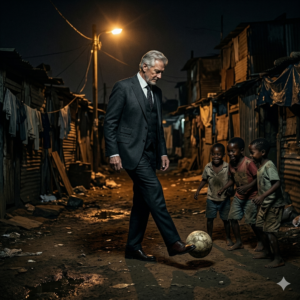
“That is exactly why I must see it,” Noah replied, his jaw clenched so tightly his teeth ached. He parked the car near a dusty, barren field illuminated by a single, flickering streetlamp. The moment Nova’s feet hit the cracked pavement, she transformed. She ran toward a group of ragged children, her laughter cutting through the grim reality of the slum like a silver bell. Noah stepped out of the Bentley, his expensive Italian loafers sinking slightly into the dirt. He stood in the shadows, watching. The children were playing football with a deflated, tape-covered ball. They had nothing, yet their joy was absolute. It was not the forced, synthetic happiness of the boardrooms; it was raw, bleeding, triumphant life.
I am a ghost haunting a graveyard of the living, Noah’s internal voice wept as he stood in the dirt, the bitter taste of his own legacy burning his tongue. I have spent my life amassing wealth, building fortresses in the sky, isolating myself from the rot of humanity. Yet, standing here in the dust, looking at these children laughing in the shadows of the buildings I planned to crush, I realize they are infinitely richer than I am. They have community. They have joy. I have nothing but bank accounts and silence. The warlord inside me is screaming to burn it all down, to maintain the ruthless trajectory of the business. But the father—this terrifying, newly awakened entity in my chest—is demanding I fall on my sword to protect this fragile patch of dirt.
Suddenly, a poorly aimed kick sent the deflated football rolling across the dust. It stopped exactly at the tip of Arthur Noah’s polished, thousand-dollar leather shoe. The children froze, staring in terror at the towering, wealthy stranger in the shadows. Noah looked down at the ruined ball. Slowly, deliberately, the titan of industry bent down, picked up the filthy ball, and gently kicked it back to the children. The tension snapped. The children cheered.
The devil walked into the slums and found God playing in the dirt.
ACT 6: THE LAST SUNSET OF THE WOLF
The boardroom the next morning smelled of stale coffee, impending wealth, and quiet hostility. The partners were assembled, pens ready, expecting the momentary lapse of judgment to have passed. Instead, Arthur Noah walked in, his posture radiating a terrifying, absolute calm. He did not sit. He tossed the unsigned contract onto the center of the glass table.
“We are moving the project,” Noah stated, his voice echoing with the finality of a judge passing sentence.
The room erupted. “What?” the lead partner shouted, his face flushing crimson. “That land is prime real estate! We have invested millions in the zoning plans! You cannot back out now!”
Noah leaned forward, placing his heavy hands on the glass, dominating the airspace. “I am not backing out. I am pivoting. That land is no longer for demolition. Instead of destroying that neighborhood, we are going to improve it. We will rebuild the roads. We will construct a state-of-the-art playground. We will renovate the housing blocks and subsidize the community. We will invest our millions elsewhere.”
“Why?” another partner demanded, horrified by the sudden injection of philanthropy into a capitalist slaughterhouse.
Noah glanced toward the corner of the room, where Nova sat quietly with her crayons, drawing on the floor. “Because,” Noah answered, his voice dropping to a gravelly, dangerous whisper, “businesses should build communities, not serve as their executioners. Anyone who disagrees can sell their shares by noon, or I will personally bankrupt you.”
Months later, the dust of Sector 4 had settled into a vibrant, thriving reality. The broken asphalt was replaced with green parks; the crumbling bricks were fortified. The warlord had spent a fortune not to acquire, but to heal. One quiet afternoon in the study, the late autumn sun casting long, golden shadows across the Persian rug, Nova walked up to his desk. She proudly handed him her latest masterpiece. It was a drawing of a large house, a green park, and three figures holding hands: a woman, a little girl, and a tall man in a suit. At the top, scrawled in blue crayon, were the words: My Family.
This is the last sunset of my era of terror, Noah reflected silently, tracing the waxy blue letters with a trembling finger, feeling the final remnants of his ruthless past evaporate into the golden light. I spent fifty years terrified of weakness, believing that to love was to invite the blade. But looking at this drawing, I realize that true power is not the ability to destroy a city; it is the courage to save one. The fame, the fear, the blood-soaked legacy of the Noah empire—it is all worthless dust. I have traded my kingdom of ash for a kingdom of light. The wolf is dead. The father breathes.
True immortality is never forged in steel and glass, but in the fragile, beating heart of a saved child.
Disclaimer : This content may be created by AI for entertainment purposes. Any resemblance to real persons, events, or places is coincidental.






