My Mother-In-Law Forced Me to Sign a Prenup… So I Added One Clause That Destroyed Her Son.
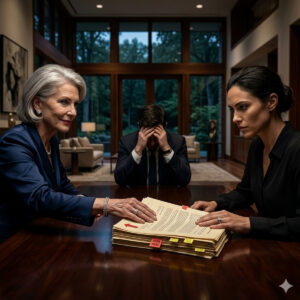
The fluorescent lights of the kitchen hummed with a clinical sort of indifference as Patricia slid the stack of papers across the reclaimed oak table. It was a twelve-page document, bound in a heavy cardstock cover, meticulously notarized and already flagged with little yellow “Sign Here” stickers. She didn’t just place them down; she slid them like a dealer at a high-stakes table, her movement practiced and fluid.
“It’s just a formality, Cara,” Patricia said, her voice like silk over a razor blade. “Protecting the family. You understand, don’t you?”
I looked up at her, meeting that smile—the one that never reached her eyes. I had seen it before. I’d seen it at the engagement party when she surveyed my chosen gown and told me the neckline was “very brave.” I’d seen it at Christmas when she asked, loud enough for the entire Whitmore clan to hear, whether my family actually had “real” traditions or if we just kind of “winged it” every year.
Always smiling. Always precise. Always drawing a line in the sand.
“The family,” I repeated softly. The words felt heavy, alien. Not our family. Not the life Daniel and I were starting. The family—the ancient, sprawling commercial real estate empire with buildings in three states and a donor’s name on a Connecticut hospital wing. In Patricia’s eyes, the diamond Daniel had placed on my finger wasn’t a symbol of commitment; it was a visitor’s pass, and the expiration date was already being negotiated.
I was thirty-one when I married Daniel Whitmore. We had met three years prior at a dry marketing conference in Chicago. He wasn’t what I expected from a man of his pedigree. He wasn’t flashy; he didn’t name-drop or wear his wealth like a costume. He was the guy who laughed at things that were actually funny, who asked questions and actually waited to hear the answers.
I fell for him slowly, the way you fall for someone when you’re trying to be careful, and then all at once when you finally stop. Daniel worked a regular desk job, drove a used SUV with a temperamental heater, and insisted on splitting the grocery bill. I knew the Whitmore money existed, but it was abstract—a background hum I chose to ignore until Patricia turned up the volume.
The prenuptial agreement appeared exactly eight weeks before the wedding. Daniel brought it home on a Tuesday, setting it on the granite counter with a strange, hesitant flick of his wrist. He wouldn’t meet my eyes.
“Mom had her lawyer draw it up,” he said, his voice sounding thin. “She’s not trying to be offensive, Cara. It’s just the estate stuff. Trusts, inheritance, the long-term legacy. You know how she is.”
“Did you ask her to do this, Daniel?” I asked, my heart beginning a slow, heavy thud against my ribs.
“She brought it up and I said I’d talk to you. It’s… it’s just standard.”
But it wasn’t. I spent that night alone at the kitchen table, the silence of the house magnified by the sound of the TV blaring from the living room. Daniel had turned the volume up too high, a desperate attempt to drown out the noise of my lack of response.
As I read, the cold started to seep in. The terms were clinical, designed to strip me of any identity other than “temporary occupant.” If the marriage ended before ten years, I walked away with nothing but my own modest salary. No shared assets. No claim to the “forever home” we were currently scouting—the one Patricia had already promised to help us finance. The investment accounts, the future inheritance, the properties—all of it was ring-fenced behind a wall of legalese. It was a document that didn’t celebrate a union; it prepared for a liquidation.
I called my sister, Renee, the next morning. Renee is a senior paralegal at a high-end firm in the city. She reads legal documents the way most people read menus: fast, looking for the hidden costs, and always with a strong opinion.
I read her the key sections over the phone, my hand trembling slightly as I gripped the receiver. When I finished, the line was silent for so long I thought the call had dropped.
“Cara,” she finally said, her voice uncharacteristically grim. “This isn’t standard.”
“What do you mean?”
“Standard prenups protect what people bring into the marriage. This one is structured to capture things that don’t even exist yet. It’s a net, Cara. It’s written like they expect you to fail—or like they’re planning to make sure you do.”
I sat on the edge of my bed, looking at the wedding dress hanging on the back of the door. The white silk seemed to mock me.
“Can I add terms?” I asked.
“You can negotiate,” Renee said. “He doesn’t have to agree. Patricia certainly won’t. But legally? Yes, you can propose amendments. If they both sign, it’s binding.”
I didn’t sleep that night. Not because of anger—I had moved past anger and into a cold, vibrating clarity by 2:00 AM. I didn’t sleep because I was busy. I loved Daniel, and I wanted to believe he loved me, but I had just discovered that the house we were building had a hidden room I was never supposed to enter.
I spent the next four days immersed in property law and marital asset precedents. I spent my lunch breaks talking to a real estate attorney I hired for a two-hour flat fee. I told her the situation was “hypothetical,” but I think she knew by the way I took notes.
Finally, I wrote it. My clause. One single paragraph. Twelve sentences of absolute, airtight autonomy.
I brought it to Daniel on a Wednesday evening. He was sitting in his home office, looking over floor plans for the house on Aldidge Street—the one Patricia was “helping” with. I set my single page on top of the blueprints.
“I’ll sign the prenup,” I said, my voice quiet but steady. “I just want this added.”
Daniel read it. Then he read it again, his brow furrowing. “A third-party influence clause? Cara, what is this?”
“It’s simple,” I said. “If any third party—including family—provides financial gifts or assistance toward our shared property, they forfeit any right to influence our lives or that property. If they try to use that money as leverage, it triggers a mandatory buyout process where they pay the legal fees.”
“Your mom wrote twelve pages to protect her past,” I added, stepping closer. “I wrote one paragraph to protect our future. If we’re both coming into this in good faith, there’s no reason not to sign it.”
Daniel looked at the paper for a long time. Then, he picked up his phone and called his mother. I left the room. I didn’t need to hear the conversation. I just watched the clock. The call lasted forty-seven minutes.
The meeting at Patricia’s house that Saturday felt like a summit between two nations that had been at cold war for decades. Her home was an exercise in “tasteful” intimidation: high, vaulted ceilings, pale velvet furniture, and artwork that possessed no color, only texture. It was a place where joy felt like a breach of etiquette.
Patricia sat on the edge of her armchair, her coffee cup held with a pinky extended—weaponized hospitality. Her lawyer, a man named Gerald who looked like he’d been plucked from a 1950s boardroom, sat beside her with a briefcase that probably cost more than my car.
“Cara, dear,” Patricia started, her voice dripping with artificial warmth. “I hope you realize this isn’t personal. It’s about legacy. Protecting what took forty years to build.”
“I completely understand,” I replied, taking a slow sip of my own coffee. “That’s why I added my clause. To protect what Daniel and I will build over the next forty years.”
The warmth in the room dropped ten degrees. Gerald cleared his throat, adjusting his glasses.
“Specifically,” Gerald said, “the language regarding third-party financial involvement is… unusually broad. It could be interpreted to limit entirely normal family support.”
“That is exactly how it is meant to be interpreted,” I said, looking directly at Patricia.
For the first time, the mask slipped. Patricia set her cup down with a sharp clack against the saucer. Behind the practiced composure, I saw it: something cold, calculating, and incredibly old.
“You’re making this adversarial, Cara,” she whispered.
“No, Patricia. I’m making it equal. The original document was a cage. I’m just making sure the door has a handle on my side, too.”
Three days later, I found out why Patricia had fought so hard against that single paragraph. Renee called me from her office, her voice frantic.
“Cara, I did some digging. I pulled the property records for that house on Aldidge Street. The one you and Daniel were ‘buying’ next month.”
My stomach did a slow roll. “And?”
“Patricia already closed on it. Six weeks ago. But she didn’t buy it for you two. She bought it in her own name, through a shell LLC. Her plan was to ‘gift’ it to Daniel—and only Daniel—after the wedding.”
I had to sit down. The room felt like it was spinning.
“Don’t you see?” Renee continued. “Under the original prenup, if she gifts it to him, it’s not a marital asset. You would have been living in a house you didn’t own, in a marriage where you were a permanent guest. She was building a life where you had no key that actually worked.”
It wasn’t a formality. It was architecture. She had designed a version of my life where I was surrounded by Whitmore money but possessed none of the power that came with it.
But my clause—the one she had just signed in a fit of prideful rage after Daniel threatened to postpone the wedding—changed everything. If she transferred that house to him now, any attempt she made to control our lives through that ownership would trigger a legal buyout she would have to fund herself. I hadn’t just amended a contract; I had dismantled her leverage.
Daniel called me two hours later. His voice had a specific flatness to it—the sound of someone whose world had just been forcibly recalibrated.
“She bought it, Cara,” he said. “Before she even told us it was an option. She was going to keep it in her name.”
“I know,” I said.
“I didn’t know, Cara. I swear to you. I didn’t know she was going that far.”
And the strange thing was, I believed him. Daniel wasn’t the villain; he was just the person his mother had been quietly living for, without ever asking him what he actually wanted. He was as much a prisoner of her “legacy” as I was supposed to be.
We got married in October.
The wedding was beautiful, though the air between Patricia and me was now as clear as a winter morning. We understood each other. No more smiles that didn’t reach the eyes. No more “brave” dresses. Just a mutual acknowledgement of the boundaries I had drawn.
Daniel cried when he saw me walk down the aisle. It wasn’t for the cameras or the “family image.” It was for me. I’ve kept that moment in a small, private corner of my heart where Patricia can’t reach.
The house on Aldidge Street was eventually transferred into both our names. Patricia signed the papers at a cold office in downtown Greenwich, her pen scratching against the parchment with a sound like grinding teeth. She was present, she was correct, and she was barely containing a fury that she no longer had the currency to spend.
Sometimes I think about what would have happened if I had just signed. If I had been “polite” and “trusting.” I would have spent my life in a beautiful home that wasn’t mine, in a marriage gently structured to ensure my eventual obsolescence. I might never have known. I would have just felt it—that low-level sense of wrongness, the feeling that I was an extra in my own life.
I didn’t destroy Patricia. I didn’t steal her “legacy.” I just read the document she handed me and I wrote back. Her mistake was assuming that because I was quiet, I was unaware. That because I was patient, I was passive.
I didn’t win a battle. I just refused to move into a house I wasn’t allowed to own. And in the end, that was more than enough.
Legacy is a powerful word, but who does it really belong to? Does it belong to the ones who built the past, or the ones who have to live in the future? Cara refused to be a guest in her own marriage, but many of us sign “prenups” in our daily lives—agreeing to terms that make us small just to keep the peace. Have you ever realized someone was building a life for you instead of with you? Tell us your story in the comments below. Subscribe to Blind Spot for more stories about the power plays no one sees coming.
Disclaimer : This content may be created by AI for entertainment purposes. Any resemblance to real persons, events, or places is coincidental.






