EMPIRE OF DIRT: THE EXILE OF THE HEIR
ACT 1: THE RUSTED CROWN OF THE PRODIGAL
I have spent a lifetime documenting the Sterling family, watching them build skyscrapers on the crushed bones of their competitors, but to truly understand the architecture of their power, you must look at their ruins. Julian Sterling was the ruin. The undisputed, brilliant crown prince of a London-based global syndicate, he was shipped across the Atlantic like a defective, highly explosive piece of cargo. His destination was not a penthouse, but a decaying, multi-million-dollar Brooklyn brownstone—a gilded cage purchased by his father, Arthur Sterling, the unseen patriarch whose very name commanded governments. The air inside the brownstone smelled of stale rain, untreated cedar, and the sharp, undeniable metallic tang of abandoned potential. Dust motes danced in the shafts of gray morning light like suspended ash.
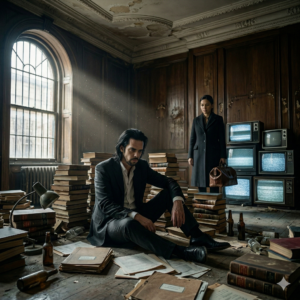
Into this mausoleum walked Dr. Clara Vance. Once a prodigy in the surgical theater, she now carried the scent of sterile hospital soap and the heavy, invisible shroud of a patient who had bled out on her table. She had traded her scalpel for a contract. She was a “sober companion,” a warden bought and paid for by the Sterling empire to ensure the prince did not put another needle in his arm. When she first saw him, Julian was standing amidst a fortress of muted television screens, his pale skin translucent, his eyes vibrating with an exhausting, manic intelligence. He did not look like a billionaire’s heir; he looked like a feral dog that had swallowed a supercomputer.
The noise, Julian thought to himself, his internal monologue a relentless, deafening storm. The incessant, deafening roar of a world that moves too slowly, that misses everything. They look, but they do not see. My father believes he can purchase my redemption with this broken doctor. He thinks distance will cure the rot. But the rot is not in London. The rot is the blood in my veins. I can feel the phantom kiss of the syringe, the sweet, dark velvet of oblivion calling out to me, promising silence. But I cannot have silence. I must have the work. If I stop moving, if I stop deducing, the ghosts will catch up.
He paced the scarred wooden floors, tracing the irregular patterns of the grain, his mind cataloging Clara’s cheap shoes, the subtle tremor in her left hand, the specific brand of resignation in her posture. He was a man starving for a puzzle to feed his ravenous intellect, a man desperate to prove that even though he had been cast out of the kingdom, he was still a king of his own making. He did not want a companion. He wanted a witness.
The bloodline was broken, but the brain remained.
ACT 2: BLOOD ON THE MARBLE ALTAR
The summons came from Captain Miller of the NYPD, an old bulldog who owed the Sterling family a debt forged in blood and political favors a decade prior. The crime scene was a monument to the vulgarity of new money: a sprawling Manhattan townhouse belonging to Richard and Evelyn Cross. When Julian stepped over the police tape, Clara trailing cautiously behind like a shadow, the atmosphere shifted. The air was thick with the scent of ozone, expensive gardenia perfume, and the undeniable, coppery stench of violence. The victim, Evelyn, lay discarded on the imported Italian marble, her life spilled out in a dark, sticky halo around her skull.
To the police, it was a home invasion gone wrong. To Julian, it was a symphony of errors, a tragic opera written in the language of shattered glass and blood spatter. He walked past the weeping husband, his eyes cold, his face a mask of absolute detachment. He wasn’t looking at a tragedy; he was reading a manuscript. He drifted toward the master bedroom, his fingers lightly brushing the lacquered walls until he found it: the panic room. The reinforced steel door was ajar, the lock undamaged from the outside.
They have it all backwards, Julian’s mind raced, the gears grinding with a terrifying, exhilarating speed. Look at the trajectory of the glass. Look at the lack of hesitation marks. She didn’t run away from the monster into the panic room. The monster was already inside waiting for her. He was the Trojan horse. But how? Why the excessive force? It’s not a burglary. It’s a performance. A brutal, calculated theater of cruelty meant to disguise a simpler, darker motive. The husband weeps in the hall, tears of genuine shock, but his shock is not for a murder. It’s for a deviation in the plan. The air tastes of a secret held too long.
Julian knelt beside the body, so close his nose almost brushed the congealing blood. He inhaled deeply, terrifying Clara with his morbid intimacy with death. He was reconstructing the final seconds of Evelyn Cross’s life frame by frame. He felt the cold steel of the gun against her temple, he heard the muffled, metallic echo of the demand, he felt the terrible realization that the fortress she built to protect herself had become her tomb. He stood up, the manic energy radiating off him in waves, his eyes locking onto Clara’s terrified face. He had found his fix.
The dead were speaking, and he was the only one listening.
ACT 3: THE SYMPHONY OF THE VEIN
The descent into the victim’s life was a descent into Julian’s own psychological purgatory. The crime scene had yielded a hidden compartment beneath Evelyn’s vanity, smelling faintly of cedar and desperation. Inside was a burner phone. A secondary life. As Julian relentlessly scrolled through the encrypted, panicked text messages sent in the weeks leading up to her slaughter, the silence of the brownstone pressed against them. Clara watched him from the worn leather armchair, her own internal demons waking up. She saw in Julian’s obsessive, feverish focus the same terrifying God-complex she used to feel when holding a beating human heart in her hands—the razor-thin line between saving a life and playing the executioner.
Secrets, Julian thought, his fingers steepled beneath his chin as he stared into the dead fireplace. We build our lives on them. We construct magnificent facades of wealth, of normalcy, of sobriety. My father hides his ruthless tyranny behind philanthropy. I hide my agonizing vulnerability behind a needle. And Evelyn Cross hid a stalker behind the walls of a panic room. The texts are desperate. They are the pleas of a woman being hunted. But she didn’t tell her husband. Why? Because the threat came from a place she trusted. The addiction to secrecy is worse than the heroin. The heroin only kills the body; the secret destroys the soul.
He felt the physical ache in his bones, the deep, rattling vibration of withdrawal that Clara’s presence was meant to suppress. The urge to escape the crushing reality of Evelyn’s terror was overwhelming. He wanted to melt away into the velvet dark, to silence the hyper-connectivity of his brain. But then he looked at Clara. He saw the guilt etched into the corners of her mouth, the way she rubbed her hands as if scrubbing away phantom blood. They were two ghosts haunting the same house, bound by their failures.
Julian realized that Evelyn hadn’t just been murdered; she had been squeezed for information. The texts weren’t just threats; they were commands. She was forced to open the safe before she was executed. The realization hit him like a physical blow, a sudden rush of adrenaline that flushed the narcotic craving from his system. He wasn’t just solving a murder; he was unearthing a conspiracy of silence that mirrored the toxic silence of his own family’s empire.
The truth is a blade that cuts the hand that wields it.
ACT 4: SINS OF THE FATHERS, PRICED IN GOLD
The revelation dragged them back to Richard Cross. The husband was not the architect of the murder, but he was the banker of the tragedy. Under the blistering heat of Julian’s relentless interrogation in the sterile, fluorescent-lit precinct room, the facade of the grieving widower crumbled into dust. Richard confessed, his voice a hollow, broken rasp. Evelyn had been kidnapped weeks ago. The body in the house was the grim conclusion of a ransom demand gone horribly wrong. Richard had tried to handle it privately, using his vast wealth to pay for a life, only to find that money is worthless when dealing with a void.
I look at this man, Julian pondered, his internal voice dripping with a mixture of contempt and profound pity. I look at this pathetic creature clutching his checkbook as if it were a shield. He is suffocating under the weight of his own fortune. It is the curse of the inheritance. My father, Arthur, taught me that gold can buy governments, silence witnesses, and purchase brilliant, broken doctors to babysit his defective son. But he never understood that wealth makes you a target. It isolates you on a mountaintop, waiting for the wolves. Richard tried to buy his wife’s life, just as my father tried to buy my salvation. Both transactions ended in a corpse.
The burden of the Sterling legacy pressed down on Julian’s shoulders. He felt his father’s judgmental eyes boring into his back from three thousand miles away. Every deduction, every brilliant leap of logic, was a rebellion against the patriarch who deemed him useless. Julian was using the Cross tragedy to prove his own sovereignty. He dug through Richard’s financial records, his therapy bills, his daily schedules. He realized the kidnappers knew too much. They knew the layout of the house, the schedule of the panic room, the deepest financial vulnerabilities of the Cross estate.
The enemy was not a stranger in the dark; the enemy was a confidant in the light.
Julian’s mind snapped the pieces together with the violent, satisfying crack of a bone setting into place. The leak was not in Richard’s business; it was in his mind. The psychiatric sessions. The one place where a man stripped away his armor and handed his weapons to a stranger.
A heavy crown guarantees a severed head.
ACT 5: THE PREDATOR IN THE VELVET CHAIR
The climax did not happen in a dark alley with a gun; it happened in a sun-drenched, soundproofed office on the Upper East Side, smelling of expensive Earl Grey tea and imported, soft leather. Dr. Aris Thorne sat behind his mahogany desk, a portrait of modern, affluent empathy. He was Richard Cross’s therapist, the shepherd of the rich and anxious. But as Julian walked into the room, his eyes scanning the diplomas, the subtle positioning of the chairs, the slight arrogance in Thorne’s immaculate posture, he recognized a fellow predator.
He thinks he is a god, Julian mused, sitting opposite the doctor, leaning forward like a gargoyle preparing to strike. He sits in this velvet chair and listens to the weeping of the elite, mining their traumas for gold. He is a parasite feeding on the neuroses of the wealthy. I know his kind. The grifters in tailored suits. He smells of superiority, masking the scent of profound moral rot. He thought he could manipulate a billionaire, kidnap his wife, take the ransom, and silence the witness, all while continuing to charge five hundred dollars an hour to hold the husband’s hand. He underestimated the variable. He underestimated me.
Julian laid the trap with agonizing slowness. He spoke of Evelyn’s burner phone, a phantom piece of evidence he had fabricated to test Thorne’s pulse. He watched the micro-expressions on the doctor’s face—the slight dilation of the pupils, the rigid tightening of the jaw. Clara stood by the door, acting as the silent sentry, feeling the suffocating tension in the room. This was not a physical fight; it was a brutal, intellectual bloodsport.
Julian unspooled his deductions, laying out Thorne’s hidden debts, his connection to the hired muscle, the exact psychological manipulation he used to force Evelyn into compliance. Thorne’s mask of benevolent concern melted, revealing the cornered, vicious animal beneath. He reached for his desk drawer, the facade of the civilized healer entirely abandoned. But Julian was faster, his intellect already three steps ahead of the doctor’s panic. The NYPD burst through the door, shattering the quiet sanctuary of the therapist’s office.
The velvet curtain fell, revealing the monster on the stage.
ACT 6: ASHES IN THE HOURGLASS
The sirens faded into the ambient, relentless roar of the New York night. The empire of Dr. Aris Thorne was dismantled, packed into evidence bags, and driven away. Julian and Clara returned to the sprawling, empty brownstone in Brooklyn. The air inside felt different now. The dust had settled. The frenetic, chaotic energy that had possessed Julian since the morning was replaced by a heavy, profound exhaustion. He sat on the floor in front of a wall of television screens showing a muted Mets game, his long limbs folded, his eyes dark and shadowed.
Clara watched him, realizing that the contract she signed with Arthur Sterling was irrelevant. She was no longer a warden guarding a prisoner; she was a soldier who had just survived a trench war alongside a mad general. She saw the tragic beauty in his intellect—a mind so powerful it burned its own vessel.
The game is over, Julian thought, the silence returning to his mind, bringing with it the inevitable melancholy. The King in London sits on his throne, believing he still controls the pieces on the board. He believes this exile is my punishment. But he is wrong. The legacy of the Sterling name—the ruthlessness, the cold calculation, the manipulation—it is dead to me. I have taken his tools and built something else. I have built a sanctuary in the ashes. We are surrounded by the debris of broken lives—Evelyn’s, Richard’s, my own, Clara’s. We are the discarded, the disgraced, the haunted.
He turned his head slightly, acknowledging Clara’s presence without a word. He didn’t ask for a drug test. She didn’t offer a platitude. They existed in the unspoken understanding that the world was fundamentally corrupt, driven by greed, secrets, and blood. But in the center of that corruption, Julian had found a chaotic purity in the truth. He was no longer the prodigal son waiting for forgiveness from a father incapable of love. He was a new entity, forged in the fires of addiction and exile, armed with a terrifying mind and accompanied by a doctor who knew exactly how to stop the bleeding. The sun was setting on the old empire, casting long, dark shadows across the wooden floor.
We are the lords of the wreckage.
Disclaimer : This content may be created by AI for entertainment purposes. Any resemblance to real persons, events, or places is coincidental.






