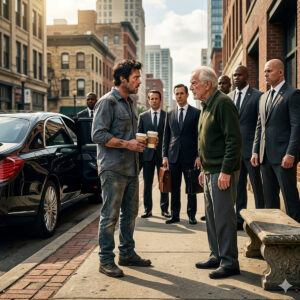
The city of Chicago has a way of swallowing people whole. On bright days, when the sky is a searing, unbroken blue and the sunlight glints off the towering glass monoliths of the Loop, the streets become a frantic river of ambition. Thousands of souls surge toward their daily grinds, eyes locked onto phone screens, moving like restless waves that never touch the shore. In the midst of this relentless motion lived Daniel Harper.
Daniel was a man of grease-stained knuckles and quiet, iron-clad integrity. At thirty-four, he was a widower and a lead mechanic at a bustling garage three miles from his modest apartment on South Franklin Avenue. His life was a symphony of simple, honest routines. Every morning, Daniel’s internal clock bypassed the jarring scream of the alarm. He would rise in the pre-dawn gray, the floorboards creaking under his weight, to prepare a steady breakfast of oatmeal and fresh fruit for his ten-year-old son, Noah.
“Check your laces, pal,” Daniel would murmur, his voice rough but warm. He’d inspect Noah’s homework with a discerning eye, ensuring every math problem was tackled with the same precision he applied to a faulty transmission. Then, hand-in-hand, they would walk to the corner where the yellow school bus hissed to a halt.
After waving goodbye until the bus turned the corner, Daniel always returned home along the same path. And every morning, for the last six months, he encountered the same fixture of the neighborhood. Near the entrance of his brick apartment building stood a weathered stone bench, and on that bench sat Robert Collins.
Daniel first noticed Robert on a morning when the sky was the color of a bruised plum and the rain fell in cold, persistent needles. The elderly man had been struggling to stand, his thin walking stick skidding on the slick pavement. His hands, translucent and mapped with blue veins, trembled with a violent fragility. Without a second thought, Daniel had stepped under the man’s arm, steadying his weight with the easy strength of a man used to lifting engines.
“Easy does it, sir,” Daniel had said. “Let’s get you balanced. How about I bring you a coffee from the diner across the street? You look like you could use the heat.”
From that rain-soaked encounter, a ritual was born. Daniel made it his personal mission to see Robert every single day. He brought warm cups of coffee that chased away the morning chill, the occasional glazed donut, and the morning edition of the Chicago Tribune. But more than the sustenance, Daniel brought his presence.
Robert was a man who seemed to have stepped out of a black-and-white photograph. He talked about an older Chicago—a city where the “L” trains sounded like thunder, where the parks felt like endless forests, and where neighbors knew the rhythm of each other’s lives. Daniel would listen, leaning against the cold stone of the bench, frequently glancing at his watch but never cutting the old man off. He saw Robert not as a burden or a curiosity, but as a lonely neighbor who deserved a bit of human dignity in a city that had long since forgotten his name.
As spring breathed fresh, floral energy into the Chicago air, the bond deepened. Kindness, Daniel found, was a seed that required very little soil to grow. Noah soon became an integral part of the morning routine. With the exuberant innocence only a child possesses, Noah began calling the man “Grandpa Robert.” The sight of the young boy running up to the bench with a drawing or a school story made the lines in Robert’s tired face soften, his smile widening further than Daniel had ever seen.
Daniel’s care extended beyond the morning coffee. He noticed the small, fraying edges of Robert’s life and quietly began to mend them. He helped Robert carry heavy groceries up the steep stairs of the neighboring building. He spent a Saturday afternoon fixing the loose, rattling handle on Robert’s front door. He replaced the dead batteries in an old, ornate wall clock that had sat silent for years. He even took it upon himself to sweep the grit and fallen leaves from around the stone bench, ensuring Robert had a clean place to rest.
“You do too much for an old man, Daniel,” Robert would say, his voice a raspy whisper of gratitude.
“Family takes care of family, Robert,” Daniel would reply, wiping dust from his hands. He meant it. Though they shared no blood, Robert had become the grandfather Noah had lost and the anchor Daniel didn’t know he needed.
Life for Daniel remained a delicate balancing act. As a single father on a mechanic’s wage, every dollar was earmarked for rent, utilities, or Noah’s future. Yet, when Robert caught a chest-shaking cold in late April, Daniel didn’t hesitate. He stayed beside Robert on the bench for an hour, watching the old man’s labored breathing, before eventually hoisting him into his old pickup truck and driving him to a local clinic. Daniel sat in the waiting room for three hours, and when the bill came, he paid it quietly at the window, insisting the receptionist not mention it to the patient. To Daniel, real goodness lost its value the moment it sought an audience.
As summer arrived, the pavement of Chicago began to radiate a relentless, shimmering heat. The air smelled of hot tar and the sweet, heavy scent of blooming city gardens. Daniel helped Robert water the wilting petunias he kept on his windowsill and spent an evening in the sweltering heat repairing Robert’s ancient, rattling floor fan so the old man could sleep.
Daniel operated under the assumption that Robert was like many others in the neighborhood—a retired worker living on a meager, thinning pension, surviving on the scraps of a life once full of noise. He promised Robert he would never let him feel abandoned in this rushing, indifferent city. He had no inkling that the “lonely neighbor” was a man whose influence reached into the very skyscrapers Daniel gazed at from his garage window. Destiny was quietly sharpening its shears, preparing to pull back the curtain on a reality Daniel couldn’t have imagined in his wildest dreams.
The morning of June 14th began with a golden, honeyed light that made the city feel almost magical. Daniel walked back from the bus stop after waving goodbye to Noah, who was heading off for a field trip. Daniel felt a lightness in his step, carrying two steaming cups of dark roast and a fresh blueberry muffin. He was looking forward to hearing Robert’s take on the latest city council news.
However, as he rounded the corner toward his building, the familiar silence of the side street was shattered.
A sleek, obsidian-black luxury sedan—an armored Maybach with windows so dark they reflected the street like a black mirror—was idling directly in front of the stone bench. Daniel froze, his grip tightening on the cardboard coffee carrier.
The doors of the sedan opened with a synchronized, heavy thud. Four men stepped out first. They were towering figures, clad in charcoal-gray suits that cost more than Daniel made in a year. They wore earpieces, their eyes hidden behind polarized shades, scanning the rooftops and doorways with the disciplined, lethal alertness of elite bodyguards.
Daniel’s heart hammered against his ribs. Is there a hit? Is this a federal raid? He watched, breathless, as two polished assistants and three men carrying heavy, leather-bound briefcases followed. The lawyers, for that is clearly what they were, moved with a shark-like intent.
The neighbors had begun to gather. Shopkeepers stepped out onto the sidewalk, wiping their hands on aprons, their whispers creating a low hum of confusion.
The lead lawyer, a man with silver-streaked hair and a face carved from granite, walked straight toward the stone bench. He didn’t look at the peeling paint or the grit on the sidewalk. He stopped before Robert Collins and bowed his head in a gesture of profound, almost reverent, formal respect.
“Mr. Collins,” the lawyer’s voice rang out, crisp and authoritative. “We have the final documents for the acquisition. Your immediate attention is required for the signatures. The board is waiting in New York via secure link.”
Daniel felt the world tilt. He watched as Robert—the man he had helped to the bathroom, the man he had bought donuts for—slowly stood up.
But it wasn’t the Robert Daniel knew. The fragile, trembling old man vanished. In his place stood a figure of absolute, commanding power. Robert straightened his spine, his chin lifting, his eyes suddenly sharp and piercing like a hawk’s. The “walking stick” was no longer a crutch; he held it like a scepter.
“I told you I was not to be disturbed until the fifteenth, Edward,” Robert said, his voice no longer raspy, but a deep, resonant baritone that carried the weight of a man accustomed to being obeyed by thousands.
The bodyguards moved into a defensive perimeter around the bench, their presence turning the simple Chicago sidewalk into a fortified command center. Robert turned his head, his gaze finding Daniel standing ten feet away, clutching the cooling coffee cups.
“Daniel,” Robert said, his expression softening into a look of genuine warmth that looked out of place amidst the cold efficiency of his staff.
Daniel took a hesitant step forward, his voice a mere ghost of itself. “Robert? What… what is all this? Who are you?”
Robert stepped toward him, the bodyguards parting like the Red Sea to let the old man through. He placed a firm, steady hand on Daniel’s shoulder.
“I am the man you thought I was, Daniel. A lonely soul,” Robert said quietly, though the lawyers hovered just behind him. “But I am also Robert Collins, the founder of Collins-Tech International and the principal investor of the Meridian Real Estate Group.”
Daniel’s breath hitched. Collins-Tech. Their logos were on the very satellites that mapped the world. Robert was one of the wealthiest men in the country, a titan of industry whose face occasionally appeared on the cover of Forbes.
“After my Martha passed away three years ago,” Robert continued, his eyes searching Daniel’s, “the money, the planes, the boardrooms… it all felt like ash in my mouth. I wanted to see if there was anyone left in this world who could see a human being instead of a bank account. I moved here, to this borough, lived anonymously, and played the part of a man at the end of his rope. I waited for months, Daniel. Thousands of people walked past this bench. Thousands looked right through me.”
Robert’s hand tightened on Daniel’s shoulder. “Only you stopped. Only you saw me. You gave me coffee when I was cold, you gave me medicine when I was sick, and you gave me your son’s love when I was empty. You didn’t do it for a headline. You did it for a mechanic’s wage, out of a mechanic’s heart.”
The lead lawyer stepped forward, clearing his throat. “Mr. Collins, the flight is scheduled for noon. We must proceed with the filing of the updated trust.”
Robert ignored him. He looked at the crowd of stunned neighbors, then back to Daniel. “My lawyers are here because they say I must return to the ‘real world’ to sign away the future. But they don’t understand that the real world is right here, on this bench.”
Robert reached into the leather briefcase held by the lead assistant and pulled out a single, heavy document embossed with a gold seal. “This is my updated will and a deed of trust, Daniel.”
The crowd went silent. Even the wind seemed to stop.
“I am leaving a significant portion of my personal estate—fifty million dollars—and the deed to the historic manor on the North Side to you and Noah,” Robert declared, his voice echoing off the brick walls of South Franklin Avenue. “I want that boy to go to any university in the world. And I want his father to never have to worry about the price of a clinic visit ever again.”
The assistants gasped. The neighbors broke into frantic, electrified whispering. Daniel felt a violent surge of emotion—a cocktail of shock, gratitude, and a strange, lingering sadness.
“Robert, I can’t… I didn’t do it for this,” Daniel stammered, tears finally stinging his eyes. “I just wanted you to have a warm cup of coffee.”
“I know,” Robert smiled, a tear of his own tracing a path down his cheek. “That’s exactly why you’re the only man I trust to have it. Humility, Daniel, is the ability to accept a thank you as well as you give a hand.”
The immediate aftermath was a blur of high-stakes motion. The lawyers insisted on Daniel signing preliminary acknowledgments right there on the sidewalk. Neighbors who had previously ignored Daniel now crowded around, their eyes wide with a predatory kind of awe, trying to touch the sleeve of the man who had just become a multimillionaire.
But the shift wasn’t just financial; it was visceral. The power dynamic of the entire street had been rewritten. The local shopkeeper, who used to grumble when Daniel asked for a line of credit for milk, now hurried out with a gift basket, bowing slightly. Daniel felt a coldness in his stomach. The world hadn’t changed; they had just finally seen his “worth,” and he hated how different it felt from Robert’s quiet gratitude.
The bodyguards remained a stern, silent wall, keeping the frantic energy of the city at bay while Robert prepared to depart. The black Maybach hummed, a predator waiting to return to the jungle.
Inside the car, the assistants were already on their phones, rearranging Robert’s life, their voices sharp and clinical. The lawyers were arguing about tax implications. To them, this was a massive, inconvenient legal hurdle. To Daniel, it was the death of his quiet routine.
Noah returned from the bus stop twenty minutes later, having forgotten his lunchbox on the kitchen counter. He stopped dead, his small mouth hanging open at the sight of the dark suits and the glowing black car. He saw his father standing there, looking pale and overwhelmed.
Robert, seeing the boy, motioned for the guards to step aside. He knelt—painfully, but with a new strength—and pulled Noah into a fierce, final embrace.
“Listen to me, Grandpa Robert,” Noah whispered, confused. “Are you going away?”
“I have to go back to work for a little while, Noah,” Robert said, pulling back and looking the boy in the eye. “But you and your dad… you’re coming to see me very soon. And I want you to remember something.”
He handed Noah a small, cream-colored envelope. “This is a promise. It says that the world is yours to build. Don’t ever let anyone tell you that you’re just a wave in the ocean. You’re the whole sea, kid.”
Robert Collins shook Daniel’s hand one last time—a firm, lingering grip between two men who had seen each other’s souls in the dark. As Robert entered the car, he looked out the window and whispered, “I’ll see you for coffee next Tuesday, Daniel. Same bench. No lawyers.”
The Maybach pulled away smoothly, its tires whispering against the hot asphalt, followed by two more black SUVs. Within seconds, the parade of power had vanished around the corner, leaving the street suddenly, jarringly quiet.
The neighbors eventually dispersed, their gossip trailing behind them like exhaust. Daniel walked back to the stone bench. He sat down heavily, the cold stone seeping through his work pants. He looked at the two cups of coffee sitting on the sidewalk—cold now, the steam long gone.
He realized that his life would never be the same. The struggle of budgeting for groceries was gone. The fear of an eviction notice was a ghost of the past. Noah’s future was a fortress of gold. But as he sat there under the glowing Chicago sun, Daniel realized that the money wasn’t the gift.
The gift was the confirmation of a truth he had lived by his whole life: that kindness is never a transaction. It is an investment in the humanity of the person sitting next to you.
He hadn’t helped a billionaire; he had helped a man. And that man had recognized him not because of his bank balance, but because of the depth of his character. Daniel looked up at the tall buildings in the distance, no longer feeling swallowed by them. He realized that the badge of a true king isn’t worn on a suit or a car—it’s found in the grease under a mechanic’s fingernails when he reaches out to steady a trembling hand.
Daniel Harper picked up the muffin, broke it in half, and handed a piece to Noah. They sat together on the bench in the quiet afternoon, a father and a son, realizing that the greatest wealth they possessed was the same thing they had started the morning with: the simple, honest routine of caring for someone who needed them.
Does real goodness require a witness, or is it most powerful in the dark? Would you have stopped for Robert if you were rushing to work in the rain? Daniel’s story is a powerful reminder that we never truly know the weight of the souls we pass on the street.
Drop a “❤️” in the comments if you believe that what you give to the world always finds its way back to you! SHARE this story with someone who needs a reminder that their quiet acts of kindness are being seen by the universe. Don’t forget to LIKE and FOLLOW Soul of Kindness for more stories that will touch your heart and remind you of the beauty in the everyday!
Disclaimer : This content may be created by AI for entertainment purposes. Any resemblance to real persons, events, or places is coincidental.






