Daniel Mercer did not own a tuxedo. In his thirty-eight years on this earth, he had never found a reason to wear one. His wardrobe consisted of heavy canvas work pants stained with motor oil, faded flannel shirts that smelled faintly of gasoline and sawdust, and steel-toed boots that had long ago forgotten their original color. He was a mechanic. He was a widower. He was a father. He was a man composed entirely of rough edges, calloused hands, and quiet, empty spaces.
He owned exactly one suit. It was navy blue, off-the-rack, and bought six years ago in a haze of suffocating grief for his wife’s funeral.
The night before the wedding, Daniel had laid the suit out on his worn ironing board. He pressed the fabric with the kind of meticulous, agonizing care a man reserves only for things he cannot afford to replace. The steam from the iron rose into the dim light of his small kitchen, carrying with it the faint, phantom scent of lilies and rain—the smell of the day he had buried Sarah. He dragged the hot iron over the lapels, smoothing out the wrinkles of six years spent hidden in the back of a dark closet, wrapped in plastic, serving as a silent monument to the worst day of his life. Now, he was being asked to wear it to a celebration. The irony was a heavy, bitter stone in his throat.
The morning of the wedding, his daughter, Lily, stood on her tiptoes on the edge of the bathroom scale to reach him. At eight years old, she possessed a soul that was terrifyingly perceptive, bearing the kind of profound wisdom that only children who have known early loss ever acquire. Her small, delicate fingers reached up to adjust his crooked, slightly frayed silk tie.
“You look like a movie star, Daddy,” she declared, her bright eyes reflecting the amber glow of the bathroom vanity lights. She smoothed the lapel of the navy jacket, oblivious to the ghosts woven into its threads.
Daniel looked at his reflection. He saw tired eyes, premature lines etched deeply around his mouth, and a suit that was visibly out of date and slightly tight across his broad shoulders. But looking down at Lily’s beaming face, the heavy stone in his throat dissolved. He laughed, a deep, rumbling sound that startled the quiet house, and leaned down to press a kiss against her warm forehead. “And you look like a princess,” he whispered. “Aunt Martha is going to spoil you rotten today while I’m gone. Be good, okay?”
After dropping Lily off with his neighbor, Daniel began the three-hour drive toward the coast. The landscape slowly shifted outside the windows of his rusting 2012 pickup truck. The blue-collar, industrial silhouettes of his hometown faded into the rearview mirror, replaced by rolling, emerald-green hills, towering iron gates, and sprawling estates hidden behind lines of ancient oak trees. He was driving into a different universe. He was driving to a wedding where he knew absolutely no one.
Well, almost no one.
He knew Vivian Ashworth. But to the rest of the world, Vivian wasn’t just a person; she was an empire. She was a billionaire, a titan of industry, a woman whose face graced the covers of financial magazines and whose last name opened any door on the planet. But Daniel didn’t know that Vivian. He knew the Vivian who had shown up at his dusty, two-bay garage fourteen months ago, stranded, furious, and dripping wet from a torrential summer downpour.
Fourteen months ago, the sky had broken open over the highway. Vivian Ashworth’s sleek, silver Mercedes had blown a tire on a stretch of road where her cell phone had inexplicably lost its signal. She had walked half a mile in the pouring rain in a pair of ruined designer heels to reach Daniel’s glowing neon “Open” sign. She had burst into his garage exuding the particular, vibrating frustration of a woman utterly unaccustomed to being helpless. She expected immediate service. She expected to wave a platinum card and make the inconvenience disappear.
Daniel hadn’t cared about her attitude. He had silently pulled his tow truck out into the storm, retrieved her car, and changed the shredded tire with quiet, methodical efficiency. When she had aggressively shoved a crisp hundred-dollar bill toward his chest as a tip, attempting to assert the only kind of dominance she knew, he had gently pushed her hand away.
“Keep it,” he had said, wiping grease from his hands with a rag. “You’ve had a rough day. Let me buy you a coffee.”
He had poured her a cup of bitter, burnt coffee from a battered machine in the back office. And for two hours, while the storm raged outside, the billionaire and the mechanic had simply sat on cracked vinyl chairs and talked. Vivian had found something in that dingy garage she couldn’t buy in her ivory towers: brutal, unvarnished honesty. She returned the following Saturday. And the one after that. Until somewhere between spark plug changes, oil checks, and conversations about the exhausting weight of expectations, an unlikely, deeply rooted friendship had bloomed.
So, when her younger sister, Clare, announced her spectacularly extravagant wedding, Vivian had called Daniel. Her voice had sounded unusually thin, stripped of its usual commanding armor. “I need someone real there, Daniel,” she had pleaded over the phone. “Everyone else in that room will be performing. I need one person who isn’t wearing a mask.”
He had tried to decline. He had argued that he wouldn’t fit in, that he didn’t belong in a room full of silk and diamonds. Vivian had not allowed it.
Now, Daniel stood at the entrance of the venue. It was technically a converted cathedral, a breathtaking monument of Gothic architecture with vaulted stone ceilings, towering stained-glass windows, and light that fell in thick, golden columns across the polished marble floors. The air was suffocatingly thick with the scent of thousands of imported white orchids and expensive, musky perfumes.
Daniel slipped into the sanctuary, taking a seat in the third row from the very back. Around him, high society milled about like peacocks. Women floated past in sweeping designer gowns that cost more than his truck. Men strutted by in custom-tailored Italian wool suits and alligator-skin shoes, their wrists heavy with platinum watches. Whenever their eyes drifted over Daniel, they slid off him quickly, glancing at his out-of-date navy suit the way people glance at a stain on a museum painting—something fundamentally out of place that shouldn’t be acknowledged.
Just a few feet away, near the grand arched entrance, a bridesmaid in an emerald-green silk dress stood holding a crystal flute of champagne. She had sharp, predatory eyes and opinions she clearly believed the world needed to hear. She leaned toward her impeccably dressed companion, her voice perfectly modulated to be heard by exactly who she wanted to hurt.
“Who invited the mechanic?” she whispered, her lips curling into a vicious smirk.
Her companion giggled, a hollow, ringing sound that echoed against the ancient stone.
Daniel heard every syllable. He didn’t turn his head. He didn’t flush with embarrassment. He simply looked down at the heavy, gold-embossed program resting in his calloused hands. You cannot insult a man who derives absolutely zero of his self-worth from your opinion of him.
A few moments later, the mother of the bride descended upon him. Evelyn Ashworth was a woman made of frost and diamonds. She approached the third row from the back, a tight, practiced smile plastered across her meticulously preserved face—a smile that completely failed to reach her cold, calculating eyes.
“Excuse me,” Evelyn said, her voice dripping with a terrifying, polite venom. “I’ve been going over the guest list, and I’m afraid I don’t quite recognize you. How exactly do you know the family?”
Daniel looked up, meeting her icy stare with the calm, steady gaze of a man who had survived storms she couldn’t even fathom. “I’m a friend of Vivian’s,” he replied softly.
Evelyn Ashworth’s perfectly manicured eyebrows twitched. She nodded slowly, executing the specific, condescending nod of a person who has firmly decided not to believe a word you’re saying, but is far too polite to call you a liar in public. She turned on her heel and glided away without another word.
Daniel didn’t elaborate. He didn’t explain the rainy afternoon, the blown tire, or the hours of honest conversation. He never did. He sat in his six-year-old suit, a ghost in a room full of shining, hollow statues.
The ceremony was agonizingly beautiful, arranged in the way that only limitless, obscene amounts of money can buy. It felt less like a wedding and more like a theatrical production planned by the divine and executed by an army of decorators. A world-class string quartet began to play, the hauntingly beautiful notes of a cello vibrating through the stone floor and settling deep in Daniel’s chest.
Afternoon light poured through the stained-glass windows, painting the aisle in vivid splashes of crimson, cobalt, and gold. Clare, the bride, walked down the aisle looking like a vision, weeping the good, overwhelming kind of tears that only come from a place of pure joy. The guests murmured in appreciative, synchronized delight.
Daniel watched the spectacle, but his mind drifted backward through time. He thought about his own wedding to Sarah. It had been held in the tiny, overgrown backyard of her parents’ house. There were no imported orchids, only cheap paper lanterns strung through the oak trees. There was no string quartet, just a scratched CD playing on a boombox. It had been wildly imperfect, deeply flawed, and it remained the single greatest day of his entire life.
Then, the groom stepped up to the microphone to deliver his vows.
His name was Marcus Webb. At thirty-four, he was devastatingly handsome, the brilliant founder and CEO of a global logistics company that had recently graced the covers of three major business magazines. Marcus was an apex predator of the corporate world. He possessed the easy, magnetic confidence of a man who had fought tooth and nail for his empire, a man who commanded attention simply by drawing breath. He stood at the altar in a bespoke tuxedo, looking down at his beautiful bride, ready to conquer his future.
Marcus began his vows. His voice was warm, resonant, practiced, and dripping with genuine love for Clare. “Clare, from the very first moment you walked into my life, you brought a light that I never knew I—”
And then, he stopped.
It was not a dramatic pause for effect. It was not a man taking a moment to collect his overwhelming emotions. It was a violent, physical halt. A stillness moved through Marcus Webb’s body like a high-voltage electrical current locking his muscles into stone.
While speaking, Marcus’s eyes had drifted, almost entirely without his own permission, over the sea of carefully curated guests. His gaze had swept past the front rows of weeping family members, past the middle rows of wealthy associates, and had landed on the third row from the very back.
His eyes locked onto the navy suit. Onto the quiet, broad-shouldered man sitting completely alone, holding a program in his calloused hands.
The color drained from Marcus Webb’s face with terrifying speed, leaving him as pale as a corpse. His jaw went slack. The microphone in his hand trembled, picking up the frantic, sudden shallowness of his breathing and broadcasting it through the cathedral’s massive speakers.
He stood at the altar of his own wedding, his beautiful bride waiting, hundreds of the most powerful people in the state watching, and he simply stared at the back row. The silence stretched. It pulled tight, thin, and unbearable. It lasted so agonizingly long that Clare, her smile faltering into confusion, reached out and touched his forearm.
Marcus didn’t seem to feel her touch. He didn’t look at her. His mouth opened, working silently for a second before a sound finally escaped.
The word that came out of the groom’s mouth was not “I do.” It was not his bride’s name. It was not a single, poetic syllable from the vows he had spent two weeks meticulously agonizing over. It was one word, spoken barely above a ragged, disbelieving whisper.
And yet, the flawless acoustics of the cathedral carried it to every dark corner, to every shadowed archway, to every single ear in the room.
“Boss.”
The cathedral instantly stopped breathing. Over three hundred heads turned in violent unison, a wave of confusion rippling through the pews. The string quartet, sensing the sudden, catastrophic shift in the atmosphere, lowered their bows, letting the music die in mid-air.
At the front of the altar, standing as the maid of honor, Vivian Ashworth closed her eyes and let out a long, slow breath. Her face held the profound, quiet expression of someone who had known a secret for a long time and had wondered, deep down, if this exact, explosive moment might ever come to pass.
Marcus stepped down from the raised altar. His best man, a sharp-faced lawyer, reached out in a panic to grab his arm, hissing his name, but Marcus moved past him blindly, as if the man were made of mist.
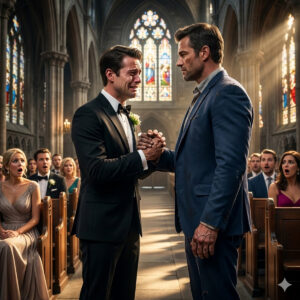
The billionaire CEO walked down the center aisle of his own wedding. The rhythmic clack, clack, clack of his expensive leather shoes against the marble echoed like gunshots in the suffocating silence. He walked past his horrified new mother-in-law. He walked past the whispering, wide-eyed corporate titans. He walked all the way to the third row from the back, stopping exactly at the edge of the pew where Daniel Mercer sat.
Daniel did not stand. He did not flinch. He sat with the terrifying, absolute stillness of a man who had long ago made peace with being invisible to the world. He looked up at the groom, his face a mask of quiet dignity.
“It’s you,” Marcus said. His voice cracked, shattering on the second word. His eyes were wide, welling with sudden, desperate tears. “I never… I never knew your last name. I never knew what your face looked like. For five years, I only ever had a fake name on a secure email server and a distorted voice on a phone.”
Daniel looked at the titan of industry, his expression completely calm. “Hello, Marcus. It’s a beautiful wedding.”
“You saved my company.” The words tore out of Marcus’s throat, ragged and wet. He wasn’t speaking to the room, but the room heard every devastating syllable. “Five years ago, Webb Logistics was exactly three weeks away from total, catastrophic collapse. I had six hundred employees. Six hundred families relying on me to feed their kids. I had mortgaged my house, borrowed everything I had, and it wasn’t enough. We were dead.”
Marcus took a trembling step closer, pointing a shaking finger at the man in the navy suit. “And then someone… you… you stepped in. You bought a silent, majority stake through a ghost LLC. You restructured my toxic debt. You personally negotiated with the ruthless suppliers. You kept us breathing. And then… the exact moment the company was stable and profitable again… you sold the entire stake back to me. At cost.”
A collective gasp echoed through the cathedral. Billionaires and investors in the crowd understood exactly what that meant. To save a dying company, make it massively profitable, and then walk away without taking a single dime of profit was an act of financial insanity. It was an act of pure, unadulterated grace.
“I hired private investigators,” Marcus wept, the tears now spilling freely down his face, ruining his perfect groom aesthetic. “I tried to find you for two solid years. The holding company was a masterclass in obfuscation. It was a labyrinth of shells. The lawyers wouldn’t give me anything. I thought…” Marcus stopped, pressing a trembling fist hard against his mouth, trying to stifle a sob. “I genuinely thought you were some kind of angel. I thought I had hallucinated you to save my own sanity.”
The cathedral was so quiet you could hear the wax dripping from the massive candelabras.
“You were good at what you did, Marcus,” Daniel said simply, his voice a low, steady rumble that commanded the absolute attention of the massive room. “You had a brilliant vision. You just needed time. Time the banks wouldn’t give you. It seemed a terrible shame to let something that good go under.”
“Six hundred families,” Marcus choked out, his shoulders shaking violently. “My team. My whole life. My future. And you just… walked away in the dark. Without taking a penny. Without saying a word.”
“You built the house, Marcus,” Daniel replied, finally standing up. He towered over the groom, broad and imposing, the frayed edges of his navy suit stark against Marcus’s tailored perfection. “I just moved a boulder out of the road so you could keep driving.”
Marcus Webb—founder, CEO, millionaire, and groom—stood in the middle of the aisle at his own high-society wedding and broke down completely. He wept without a single shred of embarrassment. He reached out with both of his manicured, trembling hands and seized Daniel’s calloused, grease-stained right hand. He held it in a death grip, pressing it against his chest over his racing heart.
And the entire room, a room filled with the most arrogant, powerful people in the state, watched in stunned, breathless silence as a man in an Italian tuxedo held the hand of a mechanic in a six-year-old, off-the-rack navy jacket as if it were a sacred, holy relic.
The Fallout: The Shift in Gravity
The atmosphere in the cathedral didn’t just shift; the fundamental gravity of the room reversed. The social hierarchy that had been so rigidly established an hour ago shattered into a million irreparable pieces.
When the ceremony finally concluded—after Marcus had collected himself, wiped his face, and walked back to his weeping bride with a heart lighter than it had been in five years—the reception spilled out onto the manicured lawns under the fading, golden evening sun.
The whispers among the guests were frantic, hushed, and electrified. Who was this man? What kind of wealth must he quietly possess to orchestrate the salvation of a global logistics firm from the shadows? Why was he wearing a cheap suit? Was it an eccentric billionaire’s disguise?
Near the open bar, the bridesmaid in the emerald silk dress—the woman with the sharp opinions who had asked who invited the mechanic—stood completely frozen, staring into her champagne flute. Her face was an agonizing shade of crimson. She found her way through the crowd and stood awkwardly beside Vivian Ashworth, staring across the lawn to where Daniel was now sitting at a secluded table.
“I didn’t know,” the bridesmaid whispered softly, the venom entirely gone from her voice, replaced by a profound, humiliating shame. “About him. About what he did. Who is he?”
Vivian took a slow, deliberate sip of her wine, her eyes fixed on Daniel.
Lily had arrived for the reception, dropped off by the neighbor. The eight-year-old girl was currently sitting on her father’s lap, her dress slightly smudged with chocolate buttercream. She was wildly gesturing, describing something with enormous, chaotic enthusiasm, completely oblivious to the fact that her father had just brought a room full of titans to their knees. Daniel was throwing his head back, laughing with pure, unfiltered joy.
“No,” Vivian said, turning her gaze back to the humbled bridesmaid, her voice carrying the quiet, cutting authority of true power. “You didn’t know. And that is exactly the point. He didn’t do it to be known. He did it because it was the right thing to do. Real power doesn’t need to announce itself when it walks into a room.”
Later that night, the highway was a ribbon of black velvet under a canopy of cold stars. Daniel Mercer drove his rusting 2012 pickup truck home. In the backseat, Lily was fast asleep, her small head resting against the window, her dress smeared with icing, her tiny dress shoes kicked off onto the floorboards.
Daniel drove in total, comforting silence. He didn’t feel the adrenaline of the wealthy men he had left behind at the reception. He didn’t feel the need to gloat about the jaws he had dropped or the arrogant minds he had blown apart. He drove in the profound, unshakeable quiet of a man who carries his worth entirely on the inside. A vault of self-respect where no one can see it, and more importantly, where no one can ever take it away.
When they finally arrived home, he carried his sleeping daughter up the stairs and tucked her gently into bed.
He walked into his own dark bedroom. He unknotted the silk tie and slipped the navy jacket off his tired shoulders. He draped it carefully over a wooden hanger and hung it on the back of the closet door. He traced the frayed stitching on the lapel one last time. He’d need to press it again before he put it away. It was, after all, the only suit he had.
And some events, Daniel thought as he turned off the light, were absolutely worth showing up for, even when the room actively tries to make you feel like you don’t belong. Because belonging, he had long since learned in the fires of grief and survival, was never really about the room you walk into. It is entirely about the soul you bring with you.
Disclaimer : This content may be created by AI for entertainment purposes. Any resemblance to real persons, events, or places is coincidental.






