The morning of October 14th began with the suffocating chill that had defined Cassandra Monroe’s life for five grueling years. She woke up in the cramped, airless attic room—a space that had once held dusty boxes and discarded holiday decorations before Patricia, her stepmother, decided that Richard’s daughter from a previous marriage didn’t deserve the dignity of a proper bedroom.
Weak, gray autumn light filtered through the single, grime-caked window, casting long, sharp shadows across the battered wooden desk. There, resting like a sacred artifact, was the only thing Cassandra owned of any real value: a photograph of her mother. It was taken before the cancer had hollowed her out, back when her smile could still light up a room. Cassandra, now seventeen, traced the edge of the silver frame with a trembling finger, treating the glass like a lifeline.
“I miss you, Mom,” she whispered into the freezing room, her breath pluming in the cold air. It was her daily ritual, a desperate plea to a ghost just to feel tethered to the earth.
She dressed quickly in her worn school uniform, the fabric thinning at the elbows, but her heart beat with an unfamiliar rhythm today: hope. Carefully, reverently, she slipped a crisp, white envelope into her faded backpack. It was an acceptance letter to Boston University. A full academic scholarship. It was her ticket out of this domestic purgatory, the physical proof of four years of relentless studying under the dim glow of a flashlight while the rest of the house slept. She hadn’t breathed a word of it to anyone. To speak of joy in this house was to invite them to destroy it.
Cassandra crept down the wooden stairs, her footsteps practiced and silent. In the kitchen, Patricia stood by the granite counter, pouring coffee. She was forty-five, her hair bleached a harsh, unnatural blonde, her eyes the color of winter ice. She didn’t so much as blink when Cassandra entered the room. To Patricia, Cassandra was less than a servant; she was an irritating smudge on the glass of her perfect new life.
Sitting at the heavy mahogany dining table was Rachel. At twenty-two, Cassandra’s stepsister was objectively beautiful, but her features were sharpened by a perpetual, simmering cruelty. Rachel was scrolling mindlessly through her phone, but as Cassandra passed, she looked up.
A slow, predatory smile spread across Rachel’s glossed lips. It was the smile of a cat watching a mouse wander blindly into a corner.
“Up so early, little sister?” Rachel purred, her voice dripping with artificial sweetness. “Something good happened?”
Cassandra kept her eyes fixed firmly on the fruit bowl. She took a single green apple, slipped it into her bag, and remained utterly silent. Silence was her armor. Over the past five years, she had learned the agonizing lesson that any word she spoke would be weaponized. Rachel had hated Cassandra from the moment they met. She hated that Cassandra was brilliant, hated that she was naturally beautiful, and most of all, she harbored a venomous jealousy because Cassandra was the spitting image of Richard’s first, true love.
Just then, Richard Monroe descended the stairs. He was a man hollowed out by life, his tie improperly knotted, his shoulders slumped beneath the weight of an invisible burden. He kissed Patricia’s cheek, patted Rachel affectionately on the shoulder, and said, “I’m heading to the firm. See you girls tonight.”
He walked right past Cassandra. He didn’t look at her. He didn’t say good morning. It was as if his eyes physically could not focus on her face without tearing open the agonizing grief of losing his first wife. His cowardice manifested as total abandonment.
Cassandra swallowed the hard lump of rejection in her throat, slung her heavy backpack over her shoulder, and walked out the front door into the biting October wind. She didn’t know that she was leaving the Monroe house for the very last time. She didn’t know that Rachel was already standing by the upstairs window, watching her leave with eyes black with malice, ready to spring a trap that had been months in the making.
The moment Cassandra disappeared down the gray, rain-slicked street, Rachel set her coffee mug down with a sharp clack. Her fake smile vanished, replaced by a chilling determination. She exchanged a single, loaded glance with her mother. Patricia offered a subtle nod, turned back to her espresso, and washed her hands of the cruelty to come.
Rachel ascended the stairs with the silent grace of a hunter. She pushed open the door to Cassandra’s miserable attic room and stepped inside. From the depths of her designer handbag, Rachel withdrew her arsenal: a small plastic bag filled with crushed aspirin and baking soda—which looked convincingly like illicit drugs—a cheap burner phone loaded with fabricated, damning text messages, and a thick stack of two thousand dollars in cash, which Rachel had carefully withdrawn from her own trust fund over the past quarter.
With surgical precision, Rachel dismantled Cassandra’s life. She stuffed the bag of white powder deep into the corner of Cassandra’s dresser, hiding it just enough to make it look like a guilty secret. She shoved the cash beneath a pile of frayed sweaters. She slipped the burner phone into the pocket of Cassandra’s only winter coat.
Then, Rachel walked to the desk. She stared down at the photograph of Cassandra’s mother, her lip curling in absolute disgust. With a flick of her wrist, Rachel slapped the frame face-down onto the wood. The era of this ghost was over. Tonight, Rachel would reclaim her father completely.
At four o’clock, the sky broke open. The gentle autumn chill had mutated into a violent, howling October storm. Cassandra pushed open the heavy front door, her hair damp, but her spirit buoyant. All day, her mind had danced with visions of telling her grandmother, Margaret, about the Boston University scholarship.
But the smile instantly died on her lips.
The living room felt like a tribunal. Her father stood dead-center, his face an alarming, apoplectic shade of purple. The veins in his neck pulsed violently against his collar. In his shaking right hand, he clutched the plastic bag of white powder. In his left, the thick wad of cash.
Patricia stood leaning against the kitchen archway, arms crossed, her face a mask of supreme, vindicated disgust. And there was Rachel. Rachel was clinging to her father’s arm, her face buried in his shoulder, sobbing hysterically. Her eyes were red, her shoulders heaving with the force of her entirely fabricated grief.
“What the hell is this?!” Richard roared. His voice was a physical blow, cracking like thunder against the walls. He shook the bag of powder so violently it threatened to burst. “Drugs in your room?! Two thousand dollars in stolen cash?! The money I’ve been missing for months! How stupid do you think I am, Cassandra?!”
Cassandra’s blood ran completely cold. The floor seemed to vanish beneath her feet. “Dad… I don’t… I don’t know what that is,” she stammered, her voice a thin, reedy whisper. “I’ve never seen those things in my life.”
Rachel wailed louder, a theatrical masterpiece of despair. “Dad, I tried!” she sobbed, clutching his jacket. “I knew she had a problem, but I thought I could help her! I didn’t want to break your heart, so I kept it a secret. But I found those things today, and I was so terrified she was going to overdose!”
In the fraction of a second when Richard turned his head to comfort his weeping stepdaughter, Rachel lifted her eyes. She looked straight at Cassandra over their father’s shoulder. The tears were still falling, but Rachel’s lips curled into a vicious, triumphant smirk.
Cassandra saw it all. The trap. The absolute, unadulterated evil of it.
“Dad, she’s lying!” Cassandra screamed, stepping forward, her hands outstretched in desperation. “Rachel put that there! You have to believe me!”
“Believe you?!” Richard spat the words like venom. He shoved her back, his eyes filled with a revulsion so profound it felt like a knife twisting in her gut. “Rachel showed me the phone! The burner phone with messages to dealers! You disgust me.”
“I don’t even own a phone!” Cassandra cried, tears finally spilling hot and fast down her cold cheeks. In a sheer panic, she remembered her salvation. She tore open her backpack, her hands shaking so violently she could barely work the zipper. She pulled out the heavy, cream-colored envelope.
“Look at this, Dad! Please, just look!” she begged, holding it out like a shield. “It’s a full scholarship to Boston University. If I were an addict, how could I achieve this? How could I maintain a 4.0 GPA?!”
Richard snatched the envelope from her trembling fingers. For a agonizing heartbeat, he looked at the official seal. A flicker of hesitation crossed his furious eyes. The truth was there, staring him in the face.
But then Rachel’s voice, sweet and poisonous, sliced through the hesitation. “Grades can be bought, Dad. Especially with stolen money. Don’t let her manipulate you again.”
Richard’s face hardened into a mask of pure granite. He looked at the letter, then looked at his daughter. And then, with a terrifying, deliberate slowness, he gripped the top of the envelope.
Riiiiiiip.
Cassandra gasped, the sound choking in her throat as if the air had been violently sucked from the room.
He tore the letter in half. Then in quarters. Then into eighths. He let the pieces fall from his hands, fluttering to the hardwood floor like dead, heavy snow. With those pieces of paper went her escape, her future, her entire life.
“I don’t have a junkie for a daughter,” Richard whispered, his voice dropping to a register of absolute, freezing hatred. “I don’t need a daughter like you in this house.”
He lunged forward. His large, heavy hands clamped around Cassandra’s fragile upper arms. His grip was brutal, fingers digging into her muscles deeply enough to leave violent, dark bruises. He dragged her toward the foyer. Cassandra thrashed, kicking wildly, screaming for him to stop, pleading for him to listen, but she was a malnourished seventeen-year-old girl fighting a grown man consumed by blinding, cowardly rage.
He yanked the heavy oak door open. Outside, the October storm was raging, the wind shrieking through the skeletal trees.
With one final, violent shove, Richard threw his daughter out into the roaring tempest. She stumbled over the threshold, her knees slamming agonizingly against the wet stone steps. Her backpack came flying out a second later, striking her in the back.
Cassandra scrambled to her feet, turning back to the warm, illuminated doorway. Richard stood there, a towering silhouette of indifference.
“Get out of my life,” he said, his voice entirely devoid of emotion. “If you die on the street tonight, don’t you dare crawl back here.”
SLAM. The sound of the heavy door shutting was final. The deadbolt clicked with the heavy, metallic finality of a gunshot. Cassandra threw herself against the wood, pounding her raw, red fists against it, screaming until her vocal cords shredded, crying until she was choking on her own sobs and the freezing rain. No one answered.
She backed away, stepping into the flooded yard. She looked up at the second-story window. Rachel was standing there, bathed in warm yellow light, watching her drown in the storm. Rachel lifted a hand and offered a slow, mocking wave.
Cassandra stood frozen in the deluge. She was wearing only her thin cotton blouse and a pleated skirt. No coat. No money. No phone. The temperature was plunging toward freezing, and the rain felt like thousands of icy needles driving into her exposed skin.
Survival instinct, primitive and desperate, finally kicked in. She had to walk. Margaret’s house—her grandmother—was nine miles away. Nine miles through a torrential, freezing hurricane. But it was her only beacon of light in a suddenly pitch-black world.
She picked up her soaked backpack and began to walk.
The first two miles were a numb blur. Cassandra repeated her grandmother’s name like a religious mantra, placing one foot in front of the other. But by the fourth mile, the nightmare truly began. Hypothermia did not announce itself gently; it invaded her body like a creeping paralysis. Her canvas shoes were blocks of lead, sloshing with freezing water. She lost feeling in her toes, then her feet, then her calves. Her fingers turned a sickly, translucent blue, locked rigidly around the straps of her bag.
By the sixth mile, the violent, uncontrollable shivering stopped. That was the most terrifying part. Her body had given up trying to warm itself. Her mind began to fracture, unspooling into delirium. The dark, empty road stretched out endlessly. She began to hallucinate, hearing her dead mother’s voice whispering in the howling wind, telling her it was okay to lie down, okay to close her eyes and rest.
“Mom… I’m so cold,” Cassandra whispered through blue, cracked lips. Her legs buckled. She hit the wet, jagged asphalt, scraping her knees raw. She forced herself back up, driven by sheer, animalistic terror.
By the eighth mile, she couldn’t remember her own name. She was just a shadow dragging itself through a tempest.
She didn’t hear the roar of the engine until it was too late.
Blinding, halogen headlights tore through the curtain of rain, illuminating her fragile, soaked frame like a deer caught in a sniper’s scope. The car was moving at sixty miles an hour, hydroplaning on the flooded road. Cassandra turned her head, too utterly exhausted to move, too numb to jump.
The heavy side mirror and the quarter panel of the speeding sedan clipped her shoulder and hip with the force of a swinging sledgehammer.
Cassandra was launched into the air like a discarded ragdoll. She hit the gravel shoulder with a sickening, wet crunch. Two ribs snapped instantly, the jagged bone threatening her lungs. Her left wrist shattered against a jagged rock, tearing the flesh open. Her head bounced against the asphalt, pain erupting behind her eyes in a blinding flash of white before dulling into a deep, agonizing throb.
The car didn’t even tap its brakes. It sped off into the night, leaving her to bleed out in the mud.
Cassandra lay on her back, the icy rain washing the warm, metallic-smelling blood over her face. She couldn’t breathe. Every gasp felt like swallowing broken glass. The pain was an ocean, pulling her under. She looked up at the starless, black sky, feeling the last of her body heat seeping into the frozen earth.
She was going to die here. Alone. Unloved. Forgotten.
As the edges of her vision began to darken, collapsing inward like a dying television screen, she heard the crunch of tires on gravel. A car door opened. Heavy, purposeful footsteps approached.
A shadow loomed over her, blocking out the driving rain. Strong, impossibly warm hands gripped her face. The scent of rain mixed with something intoxicating—expensive leather, cedar, and the faint, sharp tang of gunpowder.
“Don’t sleep,” a voice commanded. It was deep, rich, and vibrated with an absolute authority that demanded obedience even from death itself. “Look at me. Open your eyes.”
Cassandra fought the darkness, forcing her heavy eyelids up. She saw a chiseled jawline, a jagged scar running from a temple to a cheekbone, and eyes the color of a winter storm—steely, gray, and piercing.
“Call a doctor,” the man barked over his shoulder to unseen figures. “Now.”
Then, he slipped his arms beneath her broken body, lifting her off the freezing ground as easily as if she were made of air. The warmth of his chest radiated through his soaked thousand-dollar suit, enveloping her in a cocoon of safety she hadn’t felt since she was a child.
“I’ve got you,” the stranger whispered.
And then, Cassandra finally let go, surrendering to the absolute blackness.
Cassandra awoke to the scent of sterile bandages and the suffocating luxury of silk sheets. She was in a master bedroom that looked like it belonged in an Italian palazzo, her ribs tightly wrapped, her shattered wrist pinned and stitched.
The man who had pulled her from the jaws of death introduced himself as Alexander Castellano. He was thirty-six, the undisputed, terrifying king of Boston’s criminal underworld. He was a man who ordered executions before breakfast, a man whose name was whispered in terrified hushes by politicians and police chiefs alike.
Yet, when he looked at Cassandra, his steel-gray eyes softened. He didn’t see a stranger; he saw the reflection of his own shattered childhood. He told her the truth, raw and unvarnished: twenty-six years ago, he had stood in the rain as a ten-year-old boy, watching his father murder his mother, shivering and entirely abandoned by the world. Looking at Cassandra’s broken body on the roadside had ripped open a scar he thought had turned to stone. He saved her because no one had saved him.
For a week, he guarded her like a dragon hoarding a treasure. When she was well enough, he personally delivered her to her grandmother Margaret’s warm, safe home. Before driving away into the shadows, he handed her a matte-black card with a single silver phone number. “I won’t pull you into my dark world,” he had promised, his voice thick with an emotion he refused to name. “But if you ever need me. I will be there.”
Ten Years Later.
The decade had hardened Cassandra into steel. Margaret had passed away, leaving Cassandra entirely alone once more, but she did not break. She became an ER trauma nurse, working the grueling night shifts, saving lives in the very hospital where she had once healed. She never spent the anonymous envelopes of cash that arrived perfectly on time every month. She never called the number on the black card. But she kept it in her pocket every single day, a silent talisman against the dark.
Until the letter arrived from Maple Grove Nursing Home.
Richard Monroe, her father, was dying. He had suffered a massive stroke. Patricia had drained his bank accounts and fled with a younger man. Rachel had spiraled into bitter poverty, estranged and toxic. Richard was paralyzed, rotting away in a cheap bed, begging for his daughter’s forgiveness before his final breath.
The trauma of the past rose up, threatening to drown her. Her hands trembling, Cassandra pulled out the worn black card. She dialed the number. It rang only once.
“Cass.” Alexander’s deep voice answered, vibrating through the speaker. Ten years of silence, and he breathed her name as if he had been waiting by the phone for a decade.
He accompanied her to the nursing home. He stood like a monolith of dark, protective energy in the sterile hallway while Cassandra walked into the bleak room. She looked at the withered, sobbing husk of the man who had thrown her away, and she felt no rage. Only a profound, liberating pity.
“I forgive you,” Cassandra told her weeping father, her voice steady and clear. “But understand this: I don’t forgive you because you deserve it. I forgive you because I refuse to carry your poison in my veins for another day. You chose a lie over me. I built an entire, beautiful life without you. Your guilt is yours to take to the grave.”
She walked out of that room lighter than air. But the past was not done with her.
Rachel was waiting in the hospital lobby. Time had not been kind to her stepsister; her face was gaunt, her eyes manic and bloodshot with unhinged jealousy. She screamed, lunging at Cassandra, blaming her for their father’s hatred, blaming her for the ruin of her life.
Before Rachel’s claw-like hands could even graze Cassandra’s coat, Alexander stepped out of the shadows. His hand snapped out, clamping around Rachel’s throat with blinding, terrifying speed. He didn’t squeeze, but the threat of lethal violence radiated from him like heat from a furnace.
“Don’t ever look at her again,” Alexander whispered, his voice a freezing current.
Rachel recognized the scar. She recognized the demon of Boston. She scrambled backward, sobbing in pure terror, and fled into the streets.
But Rachel’s hatred was a terminal disease. And it led directly to the Breaking Point.
Three nights later, fueled by a psychotic desire for vengeance, Rachel sold Cassandra’s schedule to Victor Marchetti—a rival mafia boss who had lost two brothers to Alexander’s wrath. Victor didn’t care about Rachel’s family drama; he cared that Alexander Castellano had finally shown a weakness. He had a heart. And Victor wanted to cut it out.
Cassandra was walking to her car after a grueling 12-hour shift. The autumn air was crisp. Suddenly, the shadows detached from the walls. A rough, calloused hand clamped over her mouth, suffocating her scream. A needle pierced the side of her neck. Cold fire rushed through her veins. The world tilted, spun, and went violently black.
She awoke tied to a heavy metal chair in the center of a cavernous, abandoned industrial warehouse. The smell of rust, motor oil, and damp concrete filled her lungs. Her head pounded violently.
Standing before her, grinning like a jackal, was Victor Marchetti. Surrounding him in the gloom were thirty heavily armed men, assault rifles resting against their hips. And standing in the corner, her arms crossed, her face glowing with sick, victorious glee, was Rachel.
“Hello, little sister,” Rachel taunted, stepping into the dim overhead light. “Did you really think you could win? Did you really think you got a happily ever after?”
Cassandra strained against the thick zip-ties biting into her wrists, her heart hammering frantically against her ribs. She wasn’t afraid of dying. She was terrified of what Alexander would do.
“He’s coming,” Victor gloated, checking the magazine of his pistol. “I sent him the photo. He’s walking right into a slaughterhouse. Thirty guns aimed at the door. The great Alexander Castellano dies tonight, and then… well, then my boys are going to have some fun with you, sweetheart.”
CRASH.
The massive corrugated metal doors at the front of the warehouse didn’t just open; they were violently blown inward by an explosive breach. Dust and smoke billowed into the cavernous space.
Through the clearing smoke, a single figure emerged.
Alexander Castellano hadn’t brought his army. He had come alone.
He wore a tailored black suit, discarding any pretense of armor. In his hands were two suppressed customized handguns. His face was a mask of terrifying, absolute calm. He didn’t look like a man walking into a trap. He looked like the Grim Reaper walking into his own domain.
“Castellano!” Victor screamed, taking a step backward, suddenly unnerved by the sheer audacity of the lone man. “Shoot him! SHOOT HIM!”
But Alexander was already moving.
It was a ballet of visceral, terrifying violence. Alexander didn’t just shoot; he flowed through the space with the lethal precision of a predator unchained. Thwip-thwip. The two men closest to Cassandra dropped instantly, perfect crimson holes appearing between their eyes.
The warehouse erupted into deafening chaos. Muzzle flashes strobed like lightning in the dark. Bullets chewed through concrete and metal, sparking violently around him. But Alexander moved faster than they could track, sliding behind steel pillars, firing with impossible accuracy. Every time his guns recoiled, a man hit the floor. He was a force of nature, driven by a rage that had been simmering for twenty-six years, finally unleashed to protect the only light he had ever allowed into his life.
Cassandra watched through tears of sheer awe and terror. She saw blood splatter across Alexander’s white dress shirt as a bullet grazed his shoulder, but he didn’t even flinch. He walked straight through the hail of gunfire, a terminator focused entirely on her.
Victor panicked. He lunged toward Cassandra, pulling a combat knife, intending to slit her throat and use her as a human shield.
Alexander’s eyes locked onto Victor. Time seemed to slow to an agonizing crawl. Alexander dove to his knees, sliding across the dusty concrete, raising his right arm.
BANG.
The bullet shattered Victor’s kneecap. Victor screamed, collapsing to the floor, dropping the knife just inches from Cassandra’s boots.
In less than four minutes, the warehouse was dead silent, save for the groans of the dying and the heavy pinging of spent shell casings rolling across the floor. Twenty-eight men lay dead. The remaining two had dropped their weapons and fled into the night.
Alexander holstered his weapons. He ignored Victor, who was writhing in agony in pools of his own blood. He ignored Rachel, who had backed into a corner, sinking to the floor, paralyzed by a terror so profound she had wet herself.
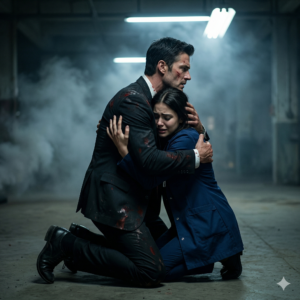
Alexander walked straight to Cassandra. He dropped to his knees before her, pulling a switchblade from his pocket to slice through her zip-ties. The moment her hands were free, she threw her arms around his neck, burying her face in the crook of his shoulder, smelling the gunpowder and blood mixed with his cologne.
“You came,” she sobbed hysterically, her fingers digging desperately into his ruined suit jacket. “I knew you would. I knew it.”
Alexander dropped the knife. His large, trembling hands cupped her face, his thumbs wiping away her tears, smearing a streak of his own blood across her cheek. The icy, terrifying mafia boss was completely gone. In his place was a man looking at his entire universe.
“I told you,” Alexander whispered fiercely, his forehead resting against hers, his breath ragged. “I will always come. Even if I have to burn the whole world down to find you.”
When Lorenzo and the Castellano syndicate finally breached the warehouse ten minutes later, they froze at the scene. They had known their boss was lethal, but they had never witnessed the pure, apocalyptic devastation he was capable of when his heart was threatened.
Victor Marchetti was dragged away by Lorenzo’s men. He wouldn’t be killed immediately; he would be handed over to the darkest corners of Alexander’s empire, left to a fate that would make him beg for a bullet.
As for Rachel, Alexander walked over to where she cowered on the floor. Cassandra watched as he leaned down, towering over the pathetic, ruined woman who had spent a decade trying to destroy her.
“Please,” Rachel whimpered, choking on her own spit. “Please don’t kill me. I’m her sister. Please.”
Alexander looked down at her with eyes emptier than a grave. “Killing you is a mercy you haven’t earned,” he said softly. “You are going to leave Boston tonight. You will have no money, no name, and no family. And every time you close your eyes, every time you hear a footstep behind you in the dark, you will wonder if it is one of my men coming to collect. You will live the rest of your miserable life in pure terror.”
He turned his back on her, a dismissal absolute and final. Rachel dragged herself out of the warehouse, disappearing into the cold night, destined to live as a haunted, hunted ghost.
Alexander walked back to Cassandra, lifted her gently into his arms just as he had done ten years ago on that rainy highway, and carried her out into the crisp, clean autumn air.
One year later.
Cassandra stood by the massive floor-to-ceiling window of the Castellano estate, watching a heavy October rain wash over the manicured gardens. She was no longer a frightened, abandoned teenager fighting for scraps of affection. She was a respected trauma nurse, a woman who had forged her own unbreakable strength from the fires of betrayal.
More importantly, she was home.
She felt the familiar, grounding warmth of Alexander stepping up behind her. His arms wrapped securely around her waist, pulling her back against his chest. He pressed a soft kiss into her hair. The brutal king of the underworld was at absolute peace, tamed by the only woman who had ever looked at him and seen a man instead of a monster.
“Still hate the rain?” Alexander murmured, his voice a deep, comforting rumble against her spine.
Cassandra leaned her head back onto his shoulder, a serene smile touching her lips. “Not anymore,” she whispered, covering his hands with her own. “Because the rain brought you to me.”
Sometimes, a storm isn’t sent to destroy you. Sometimes, it is sent to rip away the lies, to wash clean the toxicity of those who don’t deserve you, and to deliver you directly into the arms of a destiny you never dared to dream of. Betrayal from family is the deepest wound a heart can suffer, but it does not have to be the end of your story. Forgiveness isn’t about letting them back in; it’s about setting yourself free to be loved by someone who will cross through hellfire just to hold your hand.
Disclaimer : This content may be created by AI for entertainment purposes. Any resemblance to real persons, events, or places is coincidental.






