THE ARCHITECT OF SILENCE: THE ZORIC CHRONICLES
ACT 1: THE HUNGER BENEATH THE COBBLESTONES
Marseille doesn’t breathe; it exhales the scent of salt, diesel, and rot. I grew up in the shadow of the Vieux Port, where the water is less an ocean and more a graveyard for secrets that refused to stay buried. My father was a man of small dreams and massive debts, a ghost who haunted our apartment with the smell of cheap tobacco and the crushing weight of his failures. I learned early that in this city, you are either the hammer or the nail.
I watched the debt collectors—men with leather jackets and eyes like cold flint—standing at our door. I learned to read the rhythm of their knocks. Three short, one long. The language of impending violence. I spent my youth pretending. Pretending the fridge was full when it was empty. Pretending I didn’t hear my mother weeping in the bathroom. Pretending that the world wasn’t a shark tank designed to swallow girls like me whole.
The hunger wasn’t just in my stomach; it was in my marrow. It was a cold, sharp ambition to never be the one waiting for the knock. I wanted to be the one who owned the door.
I took the job at Lou Viewport because it was a cathedral of shadows. Dark wood paneling that had absorbed a century of conspiracies. Low lighting that turned men into silhouettes. It was a place where the powerful came to eat, and the invisible came to serve. I became the perfect invisible thing. I learned to pour wine without a sound, to anticipate a glass’s emptiness before the guest even felt the thirst. I moved like smoke through the dining room, a silent witness to the geography of power.
Internal monologue is a dangerous thing in a room full of predators. You start to think you’re one of them because you see their skin under the expensive wool. You see the sweat on a billionaire’s upper lip. I realized that power isn’t about the money; it’s about the information. The things people say when they think the furniture isn’t listening. I wasn’t just a waitress. I was a chronicler of the damned, waiting for the one piece of truth that would change my orbit forever.
I felt the weight of my father’s legacy every time I cashed a paycheck that went straight to his creditors. Fourteen months after he died, he was still taking from me. Every step I took on those Marseille cobblestones felt like walking through wet cement. I needed a way out. Not just a door, but a bridge. I didn’t know yet that the bridge would be built of poison and a four-second decision.
Power is a ghost that only speaks to those who know how to listen.
ACT 2: THE CLEAR STAIN OF TREACHERY
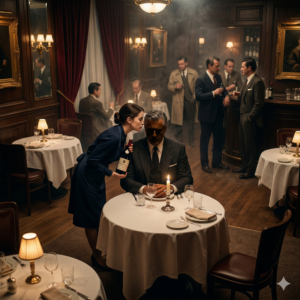
The candle had been burning for exactly 47 minutes. I know because I timed my rounds by the melting wax. It was a Tuesday, but the air in Lou Viewport felt heavy, like the atmosphere before a Mediterranean gale. Ravi Zoric had booked the room. You don’t “serve” Ravi Zoric; you survive him. He was a man who moved with the loose, controlled grace of a panther who had already decided which throat to tear out.
Across from him sat Sandro Valz. Sandro was a man of bright smiles and dark interiors. He laughed too loudly, showing teeth that looked like they belonged on a shark. I watched them from the periphery. Two titans of the shipping trade, carving up the Mediterranean over sea bass and vintage Bordeaux.
Then, the moment. The frame-by-frame fracture of reality.
I leaned in to adjust the tablecloth near Zoric’s right hand. My fingers brushed the underside of the wood. It was sticky. A clear, slightly viscous film. My heart didn’t race; it stopped. I walked to the kitchen, my hand held away from my body as if it were a ticking bomb. In the dim light of the dish station, I saw it. Almost nothing. A faint shimmer.
Memory is a cruel teacher. Two years ago, my brother Tomas had touched a marine solvent at the docks. A colorless gel. Silent. It doesn’t burn; it just seeps. Four days later, his kidneys were shutting down. The doctors called it “silent failure.” If he hadn’t mentioned the solvent, they would have called it natural causes.
I stood there for 90 seconds. The kitchen was a chaos of clattering porcelain and Bernard’s frantic whispering. But inside me, there was a vacuum. I looked at my hand. If I said nothing, Zoric would be dead by Thursday. The port would descend into a bloody vacuum. My father’s debts might vanish in the chaos. I could walk away. I could be free of the shadow.
But I saw Tomas’s yellow skin in that hospital bed. I saw the cowardice of a killer who doesn’t use a blade, but a chemical. I realized that if I stayed silent, I was the one holding the gel. My internal world was a storm of calculation. Who is watching? Sandro’s men. They are positioned at the exits. They aren’t guarding; they’re trapping. I realized Sandro had maneuvered the entire room. He wasn’t a guest; he was an executioner. And I was the only person in the world who knew the trap was already sprung. I felt a coldness spread through my chest that had nothing to do with the wine cellar. This wasn’t just a murder; it was an erasure.
The most lethal poisons are the ones that look like nothing at all.
ACT 3: THE WHISPER OF THE DAMNED
I picked up the bottle of 2012 Chateau Latour. My hands were steady. That was the most terrifying part—how easily I stepped into the role of a savior. I walked back into the dining room. The air was thick with Sandro’s laughter. He was telling a story about a yacht in Valencia, his hand flat on the table, the image of a man who had already won.
I moved to Zoric’s right side. I leaned in, the precise angle of a professional. I could smell his cologne—sandalwood and expensive iron. I tilted the bottle, and in the six inches of air between my lips and his ear, I breathed the words that would end one empire and solidify another.
“Sir. Look under the table. Don’t touch it.”
I didn’t wait for a reaction. I stepped back and walked toward the window, straightening a napkin. My back was a target. I expected the metallic click of a Beretta. I expected the world to explode. Instead, there was a minute of agonizing silence. A minute where the universe held its breath.
From the corner of my eye, I saw Zoric “accidentally” drop his napkin. He leaned down. Four seconds. When he came back up, his face was a mask of ancient stone. He didn’t look at me. He didn’t look at the table. He looked directly into Sandro’s eyes.
“Strange,” Zoric said, his voice a low, melodic rasp. “I was warned not to touch anything tonight.”
The silence that followed was operatic. It was the sound of a man realizing his grave had been dug for the wrong person. Sandro’s smile didn’t fade—it froze. It became a death mask. Zoric’s men, silent as ghosts, moved into position. A man with a white cloth wiped the underside of the table. He held it up like a trophy of treason. “Test it,” Zoric commanded.
The aftermath was a masterpiece of quiet efficiency. No shouting. No gunfights. Sandro was “escorted” out the back door. He looked at me once as he passed. In his eyes, I saw the realization that a waitress—a piece of furniture—had dismantled a multi-million dollar assassination. He was gone into the Marseille night, a ghost before he was even dead.
I stood in the empty dining room as the candles were extinguished. I felt the weight of what I’d done. I hadn’t just saved a man; I had chosen a side in a war I didn’t understand. The vengeance would be quiet, and the silence would be permanent. I went to the kitchen and rinsed my hands again, but the stickiness felt like it was inside my skin now.
Silence is the only currency that never loses its value in the dark.
ACT 4: THE BURDEN OF THE PROTECTORATE
Ten minutes later, I was in Zoric’s office. It wasn’t the office of a movie villain. It was a workspace. It smelled of old paper and the harbor. Zoric stood at the window, watching the lights of the port smear across the black water. He looked tired. Not the tiredness of a long day, but the exhaustion of a man who has spent forty years waiting for a betrayal.
“How did you know?” he asked.
I told him about Tomas. I told him about the 90 seconds in the kitchen. I told him I didn’t do it for him. I did it for Bernard and the staff. Because if he died there, the police and the rivals would tear those poor people apart looking for answers.
He looked at me with a terrifying intensity. It wasn’t predatory; it was appreciative. “You saw what trained men missed,” he said. “You have a gift for the truth, Mirea. I want you to work for me. Not here. Near me. Protected.”
I felt the lure of it. The “Protection.” It’s the most seductive word in the world to someone who has always been vulnerable. I could have had a car, an apartment, a name that made people move out of my way. I could have ended my father’s debts with a single phone call. I could have transitioned from the girl who poured the wine to the woman who decided who drank it.
But I looked at the way he held his glass. With his left hand. Even now, in his own office, he was afraid of his own furniture. I realized that his “protection” was just a different kind of cage. If I joined him, I would become part of the machinery. I would spend the rest of my life looking under tables.
“No,” I said.
The word hung in the air like a gunshot. I watched for the flash of anger, the “Don’t you know who I am?” moment. It never came. He simply nodded. He respected the refusal more than he would have respected the surrender. He saw that I wasn’t looking for power; I was looking for peace.
I left that night with a sense of crushing weight. The burden of knowing I was “remarkable” was heavier than the burden of being invisible. I walked home through the salt air, feeling the eyes of the city on me. I had stepped into the light for four seconds, and the shadow it cast would follow me for the rest of my life. I had saved the King, but I had no desire to live in the palace.
The heaviest crown isn’t the one you wear, but the one you refuse.
ACT 5: THE MODERN GHOSTS OF MARSEILLE
Two weeks later, I found an envelope in my locker. No note. Just enough money to disappear. I didn’t thank anyone. I didn’t tell Bernard. I just caught a train.
I moved to a small town where the only thing that moved quietly was the wind through the olive trees. I worked in a bistro where the customers were farmers and tourists who didn’t know the difference between a shipping magnate and a hole in the ground. I poured wine for people who laughed because they were happy, not because they were winning.
But the world changed. The digital age made “invisible” people a dying breed. Cameras everywhere. Data footprints. I watched from afar as the Zoric empire adapted. I saw his name in the business sections, sanitized, “legitimized.” He was a philanthropist now. A pillar of the new Marseille. But I knew the foundation was still built on that sticky gel.
I spent years wondering if I’d made a mistake. I saw the struggle of the modern world—the fight for relevance, the constant noise. I lived in the boredom I had craved, but boredom is a slow poison of its own. I would sit in my quiet kitchen and feel the ghost of that 2012 Chateau Latour in my hand. I would think about Sandro Valz, who had vanished so completely it was as if he’d never existed.
The conflict wasn’t with Zoric or the port anymore. It was with myself. The girl who could have been a queen was now a woman who aged in the sun, unnoticed. Was the legacy of my “bravery” just this? A quiet life in a loud world? I realized that the bloodline of my decision didn’t end with me. It lived in every glass I poured without poison. It lived in the fact that Bernard was still alive, probably grumbling about napkins in Marseille.
The modern world demands we be “someone.” It demands we post our lives, shout our truths, and claim our status. But there is a power in being the ghost in the machine. There is a gritty realism in knowing you changed the course of history and didn’t need a “Like” to prove it. I was the architect of a silence that saved a city from a war it never knew was coming.
Legacy isn’t what you leave behind; it’s what you prevent from happening.
ACT 6: THE LAST SUNSET AT THE PORT
I am old now. My hands, once so steady, have started to betray me with a slight tremor. I returned to Marseille one last time. Not as Mirea Damon, the waitress, but as a ghost visiting her own grave.
The Lou Viewport is gone, replaced by a glass-fronted fusion restaurant that smells of ginger and desperation. The dark wood is gone. The shadows have been bleached out by LED lights. The men with guns have been replaced by men with algorithms. But the port… the port is the same. The water still looks like it’s hiding something.
I heard that Ravi Zoric died last month. Not from poison. Not from a bullet. Heart failure. Natural causes. The irony wasn’t lost on me. He got the death the gel was supposed to mimic. He died in a bed with silk sheets, surrounded by the empire I helped him keep. I wonder if he ever thought of me in those final moments. If he looked at his right hand and remembered the girl who told him to look down.
I sat at a café overlooking the water and watched the sun dip below the horizon. The “last sunset” of an era. The age of the operatic titans, the Godfather-style machinations, is over. The world is too fast for patience now. Too loud for whispers.
I looked at my reflection in the window. I never got rich. I never became famous. I spent my life in the service of others. But as the sky turned the color of a bruised plum, I felt a profound sense of justice. I had lived a life of my own choosing. My father’s debts were paid with a different kind of currency—integrity.
I am the last one who knows the truth of that Tuesday night. When I die, the story of the clear gel and the waitress will finally vanish. And that is exactly how it should be. The best stories aren’t the ones told in books; they’re the ones that keep the world turning while everyone else is sleeping.
I watched a young waitress in the new restaurant. She was moving fast, head down, refilling a glass before it was empty. I wanted to tell her to keep her eyes open. I wanted to tell her that she was the most powerful person in the room. But I didn’t. She has her own era to resurrect. Her own shadows to navigate.
I stood up, walked toward the train station, and didn’t look back. The salt air felt good in my lungs. Marseille was exhaling again, and for the first time in eighty years, I didn’t feel like I was holding my breath.
The world doesn’t end with a bang or a whimper, but with a secret kept well.
Disclaimer : This content may be created by AI for entertainment purposes. Any resemblance to real persons, events, or places is coincidental.






