THE TOWER SHADOW: THE PSYCHOPATHOLOGY OF CHARLES WHITMAN
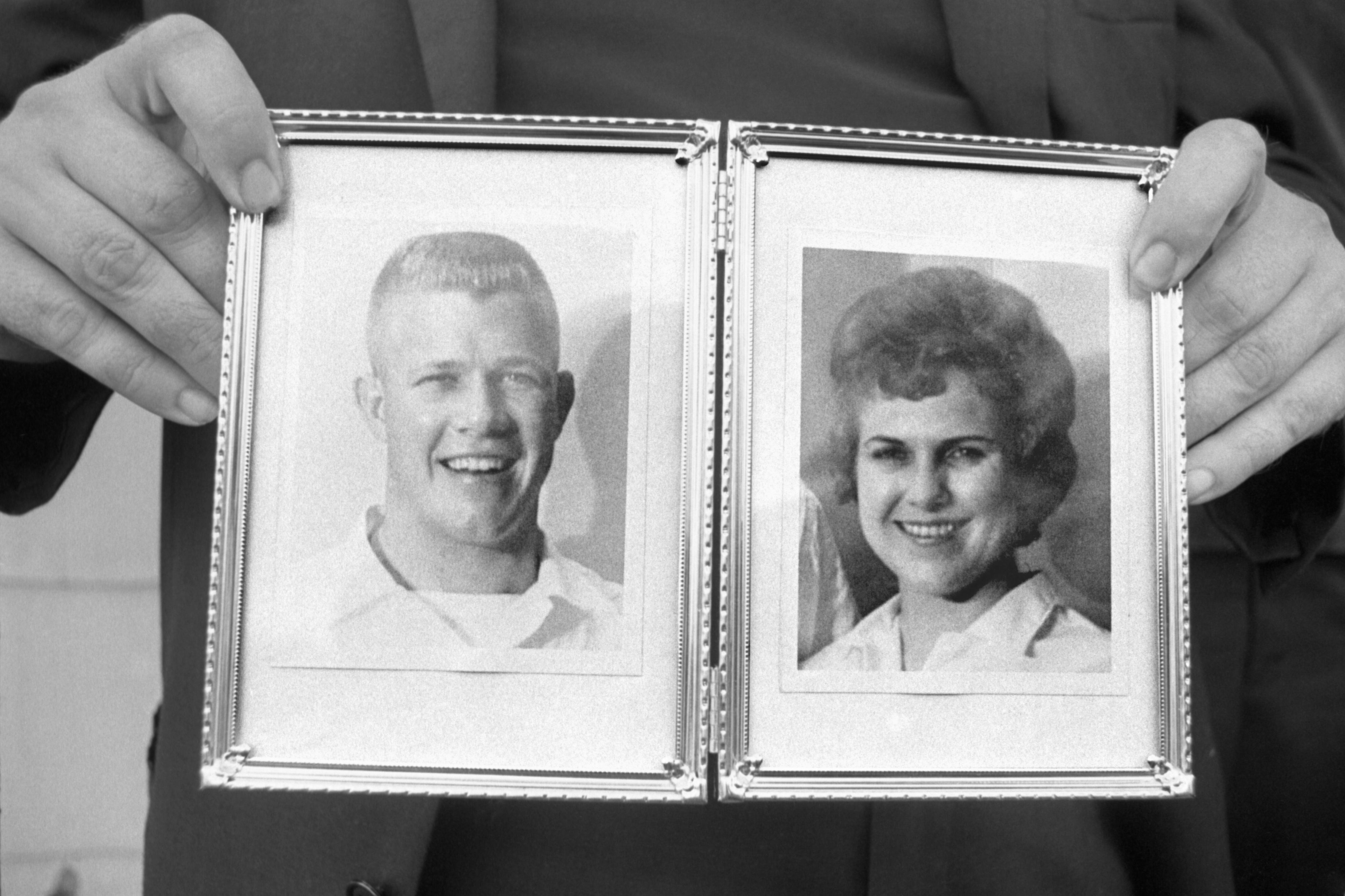
The Texas heat on August 1, 1966, was a physical weight, a shimmering, humid pressure that seemed to distort the very air around the University of Texas at Austin campus. But the real distortion wasn’t atmospheric; it was human. At 11:48 a.m., the first crack of a Remington hunting rifle shattered the mundane chatter of the midday crowd. It was a precise, clinical sound. Claire Wilson, eighteen years old and eight months pregnant, felt a sudden, searing void where life had been. Her unborn child was the first to die, a casualty of a 231-foot drop in morality.
From the observation deck of the UT Tower, the world looked like a chessboard to Charles Joseph Whitman. To the people below, the tower was a landmark; to Whitman, it was a “killing ground.” He didn’t just stumble onto that deck. He arrived with a Marine Corps footlocker packed with the meticulousness of a man planning a long-range reconnaissance mission—or a funeral. Inside were rifles, shotguns, pistols, 700 rounds of ammunition, jugs of water, Dexedrine, and even deodorant. It was the inventory of a premeditated nightmare. For 96 minutes, Whitman operated with a chilling, detached efficiency, picking off strangers from distances of 500 yards. He wasn’t a “madman” in the traditional, rambling sense. He was a highly trained technician of death, a sharpshooter whose every twitch was a calibrated deviation from the human contract.
Charles Whitman was the quintessential American boy, a masterpiece of social manipulation. Born in 1941 in Lake Worth, Florida, he was the eldest son of a family that, from the curb, looked like the blueprint for the suburban dream. His father, Charles Adolphus Whitman Jr., ran a successful plumbing business; his mother, Margaret, was the bookkeeper. But behind the manicured lawn of the Whitman residence lay a domestic fortress ruled by a tyrant. The elder Whitman was an abusive alcoholic who treated his wife, children, and even the family pets with a rhythmic, predictable brutality.
Psychologists often look for “red flags” in early development, yet Charles seemed to counteract every negative influence with an overcompensated excellence. He became a Boy Scout at eleven and, in an almost pathological sprint for validation, became the youngest Eagle Scout in history just three months after his twelfth birthday. This wasn’t just achievement; it was a psychological shield. By excelling, Charles could hide the “human shadow” cast by his father’s violence. He graduated seventh in his high school class, a polite, intelligent young man whom everyone liked but no one truly knew.
The fracture in the facade first appeared when Charles, after a night of teenage intoxication, was beaten by his father and thrown into the family swimming pool. It was a humiliating baptism that pushed him toward the ultimate structure: the United States Marine Corps. In the Marines, he was “outstanding,” a sharpshooter who found comfort in the rigid hierarchy and the mechanical certainty of weaponry. However, the shadow followed him to Guantanamo Bay and later Camp Lejeune. Beneath the uniform, Whitman was unraveling. He was court-martialed for gambling and loan sharking—predatory behaviors disguised as barracks recreation. When he returned to Austin to study architectural engineering, he brought with him a real estate license, a full academic load, and a mounting internal pressure that he described as “oozing with hostility.” He was hiding in plain sight, a “friendly” student who told classmates that “a person could stand off an army from the top of that tower.” They thought it was a joke. It was a blueprint.
The mundane environment of 1960s Austin provided the perfect camouflage for Whitman’s final descent into psychopathy. On the evening of July 31, 1966, he sat at his typewriter, the rhythmic clack-clack-clack of the keys serving as the heartbeat of a premeditated slaughter. He was typing a suicide note, a clinical explanation for the bloodbath to come. He was interrupted by friends, Larry and Elaine Fuess. To them, Charles seemed “particularly relieved,” as if he had finally solved a complex engineering problem. The “problem” was the existence of the people he supposedly loved.
Psychologists often refer to “altruistic homicide,” a twisted logic where a killer murders loved ones to “spare” them from the shame of the killer’s future actions. At 12:30 a.m., Whitman drove to his mother’s apartment. He didn’t use a gun; he used a knife. Stabbing his mother to death was an intimate, visceral act of separation. He covered her body with sheets, a “nursing” gesture common in domestic killers who experience a sudden surge of post-mortem regret. He left a note on a yellow legal pad, citing his “intense hatred beyond description” for his father and his desire to alleviate his mother’s suffering.
At 3:00 a.m., he returned to his own home. His wife, Kathleen, was asleep. She was a biology teacher, a woman who represented the life he was supposed to build. He stabbed her repeatedly through the heart. The silence of the house in those early hours was the silence of a tomb. Whitman then sat back down and finished his notes. He didn’t flee. He didn’t panic. He rented a hand truck. He cashed bad checks. He went to a hardware store and told the cashier he was going to “hunt wild hogs.” The manipulation was total; the mask of the ordinary consumer remained intact even as his boots were figuratively stained with his family’s blood.
At 11:25 a.m., Whitman arrived at the university. He was wearing blue nylon coveralls over his jeans, a costume designed to signal “service worker.” In the hierarchy of social perception, repairmen are invisible. He showed a campus guard a fake research assistant ID to secure a parking spot. He was carrying a Marine Corps footlocker, claiming he was “delivering teaching equipment.” This is the core of psychopathic manipulation: using the victim’s own social protocols against them.
Inside the tower, he encountered Vera Palmer, an employee who noticed the elevator wasn’t working. She flipped the switch for him. Whitman didn’t scowl; he smiled. “Thank you, ma’am. You don’t know how happy that makes me,” he said. It was a genuine expression of joy because the “machine” was finally in motion. He reached the 27th floor and encountered Edna Townsley, the receptionist. Without a word, he split her skull with his rifle butt, dragging her still-breathing body behind a sofa.
The most disturbing micro-expression occurred minutes later. A couple, Donald Walden and Cheryl Botts, walked into the room. They saw Whitman leaning over the couch, his hands likely trembling with the adrenaline of the first strike. They saw dark stains on the carpet. In an era of suburban innocence, they assumed it was varnish. Botts smiled at him. Whitman, the Eagle Scout, the polite student, the man who had just murdered three people, smiled back and said, “Hi, how are you?” as if they were passing on a sidewalk. This “mask of sanity,” as described by Hervey Cleckley, allows the predator to mirror normal social interaction even while standing in a pool of blood. It is a terrifying cognitive dissonance that left the couple walking away unbothered, while Whitman returned to his barricade.
The transition from the “smiling boy” to the “lone sniper” was marked by the first shot fired on the observation deck. When the Gabour family, vacationing from Arkansas, tried to push past his barricade, the ” Eagle Scout” vanished. He fired his shotgun point-blank, killing sixteen-year-old Mark Gabour and his aunt Marguerite. He wounded the mother and the brother. The survivors ran for help, and Whitman, knowing the clock was now ticking, executed the dying Edna Townsley with a single shot to the head. He was now fully committed to his “killing ground.”
At 11:48 a.m., the “poet of the pueblo” began his public performance. The psychology of a mass shooter often involves a desire for “infamy” or a final, explosive assertion of power over a world that the shooter perceives as hostile. Whitman took his position 231 feet above the plaza. He put on a white headband—a warrior’s affectation. His targets were random: Claire Wilson, Roy Dell Schmidt, Billy Speed. He was calm. He was precise. When Austin patrolman Billy Speed took cover behind a columned wall, Whitman observed a tiny, six-inch gap between the stones. He waited for the rhythm of the officer’s breathing or movement, then threaded a chest shot through the aperture.
This shift represents a “predatory state.” In this state, the empathy circuits of the brain are entirely bypassed. The people below were no longer humans; they were “plentiful targets.” Even as the police began to return suppressive fire, Whitman didn’t panic. He utilized the storm drains at the bottom of the deck walls as portholes. He was playing a game of “cat and mouse” with an entire city. The sound of his shots, echoing off the limestone buildings, created a “Suburban Nightmare” that lasted over an hour and a half.
The “Cat and Mouse” game reached its climax when the police realized that suppressive fire from the ground was insufficient. They needed to breach the fortress. A light aircraft, piloted by Marion Lee, circled the tower to distract Whitman, but the sniper was too disciplined to be lured out. The breach required a different kind of courage—the “civilian hero.” Alan Crum, a retired Air Force tail gunner and bookstore manager, met with Department of Public Safety agent William Cowan and Officer Jerry Day. They were joined by Ramiro Martinez, an off-duty officer who had heard the news on the radio and rushed to the scene.
As they ascended to the 26th floor, the atmosphere was suffocating. The heat, the smell of gunpowder, and the weight of the unknown created a high-stakes psychological pressure cooker. On the 26th floor, they met Michael Gabour Sr., who was trying to save his dying son. The raw grief in the room served as a catalyst. Crum looked at Martinez and asked the quintessential American Noir question: “Are we playing for keeps?”
Martinez’s response was sharp and punchy: “You’re damned right we are.”
“Well, you better deputize me,” Crum said.
“Consider yourself deputized.”
This dialogue marks a shift from institutional response to a primal, collective defense. They reached the deck and found the carnage Whitman had left behind. They moved in a tactical “V” formation, flanking the sniper. Crum heard Whitman’s footsteps and fired a shot into the air to distract him. This micro-moment of manipulation gave Martinez the opening he needed. Martinez broke cover and fired all six shots from his service revolver. He missed, but the distraction allowed Officer McCoy to lean over the wall and fire a shotgun blast directly into Whitman’s white headband. Several pellets struck him between the eyes. He fell. Martinez grabbed McCoy’s shotgun and finished the “Eagle Scout” with a point-blank blast to the arm. The silence that followed was the silence of justice, though the ground-level officers continued to fire upward, unaware that the shadow had finally been extinguished.
The investigation that followed was a descent into the “Human Shadow.” By 3:00 p.m., Whitman’s father had called the police, identifying the sniper as his son. The notifications at the homes revealed the bodies of Margaret and Kathleen and the meticulous notes Charles had left behind. But the real forensic truth emerged during the autopsy.
The medical examiner located a pecan-sized tumor in the white matter above Whitman’s amygdala. The amygdala is the brain’s emotional center, responsible for regulating fear, aggression, and impulse control. While the tumor was not connected to sensory nerves, many experts believe it acted as a constant, low-level irritant to his neurological systems. This “forensic truth” provides a bridge between the psychological and the biological. Did the tumor cause the massacre? Or did it simply lower the threshold for the violent impulses that Charles had learned from his abusive father?
Whitman had complained of migraine headaches and “intense hostility.” He had even sought help from a campus psychiatrist, Dr. Maurice Heatley, describing fantasies of shooting people from the tower. But the “PR machine” of the 1960s mental health system wasn’t equipped to handle a Marine with a concealed engineering plan for murder. The tumor serves as a “red flag” that was literally buried in his skull, a biological deviation that mirrored his moral collapse.
Charles Joseph Whitman became the first “mass shooter” in American history, a title that has since lost its singularity. He killed seventeen people and wounded thirty-one. The tragedy lingered for decades; David Hubert Gunby, shot at age twenty-three, died of complications thirty-five years later, and his death was ruled a homicide. Whitman chose his killing ground with the cold eye of a Marine and the architectural mind of a student. He sealed off his rear, leaving no escape for his victims or himself.
The psychological “Why” is a tapestry of genetic predisposition, environmental trauma, and biological defect. He feared he was becoming like his father—a violent, controlling tyrant. By murdering his mother and wife, he attempted to “save” them, while simultaneously punishing his father by destroying the people the elder Whitman claimed to own. It was a grand, theatrical act of self-loathing.
The community of Austin was forever changed. The UT Tower, once a symbol of academic heights, became a monument to a “Suburban Nightmare.” Whitman’s fall from grace was not a sudden plunge but a long, calculated crawl toward the edge. He proved that a man could be an Eagle Scout, a Marine, a husband, and a monster all at once. The “Texas Tower Shooting” was a prelude to a new American era where the shadow in the spotlight would become a recurring, devastating presence. As we reflect on that August day, we are left with the intimate, uncomfortable realization that the perfect facade of the American Dream can crack at any moment, revealing a darkness that no amount of white paint can cover.
Disclaimer : This content may be created by AI for entertainment purposes. Any resemblance to real persons, events, or places is coincidental.






