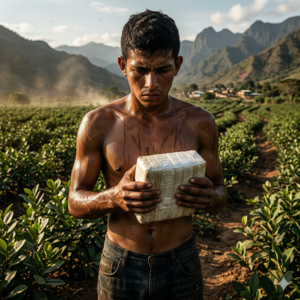
In the humidity of a Colombian morning, a young man named Matteo stands on a hillside overlooking a sea of green leaves. He is twenty years old, and a trail of sweat carves a path down his back under a frayed, faded shirt. In his hands, he grips a tightly-wrapped brick of white powder, heavy enough to alter the fate of an entire neighborhood. To an outsider, he looks like a field hand. To Mateo, this brick is a golden ticket, a passport out of a life that has already consumed his father’s health and bent his mother’s back.
Matteo knows the future because he has rehearsed it a thousand times in his mind. In ten years, he won’t be standing in a field; he will be sitting in a high-rise, looking down at the very city that once tried to starve him. In twenty years, his name will be whispered with both fear and reverence. He doesn’t know the exact roof where his journey will end, or the exact hour when the blood will seep through his silk shirt, but for now, those concerns are secondary to the promise of agency. He is ready to begin.
His life before today was a looped film of generational poverty. Every month, his father, weary from sixteen-hour days, still had to beg for loans. His mother’s hands, calloused and rough as sandpaper, prepared simple food she would then sell at a crowded market. Their neighbor, a boy no different from Matteo, was wearing a thick gold chain, his mother now living in a new house with running water. He didn’t go to university. He never worked in a factory. A simple nod across the street was all the invitation Matteo needed. He understood the subtext. He nodded back.
The first delivery felt like carrying a bomb. His heart hammered in his ears, and every instinct told him to drop the small package and run. But when it was over, he held more cash than his father made in three months. The money under his pillow that night was intoxicating. The feeling that he had value, that he was more than just a background character in someone else’s success story—that was the real addiction.
By the tenth delivery, the fear was gone. Matteo was no longer running packages; he was managing other kids, other desperate versions of his old self. He rose quickly because he treated the business like a complex logistics company, not a series of street deals. He calculated the variables. He saw a fragmented, bleeding organization that needed a real CEO, and that person was him.
Money became an abstract concept. Millions flowed in every week. At one point, 420 million dollars a week. There was so much cash that entire warehouses had to be built, and Matteo simply accepted that rodents would eat tens of millions of dollars in rotting bills every year. It was a tax on success he didn’t mind paying. He bought the luxury cars, the secluded mansions, and his own exotic zoo. More importantly, he bought influence. Plata o Plomo. Silver or lead. This was the only contract that mattered now.
Then, he did something unprecedented. He became a Robin Hood. He built houses, hospitals, and soccer fields for the poor, transforming himself into a folk hero. Mothers prayed for him, children cheered his name, and for a moment, he believed his own legend. He was untouchable. He was a god in his own created universe.
But power is a fragile architecture. The first cracks are internal. One night, the silence of his fortress felt suffocating. He realized that the bodyguard making a quiet phone call could be his closest ally, or he could be talking to the DEA. In a world with only one rule, “Kingpin strategy,” every shadow is a threat. Matteo ordered the man’s execution, not because he had proof, but because he had a feeling.
The feeling didn’t go away. Instead, it multiplied. Every trusted advisor, every loyal soldier, was now a potential traitor. To protect his empire, he began to purge his own ranks, conceptually cutting off his own fingers. While he was self-destructing from the inside, the DEA and the Special Search Block were methodically closing in on all fronts—supply, production, distribution, finance, assets, and communications. They planted their own agents, tracked his every move, from his breakfast choice to the size of his shoes. They were patient, knowing he only had to be wrong once.
He lived in the world of three phones, each used only once and then discarded. He never slept in the same place for two consecutive nights. But in a momentary relapse into human sentiment, a phone call from his son broke his discipline. The boy wanted to know when his father would be home. Every second on the line was a trace. Matteo knew it, but he couldn’t bring himself to hang up.
Special operations teams located the signal. On December 2, 1993, he was trapped. A single call had cost him everything. He died on a rooftop in Medellín, his open eyes a final testament to the ultimate cost of love in a merciless game.
The story, however, has no shortage of players. El Chapo Guzmán, a man who built a kilometre-long tunnel with lighting, tracks, and a motorbike under his prison shower to escape, thought his obsession with control would make him superior. But it was his own ego, his desire to be immortalized on film by meeting with actor Sean Penn, that revealed his location. His reward is a lifetime in ADX Florence, Colorado—twenty-three hours a day in a concrete box with no windows, no sound, no human contact. A living ghost.
Assume for a moment you learned from their mistakes. You became a ghost, like Otoniel of the Clan del Golfo. No phone calls to family, no meetings with actors, a life of absolute emotional and physical austerity in the jungle. Then your own body betrays you. Diabetes, kidney disease, hypertension—all require the medical care the jungle cannot provide. The Colombian military and the DEA, through 500 soldiers, 20 helicopters, and 10 drones, tracked the logistics of his survival, from food to medical supplies. They didn’t find him; they found the biological trail of his dependency. Captured, he faces 45 years in prison, a reminder that your own mortality is the ultimate informant.
And then there was Griselda Blanco, the Black Widow, the only woman to reach the pinnacle of the drug world, who invented the motorcycle drive-by assassination method. The mother of the technique that defined an era of urban violence. After serving her time, she was deported back to Colombia. One afternoon in Medellín, a motorcycle slowed beside her. Two shots, identical to the method she had pioneered, left her lifeless on the street. The violence had returned to the source.
When you look back, the script is a mirror. Escobar, defeated by love. El Chapo, defeated by ego. Otoniel, defeated by his own body. Blanco, defeated by her own creation. None were defeated by a superior opponent; all were undone by a fundamentally human trait that money, weapons, and tunnels cannot protect you from. They all started with the promise of absolute freedom, but each ended up confined in a space smaller than where they began—a rooftop, a concrete box, a sidewalk, or a prison cell.
This story is a warning. You don’t need to be a drug lord to lock yourself in your own cage. The CEO who destroys competent employees, the controlling partner, the person curated on social media—they are all versions of the same psychological trap. They are all desperately gripping something, believing it will keep them safe, when in reality, it is simply holding them captive.
Disclaimer : This content may be created by AI for entertainment purposes. Any resemblance to real persons, events, or places is coincidental.






