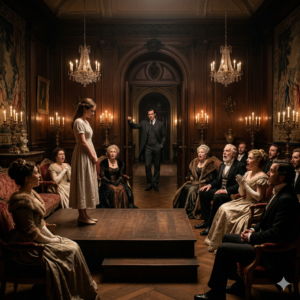
The laughter was the worst part. Not the words. I had survived my family’s words for twenty-three years. Not the hand on my elbow steering me forward like livestock. Not even the sea of faces in Lady Peyton’s drawing room, every eye bright with amusement at the Whitmore family’s latest entertainment. No, it was the laughter. Because laughter meant they were all in on it, and I was the only one standing outside the joke, wearing it like a gown I hadn’t chosen.
And of course, my stepfather, Gerald Cavendish, announced, his voice carrying that oiled theatrical warmth he reserved for audiences, “No Whitmore charity auction would be complete without our final offering.” He paused. Timing. Gerald had always understood timing. “A dance… nay, a full evening’s companionship with the last unmarried Whitmore daughter!”
He gestured toward me, and the room rippled with cruel amusement.
I should explain what I looked like in that moment because it matters. I was not ugly. I was not deformed. I was simply unmemorable. Brown hair without the courtesy of being chestnut or auburn. A face that was pleasant but never stopped anyone mid-sentence. A figure neither willowy nor voluptuous. I was the kind of woman people’s eyes moved past on the way to my sister Cecilia, who was golden and devastating and already married to an earl’s second son. Gerald knew this. That was the joke.
“Shall we start the bidding at… oh, let us be generous. Five pounds!” He grinned at the room. “For charity, naturally.”
Silence followed—the particular silence of people deciding how to laugh. My mother sat in the third row, her fan moving in precise mechanical strokes. She did not look at me. She had not looked at me once since Gerald had explained the evening’s program that morning, when I had stood in the breakfast room and said very quietly, “Please don’t do this.” And she had said, without raising her eyes from her toast, “Don’t be dramatic, Eleanor. It’s for the hospital fund.”
“Come now,” Gerald pressed, and I could hear the first tremor of irritation beneath his joviality. The joke only worked if someone played along. “Surely one of you fine gentlemen—”
“Five hundred pounds.”
The voice came from the back of the room. It was not loud. It did not need to be. It cut through the noise the way a blade cuts through silk, without effort, without resistance, leaving absolute silence in its wake. Every head turned.
I had not seen him come in. Later I would learn he had arrived only minutes before, that he had not been expected, that Lady Peyton had nearly fainted when her butler announced him. Because the Duke of Ashworth had not attended a London social function in over two years, and his presence in her drawing room was roughly equivalent to the King wandering into a village pub.
He stood near the doorway, one shoulder against the frame, as though he had been watching for some time. He was tall, with dark hair cut shorter than fashion dictated. His face was not handsome in the way portraits flattered, but striking in the way storms were striking. All severity and shadow, with eyes so pale they seemed to hold no color at all. He was looking directly at me—not through me, not past me, but at me, as though I were the only solid thing in a room full of smoke.
“I… I beg your pardon, Your Grace?” Gerald’s voice had climbed half an octave.
“Five hundred pounds.” The Duke straightened from the doorframe. He did not smile. “For the lady’s evening. That was the offer, was it not?”
The room had gone so quiet I could hear the candles flickering. Gerald laughed, a sharp, uncertain sound—a dog that has been surprised by something larger in its territory. “Your Grace, this is merely a bit of fun, a charity diversion.”
“Then you should be delighted.” The Duke reached into his coat and produced a leather billfold. He extracted the notes with the unhurried precision of a man settling a bill at his tailor. “Five hundred pounds for the hospital fund, I believe you said.”
Lady Peyton made a sound like a tea kettle reaching boil. Gerald’s face had gone a shade I had never seen before, somewhere between chalk and ash. He had built the joke on a certainty that no one wanted me, that my presence on that makeshift stage was inherently, obviously comic. The Duke of Ashworth had just obliterated that certainty, and he had done it without raising his voice.
“I… Well, this is most generous, Your Grace. Is the offer accepted?”
It was not really a question. It was the tone of a man who had never in his adult life been told no. Gerald took the money, his hand shaking visibly.
“Wonderful,” the Duke said. He looked at me again, that same unwavering, colorless gaze, and inclined his head in the barest sketch of a bow. “Miss Whitmore, I shall call for you at seven tomorrow evening.”
Then he left. He simply walked out of the drawing room and directly out the front door, leaving behind five hundred pounds and a room full of people who had entirely forgotten how to speak. I stood on that little stage alone, my hands clasped so tightly my knuckles ached. And I thought, What just happened? And then, underneath that thought, a smaller, more dangerous one: Why?
I did not sleep that night. I lay in my narrow bed in the room at the back of the house—the room that had been a servant’s quarter before Gerald decided I did not warrant the bedroom I had grown up in—and tried to understand.
James Hartwell, 7th Duke of Ashworth. Thirty-one years old, unmarried, enormously wealthy, and for the past two years, a ghost retreated from society after the death of his younger brother in a riding accident. He was not the kind of man who bid on anything. He was the kind of man who, if he wanted something, simply acquired it. So why me? Pity? Political maneuvering? Or—and this was the thought that made my stomach tighten with something I refused to call hope—had he seen something the rest of the room had missed?
He arrived at seven precisely. The carriage was black and unadorned, the horses matched bays, beautiful and immaculately kept. Everything about the equipage said the same thing the Duke himself had said the night before: I do not need to impress you. I am simply here.
Gerald intercepted me in the hallway. “This is a remarkable opportunity,” he hissed, smiling a dangerous smile. “A man like Ashworth… the connections alone.”
“You auctioned me as a joke,” I said coldly. “And now you would like me to be useful.”
“I would like you to remember who keeps the roof over your head,” Gerald countered, the warmth leaving his voice.
I held his gaze until he flinched, then walked past him and out the front door.
The footman handed me into the carriage. The Duke was already seated inside. “Miss Whitmore,” he said, inclining his head. “You are wondering why.” It was not a question.
“I would be a fool not to.”
“You would. And I do not think you are a fool, Miss Whitmore, despite your family’s energetic efforts to present you as one.” The words landed like a slap—not to my face, but to Gerald’s.
“You saw what they were doing,” I said quietly.
“I did not find it amusing.”
“So, this is pity.”
“No,” he said, so flatly that I believed him instantly. “Pity is passive. I paid five hundred pounds. That is not a passive act.”
We rode in silence for a long time. Then, he spoke again. “Three years ago, I attended a lecture at the Royal Institution on the mathematics of architectural load-bearing. There was a woman in the third row who asked a question about the distribution of lateral force in Gothic vaulting that made the lecturer stop and stare. It was the most intelligent question I had ever heard asked in a public forum, and it came from someone the rest of the audience had been ignoring entirely.”
My heart stopped. I remembered that lecture. I remembered the embarrassed silence afterward, the way the man beside me had shifted uncomfortably as though my curiosity were a social violation.
“You remember that?” I whispered.
He looked at me with those pale, steady eyes, and for the first time, I saw depth behind the severity. “Miss Whitmore, I have an exceptional memory for things that matter.”
He took me to Blackmire House on Grosvenor Square, to a library so vast the candlelight did not reach the ceiling, where the walls were lined with books and a fire burned in a massive hearth. He knew I would prefer privacy to spectacle.
We dined on roasted pheasant and early asparagus. We talked. He asked about architecture, about the mathematics I had taught myself from books borrowed—and sometimes stolen—from Gerald’s study. He asked what I would build if I could build anything.
“A bridge,” I said without thinking. “One that doesn’t need to be beautiful, just sound. Strong enough to hold. No ornamentation, just function and faith.”
He set down his glass. In the firelight, he looked less like a duke and more like a man who had just heard something he had been listening for his entire life. “You are not what they say you are,” he said quietly. “They say nothing because they have decided you are nothing. And they have been so thorough in that decision that even you have begun to believe it.”
The words hit a locked room inside me—the room where I kept the version of myself that still believed she deserved to take up space. My eyes burned. I had not cried since I was sixteen, but I came dangerously close.
“I should like to see you again,” he said.
“Why?”
A ghost of a smile transformed his face so completely I felt the breath leave my body. “To find out what else they were wrong about.”
He called again four days later, and again the following week. On the third visit, he brought a leather folio containing architectural drawings for a footbridge on his estate, commissioned ten years ago by his father and never built.
I studied the drawings. “The design is sound,” I said carefully. “In the way a fortress is sound when what you need is a house. The approach is conservative to the point of waste.” I traced the lines with my finger, forgetting for a moment that I was speaking to a duke. “A segmental arch would distribute the load more efficiently. It is rather like building a sentence with too many words. The meaning is there, but the structure is clumsy.”
I looked up. He was not looking at the drawings. He was looking at me with recognition, with something dangerously close to wonder.
“You see it everywhere, don’t you?” he said, leaning forward. “The wastefulness. The gap between what is built and what is needed. In structures, in conversations, in rooms full of people saying nothing that matters. You have been seeing it your whole life.” His jaw tightened, and for the first time, I saw his control crack. “My brother was the only person who ever understood me. After he died, I decided solitude was safer. I tried to live inside the walls. But then you asked a question about Gothic vaulting, and the walls came down.”
I reached across the space between us and laid my hand over his. I was dismantling my own fortifications, and I was doing it with my eyes open. His fingers closed around mine—just function and faith, the weight of one person holding on to another.
“You should call me Eleanor,” I said softly.
“Eleanor,” he repeated, like the syllables were something precious.
“And I should like,” I added, “to redesign your bridge.”
He smiled then—a real smile, rare and crooked and devastating. And I understood with absolute clarity that I was not falling; I had already fallen three years ago.
The letter arrived on a Tuesday, propped against the teapot with Gerald’s studied casualness. It informed me that Gerald had accepted an offer of marriage on my behalf from Sir Edmund Travalik, a fifty-three-year-old, twice-widowed baronet who had stared at my collarbones throughout a fish course six weeks prior.
I walked into Gerald’s study. “You cannot do this. I am not yours to sell.”
Gerald leaned back, exuding the subtle intimidation of sheer mass. “Your father left you nothing. You are dependent upon my goodwill, and my goodwill has a price. Travalik will pay fifteen hundred a year to the family.” He smiled cruelly. “If you resist, I will make very certain that the Duke of Ashworth hears about your mother’s history. The full history.”
My blood went cold. He knew about my mother’s eleven months in a debtor’s prison before she married him. If that reached the gossip sheets, it would destroy us all, including my sister’s fragile aristocratic marriage. He was not threatening me; he was threatening everyone I loved.
I did something reckless. I went to Grosvenor Square alone. I told James everything.
James turned to the window, his hands clenching at his sides. “Travalik,” he said, his voice flat. “His second wife died of a fall. The coroner’s report was accommodating.” He turned back, his pale eyes now steel. “I cannot simply make the debt disappear by Friday, Eleanor. We need something else that removes Gerald’s power.”
The answer came to me that night—not from desperation, but from mathematics. Gerald’s power rested on the assumption that exposure of the debt would destroy the family. But exposure only worked if the information was new. If I revealed it myself, Gerald lost the trigger entirely.
I told James my plan. I would go to Lady Peyton, the worst gossip in Mayfair, and confess the truth as a private tragedy.
“You would expose your own mother’s shame?” James asked softly.
“I would expose it as tragedy rather than let Gerald wield it as disgrace. I am cornered, and I am good at mathematics.”
He smiled, and my heart turned over. “Go to Lady Peyton. My solicitors will work on the records, and I will pull every financial thread Gerald Cavendish has until his entire fabric comes apart.”
Lady Peyton listened, and to her credit, she reframed my humiliation as dignity. By Saturday, the story had traveled through Mayfair, not as a scandal, but as a tale of a young woman’s quiet endurance and a duke’s unwavering loyalty. Gerald was furious.
But Gerald escalated. At Lady Ashford’s ball, the event of the season, Cecilia found me, pale and trembling. “Gerald has written to Travalik,” she whispered. “He fabricated a letter saying you are compromised, that Ashworth has ruined you. He asked Travalik to confront the Duke publicly tonight.”
I found Travalik first. He stood with a glass of champagne and a folded letter, savoring the moment.
“You were just about to make a spectacle based on a forgery,” I said, my voice low but carrying. “That letter was written by my stepfather, who has debts he cannot pay and a stepdaughter he cannot sell. And you are the fool he found willing to do his work for him. If you unfold that letter, I will announce your second wife’s suspicious death to this entire room.”
The ballroom had gone quiet. Travalik’s face turned gray.
“She is not finished,” a voice said behind me. James stepped forward, his hand finding the small of my back—a light, deliberate touch that said everything. He looked at Travalik with calm, precise attention. “You may leave this ball with your reputation intact, or I will ensure every detail of your financial arrangement to purchase a woman becomes public record.”
James turned to the silent, breathless crowd of three hundred people. “I have been investigating Mr. Cavendish’s finances. I have found forged securities, fraudulent estate valuations, and the systematic theft of his stepdaughter’s inheritance. This information goes to the authorities on Monday.”
Then, he turned to me. The coldness left his face, replaced by faith. “Eleanor,” he said, his voice faltering—the Duke of Ashworth, whose voice never wavered, faltered. “I love you. Not the idea of you. You. The woman who asked a question in a silent room and changed the entire architecture of my life.”
“You impossible man,” I said, my voice wrecked, uncaring of the three hundred witnesses. “It has been a yes since the moment you said five hundred pounds.”
He kissed me in the middle of Lady Ashford’s ballroom, and the sound of the applause that erupted rattled the chandeliers.
Gerald fled to the continent before the investigation concluded, vanishing into anonymous poverty. We married in June at Blackmire Park in a chapel so old the stones remembered a time before titles existed.
A year later, I stood in the library at Blackmire, looking at my plans for the segmental arch footbridge. Through the window, I could see the finished structure, clean and strong, already carrying villagers across the water. Function and faith.
James came up behind me, wrapping his arms around my waist. “It holds,” he said, pressing his lips to my temple. “Rather well.”
I leaned back against him, looking out at the bridge I had built, knowing that the foundation we had constructed together was strong enough to hold us for a lifetime.
Disclaimer : This content may be created by AI for entertainment purposes. Any resemblance to real persons, events, or places is coincidental.






