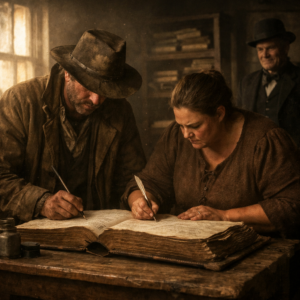
The county recorder’s room at Dry Creek was built for paper, heat, and patience, but that day it held none of the three. Silas Roarke stood by the window, his hat gripped in a hand calloused by a decade of unforgiving ranch work. Outside, the street had the flat, gray color of a three-year drought. Silas didn’t want a wife; he needed one. Without a woman in residence before sundown, a predatory clause in his bank note would trigger, reverting his water rights to the bank. It was a legal noose tightened by Horace Belle, the town’s wealthiest banker, aimed at seizing Silas’s land and the only home his orphaned niece and nephew, Netty and Owen, had left.
The woman the county had provided was Miriam Vale. She was broad-built and quiet, a widow with no family worth naming. Silas looked at her once—plain wool dress, dust at the hem, hands resting on a heavy iron-bound trunk with a quiet firmness—and saw only a burden he had to carry to keep his creek.
“You understand what this is?” Silas asked as the recorder opened the ledger.
“Yes,” Miriam answered. her voice was low and clear, carrying an unexpected weight.
The marriage took less than four minutes. No preacher, no ring. Just two signatures on a piece of paper that prioritized water over love. As Silas lifted Miriam’s trunk into the wagon, he noticed it was unusually heavy. The iron corners were worn smooth, and the hasp was scarred with fresh scratches, as if someone had recently tried to pry it open. Miriam watched him look, but said nothing.
They hadn’t even cleared the shallow draws outside of town before the silence of their ride was shattered. Three riders crested the west lip of the ridge, fast and low. One carried a short shotgun. Silas snapped the reins, but Miriam didn’t scream or freeze. She dropped low, bracing her trunk against the wagon’s kick with an arm through the handle.
“Leave the trunk!” Silas barked as a shot tore a strip of wood from the wagon rail.
“No,” Miriam replied, her jaw set.
Silas drove the team into a narrow stone outcrop, fishtailing the wagon to throw up a wall of dust. When a rider tried to grab the rear rail, Miriam snatched up the iron brake lever and swung it with brutal precision, cracking the man’s forearm. Silas veered into a narrow cattle path he knew from childhood, pushing the horses until the riders were forced to slow or kill their mounts on the shale.
When they finally reached the ranch, both were covered in dust and breathing hard. Silas turned to her, his face bleeding from a wood splinter. “Who were they?”
“I don’t know their names,” Miriam said, meeting his eyes. “But they came for this trunk. It holds something men will hurt people to get.”
Life at the Roarke ranch became a siege of shadows. Silas’s foreman, Luke, and the housekeeper, Mrs. Tully, looked at Miriam with suspicion, seeing her as the lightning rod for the trouble that now circled their fences. But Miriam didn’t act like a guest. She wrestled feed sacks, repaired broken harness straps, and moved through the house with a disciplined stillness that Silas began to realize wasn’t emptiness—it was battle-ready composure.
The second night, Silas caught a shadow near the pump and fired a warning shot. He found Miriam in her doorway, hand on her trunk, awake and unblinking.
“What did you lose before you started sleeping with one hand on iron?” he asked.
“Enough,” she said, and the conversation ended there.
The pressure from the town intensified. Supply orders from the general store came back halved. The church pews grew cold. Even the water gates were found chained shut at dawn, fouling the troughs with muck. Then, Silas’s neighbor, Amos Crowe, rode in with a temper as dry as his pastures, accusing Silas’s cattle of crossing his north line.
Silas and Miriam rode out to the west boundary to settle the dispute. At the first marker stone, Miriam climbed down and brushed away the silt. “This stone has been turned,” she noted. She pointed to a shallow scar in the dirt where the marker had once faced west. The newer county maps showed a line that favored the bank’s holdings, but the ground told a different story.
They rode the line further, finding water where Silas thought there was none. Miriam found a seep below a gravel shelf by reading the green roots of a cottonwood stand. “The wash shifted two seasons ago,” she explained. “Water settles here now.”
That night, Silas cornered her in the back room. “You want to tell me why you know more about survey marks than the county recorder?”
Miriam finally opened the gate. Her true name was Miriam Harrow. Her father, Ephraim Harrow, had been the county surveyor before Sheriff Harlon Briggs ever wore a badge. He had discovered that the valley’s land and water records were being systematically altered on paper to benefit a few powerful men—specifically Banker Belle and Sheriff Briggs. When he refused to certify the lies, he was murdered—officially a “horse fall,” but Miriam knew better. She had spent the last year in hiding, sorting through territorial filings, building a list of twelve families who had been stripped of their land by fraudulent paper.
“The proof is in the trunk,” she said. “But it’s not enough. My father hid the original field books near Red Butte. He knew a thing written twice was harder to kill.”
Silas felt a cold realization. His own ranch, the very land he had married to protect, sat on an altered line. If he helped her find the truth, he might lose the south pasture he had fought so hard to keep.
“You knew this when you came?” Silas asked.
“I let you say vows because the water kept your children alive,” she said without apology. “And because without a lawful roof, I couldn’t stay long enough to reach what he left.”
Silas looked at his niece Netty, who was watching from the hall. He thought of the lie he was living. “I’d rather those children stand on less ground than grow up on a lie,” he muttered. “Pack a blanket roll. We ride for Red Butte at dawn.”
The journey to Red Butte was a crawl through broken shelf rock and stinging wind. They were hunted from the start. Sheriff Briggs hadn’t just been watching; he was boxing them in. On the second day, near a cedar stump Miriam remembered from her father’s notes, they found a tin case hidden in a rock slot. Inside were the original field pages and a second brass marker plate.
A rifle shot splintered the stone by Silas’s shoulder.
“Down!” he roared.
They fled through a narrow wash under heavy fire. Miriam rode the bay mare with the tin case strapped to her chest, leaning low over the animal’s neck as bullets sang off the rocks. Silas veered into a cedar break, branches whipping his face, leading them toward a steep shale slope. It was a desperate gamble. The horses slid down the treacherous grade like it was dry grain, leaving their pursuers stranded at the lip.
Silas didn’t take her home. He knew that would bring the violence to the children. Instead, they rode through the night to the town of Red Butte, where a federal land clerk was scheduled to arrive.
They were tied to the hitching rail at dawn when Horace Belle and Sheriff Briggs stepped from the shadows of the porch. Briggs had two deputies at his back, their hands hovering near their holsters.
“You’ve made this needlessly public, Silas,” Belle said, his voice smooth as silk. “Hand over the field materials. We can settle this as neighbors.”
“I’ve had enough of your ‘neighborly’ reviews,” Silas replied, the bedroll containing the tin case tucked firmly under his arm.
The land office bolt slid back. The clerk opened the door. Miriam stepped forward, her voice ringing out in the morning air. “My name is Miriam Harrow. I am the daughter of Ephraim Harrow, and I am here to file a sworn statement of record.”
Inside the office, the air was thick with the scent of old ink and impending ruin. As the clerk began to unfold the field pages, one of Briggs’s deputies lunged across the counter. Silas didn’t hesitate; he hit the man with his shoulder, sending him crashing into the shelving. He drove an elbow into the second deputy, knocking him off balance, while Miriam caught Briggs’s wrist as he reached for the documents.
“You have held enough of this county,” she told him.
The clerk, emboldened by the federal seal on his desk, slammed the stamp press down on the filed packet. The metal struck with a definitive thud.
“Entered and witnessed,” the clerk announced. “Today’s entry stands.”
Horace Belle went white. Sheriff Briggs stood as still as a statue, the hatred in his eyes broken by the realization that the record had finally outrun him. The silence that followed was broken only by the ordinary sounds of the town outside—a mule braying, a wagon rolling past. The great wrong had been corrected under the same sky people used to buy nails.
The ranch was smaller by spring. The inquiry took months, resulting in Briggs losing his badge and two other families regaining their stolen grazing strips. Silas’s south pasture narrowed exactly as Miriam had predicted. He signed the corrected deed in the same recorder’s room where they had first met, but this time, he did it without resentment.
The house changed, too. Miriam’s trunk moved from the storeroom into Silas’s bedchamber, a silent acknowledgment that distance no longer served them. Netty and Owen stopped watching her like a stranger; her name fell easy in their mouths, a house name, a mother name.
One evening, Silas rode the south boundary with Miriam to see the new marker. The chisel mark faced true.
“I’m sorry for what it cost,” Miriam said as the wind lifted strands of her hair.
Silas looked over the smaller, cleaner holding. “I’m not sorry we paid it,” he replied.
That night, in the quiet of the porch, Silas sat beside her. The windmill turned slowly over the branch water, which now ran through the right line.
“In that recorder’s room,” Silas said after a long silence, “I thought I was marrying a problem.”
Miriam turned her head slightly, a ghost of a smile on her lips. “You were.”
“I think I got the right kind,” he said.
Silas reached out and laid his hand over hers on the wooden step. He had lost land, but he had found a foundation that no longer rested on someone else’s stolen claim. Inside, the children laughed, and for the first time, the sound didn’t feel like a stay against execution. It felt like the start of a life. Silas Roarke had married for survival, but in the shadow of the red butte, he had finally learned what it meant to live.
Disclaimer : This content may be created by AI for entertainment purposes. Any resemblance to real persons, events, or places is coincidental.






