The creek bed was dry, pale clay cracked like old plates, and gray gravel marked where the water used to run. Ren Voss sat against a cottonwood tree, eating the last of a heel of bread—two days old, hard on one side, soft on the other. She ate it slowly because there would not be more. Somewhere east, past a line of brown hills, was a town called Grover’s Creek. A woman at a feed store had told her a ranch out there needed a cook and a laundress. She was not hopeful. Over the past three years, she had stopped spending hope on things that were not yet in front of her. She would go, and she would ask. If they said no, she would find the next place.
It had not always been that way. Her father, Ezekiah Voss, was a Cherokee healer and trader, a broad, quiet man with a calm that most people mistook for slowness until they dealt with him twice. He owned two hundred acres of valley land east of the Grover’s Creek territory—good land, flat on the western half and gently rising on the eastern slope. He had built a house on it with his own hands. He was a healer not by advertisement, but by quiet reputation. People came to him after the doctors had done what they could and left. He used plants, warm water, and his hands, working with a profound patience. When Ren was twelve, her mother died of a rapid fever, leaving just the two of them. Ezekiah did not protect his daughter from the world; he brought her into it. She learned his ledgers by copying entries, and she learned his healing by watching him work.
Ren remembered two patients vividly: a freighter with a crushed lower back and a young boy who had fallen from a barn loft. Both had been told they would never walk again. Both walked out of Ezekiah’s care on their own two feet. Ren had once asked her father what made his methods work. “The spine can be shocked without being broken,” he had told her. “When it is shocked, the nerves go quiet. The body forgets how to send the signal. What we do is remind it. We are not fixing anything. The body already knows how to heal itself. We just keep asking it until it remembers.”
Three winters ago, Ezekiah succumbed to pneumonia. Within weeks of the burial, Ren’s uncle Cyrus arrived with a county clerk. Ren was twenty-eight, unmarried, and of mixed heritage in a frontier county that did not extend legal weight to her circumstances. Cyrus cared nothing for his brother’s generous ways, but he cared very much for the land and the account balance. Ren was forced off her own property in thirty days. For three years, she walked, finding brutal, thankless work wherever she could—washing shirts for logging camps, cooking for road crews. She learned to keep her head down and her identity hidden, because speaking only brought questions, and questions only brought trouble.
She finished her bread, laced up her split boots, and walked the three miles to the Hadley Ranch. The ranch sat at the end of a long dirt road, boasting a large, two-story house with weathered white paint. Fletcher Hadley answered the door. He was a tall, lean man whose face was weathered and tightly closed. He didn’t offer a warm welcome, merely assessed her and asked if she could cook and do laundry. When she said yes, he walked her through the house, showing her the iron stove, the washboards, and a small, spartan alcove that would be her cot.
Before he left her to her work, Fletcher stopped in the hallway. At the far end was a closed door. He pointed to it with absolute authority. “My boy is at the end of that hall. He stays in his chair. He is not well, and he does not need anything from strangers. You do not go to that end of the hallway. Not for any reason. Not even if he calls out. You leave that end of the hall to me.”
Ren agreed. For two weeks, she learned the silent rhythms of the Hadley ranch. She woke before dawn, built the fires, baked cornbread, and washed the heavy canvas work shirts. Fletcher and his foreman, Orson, spoke little. They ate her food without complaint or compliment. But at night, lying on her narrow cot, Ren heard a sound drifting down the hallway from the boy’s room. It was a low, rhythmic sound of distress—the sound of a body whose muscles were tightening and cramping, pulling tendons short in the dark without the ability to shift position. She knew that sound. Her father had described it to her. Yet, she stayed on her cot.
In the middle of her third week, the ranch was empty. Fletcher and the hands were out repairing a distant fence. As Ren carried a stack of clean linens down the corridor, she heard a daytime sound from the boy’s room—the sound of profound, breathless effort. She stopped. The door was cracked open a few inches. Through the gap, she saw a nine-year-old boy sitting in a rolling wooden chair. His knuckles were white as he gripped the armrests, his entire body rigid with the effort of trying to lift his left foot off the footrest. The foot was pale, turned slightly inward, the toes curled. He held his breath, pushing everything he had into the attempt. The foot did not move. Defeated, his head dropped forward.
Ren turned and walked back to the kitchen, her heart hammering against her ribs. She placed both hands flat on the wooden work table. A sleeping nerve lets the foot turn in, her father had said. A dead one lets it fall flat. The boy’s foot was turned in. She walked to the supply shed. Among the standard frontier medicines, she found exactly what she needed: dried yarrow, coarse salt, and a bundle of willow bark.
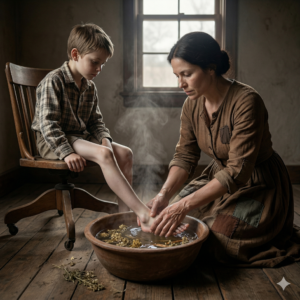
The next day, when the ranch was empty again, Ren prepared a wide clay bowl with warm water, dissolving the salt and crumbling the yarrow and willow bark into the bath. She carried it down the hall and opened the boy’s door. He wheeled around, his dark eyes suspicious and angry. She did not explain. She set the bowl on the floor, pulled his footrest out, and simply said, “Give me your feet.”
He stared at her, trying to figure out the catch, but slowly, he lowered his bare feet into the warm water. Ren began with the left heel, pressing the heel of her palm in a slow, firm circle, moving along the outer edge of the sole, across the ball, and then to the arch. She pressed inward and upward, holding for a count of ten. The room was perfectly silent, save for the soft slosh of the water. Fifteen minutes passed. Then, Gideon’s left foot moved. It was a quick, involuntary curl and release of the toes. The boy let out a sharp gasp, gripping his chair. “I felt it,” Ren said quietly. Gideon stared at his foot, his face stripped of its hardened anger, replaced by the terrifying, fragile possibility of hope.
For weeks, Ren visited the room every second afternoon. Gideon kept the secret, a silent conspirator in his own healing. The twitches grew stronger. One afternoon, while Ren pressed deeply into his arch, Gideon pulled his foot back with a sharp, involuntary cry of pain. Ren froze. Her father had warned her of this—when a silent nerve wakes up, it does not wake gently; it fires, sending shooting pain. It meant the treatment was working.
But the secret could not hold. Orson, ever observant, noticed Ren carrying a bowl down the hall and quietly reported it to Fletcher. That evening, Fletcher stood in the kitchen doorway, his face a mask of restrained fury. He demanded to know if she had been in his son’s room. Ren did not flinch. She told him the truth. She explained the shocked spine, the sleeping nerves, the yarrow and salt, and the undeniable progress Gideon was making. Fletcher listened in stone-cold silence. “You stay in the kitchen today,” he finally said. “I will think on what you’ve told me.”
The next afternoon, a buggy rattled up to the house. Dr. Silas Peyton, an arrogant county physician, stepped out, followed by a local gossip. Peyton had brought a formal complaint against Fletcher, threatening him with legal liability for allowing an “unlicensed vagrant” to practice medicine on his son. Peyton’s diagnosis was that the paralysis was permanent, and any interference was dangerous. Through the thin walls, Ren heard Peyton lower his voice, offering to buy Fletcher’s “eastern pasture” to help ease his burdens. Ren’s breath caught. The eastern parcel. That was her father’s land. The land Cyrus had stolen and sold.
Fletcher did not sign the complaint right away. He retreated to his study, where he opened a heavy walnut cabinet and pulled out his father’s old trading ledger. Paging through the records from twenty-eight years ago, his finger stopped on a name: Ezekiah Voss, Cherokee trader. Fletcher stared at the ink. When he was sixteen, a terrible fall from a horse had paralyzed his left leg. His father had brought a quiet, dark-skinned healer to the house who used warm water and herbs. Two months later, Fletcher walked again. Tucked behind the ledger page was an unmailed letter written by his father, stating that Ezekiah’s eastern parcel was to remain protected under a handshake agreement as long as a Voss drew breath.
Fletcher realized the profound weight of his inheritance. The land he had legally bought from Cyrus was morally stolen from the daughter of the man who had given him back his legs.
Three days later, Dr. Peyton returned, bringing Sheriff Briggs to formally evict Ren and serve the complaint. Fletcher met them on the porch, his demeanor unyielding. “Before you serve anything, come with me,” he instructed.
He led the men down the hallway to Gideon’s room. Ren was already there, standing quietly beside the boy’s chair. The small room felt suffocatingly full as Fletcher stood beside his son. “Gideon,” Fletcher said gently, “show them.”
Gideon gripped the armrests of his chair. His arms trembled as he pushed his weight forward. Slowly, agonizingly, the boy rose from the seat. He got his weight over his feet and let go of the chair. He stood. Dr. Peyton’s jaw went slack, his leather medical bag dipping toward the floor. Sheriff Briggs instinctively took his hat off, holding it against his chest in quiet reverence.
Gideon took a step. His left foot came forward and landed flat. He took another. His right foot dragged slightly, but he corrected it, completing the stride. He walked four steps away from the chair, standing entirely on his own. He then pivoted, fighting for balance, and walked the four steps back, lowering himself safely into the chair.
Dr. Peyton stammered, trying to dismiss the miracle as an involuntary muscular spasm. Fletcher ignored him. He walked to Gideon’s small desk, where he had placed the deed to the eastern parcel the night before. Taking a pen, Fletcher signed the transfer notation on the back. He handed the heavy, official document to Ren. She looked down and saw her name written on the transfer line. Next, Fletcher handed her a sealed letter addressed to Cyrus Voss. “He will know,” Fletcher said. “I thought you should be the one holding it when he finds out.”
Ren held the deed to her father’s land, her hands trembling for the first time. “This was my father’s,” she whispered.
Fletcher picked up Peyton’s formal complaint and held it up. “This woman saved my son’s life using knowledge she inherited from a man who once saved mine. I will not be signing this. Leave my ranch.” Peyton and the Sheriff turned and walked out, the sound of their buggy fading down the dirt road.
Three weeks later, the first light snow fell over the valley, dusting the fence posts and the barn roof. The land transfer was officially under review by the county. On a clear, crisp morning, Gideon walked the length of the porch, his hand resting lightly on Ren’s forearm for balance. When they reached the end, he looked out over the sprawling eastern parcel. “Will you still be here when I can run?” he asked.
Ren looked at the boy, the winter wind catching her hair. “Ask me again in spring,” she replied.
That evening, Orson brought Ren an old, cracked leather saddlebag he had found buried in the supply shed. Carved into the strap was a simple mark—two crossed lines. It was her father’s mark. Inside, wrapped in yellowed cloth, was a bundle of dried yarrow and a piece of thin birch bark covered in the charcoal symbols of his healing sequences. She sat on the steps and held her father’s legacy in her hands, the quiet stillness of the valley wrapping around her.
As darkness fell, Fletcher walked out onto the porch and stood beside her, looking out at the snow-dusted land. “If you wanted to stay through the winter,” he said quietly, “the ranch has need of you. And Gideon would ask for you.”
Ren looked out at the eastern parcel, its borders invisible in the night but its shape known entirely by memory. She thought of the birch bark, the boy’s courageous steps, and the long, bitter years of wandering that had finally come to an end.
“I’ll stay through winter,” Ren said, her voice steady and full of quiet peace, “and see how the land sits come spring.”
Disclaimer : This content may be created by AI for entertainment purposes. Any resemblance to real persons, events, or places is coincidental.






