The Transaction
Martha Dunn stood in the periphery of her father’s parlor, a ghost in her own home. The room had been scrubbed and arranged since dawn, the good china laid out like bait on the side table. Her father, Clarence, paced with a nervous, greedy energy, smoothing his hair and adjusting his collar. He had instructed his two younger daughters, Emma and Caroline, to wear their best dresses and practice their most modest, appealing smiles. He had told Martha nothing at all. She was simply told to stand quietly in the corner and not embarrass the family.
When the three ranchers arrived, the air in the room grew thick with calculation. They were men of means, evaluating Clarence’s daughters like livestock at a county auction. Among them was Samuel Garrett, a widower and the wealthiest man in the room, whose sprawling lands stretched from the river to the foothills. He carried a quiet, undeniable authority.
Clarence poured whiskey, his voice booming with forced joviality as he presented his merchandise. “Gentlemen, I have three daughters. Fine girls, healthy, capable. Choose any daughter among these three, and we can come to terms.” He gestured expansively to seventeen-year-old Emma, praising her beauty and sweet temperament. Emma lowered her eyes exactly as she had been rehearsed. Next, he presented fifteen-year-old Caroline, touting her gentle touch and maternal promise. Caroline blushed on cue.
Clarence did not gesture toward Martha. He did not say her name. He let the silence speak for his eldest, plainest daughter. The other men glanced at her plain, worn dress and quickly looked away.
But Samuel Garrett did not look away. He set his whiskey glass down with a sharp clack against the wood. He crossed the room, his boots making no sound, and stopped directly in front of Martha. His gray eyes were steady, searching, and entirely focused on her.
“I’ll take this one,” Samuel said.
The parlor fell deadly silent. Clarence’s smile slipped off his face like a poorly tied mask. He stammered, his face flushing from pale to crimson, attempting to redirect Samuel to the “suitable” girls. “Mr. Garrett, surely you’d like to reconsider. Emma is the eldest of the suitable…”
“I’ve made my choice,” Samuel said. “I can see for myself. That’s why I’m choosing her.”
It was a silent transaction, a calculated decision devoid of romance. Samuel agreed to take her without a dowry or negotiation. He would return at dawn in seven days. When the door closed behind him, the parlor erupted. Clarence paced furiously, slamming his fists, furious that his scheme to marry off his favored daughters to wealth had backfired. He pointed a trembling finger at Martha. “You’ll go. You’ll keep your mouth shut, and you will not embarrass me.”
Martha packed her meager belongings into a small trunk: two worn dresses, her mother’s Bible, and a comb. As she lay awake listening to her sisters whisper cruel theories about why the blind, pitying rancher had chosen her, Martha knew one thing for certain. She wasn’t being rescued out of kindness. Men like Samuel Garrett operated on purpose. He needed something from her, and though she didn’t know what it was yet, she knew leaving this house of humiliation could not possibly be worse than staying.
The Silent Journey
Samuel arrived exactly seven days later, just as the sun crested the horizon. Martha had waited on the porch, refusing to give her family the satisfaction of a goodbye. Samuel took her trunk, offered a firm hand to help her into the wagon, and drove them out of town.
The journey was marked by a heavy, deliberate silence. Martha sat stiffly, her throat dry, wondering what kind of life awaited her at the end of the dirt road. Hours passed, the plains giving way to rolling hills, until the Garrett ranch finally came into view. It was a sturdy, weathered two-story house built for function, devoid of flowers or curtains.
Two young boys stood on the porch, identical with dark hair and serious, guarded eyes. They were Jacob and Thomas. They did not smile or wave as the wagon approached. They simply watched with the wary gaze of children who had known profound loss.
Samuel led Martha inside. The house was clean but starkly bare. He showed her the kitchen, the pantry, and finally, a small, unadorned room off the kitchen. “This is yours,” he said.
Turning to face her, his voice was entirely matter-of-fact. “I need someone to care for the boys. To keep the house, to cook and clean. They lost their mother three years ago. They don’t trust easily. I’m not looking for a romantic arrangement. I chose you because when I looked at you, I didn’t see someone waiting to be served. I saw someone who works, someone who endures.”
“I’ll do what’s needed,” Martha said quietly.
And she did. She unpacked her two dresses and immediately walked into the kitchen, found flour, lard, and salt pork, and began to prepare supper. When she called the boys in, they ate in absolute silence. It was a house of ghosts, but work was a language Martha understood perfectly.
Earning the Light
The days fell into a relentless, comforting rhythm. Martha woke before dawn, built the fires, baked bread, scrubbed floors, and hauled water. Samuel worked the pastures from sunrise to dusk, speaking only to relay instructions. The boys hovered in the periphery, watching her every move like skittish wild animals trying to decide if the new creature in their territory was a predator or prey.
The heavy silence of the Garrett ranch was vastly different from the silence of her father’s home. There, she had been ignored. Here, she was observed.
The first crack in the ice came through the scent of yeast and warm flour. One morning, Thomas crept into the kitchen, watching her knead dough. “My mama used to make bread,” he whispered.
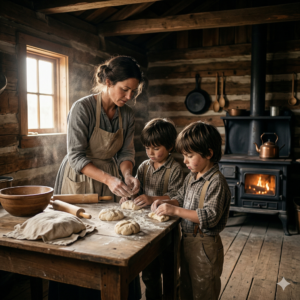
Martha did not offer hollow platitudes. Instead, she tore off a piece of dough and handed it to him. “Would you like to help?” Soon, Jacob joined them. The three of them stood in a quiet line, hands dusted in white flour, shaping loaves. When they ran outside later, they called back a hesitant, “Thank you, ma’am.” It was a fragile beginning.
But the true test of her endurance came three weeks later when Jacob fell violently ill. His skin burned with a raging fever, his breath shallow and frantic. Samuel had to ride out to secure the perimeter and asked Martha to stay with him.
Throughout the long, agonizing night, Martha sat by Jacob’s bed, constantly cycling cool cloths over his forehead. Thomas sat on the floor, terrified. “Is he going to die? Our mama left because she got sick.”
Martha looked at the trembling boy, her own exhaustion pushed aside by a fierce, sudden protectiveness. “I’m not leaving,” she told him firmly. “I’m right here, and I’m staying.”
When Samuel returned at dawn, frantic and expecting the worst, he found Jacob sleeping peacefully, his fever broken. Martha was swaying on her feet from sheer exhaustion. Samuel looked at her—truly looked at her—and saw the dark circles under her eyes and the raw, red skin of her hands.
“Thank you,” Samuel said later that afternoon, his voice thick with uncharacteristic emotion. “For staying. For not giving up.”
“I won’t give up,” Martha replied.
From that day forward, the ranch shifted. The boys began following her around, bringing her smooth river stones and telling her stories of their mother, trusting Martha to hold their memories without erasing them. Samuel lingered at the supper table, his coffee growing cold, asking her opinions on the harvest and the horses. She was no longer just the hired help; she was becoming the compass of the household.
The Judgment of the Town
As Martha’s heart began to anchor itself to the ranch, the outside world intruded. The town of gossips could not abide a disruption to their social order. They whispered about Samuel’s “inappropriate” choice. When a nosy neighbor, Mrs. Holloway, came to the ranch wielding a basket of preserves and a litany of thinly veiled insults about Martha’s plainness, Samuel stepped in. He didn’t raise his voice, but he firmly handed the basket back to the woman and showed her the door, defending Martha with a quiet, undeniable authority.
But the true confrontation came on a Sunday. Samuel insisted they attend church as a family. As they walked down the aisle, the congregation parted like the Red Sea, eyes wide with judgment. The preacher delivered a pointed sermon on duty, order, and wives who overstepped their bounds. Martha kept her eyes fixed on her lap, her face burning.
When they exited, a gaggle of the town’s most prominent women ambushed them on the steps. They questioned the morality of the arrangement, demanding to know why Samuel hadn’t chosen a younger, prettier sister.
Samuel cut through their venom like a scythe. “You want to question my wife’s morals?” his voice cracked like a whip across the churchyard. “You stand here in front of a church, tearing down a woman you don’t know. Martha works harder than anyone I’ve ever known. She cares for my sons. She keeps my home. She has earned her place in my life, and if you have a problem with that, you have a problem with me.”
He guided Martha to the wagon, leaving the women stunned in the dust. On the ride back, he looked at her with fierce sincerity. “What they think doesn’t matter. You’re not alone in this.”
The Magistrate’s Decision
The peace they fought for was shattered weeks later by the arrival of Clarence Dunn. Accompanied by the sheriff and a sharp-suited lawyer, Clarence rode up to the ranch clutching a legal petition. He claimed Samuel had stolen Martha without paying a proper bride price and demanded the arrangement be annulled so he could extract compensation. The law required them to face a magistrate in town the next day.
The meeting hall was packed with townsfolk eager for a spectacle. Clarence’s lawyer spoke grandly of tradition, contracts, and a father’s rights, demanding Martha be returned to Clarence’s custody.
When it was Samuel’s turn to speak, he did not look at the magistrate. He looked at the crowd.
“Clarence Dunn invited me to his home and offered his daughters like livestock,” Samuel’s voice rang clear and hard. “He praised two of them and said nothing about the third. I chose Martha because I saw someone who endured. He agreed to the terms. He is only challenging this now because he thought he could profit, and when he didn’t, he decided the agreement didn’t count.”
Samuel turned his fierce gaze on Clarence. “Clarence never cared for her. He humiliated her and sent her away without a second thought. And now he wants her back not because he loves her, but because she is property to him.”
Samuel turned back to the silent, watching town. “If I send Martha back, who here will take her in? Who will stand up and say they’ll give her a home and treat her with respect?”
The hall was dead silent. No one moved.
“That’s what I thought,” Samuel said. “Because no one here sees her worth. But I do. And I would choose her again.”
Suddenly, young Jacob stood up in the front row, his small voice breaking the silence. “She’s our Ma. She takes care of us.” Thomas stood up right beside him. “She doesn’t leave.”
The stern magistrate looked at the boys, looked at the trembling Clarence, and struck his gavel. “The arrangement was made. Both parties agreed. Mrs. Garrett is Mr. Garrett’s wife. This matter is closed.”
Clarence sputtered in outrage, but Samuel simply took Martha’s hand and led her out of the hall. The shadow of her father’s tyranny was finally, permanently broken.
The Heart of the Home
Winter arrived, blanketing the plains in deep, quiet snow. The ranch was warm, smelling of woodsmoke and rising bread. The boys were outside building a snow fort, their joyous laughter echoing against the barn walls.
Martha stood by the window, watching them. Samuel came up behind her, his presence a comforting, solid anchor.
“They’re happy,” Samuel said softly.
“They are,” Martha agreed.
Samuel looked at her, his gray eyes reflecting the firelight from the hearth. “Are you?”
Martha thought about the ghost of the woman she used to be, standing in the periphery of a parlor where she was unwanted. Then she looked at the life she had forged with her own two calloused hands—a life where she was deeply needed, fiercely protected, and wholly loved.
“Yes,” she said, her voice thick with emotion. “I am.”
That evening, after the supper dishes were cleared and the boys were tucked into their beds, Samuel stopped her in the kitchen. He reached out, his rough hand gently cupping her face.
“You’re not just part of this family, Martha,” he whispered, stepping close enough that she could feel the warmth of his breath. “You’re the heart of it.”
He leaned forward and pressed a gentle, lingering kiss to her forehead. It was a promise, a declaration, and a surrender all at once.
When Martha finally lay in her bed that night, listening to the creak of the floorboards and the steady breathing of the people she loved, she knew she had found the one thing she had never been given. She had been chosen. Not for her appearance, not for a dowry, but for the unbreakable strength of her spirit. And it was more than enough. It was everything.
Disclaimer : This content may be created by AI for entertainment purposes. Any resemblance to real persons, events, or places is coincidental.






