An Officer Searched My Pockets… Then She Leaned Closer and Whispered, “That’s Hard… to Ignore.”
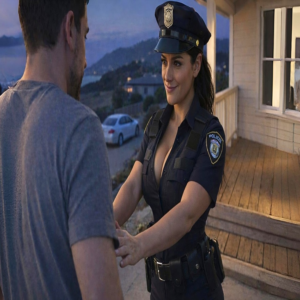
She had her hand in my pocket before she even knew my name. I want to be clear about something. I was not doing anything wrong. I was standing on the porch of a house I had legally rented, holding a mug of black coffee, watching the last of the daylight dissolve over the coastal hills of Carillo Bay. I had been in this town for exactly 4 hours, for hours.
And somehow I already had a patrol car in my driveway and an officer coming up the path like she was expecting trouble. I noticed her shoulders first. That probably sounds strange, but in my line of work, you learn to read bodies before you read faces. She was not walking with the loose, easy stride of someone on a routine call.
She was walking with weight. Every step was deliberate, measured, like someone who had been burned enough times to stop assuming anything was simple. She was bracing, and she had already decided I was going to make her night harder. I did not move off the porch right away. I know how that sounds, but I have spent 15 years talking people down from ledges, out of locked rooms, away from decisions they cannot take back.
I know what panic looks like in a body, and I know what deliberate aggression looks like. This woman was neither. She was exhausted, and exhausted people make mistakes when you rush them. So, I took one slow sip of coffee and waited. Sir. Her voice came out firm, trained, the kind of voice that fills a room without trying. But underneath it, buried just below the surface where most people would never hear it.
There was a tremor, not fear, fatigue. Step away from the door, hands where I can see them. I set the mug down on the porch railing. Nice and slow. The ceramic made a soft sound against the wood. I walked down the three steps with my hands open at my sides. She was closer now, mid-30s, dark hair pinned tight under her cap, the brim throwing a shadow across her eyes.
Her name tag said Reeves. Her eyes were doing the thing trained eyes do. Moving fast, reading fast, cataloging everything about me in under 3 seconds. She checked my waistline. She checked my hands. She checked the door behind me. I told her I was renting the place and that the lease was on the kitchen counter.
We had a call, she said, not backing off her stance. Break-in reported. Suspect description matches you. Dark hair, athletic build, gray shirt. She gestured toward the side of my rental car. Turn around. Hands on the vehicle. She guided me with one hand on my forearm, keeping me in her line of sight the whole time. Professional, controlled.
I placed my palms flat on the warm metal of the car hood and spread my feet without being told. I knew the drill better than most. She started the search. Her hands moved quickly and efficiently down my sides, checked my waistband, moved to my jacket pockets. Left side, nothing. She crossed to the right, and then she stopped.
Her hand went still against my hip. The whole rhythm of the pat down just broke like a song that skips in the middle of a verse. I found something, she said. Her voice had dropped. The bark was gone. What replaced it was something harder to name. Not alarm, more like the particular attention of someone who has just realized the situation is not what they thought it was.
I turned my head slightly and looked over my shoulder. What is it? She met my eyes for just a second. One unguarded second, the professional mask slipped. She had warm brown eyes, and right now, they were doing something between confusion and recognition. She pulled her hand out of my pocket. She was holding my card holder.
Solid titanium, the kind with a spring-loaded edge that makes it heavier than it looks. She turned it over once, then flipped it open. She read the name on the first card out loud. Then, she went quiet. Not the quiet of someone who has nothing to say. The quiet of someone rearranging everything they just assumed. The negotiator, she said slowly.
You’re the one who handled the boardroom situation in Seattle. It was not really a question. I’m on vacation, I said. She stared at the card for another moment, then looked back at the house, then at my gray shirt, then at the coffee mug still sitting on the porch railing. Something in her posture shifted. The threat assessment was over.
What came next was something she clearly had not prepared for because she had not expected to feel embarrassed tonight. My dispatcher described a suspicious male in a gray shirt lurking near the property, she muttered, stepping back and handing the card holder to me. “I was drinking coffee,” I said.
“It was apparently very suspicious coffee.” She said it under her breath, almost to herself. And then a short sharp laugh escaped before she could stop it. She pressed her hand over her mouth immediately like laughter was a violation of some internal code. I slipped the card holder back into my pocket. I did not smile.
I kept my expression neutral because she was already embarrassed and I was not going to make it worse. She cleared her throat. Officer Reeves, I apologize for the inconvenience. Mr. Robertson. She said my name carefully like she was still processing it. We’ve had a string of garage breakins in the area. Neighbors have been calling in anything that looks out of place.
Enzo, I said, and you have good technique, though. You missed the ankle. She looked at me flatly. I didn’t miss it. I just figured if you were the person who wrote the book on deescalation, you probably weren’t going to kick me. That was the moment I stopped reading her as a situation and started reading her as a person because that was not a guess.
She knew the book. She had read it or at least enough of it to know what it was about and who wrote it. And she had filed that information away and used it in real time in the middle of a pat down to make a calculated decision. That is not something most people do. That is not something most cops do.
I looked at her again. really looked. The fraying stitching along the edge of her tactical vest, the shadows under her eyes that had been there long enough to feel permanent, the way she had gone slightly rigid when a second patrol car rolled slowly past the driveway without stopping, without waving, without any acknowledgement at all.
She watched that car until it turned the corner. Then she looked back at me. There was something behind her eyes that I recognized, not from any case file or any debriefing from a mirror. It was the look of someone doing the work they believe in inside a system that has started pushing back. She was not hunting anyone tonight. She was the one being hunted.
She gave me one last professional nod, told me to have a good evening, and turned back down the driveway toward her patrol car. I watched her go. I picked up my coffee mug. It had gone cold. I did not go back inside right away. I stood there in the dark and thought about the way she had laughed before she could stop herself and the way her shoulders had carried something that had nothing to do with me.
4 hours in Carillo Bay, 2 months of silence ahead of me, I had a feeling the silence was already over. 3 days later, I heard her before I saw her. I was in the fourth aisle of a hardware store on the main strip, two blocks from the water, looking for a specific gauge of wire. The rental’s doorbell had been wired wrong.
Someone had used the cheap stuff and it had oxidized through. I could have called the landlord. I should have called the landlord, but my hands had been restless since I arrived. The kind of restless that comes from a brain that does not know how to be quiet, and fixing something small was the only thing that helped. I had the wire in my hand and was comparing two gauges when the voice cut through the store noise.
I’m telling you, Reeves, the report is not there. If you didn’t file it, that is on you. It was a male voice, flat, nasal, and carrying that specific tone people use when they want to embarrass someone publicly while sounding like they are just stating facts. I knew that tone. I had sat across from it in boardrooms and interrogation rooms, and I knew exactly what it was designed to do.
I set the wire down and walked to the end of the aisle. Through the gap between the shelving units, I could see the key cutting station about 20 ft away. Officer Reeves was standing in front of it out of uniform, dark jeans, a plain jacket, her black hair cut straight just past her jaw. She looked like she had come in to pick up something simple, and had been ambushed.
The man standing over her had sergeant stripes on his sleeve. He was broad with a thick neck and the kind of posture that takes up space on purpose. I did not know his name yet. I would learn it was Doyle. Right now, all I knew was what I could see. He had moved into her personal space by about 8 in more than any conversation required, and he was not moving back.
The Peterson report, he said, lowering his voice just enough that only she could hear it clearly. You filed it, you said. It was in the tray, you said. Well, it is not there now and the DA is ready to drop the charges because the file is gone. You know who Peterson’s father is? He sits on the budget committee. This looks messy, Reeves. It looks like you are slipping.
She did not step back. I will give her that. She held her ground with her hands tight at her sides and said, “Clearly, I filed it at 0800. I placed it in the tray myself. Two witnesses saw the folder.” witnesses. He said the word like it was something he had found on the bottom of his shoe.
Rookies who will say whatever you tell them. That is your defense. He tilted his head slightly. Maybe the hours are getting to you. Patrol is a young person’s game. I watched her jaw tighten. I watched her pull a breath in through her nose. She was caught. If she raised her voice, she was out of control. If she stayed silent, she was admitting it.
He had built the trap well. He had done this before. I walked out of the aisle. Nori. I move the way I move when I enter a room that is about to blow. Calmly with direction. I did not look at Doyle. I looked straight at her. Officer Reeves, I said, and my voice came out carrying. The kind of voice that lands in a room without effort. Glad I ran into you.
I’ve been meaning to follow up. Doyle turned around fast, annoyed. Who are you? I ignored him completely, which I knew would bother him more than any answer. I kept my eyes on her. The security footage from my rental property. I pulled the timestamps this morning. It confirms your patrol check at 0800.
I can see you from the porch camera walking toward the precinct entrance. Clear as anything, she stared at me. There was a half second of pure confusion on her face. She had not asked me for any footage and we both knew it. And then something clicked behind her eyes. She caught it. Right. She said steady. The footage. Yes. I turned to Doyle then. Slowly.
The way you turn when you are not in a hurry because you do not need to be. I extended my hand. Enzo Robertson. I’m staying in the area for a few months. I assume you’re her supervisor. I let the word supervisor do its small precise work. Not sergeant, not sir. Supervisor, a bureaucratic word that made him sound like middle management rather than a threat.
If the report is physically missing, but her timestamp exists on my footage and on the precinct’s own entry log, then you do not have a performance issue on your hands. I paused. You have an evidence tampering issue. That is a felony. The store felt quieter. Doyle looked at my hand without shaking it.
He looked at my face. He was trying to place me and not getting there fast enough and that uncertainty was doing its job. Bullies operate on certainty. Take that away and they stall. We do not need civilians walking into department matters, he said. But the volume was different now. The crowd playing edge was gone. Completely understood, I said pleasantly.
I’ll let you both get back to it. I gave Reeves a brief nod like we had just finished a routine conversation and turned back toward the shelving. I did not go far. I moved one aisle over and crouched down to look at a shelf of anchor bolts, listening. 30 seconds later, I heard Doyle’s footsteps move away toward the back of the store.
I waited another minute and then came back around. She was standing where I had left her, a basket at her feet with a handful of items in it. She was staring at the key cutting machine like it had personally offended her. “You lied,” she said without looking up. “I created a version of events that gave him fewer options,” I said. She looked at me then.
“That is the same thing. It really isn’t.” She picked up her basket. Inside, I could see a small package of screws, a tube of something, and a roll of weather stripping. I leaned over and looked at the screw package. Wrong gauge for pine. They would strip out in a season. I swapped them without asking for a shorter stainless set from the rack beside me.
These will hold, I said, and put one drop of thread locker on the bolt before you seat it. Keeps it from backing out under vibration. She looked at the screws in my hand. She looked at me. How do you know what I need them for? The weather stripping is for a door frame. The gauge you had picked is too long and too soft.
The latch is probably pine. I handed her the correct set. The thread locker is on the second shelf behind you. A long pause. She took the screws. You know your way around a hardware store. I know my way around problems, I said. She was quiet for a moment, then lower. He has been doing this for 6 months. Moving things, losing files, making it look like my paperwork is falling apart.
She said it plainly without drama. The way someone states a fact they have already spent too long carrying. He wants the senior slot. I am the only one with enough time in grade to block him. I did not say anything right away. I let her words settle. He is going to keep going, she said, until it works. I looked at her.
She was not asking for sympathy. She was not asking to be rescued. She was stating a problem out loud. maybe for the first time to someone who was not inside the system with her. Not if the game changes before he finishes it, I said. She looked up at me. Something shifted in her expression. Not hope exactly, more like the specific alertness of someone who has just heard something they did not expect.
I never forget a thorough search, I added. She held my gaze for a second longer than she needed to. Then she picked up her basket, gave me one short nod, and walked toward the register. I watched her go. Then I went back to find the wire I had originally come in for. My hands for the first time since I had arrived in Carillo Bay, were not restless anymore.
She texted the address 2 days after the hardware store. No preamble, just a street name, a time, and the word Thursday. I recognized the cross street. It was four blocks from the water, close enough to smell the bay if the wind was right. I arrived 5 minutes early and parked on the street. She was already sitting in the booth when I walked in.
I had never been to this diner before, but I understood immediately why she had picked it. Vinyl seats patched with electrical tape. A laminated menu with coffee rings on the corners. A ceiling fan that spun slightly too slow to do anything useful. Nobody important ever came here. It was neutral, forgettable, exactly what we needed.
She was in a dark henley jeans, and for the first time since I had met her, her black hair was loose. It fell straight and sharp past her jaw, and it made her look like a completely different person. Softer on the outside, but her eyes gave her away the moment she heard the bell above the door. She looked up and checked the room behind me before she looked at my face. old habit.
She was counting exits even off the clock. I slid into the booth across from her and set my notebook on the table. She looked at it then at me. So, she said, “Teach me how to deal with a man who has spent 6 months trying to erase me. I didn’t answer right away. I poured myself a coffee from the carffe on the table and let the silence sit for a second.
Silence makes people fill in the blanks.” And I wanted to see what she filled hers with. She didn’t fidget. She didn’t look away. She just waited. That told me a lot. You’re playing the wrong game, I said finally. She frowned. I’m playing the only game available to me. >> No, you’re playing defense. Every time Doyle accuses you of something, you explain yourself.
Every time he attacks, you put your shield up. You’re reacting to him. He throws, you catch. He leads, you follow. You’ve been doing it for 6 months and it hasn’t worked. So, let’s stop doing it. She wrapped both hands around her mug. So, what do I do instead? You stop trying to win his game. I said, “You build your own.” I opened the notebook and turned it toward her.
I had written three words at the top of the page. She read them quietly, lips barely moving. Then she looked up. “Information is ammunition,” I said. From today, you document everything. Every conversation you have with Doyle, every order he gives you, every time he stands too close or talks over you in a briefing or conveniently loses a file with your name on it, you don’t file any of it. You don’t report it yet.
You just keep it. Every single thing written down, timestamped, saved somewhere he can’t reach. You’re building a fund. Think of it like a safety net you never want to need, but will be very glad you made. She was quiet for a moment. And if something happens before I have enough, then we use what we have.
But Doyle is not a patient man. Patient people don’t steal evidence in broad daylight. He will make another move. And when he does, we will be ready for it. The waitress came. She ordered a burger medium with extra pickles. I ordered a salad. She raised both eyebrows. I need my brain working tonight. I said, “I need mine working, too.
” And I ordered a burger. Fair point. While we waited for the food, I drew a rough diagram on a fresh page. Three levels. Chief Garland at the top. She confirmed he was close to retirement. Checked out. Mostly just trying to make it to his pension without a scandal. Doyle in the middle, ambitious, calculating, with enough allies to make noise, but not enough integrity to keep them loyal under pressure.
And then the junior officers at the bottom. six of them on her shift rotation. Young, uncertain, watching everything. Those six, I said, tapping the bottom of the diagram. That’s where this gets one. She looked at the page. They’re scared of him. Of course they are. He has stripes and a bad temper. But scared people are not loyal people.
They’re just quiet. There’s a difference. I leaned forward slightly. right now when something goes wrong on shift who do they come to she thought about it me sometimes when he’s not around good make it always make it even when he is around when Ruiz can’t figure out a report you help him when the new girl on nights doesn’t know how to handle a difficult call you walk her through it you become the person they trust not because you have authority over them but because you’re the one who actually shows up I paused
Doyle rules by making people afraid of what happens if they don’t follow him. You need to lead by making people feel safer when they do. She stared at the diagram for a long moment. You make it sound simple. It’s not simple at all. I said, “It’s going to take patience, but it works because in the end, he only has power over you if you’re standing alone.” The food came. We ate.
She talked about the neighborhood. She patrolled a stretch of the Bayside blocks where she knew half the families by name. She talked about a woman on Crestline Avenue who left her porch light on every night for a son who hadn’t come home yet. She talked about it the way people talk about things that have gotten under their skin and stayed there. I listened without interrupting.
Then midway through her second story, she stopped talking. I followed her gaze to the front window. Outside standing near the old vending machine by the entrance was a kid, 12, maybe 13, in a jacket too light for the temperature. He wasn’t waiting for anyone. He wasn’t on his phone.
He was just standing there with his hands in his pockets, looking at the lit up diner window. The way people look at things they don’t think they’re allowed to want. She didn’t say anything to me. She didn’t ask my opinion. She slid out of the booth, walked to the counter, and quietly paid for two plates of food. When the bags came out, she carried them herself through the front door.
I watched through the glass as she crouched down so she was at the kid’s level. She didn’t badge him. She didn’t make a speech. She said a few words I couldn’t hear, held the bags out, and waited. He took them. Then he was gone. Moving fast down the sidewalk into the dark like he was afraid someone would ask for them back.
She came back inside, sat down, and tucked the receipt neatly under the edge of her coffee cup. She picked up her burger and took a bite like nothing had happened. “You’re staring,” she said. “You didn’t even think about it.” I said, “There’s nothing to think about.” I watched her for a second. Then I said, “You rub your left temple every time you say his name.
Doyle, you just did it twice in the last 10 minutes. It means he’s living rentree in your head and it shows. If you do that in the hearing room, he wins before you open your mouth. Her hand stopped halfway to her face. She lowered it slowly. She didn’t argue. She didn’t get defensive. She just nodded once like she was filing it away.
That small response told me more about her than anything else had. She was coachable. She was steady. and she was trying very hard not to let me see how close to the edge she actually was. We walked out to the parking lot an hour later. The air off the bay was cold and sharp. She fished her keys from her jacket pocket and paused at the door of her truck.
Same time next week? She asked. Same time? I said. She gave me a look I couldn’t fully read. Then she got in and drove away. I stood in the empty lot for a moment longer than I needed to. The diner light buzzed behind me. The street was quiet. I told myself I was just reviewing the plan, thinking through the strategy, being professional.
I was lying to myself and I knew it. My phone buzzed at 4:47 in the afternoon, and something about the timing felt wrong before I even read it. I was sitting at the kitchen counter of the rental, halfway through a cup of coffee that had gone cold, reviewing a contract document on my laptop. The text was short for lines, but I read it three times because I kept hoping I had misread it.
Doyle found out about the drive, claiming I fabricated everything. Hearing is Friday. They’re saying conduct unbecoming. Fraternizing with a civilian to obstruct an investigation. I closed the laptop. I picked up my keys and walked out to my car. The drive to the station took 8 minutes. I counted the stop lightss and they all turned red.
She was outside when I arrived, sitting on the low concrete bench near the side entrance, not the front steps where people could see her. Her elbows were on her knees, and she was staring at a fixed point on the ground about 2 ft in front of her feet. She was still in uniform. She had not moved inside after her shift ended.
I sat down beside her, not close enough to touch, just close enough so she knew she wasn’t alone on the bench. Neither of us said anything for a while. Car pulled out of the lot. A radio somewhere inside the building crackled and went quiet. The sky was going gray in the way it does before it decides whether to rain or just threaten to.
He called you my boyfriend, she said. Her voice was flat, not angry, just drained. I heard he told the chief I hired a tech expert to fake time stamps. that I recruited a civilian to manufacture evidence because I knew I was going to get caught. She finally looked up. Not at me, but at the station wall in front of us.
He turned you into the proof that I’m corrupt. That’s a very specific kind of move. I said, “He’s not attacking the evidence anymore. He’s attacking the story around the evidence, making the truth look suspicious.” I paused. It means he’s scared. She looked at me then. Scared people escalate, I said. And when they escalate, they make mistakes.
He has the chief’s ear, Enzo. He plays golf with two of the councilmen. I have a hearing in 4 days, and if they pull my badge over this, I don’t. She stopped. She pressed her lips together. She was not going to finish that sentence in front of me, and I respected that. Walk me through Friday morning. I said, “The day you filed the report out loud from the moment you got in your car.
” She looked at me like I had asked her to do something strange. I need to hear it the way you’ll say it in that room. I said, “Start talking.” She took a breath. I came in at 0745. I ran the report during the last hour of my shift. I printed it at 0752, got the witness signatures by 0758, and walked it to the evidence tray at 0803.
Who was at the desk? Ruiz. He was logging intake. Did he see the folder? He made a comment about my handwriting. Said it looked like seismic activity. Good. What did you do after? Went back out. I had a welfare check on Crest Line before end of shift. Badge swipe at the exit. She paused.
Yes, the entry system logs every swipe. Body cam activates when I leave the vehicle. It would show me re-entering the lot. I reached into my jacket and pulled out my phone. I opened a folder and turned the screen toward her. There were four items inside. A confirmation email from the city records portal. A timestamped receipt for a public records request.
a second email from the evidence management vendor confirming camera upload protocol and a fourth document she hadn’t seen yet. She leaned in. Her eyes moved across the screen slowly. I filed the traffic camera request the same week you told me about the missing report at the hardware store. I said. I didn’t say anything because I didn’t want to build your expectations around footage I hadn’t confirmed yet, but it came through and it shows Doyle’s vehicle parked behind the convenience store on 5th at 0847 that morning. 8
minutes after your swipe out. She straightened up. What is he doing on the footage? Disposing of something in the dumpster. The silence that followed was different from the silence at the start of the bench. This one had weight to it. the kind that comes right before a decision gets made.
He’ll say it’s not related, she said. He’ll say a lot of things. I said, “That’s fine. We’re not trying to prove guilt in a Friday hearing. We just need to introduce enough reasonable questions that an external investigation becomes unavoidable. You don’t accuse. You present discrepancies. You make it procedural. Make it boring.
Boring destroys liars because liars need drama to survive. She looked at the phone again. You’ve been building this for weeks since the hardware store. You didn’t tell me. You had enough to carry. I put the phone away. But there’s something else. She waited. The documentation you’ve been keeping since the diner.
I need you to think carefully about whether there’s anything in it that overlaps with his financial behavior. overtime logs, evidence, checkout records, anything that didn’t sit right, but you wrote down anyway. She was quiet for a long moment. The kind of quiet that means the brain is moving fast. There are some inventory numbers, she said slowly.
From seized property, small amounts. I flagged them twice and both times the paperwork came back corrected, but the corrections were in different handwriting than the originals. That is very useful, I said. That’s also terrifying, she said. Because if I bring that to the hearing and I’m wrong, you don’t bring accusations.
I said, you bring discrepancies and you request an external audit. There’s a very big difference between saying someone is stealing and saying the numbers don’t add up and asking someone qualified to check. One is an attack. The other is due diligence. Due diligence is hard to punish. She exhaled slowly through her nose.
Some of the tension in her shoulders shifted. Not gone, but redistributed like she had put it somewhere she could carry it better. He’s counting on you to walk into that room emotional. I said he wants the chief to see a desperate officer grasping at excuses. So, we’re going to make sure what they see instead is someone so prepared, so calm, and so thoroughly documented that attacking her looks like the desperate move.
She turned her head and looked at me directly for the first time since I had sat down. Why are you still here? She asked. It wasn’t rude. It was genuine. You came for 2 months of nothing. You’ve turned this into a full-time project. I didn’t answer right away. I looked out at the gray sky above the station roof.
I found something worth staying for, I said quietly. She didn’t push me to explain it. She didn’t fill the silence with something easy. She just nodded once and looked back at the ground. We sat there for another few minutes. The temperature was dropping. Somewhere across the lot. A door opened and closed. Neither of us moved.
Then she stood up, straightened her belt, and looked down at me. “Friday,” she said. “Friday,” I said back. She went back inside. I stayed on the bench a little longer, turning the whole thing over in my head. the hearing, the footage, the inventory discrepancies, the way she’d said, “Why are you still here?” Like, she genuinely could not figure out the answer.
I had told her I found something worth staying for. I meant every word. I just wasn’t ready to tell her exactly what it was. I drove back to the rental. The lights were on across the bay, small and steady against the dark. I sat in the driveway for a minute before going inside. The engine off, the key still in my hand.
For days to Friday, nobody in that room expected me to walk to the podium. I could feel it the moment I stood up from the back row. Heads turned. A few people whispered. The city attorney shuffled her papers like the order of things had suddenly gone wrong. Doyle’s eyes found mine from across the room. And for just a second, just one, something flickered behind them.
Not fear, not yet, but the first cousin of it. I buttoned my jacket and walked slowly to the front. The civic chambers smelled like old carpet and recycled air. The kind of room where careers got buried under paperwork, and nobody cried about it afterward. Fluorescent lights hummed overhead.
Two rows of folding chairs held a mix of off-duty officers, a union rep, one local journalist with a small recorder, and a handful of people I could only describe as Doyle’s audience. People he had called here to watch. He had wanted a show. I was going to give him one. Chief Garland sat at the head of the long table, fingers laced, mouth flat.
He was a man counting the months until his pension, and this hearing was the last thing he wanted on his calendar. To his right sat Doyle, pressed uniform, silver pen clicking slowly against the table, relaxed, theatrical, the posture of a man who had already decided how this ended. To the chief’s left sat officer Reeves.
She sat with both hands flat on the table, spine straight, eyes forward. She didn’t look at me when I walked up. She didn’t look at Doyle either. She looked at the chief, steady and unblinking like she was the only adult in the room who had decided to stay that way. I adjusted the microphone.
I did not look at the city attorney. I did not look at the chief. I looked directly at Doyle and I kept my voice level the way I had been trained to speak when the room needed to hear every single word. I told the room I was not referencing the camera mounted on my rental porch. Doyle’s pen stopped clicking.
I said I was referencing the traffic camera at the intersection of Harbor and Fifth. The one I had filed a public records request for four weeks ago. The one the city’s own transportation office had processed and returned to me in full timestamped, unedited, and legally obtained. The one that showed Sergeant Doyle standing beside a dumpster behind the convenience store on Fifth Street at 8:47 in the morning with a blue file folder in his hand. The room didn’t react loudly.
It reacted the way rooms do when something real lands. A collective stillness, the kind where people stop shifting in their seats and just go quiet. Doyle stood up. His chair scraped back hard against the tile floor. He said I was lying. He said the footage showed nothing. He said I was a civilian with a grudge and a laptop and no authority to stand at that podium.
His voice was loud and controlled. The practiced loudness of a man who had used volume as a weapon for years. I waited. I let him finish every word. I didn’t interrupt, didn’t flinch, didn’t break eye contact. When he finally stopped, I reached into the folder under my arm and placed a bound stack of documents on the table in front of Chief Garland.
Not dramatically, not with a speech. I just set it down the way you set down something that doesn’t need an introduction. Six months of evidence log discrepancies. Each one cross-referenced against Doyle’s shift schedule. Each one annotated in Officer Reeves own handwriting, neat and precise with dates, case numbers, and amounts, small enough to miss if you weren’t looking, consistent enough to form a pattern that no reasonable person could call coincidence.
The journalist in the back row leaned forward. I walked to her table and sat down beside her, not in the audience, at the table. Her union attorney had filed my authorization that morning and I had the confirmation on my phone if anyone wanted to check. Nobody checked. Under the table, her hand found my knee. She didn’t grab it.
Didn’t squeeze dramatically. She just placed her hand there, steady and firm. The way you hold on to something when you need the ground to stop moving. I didn’t look at her. I kept my eyes on the chief. But I felt it, that small, quiet weight. and it settled something in me that I hadn’t realized was still loose. She stood up.
She didn’t raise her voice. She didn’t perform. She spoke to Chief Garland like the two of them were the only people in the room and everyone else was just catching up. She said she was requesting Doyle’s immediate suspension pending a full external investigation. She said she was requesting the complete expungement of her disciplinary file.
She said she was requesting that the external audit of the evidence logs begin within 5 business days. Then she sat back down. The chief looked at the documents. He turned three pages slowly reading while the room held its breath. He looked up once at Doyle, who was still standing, jaw-tight, silver pen, now gripped hard in one fist.
Then the chief looked at the journalist, who was still scribbling. He said, “Granted, one word, flat and final.” Doyle sat down like something had been cut out from under him. He didn’t explode. He didn’t argue. He just sat there. And for the first time since I had watched him corner her in that hardware store, he looked exactly like what he was, a man whose leverage had just run out.
I exhaled slowly through my nose. Officer Reeves did not look relieved. She looked like someone who had carried something very heavy for a very long time and had just been told she could finally put it down, but wasn’t quite ready to believe it yet. I understood that feeling. We stayed seated while the room slowly broke apart around us.
Chairs scraping, voices picking up, the journalist making her way toward the front. I did not move until she moved. Whatever happened next, she was going to lead it. That was always the plan. She didn’t look at me when we walked out. Not right away. The double doors pushed open into late afternoon light, and the air outside hit differently after an hour in that sealed, recycled room, cooler, sharper, carrying the faint brine smell of the bay two streets over.
Camera flashes went off near the bottom of the steps. Two local news vans had parked at the curb. The journalist from inside was already on her phone, moving fast toward her car. I stopped at the top of the steps and stayed there. She walked down to the press without hesitating. She stood in front of the cameras with her shoulders back and her voice even giving them three sentences.
The suspension, the audit, the expungement, and nothing more. No emotion for them to clip and replay. No drama for someone to frame as something other than what it was. A cop who had been right, who had proven it, and who was still standing. When it was over, she turned away from the cameras and scanned the steps until she found me.
I was still at the top of the steps, hands in my jacket pockets, watching her the way I had watched her from the beginning, not to assess anymore, not to calculate, just because I couldn’t not. She climbed back up the steps toward me, and the closer she got, the more the performance fell away. The careful posture softened.
Her hands, which had been so steady in that chamber, were trembling slightly at her sides. Now, the adrenaline was leaving her body all at once, the way it does when you’ve held yourself together through something that had no right to go as well as it did. She stopped a few feet in front of me. For a moment, she didn’t say anything. Neither did I.
The noise from the press area was fading below us. A few of her colleagues lingered near the building entrance, watching us without pretending not to. Chief Garland passed through the lot at the bottom of the steps, nodded once in my direction. just once and kept walking. She asked if I had done anything questionable to pull that traffic footage.
I told her it was all public record. Every request filed correctly, every form timestamped, every response returned through the proper city channel. I told her I just knew where to look and how long it would take. She looked at me for a long moment like she was deciding whether to believe that was the whole story. Then she reached into her jacket pocket.
She pulled out a single key on a plain ring and held it out between us, level with my chest. She didn’t make a speech about it. She didn’t look away when she said it. She told me I was wasting money on the rental. Her place was two blocks from the water. Small, nothing impressive, a heater that rattled every time the temperature dropped, and a view that was mostly her neighbors wooden fence.
She said the coffee was already bought and stocked, the expensive kind, the one I ordered every Thursday morning at the diner. I looked at the key. I looked at her behind her. I was aware of exactly who was still watching. Two of her fellow officers near the door. The union rep walking to his car. The journalist who had stopped beside her van and was very deliberately looking at her phone. Chief Garland was gone.
But the moment wasn’t private. She knew that she had chosen this spot this moment in plain view of all of it. She wasn’t handing me a key. She was making a statement. I asked her about the coffee, specifically whether she had remembered that I took it black, no sugar, and that I had strong opinions about the grind size. The corner of her mouth pulled up.
She said she had remembered. She had also remembered that I mentioned more than once over Thursday dinners that the rental had thin walls and that the ocean view I had paid for was partially blocked by a badly placed palm tree. She had been listening. She had been paying attention to all of it the whole time, the same way I had been paying attention to her. I reached out and took the key.
Her fingers were still cool from the outside air. When my hand closed over the key, my thumb crossed the back of her knuckles and neither of us pulled away. It wasn’t a long moment. It didn’t need to be. Some things don’t announce themselves. They just arrive quietly. The way a door opens when you finally have the right key.
I told her to lead the way. She let out a breath slow and steady. And for the first time since I had watched her walk up my driveway all those weeks ago, with tension coiled in her shoulders and exhaustion behind her eyes, she smiled without holding anything back. It reached all the way up. It made her look like someone who had just remembered something she thought she’d lost.
She turned and walked down the steps toward her truck, which was parked at the curb below. I walked beside her, not trailing behind, not steering her forward. Beside her, shoulderto-shoulder, at the same pace, her colleagues near the door said nothing. One of them, a younger officer I recognized from the precinct steps, lifted his chin slightly as we passed.
Not a salute, just an acknowledgement. A quiet nod that said he had seen all of it and he understood. We reached her truck. She unlocked it, pulled the door open, and paused. She looked over at me and said that the heater really did make a terrible sound, and that she wanted me to know that upfront before I had any expectations.
I told her I had spent 2 months trying to find silence, and it turned out silence was the last thing I actually needed. She got in. I walked to my car, which was parked two spaces behind hers on the same street. I sat behind the wheel for a moment before I started the engine, turning the key over in my hand.
Brass, simple, unremarkable, the kind of key that could belong to any door on any street. But I knew what door it opened, and I knew what was waiting on the other side of it. Not perfection, not quiet, not the clean distance. I had come to this town chasing something better. I started the car and followed her tail lights out from the curb, through the side streets of Carillo Bay, past the hardware store, past the diner, past all the small, ordinary places where something extraordinary had quietly taken shape without either of us planning it. I used to think I was good
at reading every room I walked into. Turns out, the one room I had never learned to read was the one where someone was worth staying for. I wasn’t on vacation anymore.
Disclaimer : This content may be created by AI for entertainment purposes. Any resemblance to real persons, events, or places is coincidental.






