“Single Dad Finds a Blind Woman Abandoned at a Bus Stop — Her Secret Stuns Him”
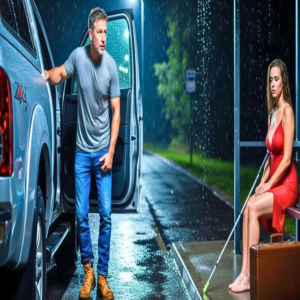
What would you do if you found someone left to die in the freezing rain and saving them meant uncovering a secret dark enough to destroy you both? Tonight, I’m taking you into one of the most chilling stories I’ve ever told about a single father, a blind woman abandoned at a bus stop and the twisted conspiracy that connected them.
The rain came down like nails.
Evan Carter’s hands gripped the steering wheel so hard his knuckles had gone white. His eyes straining through the wash of water that the wipers could barely keep up with. October in Brier Glenn was always brutal. Cold, wet, unforgiving. But tonight felt different. Tonight felt like the kind of storm that swallowed things whole and never gave them back. He was exhausted.
16 hours on a construction site, hauling beams and pouring concrete until his back screamed and his shoulders felt like they’d been filled with lead. His clothes were still damp from the afternoon drizzle, his boots caked in mud. And all he wanted, all he wanted was to get home, kiss his daughter good night, and collapse into bed. Mia would be waiting.
She always was. Eight years old, gaptothed, stubborn as hell, and the only thing in this world that kept Evan’s feet moving forward since her mother had walked out three years ago. No note, no explanation, just gone. It had been the two of them against everything. And Evan had learned to live with that weight. He’d learned to cook macaroni six different ways, to braid hair even when his fingers were too thick and clumsy.
to check homework. He barely understood to be both mother and father in a world that didn’t make space for single dads who worked with their hands. But he was good at it. He had to be. The highway stretched out ahead of him, dark and empty. The yellow lines barely visible through the downpour.
No other cars, no street lights, just the tunnel of his headlights cutting through the rain and the low growl of the engine beneath him. He reached for the radio, twisted the dial, let some classic rock station fill the silence. Bad company, feel like making love. He hummed along, let his mind drift, let the miles pass, and then he saw her.
At first, he thought it was a trick of the light, a shadow, a mailbox, maybe a trash bag blown against the bus stop shelter. But as he got closer, the shape solidified into something unmistakable. A woman sitting on the bench at the old Route 9 bus stop, completely still, her hands folded in her lap, a suitcase beside her, no umbrella, no coat, just sitting there in the freezing rain like she was waiting for a bus that would never come.
Evan’s foot eased off the gas. What the hell? There hadn’t been a bus on this route in over a decade. The stop was a relic, a rusted shell that the county had never bothered to tear down. Nobody came out here. Nobody waited here. He slowed the truck to a crawl, his headlights washing over her fully now. She was young, maybe 30, maybe a little older.
Dark hair plastered to her face, soaked through to the skin. Her clothes clung to her like a second layer of ice, and her eyes, Evan’s breath caught. Her eyes were covered. A strip of dark fabric wrapped around her head, tied at the back, leaving her face exposed, but her vision completely obscured.
She wasn’t moving, wasn’t shivering, wasn’t crying out for help. She just sat there, silent and still, like a statue left in the rain. Every instinct in Evan’s gut screamed at him to keep driving. This was weird. This was wrong. This was the kind of scene that opened every horror movie he’d ever halfwatched on late night cable.
Strange woman in the middle of nowhere, alone, blindfolded, waiting in the storm. Yeah, no thanks. But his foot was already on the brake. He pulled the truck onto the shoulder, gravel crunching under the tires, and sat there for a long moment, engine idling, wipers still beating their steady rhythm. Turn around, go home, call the cops if you want, but don’t get out of the truck.
But he couldn’t because what if she was hurt? What if she needed help? What if she’d been in an accident or attacked? Or what if she dies out here because you drove past? Evan cursed under his breath, killed the engine, and stepped out into the storm. The rain hit him like a wall, cold and brutal, soaking through his flannel shirt in seconds.
He pulled his hood up, hunched his shoulders, and walked toward the bus stop, boots splashing through puddles, his breath misting in the frigid air. “Hey,” he called out, his voice barely carrying over the roar of the rain. “You okay?” No response. He got closer, close enough to see the details now. The suitcase was old, battered, the kind with a hard shell and scuffed corners.
Her hands were pale, trembling slightly, her fingernails tinged blue. The blindfold was black silk, knotted tight, and beneath it, her lips were pressed into a thin, bloodless line. “Ma’am,” Evan tried again, softer this time. “Can you hear me?” She flinched just barely. a twitch of her shoulders, a sharp intake of breath, but it was enough to tell him she was aware.
She was conscious. She was there. “I’m not going to hurt you,” Evan said quickly, holding his hands up, even though she couldn’t see them. “I just Jesus, you’re soaked. How long have you been out here?” For a long moment, she didn’t answer. The rain pounded down around them, drumming on the metal roof of the shelter.
And Evan stood there, dripping and uncertain, wondering if he’d made a terrible mistake. Then she spoke. He said he’d come back. Her voice was quiet, cracked, like something that had been buried and dug up too late. It barely rose above the rain, but Evan heard every word. “Who?” he asked, crouching down so he was at eye level with her, even though her eyes were hidden.
“Who said he’d come back? my husband. She swallowed hard, her throat working. He said he just needed to get gas. He said he’d be right back. Evan glanced around. Empty road. No gas station for 20 m. No car. No headlights in the distance. How long ago was that? She hesitated. I don’t know. I can’t. Her voice broke. I can’t see my watch.
Evan’s stomach dropped. He looked at the blindfold again. really looked at it and realized with a cold, creeping certainty that this wasn’t some kind of game or prank. This wasn’t a woman who’d gotten lost or stranded in bad weather. This was a woman who had been left. “Okay,” he said, keeping his voice steady, calm, even though his heart was hammering.
“Okay, let’s get you out of the rain. All right, my truck’s right there. I can take you somewhere warm, get you dried off, and we’ll figure this out.” She didn’t move. I can’t. she whispered. He said to wait. He said if I moved, he wouldn’t be able to find me. Evan felt something twist in his chest.
Something hot and furious and protective all at once. “Ma’am,” he said quietly, “I don’t think he’s coming back.” She flinched again, harder this time, and Evan saw the first crack in her composure, her hands tightened in her lap, her breath hitching. And for a moment, he thought she might cry. But she didn’t.
She just sat there shaking, her lips pressed together like she was holding back a scream. Evan made a decision. He stood, grabbed the suitcase, heavier than he expected, and slung it into the bed of his truck. Then he came back, crouched down again, and held out his hand. “I’m Evan,” he said, “and I’m not leaving you here.
” She didn’t take his hand right away. She sat there frozen, and Evan could see the war playing out across her face. fear, doubt, desperation. Finally, she whispered, “Audrey.” “Audrey,” Evan repeated, and he smiled, even though she couldn’t see it. “Nice to meet you now. Come on, let’s get you out of the storm.” Slowly, hesitantly, she reached out.
Her hand was ice cold, trembling. And when Evan closed his fingers around it, he felt her whole body relax just a fraction, like she’d been holding herself together by sheer force of will, and his touch had given her permission to let go. He helped her to her feet, steadied her when she swayed, and guided her carefully toward the truck.
She moved like someone who had forgotten how to trust the ground beneath her, each step cautious and deliberate. And Evan stayed close, one hand on her elbow, murmuring reassurances. Just a few more steps. There’s a door right here. I’m going to help you up. Okay. She nodded, mute, and let him lift her into the passenger seat.
He reached across her to buckle the seat belt, and she didn’t protest. Didn’t pull away. Just sat there stiff and silent. Her hands folded in her lap again like she didn’t know what else to do with them. Evan shut the door, jogged around to the driver’s side, and climbed in. The cab was warm, the heater still running, and the sudden shift from freezing rain to dry heat made the air feel thick and strange. He glanced over at Audrey.
Water dripped from her hair pulled in the seat beneath her, ran in thin rivullets down her arms. She was shivering violently now, her teeth chattering, her whole body trembling like a leaf. Evan yanked off his jacket and draped it over her shoulders. Here, it’s it’s not much, but it’ll help. She pulled it tight around herself, and for the first time, Evan saw her face fully, pale, drawn, exhausted, but still holding on to some fragile thread of composure. “Thank you,” she whispered.
Evan started the engine, cranked the heat up as high as it would go, and pulled back onto the highway. “Don’t mention it,” he said. “Let’s just get you warm.” But they drove in silence for the first 10 minutes. Evan kept his eyes on the road, his mind racing. He didn’t know what the hell he just walked into, but every instinct he had was screaming that this was bad. This was really bad.
A woman, blindfolded, left at a bus stop in the middle of nowhere in freezing rain with nothing but a suitcase and a story about a husband who’d promised to come back. He said if I moved, he wouldn’t be able to find me. Evan’s hands tightened on the wheel. “Audrey,” he said carefully, not wanting to spook her.
“Do you want me to take you to the hospital or the police?” She shook her head quickly, sharply, like the suggestion terrified her. “No, no police.” “Okay,” Evan said, keeping his voice even. “Okay, but you need to get checked out. You’re freezing and you’ve been out there for how long exactly.” Audrey’s hands twisted in her lap. “I don’t know, hours, maybe.” “I couldn’t.
” Her voice cracked. “I couldn’t tell because of the blindfold.” She nodded. Evan hesitated, then asked the question that had been burning in his mind since the moment he’d seen her. Why are you wearing it? Audrey went very still. For a long moment, she didn’t answer. The only sound was the hum of the engine, the drumming of rain on the roof, the steady rhythm of the wipers.
Then quietly, she said, “I’m blind.” Evan’s breath caught. Uh, I I lost my sight 6 months ago, Audrey continued, her voice flat and distant, like she was reciting facts she’d memorized. Retinal detachment, both eyes. They tried surgery, but she shrugged, a tiny, helpless gesture. It didn’t work. I can’t see anything.
Not light, not shadows, nothing. Evan felt something cold settle in his chest. So, the blindfold. He made me wear it, Audrey said. He said it would be easier, that people would know I couldn’t see and they wouldn’t bother me. Bother you? Evan echoed, his voice harder than he intended. Audrey? Who the hell is he? She flinched and Evan immediately regretted his tone.
Sorry, he muttered. I just This doesn’t make sense. Why would your husband leave you out there like that? Audrey’s hands clenched in her lap. And when she spoke again, her voice was barely above a whisper. I don’t know. But Evan could hear the lie in her words. She did know, or at least she suspected. He didn’t push. Not yet.
Instead, he said, “Where do you live? I can take you home.” Audrey shook her head. I don’t I don’t want to go home. Then where? She didn’t answer. Evan sighed, rubbed a hand over his face, and made another decision. All right. And he said, “Here’s what we’re going to do. I’m taking you to my place. You can get warm, get dry, maybe eat something, and then we’ll figure out the rest.
Sound good?” Audrey hesitated, then nodded slowly. “Thank you,” she whispered again. Evan didn’t respond. He just kept driving. The house was dark when they pulled into the driveway. Evan killed the engine and sat there for a moment, staring at the small one-story ranch house he’d lived in for the past 5 years.
It wasn’t much, peeling paint, sagging porch, a lawn that needed mowing, but it was home. And right now, it was the only safe place he could think of. We’re here, he said. I’m going to come around and help you out. Okay. Audrey nodded. Evan grabbed the suitcase from the truck bed, then opened Audrey’s door and guided her down. She moved carefully, her hand gripping his arm, and Evan led her up the porch steps and through the front door.
The warmth hit them immediately, dry, safe, familiar. Daddy. Evan looked up and saw Mia standing in the hallway, rubbing her eyes, her blonde hair sticking up in every direction. She was wearing her favorite pajamas, the ones with the cartoon unicorns, and clutching her stuffed rabbit. “Hey, sweetheart,” Evan said gently.
“What are you doing up?” I heard the truck, Mia said. Then her eyes landed on Audrey. Who’s that? This is Audrey, Evan said. She’s going to stay with us tonight. She got stuck in the rain. Mia’s eyes went wide. Is she okay? She’s cold, Evan said. But she’s going to be fine. Can you go grab a towel for me? Mia nodded and darted down the hallway.
Evan turned back to Audrey, who was standing very still, her head tilted slightly like she was listening. “That was my daughter, Mia,” Evan said. “She’s eight. Nosy as hell, but she means well.” Audrey’s lips twitched. Not quite a smile, but close. Mia returned with a towel and handed it to her father. Evan draped it over Audrey’s shoulders, then guided her to the couch. “Sit,” he said.
“I’ll get you some dry clothes.” Audrey sank onto the couch and Mia climbed up beside her, staring openly. “Why is she wearing that thing on her eyes?” Mia asked. “Mia,” Evan warned. “It’s okay,” Audrey said quietly. She reached up, untied the blindfold, and pulled it away. Her eyes were open, but they didn’t focus.
They stared straight ahead, unseen, and Mia gasped softly. “You can’t see?” Mia whispered. No, Audrey said. I can’t. Does it hurt? Not anymore. Mia was quiet for a moment, then she reached out and took Audrey’s hand. “I’m sorry,” she said. And for the first time since Evan had found her, Audrey’s composure broke. “She didn’t sob.
She didn’t wail, but tears slipped silently down her cheeks, and her shoulders shook, and Evan saw the weight of everything she’d been holding inside finally start to crack open. Mia didn’t let go of her hand. Evan stood there watching and felt something shift deep in his chest. Something he couldn’t name. Something that scared him almost as much as the storm outside.
He didn’t know what he just brought into his home. But he knew with absolute certainty that nothing would ever be the same. Audrey slept on the couch that night wrapped in blankets that smelled like lavender detergent and something else, something warm and lived in that she couldn’t quite name.
Evan had given her a pair of his sweatpants and an old flannel shirt, both far too big. And she’d changed in the bathroom with trembling hands, her fingers fumbling over buttons she couldn’t see. She hadn’t meant to cry in front of the little girl, hadn’t meant to let the damn break. But Mia’s small hand in hers, that simple gesture of kindness from a child who didn’t know her, didn’t owe her anything.
It had shattered whatever fragile control she’d been clinging to. Now lying in the darkness that was her constant companion, Audrey listened to the unfamiliar sounds of this strange house, the hum of the refrigerator, the creek of floorboards as Evan moved around upstairs, the soft patter of rain against the windows, gentler now, the storm finally exhausted.
She should have been terrified. She was in a stranger’s home, completely vulnerable, unable to see, unable to run if she needed to. But somehow she wasn’t afraid. Not of Evan, not of this place. For the first time in months, she felt something that resembled safety. Her mind drifted back to the bus stop to those 4 hours of sitting in the freezing rain, waiting.
Waiting because Marcus had told her to wait. Because Marcus had promised he’d come back. Because even after everything, even after all the small cruelties and calculated control, some stupid, desperate part of her had still believed him. “He’s not coming back,” Evan had said. and Audrey had known in that moment that he was right.
She pulled the blankets tighter and tried not to think about what that meant. Morning came with the smell of coffee and something sweet. Pancakes maybe, or French toast. Audrey woke slowly, disoriented, her body aching from the cold that had seeped into her bones. For a moment, she forgot where she was, panic rising sharp and hot in her chest.
Then she heard Mia’s voice, bright and chattering, and remembered. “Is she awake yet?” “Keep your voice down, kiddo. Let her sleep.” “But I made her a plate. It’s going to get cold,” Audrey sat up carefully, running her hands over her face. “I’m awake,” she said, her voice rough with sleep. Footsteps approached and then Mia’s voice closer now. “Good morning.
I made you breakfast.” “Well, daddy made it, but I helped. I put the syrup on and everything. Despite everything, Audrey felt her lips curve into a small smile. That sounds wonderful. Thank you. Here. Evan’s voice lower, steadier. Let me help you to the table. Audrey felt his hand on her elbow, gentle but firm, and let him guide her.
She counted the steps, five to the edge of the living room, three more to what must have been the kitchen, then the scrape of a chair being pulled out. Sit, Evan said. Coffee, please. She heard the sound of liquid being poured, felt the warmth of the mug as it was placed in her hands. She wrapped her fingers around it, savoring the heat.
Forks at 3:00, Evan said. Pancakes in the middle of the plate. There’s bacon on the left, scrambled eggs on the right. Audrey’s throat tightened. He’d oriented the plate like a clock face, something her vision therapist had taught her in those first terrible weeks after the surgery failed. Most people didn’t know to do that.
Most people just put food in front of her and expected her to figure it out. Thank you, she said quietly. No problem. Mia settled into the chair beside her with a thump. Do you like chocolate chips? Daddy put chocolate chips in the pancakes. He doesn’t usually because he says it’s not healthy, but I told him it was a special occasion. It is? Audrey asked.
Well, yeah. We have a guest. Audrey took a bite of pancake, fluffy, sweet, exactly what Mia had promised, and felt something warm bloom in her chest. When was the last time someone had made her breakfast? When was the last time she’d eaten something she hadn’t had to prepare herself, fumbling through a kitchen that Marcus had rearranged without telling her, searching for ingredients he’d moved just to watch her struggle? These are really good, she said and meant it.
Told you, Mia said smuggly. Evan’s chair scraped as he sat down across from her. Audrey could feel his eyes on her, assessing, concerned. How are you feeling? He asked. Better, warmer, she paused. I’m sorry for for last night for falling apart like that. You don’t need to apologize, Evan said firmly. You’ve been through something.
You’re allowed to fall apart. Audrey didn’t know what to say to that, so she focused on her breakfast, letting the conversation flow around her. Mia chattered about school, about her friend Emma, who had brought her hamster for show and tell, about the science project she was supposed to start working on. Evan responded with the practiced ease of a parent who’d had these conversations a thousand times before.
It felt normal, ordinary, like a family, and that more than anything made Audrey want to cry again. After breakfast, after Mia had been bundled off to school with her backpack and her lunchbox and a thousand reminders from her father, Evan returned to the kitchen where Audrey still sat at the table, her hands wrapped around her second cup of coffee.
“Okay,” he said, pulling out a chair and sitting down. “We need to talk.” Audrey’s shoulders tensed. About what? About what happened? About why you were sitting at that bus stop? About your husband? She was quiet for a long moment. Then softly she said, “I don’t know where to start. Start with his name.” Marcus.
She said it like the word tasted bitter. Marcus Hail. We’ve been married for 5 years and he left you at the bus stop. Yes. Why? Audrey’s hands tightened around the mug. I don’t know, Audrey. Evan’s voice was gentle but insistent. I need you to be honest with me because what I saw last night, that wasn’t a guy who forgot where he left his wife.
That was deliberate. That was cruel. So, I need to know what we’re dealing with here. Audrey felt the walls she’d built around herself start to crack. She’d gotten so good at pretending everything was fine, at making excuses, at telling herself that Marcus was just stressed, just overwhelmed, just trying to help in his own way. But she was tired.
So tired of lying. “When I lost my sight,” she began, her voice barely above a whisper. Everything changed. I couldn’t work anymore. I was a jewelry designer, custom pieces, mostly engagement rings and wedding bands. I worked with my hands, with precision tools, with stones that cost thousands of dollars. And then one day, I woke up and couldn’t see.
And all of that was just gone. “That must have been terrifying,” Evan said quietly. “It was. It still is.” She swallowed hard. Marcus said he would take care of me. He said I didn’t need to worry about money or bills or anything. He said he’d handle it all. But But he started changing things. small things.
At first, he moved furniture without telling me, so I’d trip over it. He’d put things in different places in the kitchen, then act surprised when I couldn’t find them. He’d tell me we had plans and then cancel at the last minute, leaving me waiting, dressed, and ready for something that was never going to happen. Evan’s jaw tightened.
That’s not helping. That’s torture. I told myself he was just adjusting, that it was hard for him, too. Audrey’s voice cracked. But then he took my phone, said I didn’t need it anymore, that I might accidentally call someone or delete something important. He took my laptop. He started screening my calls, my emails.
He told my family I didn’t want to see them, that I was embarrassed about my condition. He isolated you. Yes. The word came out as barely more than a breath. And then about 2 months ago, he started talking about money, how expensive everything was. my medical bills, the adaptive equipment I needed, the vision therapist. He said we were drowning, that we might lose the house.
He said he was working extra shifts, doing everything he could, but it wasn’t enough. Evan leaned forward. Was that true? I don’t know. I couldn’t see the bank statements. I couldn’t check the accounts. He controlled everything. She paused. But yesterday, yesterday morning, he told me we were going on a trip.
He said he’d found a specialist in another state who might be able to help me, who was willing to see me for free as part of a study. He said we needed to leave right away. And you believed him? I wanted to believe him. Audrey’s voice broke. I wanted so badly to believe that there was still hope, that maybe I could get my sight back, that maybe things could go back to the way they were.
So, you went with him? Yes. We drove for hours. I fell asleep in the car, and when I woke up, we were stopped. Marcus said we needed gas. He said there was a station up ahead, but the car was making a weird noise and he didn’t want to risk it, so he was going to walk. He said it would take maybe 30 minutes and I should wait at the bus stop where it was dry.
Evan’s expression darkened. He told you to wait at the bus stop. Yes. He helped me out of the car, gave me my suitcase, and walked me to the bench. He tied the blindfold on, said it would keep people from bothering me, that they’d know I couldn’t see and wouldn’t ask questions. And then he Her voice faltered.
He told me not to move. He said if I moved, he might not be able to find me when he got back. And you waited. I waited. The shame in her voice was thick and heavy. I waited for hours. The rain started. I got cold. I got scared. But I didn’t move because he told me not to move. and I she broke off, pressing her hand to her mouth.
Evan reached across the table and covered her other hand with his. Hey, listen to me. This is not your fault. Do you understand? None of this is your fault. Audrey shook her head, tears streaming down her face. I should have known. I should have realized. How could you? You trusted him. You’re his wife. You’re supposed to be able to trust him. But I can’t see, Evan.
I can’t see anything. I can’t protect myself. I can’t even tell if someone’s lying to me because I can’t see their face. Can’t read their expression. I’m completely helpless. You’re not helpless, Evan said fiercely. You survived. You’re here. That’s not helpless. Audrey pulled her hand away, wrapping her arms around herself.
I don’t even know what day it is. I don’t know where I am. I don’t know if Marcus is looking for me or if he’s glad I’m gone. I don’t know anything. Evan was quiet for a moment. Then he said, “It’s Wednesday, October 15th. You’re in Brier Glenn in my house on Maple Street, and I think we need to call the police.
” Audrey’s head snapped up. No, Audrey. No police, please. Her voice was desperate. I can’t I can’t prove anything. It’ll just be my word against his, and he’ll say I’m confused, that I got lost, that I wandered off, and then he’ll take me home, and I’ll be right back where I started.
Except worse because he’ll know I tried to get help. He abandoned you, Evan said. In the middle of nowhere, in a storm. That’s not legal. That’s not I know what it is, Audrey said sharply. But I also know how these things work. I’m blind, Evan. I’m vulnerable. And the system doesn’t protect people like me. It protects people like Marcus, people who look good on paper, who have jobs and clean records and believable stories. Evan wanted to argue.
Wanted to tell her she was wrong. that the police would help, that justice would prevail. But he’d seen enough of the world to know she might be right. “Okay,” he said finally. “No police, not yet. But Audrey, you can’t go back to him. You know that, right?” “I know.” Her voice was small. “But I don’t have anywhere else to go. You can stay here.
” The words were out before Evan had fully thought them through, but once they were spoken, he didn’t want to take them back. Audrey’s head tilted, surprise clear on her face. What? Stay here with me and Mia, just until you figure things out. I can’t ask you to do that. You’re not asking. I’m offering.
Evan leaned back in his chair. Look, I’ve got a spare room. It’s not much, just a bed and a dresser, but it’s yours if you want it. You can stay as long as you need. You don’t even know me. I know enough. Evan’s voice was firm. I know you’re in trouble. I know you need help and I know I’m not the kind of guy who leaves someone stranded when they need a hand. Audrey was quiet for a long time.
Then so softly he almost didn’t hear it, she said, “Why are you doing this?” Evan thought about that, thought about his own life, about the way people had helped him when Mia’s mother left. About the neighbors who’d brought casserles and the foremen who’d let him adjust his schedule so he could do school drop offs.
thought about the way the world worked when people actually gave a damn about each other. “Because it’s the right thing to do,” he said simply. “And because nobody should have to go through what you’re going through alone.” Audrey’s shoulders shook, and for a moment, Evan thought she was crying again. But when she lifted her head, there was something like relief on her face, fragile and tentative, but real.
“Okay,” she whispered. “Okay, thank you.” Evan nodded, even though she couldn’t see it. We’ll figure this out. I promise. He just hoped it was a promise he could keep. The next few days fell into an unexpected rhythm. Evan went to work. Early mornings on construction sites, 12-hour shifts that left him exhausted and sore, while Audrey stayed at the house, learning to navigate the unfamiliar space.
Mia became her unlikely guide, leading her from room to room, describing everything in that breathless, detailed way only 8-year-olds could manage. Okay, so the couch is brown, but like a really ugly brown, like the color of mud. And there’s a coffee table in front of it, and daddy’s always telling me not to put my feet on it, but I do anyway when he’s not looking.
And there’s a TV on the wall, but we only have like five channels because daddy says cable is too expensive. Audrey learned the layout of the house by touch and memory. 10 steps from the living room to the kitchen. The bathroom was the second door on the left down the hallway. Her room, the spare room Evan had offered, was at the end of the hall, small and plain, but blessedly her own.
She learned the sounds of the house, too. The way the pipes rattled when someone turned on the shower. The creek of the third stare from the top. The hum of the old refrigerator that kicked on every 20 minutes like clockwork. And slowly, carefully, she began to breathe again.
On the fourth day, Mia came home from school with an announcement. “We’re doing a project on jobs,” she said, dumping her backpack on the kitchen table where Audrey sat with a cup of tea. “We have to interview someone about their job and write a report. Can I interview you?” Audrey blinked. Me? Yeah. You said you used to make jewelry, right? That’s so cool.
Nobody else in my class has a jewelry designer. Audrey felt her throat tighten. Mia, I don’t do that anymore. But you used to, right? So, you can still tell me about it? I Audrey hesitated. She hadn’t talked about her work in months. Hadn’t let herself think about the life she’d lost. But Mia was looking at her with such earnest hopefulness.
And Audrey found she didn’t have the heart to refuse. “Okay,” she said quietly. “What do you want to know?” Mia’s questions were simple, childlike. “What’s your favorite thing to make? What tools do you use? Is it hard?” But they pulled something loose in Audrey’s chest. She found herself talking about the weight of silver in her hands, the precise angles needed to set a stone, the satisfaction of finishing a piece, and knowing it was perfect.
She talked about her workshop, about the smell of solder and polish, about the clients who’ trusted her to make symbols of their love. And as she talked, she realized how much she missed it. “Do you think you could ever do it again?” Mia asked, her voice softer now. Audrey’s hand stilled around her tea mug. “I don’t know. I can’t see.
” “But you can still feel stuff, right? You can still use your hands.” It was such a simple observation delivered with the blunt logic of a child. And it hit Audrey like a physical blow. Could she? She’d been so focused on everything she’d lost, her sight, her independence, her life, that she’d never considered what she might still have.
Her hands were the same hands that had shaped metal and set stones for 10 years. Her muscle memory was still intact. Her knowledge of techniques and materials hadn’t vanished just because her eyes had stopped working. “Maybe,” Audrey said slowly. Maybe I could. Mia grinned. That would be so cool. That evening, after Mia had gone to bed, Audrey brought it up to Evan.
Do you think it’s crazy? She asked, thinking I could work again. They were sitting in the living room, the TV playing quietly in the background. Evan had a beer in his hand, his feet propped up on that coffee table Mia wasn’t supposed to touch. “No,” he said. “I think it’s brave.” “I wouldn’t even know where to start. Do you still have your tools? Audrey shook her head. They’re at the house.
Marcus probably threw them out. Or he didn’t. Evan took a sip of his beer. You want me to check? What? No, I can’t ask you to. You’re not asking. I’m offering. Give me the address. I’ll swing by. See if your stuff is still there. Marcus might be home. Then I’ll knock on the door and tell him I’m looking for you.
See what he says. Audrey’s stomach twisted with anxiety. What if he gets angry? Let him. Evan’s voice was hard. He left you in the rain, Audrey. He doesn’t get to be angry. She was quiet for a long moment. Then she gave him the address. Evan went the next afternoon during his lunch break. The house was in a nice neighborhood, treeline streets, well-kept lawns, the kind of place where people waved to their neighbors, and nobody left their trash cans out past collection day.
It made Evan’s skin crawl. He knocked on the front door and waited. The man who answered was tall, cleancut, wearing slacks and a button-down shirt like he’d just come from an office. He looked annoyed at the interruption. “Can I help you?” Marcus Hail asked. “Yeah,” Evan said, keeping his voice level. “I’m looking for Audrey Hail.
” Marcus’s expression didn’t change. “Who?” “Your wife.” “My wife is out of town,” Marcus said smoothly. “Visiting family. Can I ask what this is about?” Evan studied him. There was no panic in his eyes, no concern, just mild irritation. Like Evan was a door-to-door salesman who’d interrupted his day. “When’s she coming back?” Evan asked.
“I’m not sure, a week, maybe two.” “Why?” “Because I found her 4 days ago, sitting at a bus stop in the middle of nowhere, soaking wet and half frozen. So, either you’re a terrible husband or you’re lying.” Marcus’s expression hardened. I don’t know who you are, but I suggest you leave before I call the police. Go ahead, Evan said. Call them.
Tell them your blind wife wandered off and you didn’t bother to file a missing person’s report. For the first time, something flickered across Marcus’s face. A crack in the mask. Audrey is confused, he said carefully. She gets disoriented. It’s part of her condition. If she told you I abandoned her, she’s mistaken.
She didn’t seem confused to me. She seemed scared. Of course, she was scared. She was lost. Marcus stepped forward, lowering his voice. Look, I appreciate you trying to help, but this is a family matter. If Audrey is with you, I need you to tell me where she is so I can bring her home. She doesn’t want to come home.
She’s not capable of making that decision. Evan’s hands clenched into fists. She’s blind, not brain damaged. She needs supervision. She needs care. She needs She needs to be away from you, Evan said flatly. And if you come looking for her, I’ll make sure the police know exactly what you did. Marcus’s jaw tightened. Are you threatening me? No, I’m warning you.
Evan took a step back. Stay away from her. He turned and walked back to his truck, his heart pounding, half expecting Marcus to follow. But when he glanced back, the door was closed. The house silent. Evan sat in his truck for a long moment, hands gripping the steering wheel, breathing hard. That man was dangerous.
He’d seen it in Marcus’ eyes, in the way he talked about Audrey, like she was property, like she was something to be managed rather than someone to be loved. And Evan knew with cold certainty that this wasn’t over. He didn’t tell Audrey about the confrontation. Not yet. Instead, he focused on the practical. I didn’t see any tools, he said when he got home that evening. But I can get you new ones.
There’s a jewelry supply store about an hour from here. We could go this weekend if you want. Audrey looked stunned. Evan, I can’t afford. I’ll cover it. Call it a loan. You can pay me back when you’re on your feet again. That’s too much. It’s an investment, Evan said. And someone who deserves a second chance.
Audrey’s eyes filled with tears, and she turned away, her hands trembling. Hey, Evan said softly. What’s wrong? Nothing’s wrong. Everything’s She broke off, shaking her head. You barely know me. You don’t owe me anything. Why are you doing all this? Evan thought about that question.
He’d been asking himself the same thing for days. Why had he stopped at the bus stop? Why had he brought her home? Why was he investing time and money into a stranger’s recovery? The answer when it came was simpler than he expected. Because you deserve help, he said, “And because I think you’re stronger than you know.
” Audrey wiped at her eyes, and when she spoke again, her voice was steadier. Okay, she said. “Okay, let’s do it.” And for the first time since the night he’d found her, Evan saw something like hope flicker across her face. It was a small light, fragile and uncertain, but it was there, and Evan intended to make sure it didn’t go out. The jewelry supply store was exactly an hour and 12 minutes from Brier Glenn, tucked into a strip mall between a dry cleaner and a Thai restaurant.
Evan pulled into the parking lot on Saturday morning with Audrey in the passenger seat and Mia bouncing excitedly in the back. “Is this it? Are we here?” Mia asked for the third time in as many minutes. We’re here,” Evan confirmed, killing the engine. He glanced over at Audrey, who sat perfectly still, her hands folded in her lap.
She’d been quiet the whole drive, and Evan couldn’t tell if she was nervous or excited or terrified. “You ready?” he asked. Audrey took a breath. “I think so.” The store smelled like metal and chemicals and something faintly sweet that Evan couldn’t identify. A bell chimed as they entered, and a woman looked up from behind the counter, older, gay-haired, wearing magnifying glasses pushed up on her forehead.
“Help you folks?” she asked. “We’re looking for tools,” Evan said. “Jwelry making supplies. The works.” The woman’s eyes shifted to Audrey, taking in the white cane Evan had picked up from a medical supply store earlier that week. The way Audrey’s gaze didn’t quite focus on anything. You a jeweler? the woman asked, but her tone was curious rather than skeptical.
I was, Audrey said quietly. I’m trying to get back into it. Something shifted in the woman’s expression, a kind of recognition, a knowing. Come on back, she said, gesturing toward the rear of the store. Let’s see what we can do. What followed was an education Evan hadn’t expected. The woman, her name was Ruth, she told them, didn’t just show them tools.
She put them in Audrey’s hands, described their weight and balance, explained what each one was used for. She pulled out trays of stones and beads, let Audrey feel the difference between cubic zirconia and genuine sapphire, between glass and crystal. “You’ve got good hands,” Ruth observed, watching as Audrey ran her fingers over a set of precision files. “Strong, steady.
You’ve been doing this long.” “10 years,” Audrey said. Before I before I lost my sight, Ruth nodded like this was the most natural thing in the world. I knew a silver smith once, worked blind for 30 years, made the most beautiful pieces you ever saw, said he could feel the metal talking to him, telling him what it wanted to be.
Audrey’s fingers stilled on the tools. Really? Really? Ruth smiled. Your eyes might not work, honey, but your hands do. And in this business, that’s what matters. By the time they left, Evan’s credit card was significantly lighter, and the truck bed was full of equipment. A jeweler’s bench that folded flat, a flex shaft tool with a foot pedal, hammers and pliers, and files of every conceivable size, a small torch setup, safety equipment, and enough raw materials to keep Audrey busy for months.
This is too much, Audrey said for the 10th time as Evan loaded the last box into the truck. I can’t possibly. You can and you will, Evan said firmly. And when you start selling pieces, you’ll pay me back. Deal. Audrey hesitated, then nodded. Deal. Mia, who had been examining a tray of colorful beads with the intensity of a jewel thief, piped up.
Can you make me something like a bracelet or a necklace? Mia, Evan warned. It’s okay, Audrey said, and there was a smile in her voice. What’s your favorite color? Purple, but like sparkly purple. I think I can manage that. As they drove home, Evan caught sight of Audrey’s reflection in the rear view mirror.
She was running her fingers over a small velvet pouch Ruth had given her. practice stones, she’d called them, and her expression was thoughtful, almost peaceful. It was the first time since he’d found her that she looked like someone who could see a future. Setting up the workshop took the better part of a week.
Evan cleared out the garage, which had been serving as a dumping ground for broken lawnmowers and boxes of Mia’s outgrown clothes. He installed better lighting even though Audrey couldn’t use it and set up the jeweler’s bench against the back wall where the afternoon sun would come through the small window. Audrey worked beside him organizing her tools by touch, creating a system she could navigate without sight.
Everything had its place. Files in one drawer, pliers in another, stone sorted by size and type into labeled containers that Evan had marked with raised dots she could feel. You’re turning into a real artist’s assistant, Audrey teased one afternoon as Evan helped her mount the flex shaft to the bench. Yeah, well, don’t expect me to start making earrings, Evan said, tightening a bolt.
I can barely manage to button my own shirts half the time. Audrey laughed. A real laugh, bright and unexpected, and Evan realized it was the first time he’d heard that sound from her. He wanted to hear it again. By the end of the week, the garage had been transformed. What had been a cluttered mess was now a functional workspace, organized and accessible.
Audrey ran her hands over the bench, the tools, the carefully arranged supplies, and Evan saw her shoulders straighten, saw something like confidence returned to her posture. “It’s perfect,” she said softly. “Yeah,” Evan agreed. “It really is.” That night, after Mia had gone to bed, Audrey stayed in the garage working.
Evan could hear the soft sounds of metal on metal, the hiss of the torch, the quiet concentration of someone doing what they were meant to do. He stood in the doorway, watching her work, even though she couldn’t see him watching. Her hands moved with precision and purpose, shaping a piece of silver wire into something delicate and beautiful.
Her expression was focused, intent, and Evan realized she looked more alive now than she had since the moment he’d found her. Whatever Marcus had tried to destroy in her, it was still there, and it was stronger than Evan had imagined. The call came on a Tuesday morning, 2 weeks after their trip to the supply store.
Evan was at work halfway through his lunch break when his phone buzzed. Unknown number. He almost didn’t answer, but something made him pick up. Hello, Mr. Carter. A woman’s voice, professional and clipped. This is Detective Norah Pierce with the Brier Glenn Police Department. I’m calling about a report filed concerning Audrey Hail. Evan’s stomach dropped.
What kind of report? Missing persons filed 4 days ago by her husband, Marcus Hail. He claims she wandered away from home and may be disoriented due to her disability. He’s quite concerned. Evan’s grip tightened on the phone. She’s not missing. She’s with me. There was a pause. Can you explain that? I found her 3 weeks ago at a bus stop on Route 9.
She’d been left there, abandoned in the rain. I brought her home and she’s been staying with me ever since. Left there by whom? By her husband. Another pause. Longer this time. That’s a serious accusation, Mr. Carter. It’s the truth. I’d like to come by and talk to you both. Would this afternoon work? Evan looked at his watch.
Yeah, yeah, that works. I’ll make sure Audrey’s there. He hung up and immediately called the house. Audrey answered on the third ring. Hello. It’s me, Evan said. We’ve got a problem. Detective Norah Pierce arrived at 4:30 sharp, driving an unmarked sedan and carrying a leather portfolio. She was in her mid-40s, Evan guessed, with sharp eyes and the kind of nononsense demeanor that suggested she’d seen it all and wasn’t impressed by any of it.
Evan met her at the door and she shook his hand with a grip that was firm and assessing. Mr. Carter, thanks for meeting with me. Evan’s fine. Come in. He led her to the living room where Audrey sat on the couch, her hands folded in her lap, her posture rigid with tension. Mia was at a friend’s house. Evan had made sure of that. Whatever was about to happen, he didn’t want his daughter in the middle of it.
Detective Pierce settled into the armchair across from Audrey and pulled out a notepad. Mrs. Hail, she said gently. I’m Detective Pierce. I need to ask you some questions about what happened on October 11th. Is that all right? Audrey nodded stiffly. Yes. Can you tell me in your own words what happened that day? Audrey took a breath and began to speak.
Her voice was quiet at first, hesitant, but as she continued, it grew stronger. She described the trip Marcus had proposed, the drive, waking up at the bus stop. She described the rain, the cold, the hours of waiting. She described the blindfold, the suitcase, Marcus’ final words before he’d walked away. Detective Pierce took notes, her expression unreadable.
When Audrey finished, Pierce looked up. Did your husband give you any indication of why he was leaving you there? No. Had you argued? No. Everything was Audrey’s voice caught. Everything seemed normal. And you’re certain he left you deliberately? That this wasn’t a misunderstanding? Audrey’s hands clenched in her lap. I’m certain.
Pierce turned to Evan. And you found her when? That night around 9:30. I was driving home from work. Did you call the police? She asked me not to. Why not, Mrs. Hail? Audrey’s jaw tightened. because I knew it would be my word against his. And I knew Marcus would make me sound confused or incompetent. I’m blind, detective.
People already assume I can’t take care of myself. Pierce studied her for a long moment. Your husband claims you’ve been disoriented since losing your sight, that you’ve wandered off before. That’s a lie, Audrey said flatly. He says you’ve been struggling with depression, that you’ve refused help. Also a lie.
He seems very concerned about your welfare. Then why did he leave me in the rain to die? Audrey’s voice cracked and Evan saw her fighting to keep her composure. Why didn’t he file a missing person’s report the night I disappeared? Why did he wait 4 days? Pierce’s expression shifted. Something calculating and cold.
“That’s an excellent question,” she said quietly. She closed her notepad and leaned forward. “Mrs. Hail, I’m going to be honest with you. What you’re describing is serious, but it’s also difficult to prove. Without witnesses, without physical evidence, it becomes a he said, she said situation, and those are notoriously hard to prosecute.
“So, you’re not going to do anything?” Audrey said bitterly. “I didn’t say that.” Pierce’s voice was firm. I said, “It’s difficult, not impossible, but I need you to help me build a case. I need documentation, financial records, medical records, anything that shows a pattern of control or abuse. Can you get me that? I don’t have access to any of it. Marcus controlled everything.
Then we’ll get it another way. PICE pulled out a business card and pressed it into Audrey’s hand. I’m going to start digging. In the meantime, I need you to stay away from your husband. Don’t contact him. Don’t go back to the house. Don’t engage if he tries to reach you. Understood? Audrey nodded. Understood. Pierce stood and turned to Evan.
You’ve got a good setup here. Keep her safe. And if Marcus Hail shows up, you call me immediately. Don’t try to handle him yourself. Noted, Evan said, though he wasn’t sure he believed it. After Pierce left, Audrey sat in silence, her hands trembling slightly. “You okay?” Evan asked. “I don’t know,” Audrey admitted.
“She believes me, right? She’s going to help. I think so. But she’s right. We need evidence. I don’t have evidence. I don’t have anything. Then we’ll find it. Evan sat down beside her. We’re not giving up, Audrey. Not now. She turned her face toward him, and even though she couldn’t see, Evan felt the weight of her gaze.
“Why are you fighting so hard for me?” she asked quietly. Evan didn’t have a good answer for that. or maybe he did and he just wasn’t ready to say it out loud. “Because you deserve someone in your corner,” he said finally. “And because I think you’re worth fighting for.” Audrey’s breath hitched, and for a moment, Evan thought she might cry, but instead she reached out, found his hand, and squeezed it.
“Thank you,” she whispered. Evan squeezed back and tried to ignore the way his heart was pounding. Detective Pierce worked fast. Within a week, she’d uncovered things that made Evan’s blood run cold. Bank statements showing systematic withdrawals from joint accounts into offshore holdings Audrey had never known existed.
Life insurance policies taken out in Audrey’s name, with Marcus as the sole beneficiary, totaling over $2 million. Medical records that had been altered to make Audrey appear mentally unstable, incompetent to manage her own affairs. And then there was the timeline. Marcus had filed the missing person’s report four days after abandoning Audrey.
Just long enough, Pierce explained, to establish that she’d been gone, that he’d been looking for her, that he was the concerned husband. He’d been building a narrative, creating a paper trail that would support his story if Audrey’s body was ever found, because that was the plan. Pierce was certain of it now.
Marcus hadn’t intended for Audrey to survive that night. He’d left her in a remote location in dangerous conditions without the ability to navigate or call for help. He’d expected hypothermia to do the work for him. And when her body was eventually discovered, he’d collect the insurance money and play the grieving widowerower.
Except Audrey had survived. And Marcus’ perfect plan had fallen apart. He’s going to know we’re investigating, PICE told them during a meeting at the police station. And when he does, he’s going to get desperate. Desperate people do stupid things. What are you saying?” Evan asked. “I’m saying you need to be careful, both of you.
” That night, Evan installed new locks on all the doors. He set up motion sensor lights in the driveway. He made sure Mia knew not to answer the door if he wasn’t home, and he started sleeping on the couch just to be closer to the front door in case anything happened. Audrey noticed. “You don’t have to do that,” she said one night, standing in the hallway in borrowed pajamas, her hand trailing along the wall.
Do what? Evan asked, though he knew exactly what she meant. Sleep out here. Worry about me like this. You’ve already done so much. Yeah, well, I I’m not stopping now. Audrey was quiet for a moment. I don’t know how I’ll ever repay you for all this. You don’t have to repay me. Evan. Audrey. He stood up, crossed the room until he was standing in front of her.
You don’t owe me anything. You understand? I didn’t do this because I wanted something in return. I did it because it was right. She tilted her head up and Evan realized how close they were standing. Close enough that he could see the gold flexcks in her brown eyes, the faint freckles across her nose, the way her lips parted slightly when she was nervous.
“You’re a good man,” she said softly. “I’m really not,” Evan said. And he meant it. He’d made plenty of mistakes in his life, hurt people he shouldn’t have, failed at things that mattered. But standing here looking at Audrey, he wanted to be the man she thought he was. She reached up, her hand finding his face, her fingers tracing the line of his jaw with a gentleness that made his breath catch.
“You are,” she insisted, whether you believe it or not. Evan’s heart was thundering in his chest, and he knew he should step back, should put distance between them, should not be feeling what he was feeling for a woman who’d been through hell and needed safety, not complications. But he didn’t move and neither did she.
Audrey, he said, and his voice came out rougher than he intended. I don’t think. The sound of a car door slamming outside shattered the moment. Evan’s head snapped toward the window. It was past midnight. Nobody should be here. Stay here, he said, his voice sharp with command. He moved to the window, peered through the curtain, and felt his stomach drop.
Marcus Hail was standing in the driveway, staring at the house. Oops. Evan’s first instinct was to go outside, to confront Marcus head on, to make it absolutely clear that he wasn’t welcome here. But Pice’s warning echoed in his mind. Desperate people do stupid things. And Evan forced himself to think. Who is it? Audrey asked, her voice tight with fear.
Marcus? He heard her sharp intake of breath. What’s he doing? Just standing there looking at the house. Should we call Detective Pierce? Yeah. Evan pulled out his phone, not taking his eyes off Marcus. Yeah, we should. But before he could dial, Marcus moved. He walked up to the front door, calm and deliberate, and knocked.
Three sharp wraps that echoed through the quiet house. Evan didn’t answer. Marcus knocked again, harder this time. “Audrey,” he called out. His voice muffled through the door, but clear enough to hear. “Audrey, I know you’re in there. Please, baby. I just want to talk.” Audrey’s hand flew to her mouth. her whole body going rigid.
“I’m worried about you,” Marcus continued, his tone sickeningly sweet. “You’re not well. You need to come home. Let me take care of you.” Evan’s jaw clenched so hard he thought his teeth might crack. “Please, Audrey, don’t do this. Don’t throw away everything we have.” “He’s lying,” Audrey whispered, and Evan could hear the tears in her voice. “He’s lying.
I know.” Marcus knocked again, and when there was still no answer, his tone shifted. Still calm, but with an edge now, something cold and sharp underneath. I filed a missing person’s report, Audrey. The police know you’re confused, that you’re not capable of making decisions right now. They’re going to bring you home.
You can come with me now, or you can make this difficult. Your choice. Evan had heard enough. He stroed to the door and yanked it open, putting himself between Marcus and the house. Get off my property,” he said, his voice low and dangerous. Marcus didn’t flinch. Up close in the harsh porch light, he looked exactly like what he was, polished, controlled, and utterly devoid of genuine emotion.
“Mr. Carter,” Marcus said pleasantly, “I appreciate you trying to help my wife, but this has gone on long enough. Audrey needs proper care, not whatever fantasy you’ve been selling her. She’s not going anywhere with you. She’s my wife. She’s not capable of making that decision. She’s an adult and she’s made her choice. Marcus’s expression hardened.
You don’t know what you’re dealing with. Audrey is sick. She needs supervision. She could hurt herself. The only person who’s hurt her is you. That’s absurd. I’ve done nothing but support her since she lost her sight. You left her at a bus stop in a storm, Evan said flatly. You took out life insurance policies on her.
You drained her bank accounts. You wanted her dead. For just a second, Marcus’s mask slipped. Evan saw it. The flash of rage, the cold calculation. You can’t prove any of that, Marcus said quietly. Detective Pierce seems to think she can. Marcus went very still. You called the police. Audrey did, and they’re investigating you for attempted murder, fraud, and elder abuse. I’m 35.
Audrey’s 30. That’s hardly elder abuse. Then we’ll settle for attempted murder. Marcus’s jaw tightened and Evan could see him recalculating, trying to figure out his next move. “This isn’t over,” Marcus said finally. “Yeah, it is.” Evan stepped forward, crowding into Marcus’ space. “You go near Audrey again. You so much as drive down this street, and I will make sure everyone knows what you did.
Your friends, your co-workers, your family, everyone. You’ll be done. Marcus stared at him for a long moment, and Evan stared right back, refusing to blink, refusing to back down. Finally, Marcus smiled, a thin, humorless expression that didn’t reach his eyes. Enjoy your little rescue mission, Mr. Carter. But remember, Audrey’s mine. She’ll always be mine, no matter where she goes.
Then he turned and walked back to his car, got in, and drove away. Evan stood on the porch watching until the tail lights disappeared, his hands shaking with adrenaline. When he finally went back inside, Audrey was standing in the hallway, tears streaming down her face. “He’s not going to stop,” she said. “He’s never going to stop.
” Evan crossed the room and pulled her into his arms. “Yes, he will,” he said fiercely. “Because I’m not letting him hurt you again. I swear to you, Audrey. He’s done.” She clung to him, her face pressed against his chest, and Evan held her tight, willing her to believe him. He just hoped he was right. Mob. The case moved forward with the grinding slowness of the legal system.
Detective Pierce built her evidence piece by piece, financial records, witness statements, medical documentation. She interviewed Audrey multiple times, each session pulling more details from her about the months of isolation and control. She tracked down Audrey’s family, who confirmed they’d been cut off from contact, that Marcus had told them Audrey didn’t want to see them.
The insurance policies were the smoking gun. $2 million taken out 6 weeks before Marcus abandoned Audrey with premiums paid in full upfront. The insurance company’s fraud division launched their own investigation. And then there was the bus stop itself. PICE went back to Route 9, examined the location, talked to the few people who lived nearby.
Nobody had seen anything that night, but the forensic analysis was damning. Audrey’s fingerprints on the bench, evidence that she’d been there for hours. No signs of any vehicle returning. Marcus Hail was arrested on a Tuesday morning, charged with fraud, reckless endangerment, and attempted murder.
Evan watched the news coverage with grim satisfaction, but it was Audrey’s reaction that stayed with him. She’d sat perfectly still when Pierce called to tell them, the phone pressed to her ear, her expression blank. It’s over,” she’d whispered when she hung up. “He’s been arrested.” But she hadn’t sounded relieved. She’d sounded numb.
The trial was set for 6 months out, giving both sides time to prepare. In the meantime, Audrey focused on the one thing she could control, her work. She spent hours in the garage creating piece after piece, simple at first, wire wrapped pendants, beaded bracelets, but growing more complex as her confidence returned.
She made the purple bracelet she’d promised Mia, tiny amethyst chips set in silver lynx. And when she presented it to the little girl, Mia had squealled with delight and insisted on wearing it to school the next day. Word spread the way it always did in small towns. Someone saw Mia’s bracelet, asked where it came from, and suddenly Audrey had her first customer, then another, then five more.
Evan helped her set up a simple website, took photos of her pieces, managed the orders that started trickling in. Within two months, Audrey was making enough to cover her expenses. Within three, she was profitable. And somewhere in the middle of all that, between the long evenings working side by side, the quiet dinners with Mia, the easy rhythm of shared domesticity, Evan realized he’d fallen in love with her.
He didn’t know when it had happened. Maybe that first night when she’d broken down in his living room and he’d seen her strength beneath the fear. Maybe when she’d laughed for the first time, bright and unexpected. Maybe when he’d watched her work, her hands shaping beauty from metal and stone, transforming her pain into something precious.
Or maybe it had been building all along, inevitable as gravity. He didn’t tell her. How could he? She was still married, still legally bound to a man who tried to kill her. She was vulnerable, traumatized, rebuilding her life from nothing. The last thing she needed was Evan complicating things with feelings she might not share.
So he kept it to himself, buried it deep, and told himself he was doing the right thing. But sometimes, late at night, when he couldn’t sleep, he let himself imagine a different future. One where Audrey was free. One where they could be more than just survivors sharing space. One where she looked at him the way he looked at her. It was a dangerous dream.
But Evan couldn’t seem to let it go. The months leading up to the trial passed in a strange kind of suspension, like living inside a held breath. Winter came to Brier Glenn with its usual brutality. Gray skies, biting wind, snow that turned to slush on the streets and made everything feel dreary and endless. But inside Evans house, something else was happening.
Something that felt almost like healing. Audrey’s workshop became her sanctuary. She worked long hours, sometimes well past midnight, and Evan would wake to find her still in the garage, the soft sounds of her torch and tools creating a rhythm that had become as familiar as his own heartbeat. Her pieces grew more ambitious.
Intricate engagement rings with delicate filigree work, pendants that caught the light in unexpected ways, earrings so detailed they looked like they’d been made by someone who could see every microscopic imperfection. But she couldn’t. She worked entirely by touch, by memory, by some intuitive understanding of how metal wanted to move and stones wanted to sit.
And the result was extraordinary. Her customer base expanded beyond Brier Glenn. Someone posted a photo of one of her rings on social media, and it went viral in the small but passionate community of people who appreciated handcrafted jewelry. Orders came in from across the country. A boutique in Portland wanted to carry her work.
A gallery in Chicago reached out about a show. Audrey handled it all with a quiet determination that Evan found himself admiring more each day. She’d built a spreadsheet system using screen reading software, managed her finances with meticulous care, and hired a local teenager to help with packaging and shipping.
She was rebuilding not just her career, but her entire life, brick by careful brick. And through it all, she stayed in Evan’s house, in the little bedroom at the end of the hall that had somehow become hers. They never talked about when she might leave. Neither of them seemed ready for that conversation. Mia had taken to Audrey with the fierce, uncomplicated love that only children could manage.
She had appointed herself Audrey’s assistant, helping organize beads by texture, reading order details aloud, offering opinions on designs with all the confidence of an 8-year-old who believed her taste was impeccable. This one needs more sparkle, she’d announce, examining a piece Audrey had just finished.
Everything needs more sparkle. Not everything, Audrey would say, laughing. Sometimes simple is better. Simple is boring. Simple is elegant. Mia would consider this with the gravity of a judge deliberating a verdict, then nod. Okay, but can the next one have more sparkle? And Audrey would promise to make something absolutely covered in sparkle just for her.
Evan watched these exchanges from the doorway, his chest tight with something he couldn’t quite name. His daughter had lost her mother too young, had learned to be suspicious of women who came into their lives, had built walls Evan hadn’t known how to break down. But Audrey had slipped through those walls like water, gentle and inevitable, and Mia had bloomed under her attention.
It scared him how much they both needed her now. What would happen when she left? The question became more urgent as the trial date approached. Detective Pierce came by regularly to prep Audrey, walking her through what to expect, what questions the prosecution would ask, what the defense might try to use against her.
Each session left Audrey pale and shaken, and Evan would find her afterwards sitting in the workshop, her hands idle, staring at nothing with those unseen eyes. I don’t know if I can do this, she admitted one night in early March, her voice small. They were sitting in the living room. the TV on, but neither of them watching it.
Mia was asleep upstairs and the house was quiet except for the wind rattling the windows. You can, Evan said. You’re stronger than you think. I have to sit in a room with him. Look at him. Well, not look, but you know what I mean. She wrapped her arms around herself. I have to hear his voice. Listen to him lie. Listen to his lawyer try to make me sound crazy.
Pierce says the evidence is solid. The insurance policy is alone. I know what Pierce says, but I also know Marcus. He’s smart. He’s careful. He’ll have an explanation for everything, and it’ll sound reasonable, and people will believe him because he looks like the kind of man who doesn’t do terrible things.
Evan moved closer, sat beside her on the couch. Then you tell the truth. You tell them exactly what happened, and you let the jury decide. What if they decide wrong? It was the question Evan had been trying not to think about. What if Marcus walked? What if the jury bought his story, believed Audrey was confused or vindictive or mentally unstable? What if he got away with it? Then we deal with it, Evan said more confidently than he felt.
But Audrey, you can’t go into this thinking you’ve already lost. You have to fight. She turned her face toward him, and even though she couldn’t see him, Evan felt the weight of her attention like a physical thing. “I’m tired of fighting,” she whispered. I know. He reached out, took her hand, but you’re not fighting alone anymore.
Her fingers tightened around his, and they sat like that for a long time, hand in hand in the quiet darkness. And Evan tried to memorize the moment because he knew somehow that everything was about to change. The trial began on a Tuesday in late March in a courthouse that smelled like old wood and floor polish.
Evan took the day off work, arranged for a neighbor to watch Mia, and drove Audrey to the courthouse with Detective Pierce following behind. Audrey wore a simple navy dress, her hair pulled back, no jewelry except for a small silver pendant she’d made herself. A tiny compass rose that Evan had watched her craft over the course of a week.
Her hands trembled as they walked up the courthouse steps, and Evan kept his hand on her elbow, steady and sure. “I’m right here,” he murmured. the whole time. I’m not going anywhere. She nodded but didn’t speak. Her face was pale, drawn, but there was a set to her jaw that Evan recognized, the same determination she brought to her work, the same stubborn strength that had kept her alive that night in the rain.
The courtroom was smaller than Evan had expected, panled in dark wood with rows of benches that reminded him uncomfortably of church pews. Marcus sat at the defense table with his lawyer, a sharp-faced woman in an expensive suit who looked like she ate prosecution witnesses for breakfast. He was dressed impeccably as always, navy suit, crisp white shirt, tie that probably cost more than Evan made in a week.
He looked calm, composed, like a man who’d done nothing wrong. Evan hated him with an intensity that bordered on physical. The prosecution was led by a man named David Chen, who’d met with them several times during the preparation. He was methodical, thorough, and completely committed to putting Marcus away. He told Audrey that her testimony would be the emotional center of the case, the moment when the jury would see Marcus for what he really was. No pressure.
Jury selection had taken two days. And now they sat in the box. 12 people who would decide Audrey’s future. Evan studied their faces, trying to read them, trying to guess who would believe Audrey and who would side with Marcus, but they were inscrable, ordinary people plucked from their ordinary lives, and asked to judge something extraordinary.
The judge, a woman in her 60s with steel gray hair and reading glasses perched on her nose, called the court to order. The state versus Marcus Hail, she announced. Charges of fraud, reckless endangerment, and attempted murder. Mr. Chen, your opening statement. Chen stood, buttoned his jacket, and addressed the jury.
His opening was exactly what he’d promised, clear, factual, devastating. He laid out the timeline of Marcus’ plan, the insurance policies, the systematic draining of Audrey’s accounts, the isolation from her family, and finally, the cold-blooded abandonment at a bus stop on a night when the temperature had dropped below freezing and the rain had been relentless.
Marcus Hail didn’t just leave his wife at that bus stop,” Chen said, his voice steady and damning. “He left her there to die. He counted on the cold, the rain, her disability, and her complete dependence on him to finish what he’d started. He counted on her body being found days or weeks later, on the insurance money coming through, on playing the grieving widowerower while he spent the fortune he’d stolen from her.
What he didn’t count on was Evan Carter. He didn’t count on basic human decency. He didn’t count on Audrey Hail surviving. Evan glanced at Marcus, expecting some reaction. Anger, fear, shame, but Marcus’ face remained neutral, almost bored, like he was sitting through a presentation he’d already heard. The defense’s opening was predictably different.
Marcus’ lawyer, whose name was Janet Reeves, painted a picture of a devoted husband overwhelmed by his wife’s needs, struggling to care for a woman who’d become increasingly unstable after losing her sight. She suggested that Audrey had wandered off on her own, confused and disoriented, and that Marcus had been desperately searching for her.
The insurance policies were simply responsible financial planning. The moved money was protection against Audrey’s impulsive spending. The bus stop incident was a tragic misunderstanding blown out of proportion by overzealous investigators. It was masterful in its way, a complete rewriting of reality delivered with absolute confidence.
Evan felt Audrey stiffen beside him, felt her hand grip the armrest of her seat so hard her knuckles went white. “Breathe,” he whispered. “Just breathe.” Oh. The prosecution called its witnesses methodically over the next 3 days. Detective Pierce testified about the investigation. the evidence she’d uncovered, the pattern of financial manipulation.
The insurance agent who’ sold Marcus the policies testified that Marcus had specifically asked about payout timelines in the event of accidental death. Audrey’s vision therapist testified that Audrey had been competent, oriented, and fully capable of making her own decisions. Her parents testified, tearful and furious, about how Marcus had cut them off from their daughter, how they’d tried to visit and been turned away.
How Audrey’s phone calls had stopped and her emails had become stilted and strange, clearly written by someone else. “We knew something was wrong,” Audrey’s mother said, her voice breaking. “But we didn’t know how to reach her. He’d made her completely dependent on him.” The defense cross-examined each witness with surgical precision, poking holes, suggesting alternative explanations, planting seeds of doubt.
But the core facts remained. Marcus had taken out massive insurance policies on his wife, drained their accounts, isolated her from support systems, and left her in a location where she could easily have died. On the fourth day, it was Audrey’s turn. Chen called her to the stand, and Evan watched as she stood, found her cane, and made her way to the witness box with careful, measured steps.
The baleiff guided her to the seat, and she sat down, her hands folded in her lap, her face composed. The court stenographer swore her in, and Audrey’s quiet, “I do,” echoed in the silent courtroom. Chen approached, his voice gentle. “Mrs. Hail, thank you for being here today. I know this is difficult.
It is, Audrey said, but it’s necessary. Can you tell the jury in your own words what happened on October 11th of last year? Audrey took a breath, and then she began to speak. She told them everything. The trip Marcus had proposed, the promise of a specialist who could help her. The long drive, the strange stop, the walk to the bus stop, the blindfold Marcus had tied over her already sightless eyes, the weight of the suitcase he’d placed beside her, the sound of his footsteps walking away.
“He told me he’d be right back,” Audrey said, and her voice was steady, clear. He said it would be 30 minutes, maybe less. He said I needed to stay exactly where I was so he could find me when he returned. And did he return? No. How long did you wait? I don’t know exactly hours. It started raining. I got cold. I got scared.
But I didn’t move because he’d told me not to move and I trusted him. Why didn’t you call for help? He had my phone. He’d taken it weeks earlier. Said I didn’t need it anymore. Chen let that sit for a moment. Let the jury absorb it. Mrs. Hail, during the months before October 11th, did your husband control other aspects of your life? Yes.
Audrey’s voice was quiet but firm. He controlled everything. Where I went, who I saw, what I ate. He moved furniture in our house without telling me so I’d trip. He changed where things were kept in the kitchen so I couldn’t find them. He screened my calls and emails. He told my family I didn’t want to see them.
Did you want to see them? Of course I did. I missed them desperately, but I couldn’t reach them. Marcus had complete control. Why didn’t you leave? It was the question everyone always asked, the one that made Evan’s blood boil every time. But Audrey answered it with a dignity that made his chest ache.
“Because I couldn’t see,” she said simply. “Because I didn’t have money or a phone or anywhere to go. Because I was terrified of what would happen if I tried. And because some part of me still believed that the man I married was in there somewhere, that he would remember he loved me and things would get better.” And did they? No, they got worse.
until the night he left me to die. The courtroom was absolutely silent. Chen thanked her and sat down. Then it was Janet Reeves’s turn. The defense attorney approached with a sympathetic smile that didn’t reach her eyes. Mrs. Hail, “I’m sorry for what you’ve been through. Losing your sight must have been incredibly traumatic.
” “It was,” Audrey said carefully. “And it affected your mental state, didn’t it? Your medical records show you were prescribed anti-depressants.” Yes. Depression is common after sudden vision loss. You also saw a therapist. Yes. And that therapist noted in her records that you expressed feelings of hopelessness.
That you sometimes had trouble distinguishing between what was real and what you feared might happen. Audrey’s jaw tightened. I was depressed. I wasn’t delusional. But you were on medication that can cause confusion. Correct. The medication helped me function. It didn’t make me confused. Reeves pulled out a document. Um, I have a statement from your neurologist indicating that your condition sometimes causes spatial disorientation.
Is that accurate? I got lost sometimes when I was first adjusting. That’s different from So, you did get lost. You became disoriented in my own house in the first few weeks. Not. Isn’t it possible, Mrs. Hale that on October 11th you became disoriented during a rest stop, wandered away from the car, and your husband simply couldn’t find you.
No, that’s not what happened. But you can’t see Mrs. Hail. You can’t know for certain where you were or how you got there. Audrey’s voice went hard. I know exactly where I was. I know my husband walked me to that bench, told me to wait, and never came back. I know I sat there for hours in the freezing rain.
I know I would have died if Evan Carter hadn’t found me. Or Reeves said smoothly, you became confused, wandered off, and later constructed a narrative that made sense to you, but didn’t reflect reality. I’m blind, not brain damaged, Audrey said, her voice sharp. Now I know what happened to me. Do you? Because the Marcus Hail I’ve come to know is a devoted husband who took care of you, who sacrificed his own needs to meet yours, who was beside himself with worry when you went missing.
Does that sound like a man who would abandon his wife? It sounds like a man who’s very good at lying. There was a ripple through the courtroom, quickly suppressed, but unmistakable. Reeves expression hardened. Mrs. Hail, isn’t it true that you’ve been living with Mr. Evan Carter since October? In his home, under his care? Yes.
And isn’t it also true that Mr. Carter has been paying for your supplies, your equipment, helping you build a business? He loaned me money. I’m paying him back. How convenient. A man rescues you, brings you into his home, supports you financially, and now you’re accusing your husband of attempted murder.
One might wonder about your motivations. Chen shot to his feet. Objection. Council is implying impropriy without evidence. sustained,” the judge said sharply. “M Reeves, stick to the facts.” But the damage was done. Evan could see it in the jury’s faces, the doubt, the questions. Was Audrey telling the truth, or was she a confused, vulnerable woman who’d latched on to her rescuer and invented a story to justify leaving her husband? Reeves asked a few more questions, each one designed to undermine Audrey’s credibility, to paint
her as unstable and suggestable. And then finally, she dismissed her. “No further questions.” Audrey made her way back to her seat and Evan reached for her hand. It was ice cold, trembling. “You did great,” he whispered, but Audrey’s face was pale, and Evan knew she didn’t believe him. The prosecution rested the next day.
The defense called its own witnesses, colleagues who testified that Marcus was a respected professional, neighbors who said he seemed devoted to his wife, a financial adviser who claimed the offshore accounts were legitimate investment vehicles. Marcus himself took the stand calm and collected, and told his version of events with the kind of earnest sincerity that made Evan want to put his fist through a wall.
“I never meant for Audrey to be hurt,” Marcus said, his voice thick with fake emotion. “I was trying to help her. She was so depressed, so lost. I thought a change of scenery might help. When we stopped for gas and I came back and she was gone, I was terrified. I searched everywhere. I called the police as soon as I realized she was really missing.
4 days later, Chen pointed out on cross-examination. I thought she’d come back on her own. I thought maybe she needed space. When she didn’t, I panicked. And the insurance policies, we talked about financial security. It was her idea as much as mine. and the money moved offshore. Investment diversification.
Our financial adviser recommended it. Every answer was smooth, practiced, just believable enough to create doubt. Evan watched the jury, tried to read their reactions, and felt his stomach sink. They were buying it. Closing arguments came on a gray Friday afternoon. Chen gave it everything he had.
A passionate, detailed summary of the evidence. a damning portrait of a man who’d systematically destroyed his wife’s autonomy and then tried to end her life for profit. He pointed to the insurance policies, the timeline, the testimony of Audrey’s family. Marcus Hail is not a devoted husband. Chen said he’s a predator who saw an opportunity when his wife lost her sight.
He isolated her, controlled her, stole from her, and when he’d taken everything he could, he tried to kill her. The only reason Audrey Hail is alive today is because Evan Carter refused to look away. Don’t let Marcus Hail get away with this. Find him guilty. Reeves countered with a defense grounded in reasonable doubt.
She hammered on Audrey’s mental state, the medication, the disorientation. She painted Marcus as a victim of circumstance, a man caught between love and duty, whose only crime was not being able to save his wife from her own confusion. “The prosecution wants you to believe a Hollywood story,” she said. evil husband, helpless wife, dramatic rescue.
But the evidence shows something much simpler. A woman who became disoriented, and a man who searched desperately for her. Don’t convict Marcus Hail because the prosecution crafted a compelling narrative. Convict him only if you’re certain beyond a reasonable doubt. And you can’t be. Not with the facts we have.
The jury was sent to deliberate at 4 in the afternoon. Evan, Audrey, and Detective Pierce waited in a small conference room down the hall. The minutes crawled. PICE checked her phone compulsively. Audrey sat perfectly still, her hands folded, her face unreadable. How long do you think? Evan asked. Could be hours, could be days. Pierce didn’t look up from her phone.
Depends on how divided they are. 6 hours later at 10 at night, they got word the jury had reached a verdict. They filed back into the courtroom exhausted and anxious. The jury looked tired too, their faces drawn. Evan tried to read them, tried to guess, but it was impossible. The judge asked the four person if they’d reached a verdict.
We have, your honor. On the charge of attempted murder, how do you find? The four person, a middle-aged man in a cardigan, stood. We find the defendant guilty. Audrey’s breath caught. Evan’s hand found hers squeezed hard. On the charge of fraud. Guilty. on the charge of reckless endangerment. Guilty.
The word echoed three times, and each time it landed like a hammer blow. Guilty. Guilty. Guilty. Marcus’s face went white. His lawyer leaned over, whispering urgently, but Marcus didn’t seem to hear her. He was staring at Audrey, and for the first time since Evan had met him, the mask was completely gone. There was nothing there but rage and disbelief.
The judge thanked the jury and set a sentencing date for 3 weeks out. The baiff led Marcus away in handcuffs, and as he passed Audrey’s seat, he leaned in close. “This isn’t over,” he hissed. The baleiff yanked him back, but the words hung in the air. Audrey sat frozen, her face pale. Then, Detective Pierce’s hand landed on her shoulder.
“It is over,” Pice said firmly. “He’s done. He can’t touch you anymore.” And slowly, like someone waking from a nightmare, Audrey began to cry. Not the silent, controlled tears Evan had seen before. These were deep, shaking sobs that came from somewhere elemental. The kind of crying that happens when you’ve been holding yourself together for so long that the relief of letting go is almost painful.
Evan pulled her into his arms and held her while she fell apart. And he didn’t care that they were in a courthouse. Didn’t care that people were staring. She’d survived. She’d fought. She’d won. And for the first time in months, Evan let himself believe that maybe, just maybe, everything was going to be okay.
Marcus Hail was sentenced to 15 years in prison, five for each count, to be served consecutively. The judge, in her remarks, called his actions calculated, cruel, and utterly devoid of human compassion. She noted that. for the intervention of a stranger, Audrey would have died, and Marcus would have profited from her death.
“You are a danger to the person who trusted you most,” the judge said, “and you will spend the next 15 years paying for that betrayal.” The insurance company paid out the wrongfully obtained premiums plus damages. Audrey’s accounts were unfrozen, and she recovered most of what Marcus had stolen. It wasn’t everything, but it was enough.
enough to rebuild, enough to start over, enough to be free. The divorce was finalized two months later. Audrey signed the papers with steady hands, and when it was done, she sat in the lawyer’s office and felt the last chain fall away. She was no longer Audrey Hail. She was just Audrey. And for the first time in a long time, that felt like enough.
The weeks after the divorce were strange in ways Audrey hadn’t anticipated. She’d expected relief, and there was plenty of that, a lightness in her chest every morning when she woke up and remembered Marcus was locked away where he couldn’t hurt her. But there was also something else, something harder to name, a kind of vertigo, like she’d been holding herself so rigidly for so long that now, without anything to brace against, she didn’t quite know how to stand.
She stayed in Evans house. They didn’t discuss it, didn’t make it official, but when her lawyer asked where to send the final divorce papers, Audrey gave Evans address without hesitation. It was home now. The bedroom at the end of the hall with its simple furniture and the window that let in morning sun. The garage workshop where her hands knew every tool by touch.
The kitchen where Mia chattered through breakfast and Evan made terrible coffee that Audrey had learned to love anyway. Home. But with the trial over and Marcus behind bars, Audrey couldn’t ignore the question that had been hovering at the edges of her consciousness for months now. What came next? She had money. Her jewelry business was thriving beyond anything she’d imagined.
She could afford her own place now, could hire movers, could set up a new workshop somewhere else. She could thank Evan for everything he’d done and step back into her own life. The thought made her stomach twist with something that felt uncomfortably like grief. because the truth was she didn’t want to leave and that terrified her.
Spring came late that year, lingering winter refusing to release its grip until well into April. But when it finally arrived, it came all at once. Trees exploding into green, tulips and daffodils pushing up through the last patches of snow, the air losing its bitter edge and turning soft and almost sweet.
Evan took a Saturday off, his first in months, and announced at breakfast that they were going on a field trip. Where? Mia demanded, bouncing in her chair. It’s a surprise. I I hate surprises. No, you don’t. You love surprises. Mia considered this. Okay. Yeah, I do. But I still want to know. Then it wouldn’t be a surprise, would it? Audrey smiled into her coffee, listening to them bicker with the easy familiarity of people who’d been doing this dance forever.
She’d learned the rhythms of their relationship over the past months. The way Evan was firm but gentle. The way Mia pushed boundaries just to see where they were. The way they both knew exactly how far to go before backing down. It was beautiful to witness. And sometimes late at night, Audrey let herself pretend she was part of it.
Not just a guest or a charity case, but family. You coming? Evan asked, and Audrey realized he was talking to her. Where are we going? Told you it’s a surprise, but you should bring a jacket. It might be windy. Audrey had learned to trust Evan’s suggestions about weather and terrain. Had learned that when he said windy, he meant it.
And when he said, “Bring your cane,” there would be uneven ground. So she grabbed her jacket and her cane, and they all piled into Evan’s truck. They drove for almost an hour, winding through roads Audrey couldn’t see but could sense. The way the truck climbed and descended, the change in sound as pavement gave way to gravel.
The smell of pine and fresh water that meant they were near the lake. When they finally stopped, Evan came around to help Audrey out, and she stepped onto ground that was soft and slightly uneven beneath her feet. “Where are we?” she asked. “Crescent Lake,” Evan said. “There’s a trail that runs along the shore.
I thought maybe we could walk it if you’re up for it. Audrey felt something warm bloom in her chest. He’d brought her somewhere beautiful, somewhere she couldn’t see, and trusted that she’d still want to experience it. I’m up for it, she said. The trail was exactly what Evan had promised, a gentle path that curved along the water’s edge, marked with packed dirt and the occasional route that Evan warned her about before she reached it.
Mia ran ahead, calling back descriptions of everything she saw. There’s a turtle on that rock over there. It’s like this big. She presumably held up her hands to demonstrate a size Audrey couldn’t see. And there’s a million ducks. Okay, not a million. Maybe like 20, but they’re really loud.
Evan walked beside Audrey, his hand on her elbow, steady and sure. The trees are mostly maple, he said quietly. Some oak. The leaves are just starting to come in, so everything’s that bright green that only happens in spring. The lake’s calm today. You can see all the way to the bottom near the shore.
There’s a blue heron standing in the shallows about 50 yards out, just standing there like a statue. Audrey listened, building the picture in her mind. She could hear the water lapping against the shore. Could smell the rich earth and new growth, could feel the sun warm on her face. “Thank you,” she said, “for bringing me here.
“I wanted you to see it,” Evan said, then caught himself. I mean, I know what you mean. Audrey squeezed his arm. And I do see it, just differently. They walked in comfortable silence for a while, Mia’s voice drifting back to them intermittently, and Audrey felt something settle in her chest. Peace maybe, or contentment, or just the simple pleasure of being somewhere beautiful with people she cared about.
After about 20 minutes, they reached a small clearing where someone had placed a picnic table overlooking the water. Evan guided Audrey to sit and she heard the rustling of a bag being opened. “You packed lunch?” she asked. “Sandwiches and those cookies you like from the bakery on Main Street. You’re spoiling me.” “Yeah, well.
” Evan’s voice was soft, almost shy. “You deserve to be spoiled.” Mia crashed into the table with all the grace of a small tornado, already talking about the frog she’d found. And could she keep it? Please, please, please. No, Evan said. But, Dad, the frog lives here, kiddo. It wouldn’t be happy in our house. We could build it a pond. We’re not building a pond.
A small pond. Still no. Mia sighed dramatically, but accepted a sandwich, and they ate lunch to the sound of water and birds and Mia’s running commentary on everything she saw. It was perfect. And sitting there, the sun warm on her shoulders and Evan’s presence solid beside her, Audrey realized something that made her heart stutter in her chest. She was in love with him.
Not the grateful, dependent kind of love that might have been expected under the circumstances, not the fragile attachment of someone who’d been rescued and couldn’t separate gratitude from affection. This was real, deep. The kind of love that had grown slowly over months of shared mornings and quiet evenings and a thousand small moments of kindness.
The kind of love that existed independent of what Evan had done for her that would have grown even if they’d met under completely different circumstances. She loved him and she had absolutely no idea what to do about it. That evening, after Mia had been put to bed and the house had settled into its familiar nighttime quiet, Audrey found Evan in the garage.
He was fixing something, a shelf that had come loose from the wall, and she could hear the sound of his drill, the muttered curse when something didn’t line up right. “Need help?” she asked from the doorway. “Nah, I got it. Just being stubborn,” he paused. “You have a good time today?” “I did. It was wonderful. Thank you.” Yeah, well, figured you’d been cooped up too long with all the trial stuff.
Needed some fresh air. Audrey stepped into the garage, her cane tapping lightly. Evan, can I ask you something? Sure. She hesitated, trying to find the words. Why did you bring me here to your home? I mean, that first night. You could have just called the police or taken me to a hospital. Or, I told you I couldn’t leave you there.
But why? You didn’t know me. You didn’t owe me anything. Evan was quiet for a long moment. She heard him set down the drill, heard his footsteps as he crossed the garage toward her. You want the truth? He asked. Always. I looked at you sitting there in the rain and I saw someone who’d been failed by every person who was supposed to protect them.
And I thought about Mia, about what would happen to her if I wasn’t around, if something happened to me. I thought about who would stop for her if she was the one sitting in the rain. And I hoped, I really hoped that someone would, that someone would see her and refuse to look away. So, I figured, how could I drive past you and still call myself the kind of man I want to be? Audrey felt tears prick her eyes.
You’re a good man, Evan Carter. I’m really not. I just try to do the right thing when I can figure out what that is. He paused. Why are you asking? Because I need to know if you brought me here out of pity or obligation or no. His voice was firm. Neither of those things. Then what? Honestly, I don’t know. Instinct maybe.
Or just he broke off and when he spoke again, his voice was rougher. I saw you and I thought that’s someone worth saving and I was right. Audrey’s breath caught. “Evan.” “And now you’re asking because you’re thinking about leaving,” he said. “And it wasn’t a question.” “I’m thinking I should,” Audrey admitted.
“I’m thinking I’ve imposed on you long enough, that I have my own money now and my own business, and I should be standing on my own two feet.” “You should do whatever makes you happy. That’s the problem.” Audrey stepped closer. Close enough that she could feel the warmth radiating from him. I’m happy here with you, with Mia.
And that scares me because I don’t know if I’m happy because this is actually where I belong or if I’m just I don’t know, clinging to the person who saved me. Evan’s hand found hers and his touch was gentle, careful. Can I tell you what I think, please? I think you’re one of the strongest people I’ve ever met. I think you survived something that would have destroyed most people.
And you didn’t just survive. You rebuilt. You created a business. You took your life back. You faced down the man who tried to kill you and you won. That’s not clinging. That’s not weakness. That’s you being extraordinary. Then why do I feel so confused? Because you’re allowed to be confused. Because healing isn’t linear and figuring out what you want takes time.
He squeezed her hand. But Audrey, if you want to leave, you should leave. And if you want to stay, you should stay. Not because you owe me, not because you feel obligated, but because it’s what you actually want. What do you want? Audrey asked, her voice barely above a whisper. Evan was quiet for so long that Audrey thought he might not answer.
Then softly, he said, “I want you to be happy, even if that means you leave.” It wasn’t the answer Audrey had been hoping for, but it was the answer she needed because it meant Evan wasn’t going to make this decision for her. Wasn’t going to pressure her or manipulate her the way Marcus had. He was giving her the space to figure out what she wanted, even if it broke his heart. And suddenly Audrey knew.
I want to stay, she said. Not because I’m grateful or scared or confused, but because when I think about leaving, when I imagine being somewhere else, all I feel is empty. This place, your home, your life. It feels like mine, too. And maybe that’s crazy after less than a year. Maybe I’m supposed to need more time or more distance or more something.
But I don’t. I just want to be here. Evan’s thumb traced circles on the back of her hand, and his voice when he spoke was thick with emotion. You’re sure? I’m sure. Audrey, I love you, she said, the words tumbling out before she could second guessess them. I love you and I love Mia.
And I love this life we’ve built together. And I know it’s complicated and messy and probably too soon, but I don’t care. I’m tired of being careful. I’m tired of second-guessing everything I feel. So, I’m just going to say it. I love you, Evan Carter, and I want to stay. For one horrible moment, Evan didn’t respond, and Audrey felt panic rise in her throat. She’d miscalculated.
She’d misread everything. She’d ruined it. Then Evan’s hands cuped her face, gentle and sure, and he kissed her. It wasn’t careful or tentative. It was deep and certain, the kind of kiss that said everything words couldn’t. Audrey melted into it, her hands finding his shoulders, his chest, anchoring herself to him as the world spun out beneath her feet.
When they finally broke apart, both breathing hard, Evan rested his forehead against hers. I love you, too, he said. I’ve loved you for months. I just didn’t think I had the right to say it. Audrey laughed, the sound shaky and bright. You have the right. You have every right. Yeah. Yeah. He kissed her again, softer this time, and Audrey thought that this this moment, this man, this life was worth every terrible thing she’d survived to get here.
They told Mia the next morning over pancakes. So Audrey’s going to keep living here, Evan said, trying for casual and landing somewhere around awkward. If that’s okay with you, Mia looked up from her plate, syrup on her chin. Like forever? Maybe. If she wants to. Do you want to? Mia asked Audrey directly.
I do, Audrey said. If you’re okay with it. Mia considered this with the gravity of a judge deliberating a life sentence. Then she said, “Can you teach me how to make jewelry?” Audrey blinked. “That’s your only question?” “Well, yeah. I mean, you’re already here all the time anyway, and you make Dad smile more, and you’re really good at reading bedtime stories, so obviously you should stay.
But I also really want to learn how to make jewelry.” Evan covered his mouth to hide a smile. “I can teach you,” Audrey said, warmth flooding her chest. “Absolutely. Cool.” Mia went back to her pancakes like the conversation was settled. And maybe it was. The months that followed were some of the happiest of Audrey’s life.
She moved her things from the spare room to Evan’s bedroom. Not many things. She’d arrived with so little, and learned the intimacy of sharing space with someone who saw her as an equal, not a burden. They learned each other’s rhythms, their habits, the small accommodations that made cohabitation work.
Evan learned to describe things without being asked, to announce when he’d moved furniture, to leave her workspace exactly as she’d arranged it. Audrey learned the sound of his footsteps, the smell of his soap, the way his breathing changed when he was falling asleep. She taught Mia the basics of jewelry making, starting with simple wire wrapping and graduating to more complex techniques.
Mia had her father’s patience and her own natural creativity, and she took to it with enthusiasm that sometimes bordered on obsession. “I made this for Emma,” she’d announced, holding up a beaded bracelet. “And this one’s for Mrs. Henderson. And I’m making matching earrings for mom. I mean, for Audrey.
I mean, she’d stumbled over the word, confused and embarrassed, and Audrey’s heart had clenched.” “You can call me whatever feels right,” Audrey had said gently. I’m not trying to replace your mom, but I’m here and I love you and you can call me whatever makes you comfortable. Mia had thought about this. What if I call you Audrey, but in my head I think of you like a mom. That sounds perfect.
Audrey’s business continued to grow. The gallery show in Chicago happened in June, and three of her pieces sold for prices that made her gasp when the gallery owner called with the news. She hired an assistant to help with the administrative work and started taking on custom commissions. A magazine featured her in an article about adaptive craftsmanship and orders flooded in.
She paid Evan back every penny he’d loaned her despite his protests. “You don’t have to do this,” he’d said when she handed him the check. “I know, but I want to. You gave me a chance when I had nothing. Now I want to prove I can stand on my own.” “You’ve already proved that. then let me prove I keep my promises.
He’d taken the check and then he’d taken her hand and they’d stood there in the kitchen while Mia watched cartoons in the other room just holding each other. On a warm evening in late September, almost a year after the night Evan had found her, Audrey was working in the garage when she heard Evan’s truck pull into the driveway.
She’d been expecting him. He texted that he was picking up Mia from her friend’s house and would be home by 6:00. But when he came into the garage, there was something different about his energy. Nervous, maybe excited. Hey, he said, “You busy?” “Just finishing up. What’s going on?” “Come with me.
I want to show you something.” Audrey set down her tools, and followed him outside. They walked down the driveway, turned left onto the sidewalk, and walked for maybe 3 minutes before Evan stopped. “Okay,” he said. “We’re at the bus stop.” Audrey’s breath caught. She knew which bus stop he meant. The one on Route 9. The one where he’d found her.
“Why are we here?” she asked, her voice tight. “Because I wanted you to know something.” Evan’s hand found hers. “You told me once after everything was over that this place was the end. The place where your old life stopped.” And I get that. I do. But I think it’s something else, too. What? A comma? Not a period, not an end. just a pause.
A place where your life stopped long enough for something new to begin. Audrey felt tears prick her eyes. I’ve been thinking about that a lot, Evan continued about commas and pauses and new beginnings about how sometimes the worst moments of our lives turn into doorways. And I wanted to come back here with you to this place and tell you that I’m grateful.
grateful that I stopped that night, that I found you, that you trusted me enough to get in my truck, because that decision, your decision to trust a stranger, it changed everything for both of us. Audrey’s hands were trembling. Evan, I love you, Audrey. I love the life we’ve built. I love watching you work, watching you create beauty out of nothing.
I love the way you’ve become part of my family. The way Mia looks at you like you hung the moon. I love waking up next to you and falling asleep with you and every single moment in between. He was shifting and Audrey realized with a shock that he was kneeling. I know this is the place where terrible things happened to you, but I want it to also be the place where something good happened.
So, I’m asking you here right now if you’ll marry me. Audrey couldn’t breathe, couldn’t think, couldn’t do anything except feel the weight of this moment, this question, this man who’d saved her life and then given her a reason to live it. Yes, she whispered. Yes, absolutely. Yes. Evan stood and she heard the smile in his voice. Yeah.
Yeah. He kissed her and Audrey tasted salt and realized she was crying. Happy tears, the kind she’d thought she might never experience again. When they broke apart, Evan pressed something into her hand. A small box. Audrey opened it carefully, felt inside, and her breath caught. A ring. She ran her fingers over it, exploring its shape.
Delicate, intricate, handmade. She could tell from the slight irregularities that came from human crafting rather than machine precision. Mia, help me make it, Evan admitted. I hope it’s okay. I know you’re the professional, and I’m just, “It’s perfect,” Audrey said and meant it. “Help me put it on.” He slid it onto her finger, and it fit like it had been made for her, because it had been.
They were married the following October, exactly 2 years after the night they’d met. The ceremony was small, just family and close friends in Evans backyard beneath a maple tree that blazed red and gold in the autumn light. Detective Pierce was there and Ruth from the jewelry supply store and Audrey’s parents who’d flown in from Oregon.
Mia served as flower girl and ring bear simultaneously, taking her duties with the utmost seriousness. Audrey wore a simple cream dress and a necklace she’d made herself, silver with small garnets that caught the light. Evan wore a suit that Mia had insisted was fancy enough, and a tie that Audrey had chosen by texture. The officient kept it short and sweet, and when it came time for vows, Evan spoke first.
“I promise to always tell you when I’ve moved the furniture,” he said, and Audrey laughed through her tears. I promise to describe the world to you when you ask and to be quiet when you don’t. I promise to love you not because you need me, but because I choose you every day for the rest of my life. Audrey’s vows were simpler.
I promise to trust you. To believe you when you say you love me, to build a life with you that’s ours. Not just mine or just yours, but something we create together. I promise to be your partner, your equal, your home. and I promise that no matter what happens, I will never stop being grateful that you refuse to drive past a stranger in the rain.
” There wasn’t a dry eye in the backyard. When the officient pronounced them married and told Evan he could kiss his bride, the small crowd erupted in cheers. “Mia, loudest of all, Tet. They honeymooned at Crescent Lake, renting a cabin for a week, where they did absolutely nothing but sleep late, take long walks, and exist in the quiet contentment of people who’d found exactly where they belonged.
On their last evening, they sat on the dock, watching the sunset, or rather Evan watched, while Audrey listened to him describe it. “It’s going pink now,” he said. Deep rose at the horizon, fading up to lavender. The clouds are catching the light, turning orange and gold. It’s reflecting on the water, making the whole lake look like it’s on fire. Sounds beautiful, Audrey said.
It is, but not as beautiful as you, she elbowed him. That’s corny. Yeah, but it’s true. They sat in comfortable silence for a while. Audrey’s head on Evan’s shoulder, his arm around her waist. You ever think about that night? Evan asked quietly. The bus stop. Sometimes, Audrey admitted less than I used to.
Does it still scare you? No, not anymore. She turned her face toward his. Now, when I think about it, all I feel is grateful. Because if that night hadn’t happened, I wouldn’t be here with you. And this this life we have, it’s worth every terrible thing I survived to get here. Evan kissed the top of her head. I love you. I love you, too.
As darkness settled over the lake and the first stars began to appear, Audrey thought about everything that had changed in 2 years. She’d lost her sight, her marriage, her sense of safety and self. She’d been abandoned, terrorized, left to die, and she’d survived. More than survived, she’d rebuilt.
She’d created art with her hands and love with her heart. She’d found family where she’d expected only temporary shelter. She discovered that strength wasn’t the absence of fear, but the decision to keep moving forward despite it. Marcus was in prison and would be for a decade and a half more. The last Audrey had heard, he’d filed appeal after appeal, each one rejected.
He’d sent letters to her lawyer, not threatening, carefully worded to avoid legal consequences, but making it clear he blamed her for his conviction. She’d instructed her lawyer to stop forwarding them. Marcus no longer had any power over her story. He was just a footnote now, a cautionary tale.
The real story was this. A woman who’d lost everything and found it again. A man who’d stopped when he could have driven past. A child who’d opened her heart to someone new. A family built not from blood or obligation, but from choice and love. And the simple decision to show up for each other every single day. That was the story worth telling.
You know what Mia asked me yesterday? Evan said, breaking into her thoughts. What? She asked if she could change her last name to match ours. She wants to be Mia Carter Hail. Audrey felt her throat tighten. What did you say? I said it was up to her, but that I thought it was a great idea. That you’re as much her family as I am now.
She really said that? She really did? Evan squeezed her hand. So, I guess the question is, do you want to be Audrey Carter or Audrey Hail? Or Audrey Carter? She said immediately. I want to be Audrey Carter. Because Hail had never really been her name. It had been a cage, a brand, a reminder of everything she’d lost.
But Carter, that was different. That was chosen. That was home. Audrey Carter, Evan repeated, trying it out. I like the sound of that. Me, too. They sat together as the stars came out one by one, filling the sky with light. Audrey couldn’t see them, but Evan described them, the constellations, the bright planets, the faint smudge of the Milky Way cutting across the darkness.
And Audrey listened, building the picture in her mind, and thought that maybe sight was overrated anyway, because she could see what mattered. She could see the life she’d built from the ashes of the old one. She could see the man beside her, who’d refused to look away when it would have been easier.
She could see the future stretching out ahead of them, full of possibility and promise and love, not with her eyes, but with her heart. And that, Audrey thought, was the only kind of vision she needed. 5 years later, on a cold October evening, Audrey and Evan drove past the old bus stop on Route 9. They were on their way home from a gallery opening in the city where Audrey’s newest collection had been unveiled to a crowd of collectors and critics who’d praised her work as transcendent and breathtaking.
Mia was 13 now, gangly and bright and already talking about art school. She sat in the back seat with headphones on, listening to music and doing homework by the light of her phone. As they passed the bus stop, Evan slowed the truck. “Want to stop?” he asked quietly. Audrey considered it.
She’d driven past this place dozens of times over the years, but they’d never stopped, never needed to. No, she said, “Keep driving.” Because that place wasn’t her story anymore. Her story was the warmth of Evan’s hand in hers. The sound of Mia’s off-key humming in the back seat. The home they’d returned to in 20 minutes. The workshop full of orders she’d fill tomorrow.
The life they’d built together from nothing but determination and love. Her story was the ring on her finger, the one Evan had made, upgraded now with a band she’d crafted to match his, because they were a team, a unit, a pair. Her story was waking up every morning beside someone who saw her for exactly who she was and loved her. Not despite her scars, but but because they were part of the woman she’d become.
The bus stop receded in the rear view mirror, swallowed by darkness. And Audrey Carter turned her face toward home and smiled. Because some nights weren’t meant to be remembered. They were meant to be survived. And then with time and love and healing, they were meant to be left behind.
Disclaimer : This content may be created by AI for entertainment purposes. Any resemblance to real persons, events, or places is coincidental.






