The Apron My Mother-In-Law Threw At Me Was The Only Thing I Needed To Prove My Father Bought Her Empire.
Chapter 1: The Towel
The Hargrove estate sat at the end of a private road in Greenwich, Connecticut.
Old money didn’t announce itself. It simply expected to be recognized. The hedges were trimmed to a precision that felt almost punishing. The stone fountain at the entrance had never once been turned off. Not even during the drought of 2012.
Margaret Hargrove believed that stillness in a garden signaled instability in a family.
She had opinions about most things. About weather. About wine. About the appropriate age to stop wearing open-toed shoes. And she had opinions, very specific and very settled ones, about Nadia.
Nadia Osay had married her son, Carter, eighteen months ago in a ceremony that Margaret attended with a smile so practiced it could have been framed. She wore pale gold that day. Not white. Not quite cream. She stood in the receiving line shaking hands with three hundred guests as though she were the one being celebrated.
Which in her mind she was.
Carter had married late, in his mid-thirties, after years of girlfriends that Margaret had systematically made uncomfortable until they left. Nadia had not left. That, more than anything, had never quite sat right with Margaret.
Nadia was warm where Margaret was precise. She laughed too easily. Smiled at wait staff by name. Wore her hair natural to events where other women wore blowouts and pearls.
She had grown up in Baltimore. The daughter of a woman who ran a catering company and a father who, as far as Margaret had been able to determine through careful and entirely deniable inquiry, nobody seemed to know very much about.
That last part bothered Margaret more than she ever said aloud. Gaps in a person’s history felt to her like unlocked doors. She didn’t trust what might come through them.
Carter loved Nadia the way people love something they didn’t expect to find. Fiercely. Slightly disoriented. As though still adjusting to the luck of it.
He told his mother this once, sitting in her garden with a glass of iced tea. She had nodded and said that love was a wonderful foundation. Then she had changed the subject to interest rates.
The evening of Margaret’s sixty-fifth birthday party began the way all Hargrove events began.
Flowers that cost more than some people’s rent. A catering team that had been given a nineteen-page brief. A guest list that functioned less as a celebration and more as a quarterly review of the family’s social standing.
There were investors. A senator’s former chief of staff. Two of Carter’s childhood friends who had grown into the kind of men who owned boats without irony. And a cluster of women who had known Margaret since their Junior League days, who still competed with her over everything.
Including grandchildren and garden awards.
Nadia had spent the afternoon getting ready slowly. Carefully. The way you prepare for something you know will require endurance. She wore a deep burgundy dress. Elegant without trying to impress. Small gold earrings that had belonged to her mother.
Carter had kissed her cheek and said she looked beautiful. She had said thank you and meant it. But her hands had still been slightly cold when they walked through the estate’s front door.
Margaret had greeted them near the entrance to the main hall. Wearing a champagne gown that suggested she had not gotten the memo that this was her party rather than her coronation. She kissed Carter on both cheeks.
Then looked at Nadia the way someone looks at a piece of furniture they’ve been told they have to keep. But have never quite liked the style of.
“Nadia,” she said, “you look comfortable.”
It was the kind of compliment that wasn’t.
Nadia smiled and said thank you. Because she had learned in eighteen months that absorbing small cruelties gracefully was the price of keeping the peace. Carter either hadn’t heard or had chosen not to.
Which amounted to the same thing.
The party moved through its early stages with the choreographed ease of something rehearsed. Champagne was poured. Names were exchanged. A string quartet played in the far corner of a room large enough to have its own weather.
Nadia moved through the crowd slowly. Speaking to people she half knew. Smiling at stories she had heard before. Watching Margaret hold court at the center of the room with the ease of someone who had never once doubted her right to take up space.
It was during the pre-dinner hour when the room had gathered a particular density of laughter and crystal clinking that Margaret called for attention.
She did it the way she did everything. Without raising her voice. Simply by standing in a way that made the room adjust itself around her.
“Before we sit down,” she said, “I want to acknowledge the people who make a home function. Because a family isn’t just names on a wall. It’s effort. It’s contribution. It’s knowing your role.”
Nadia felt something shift in the air.
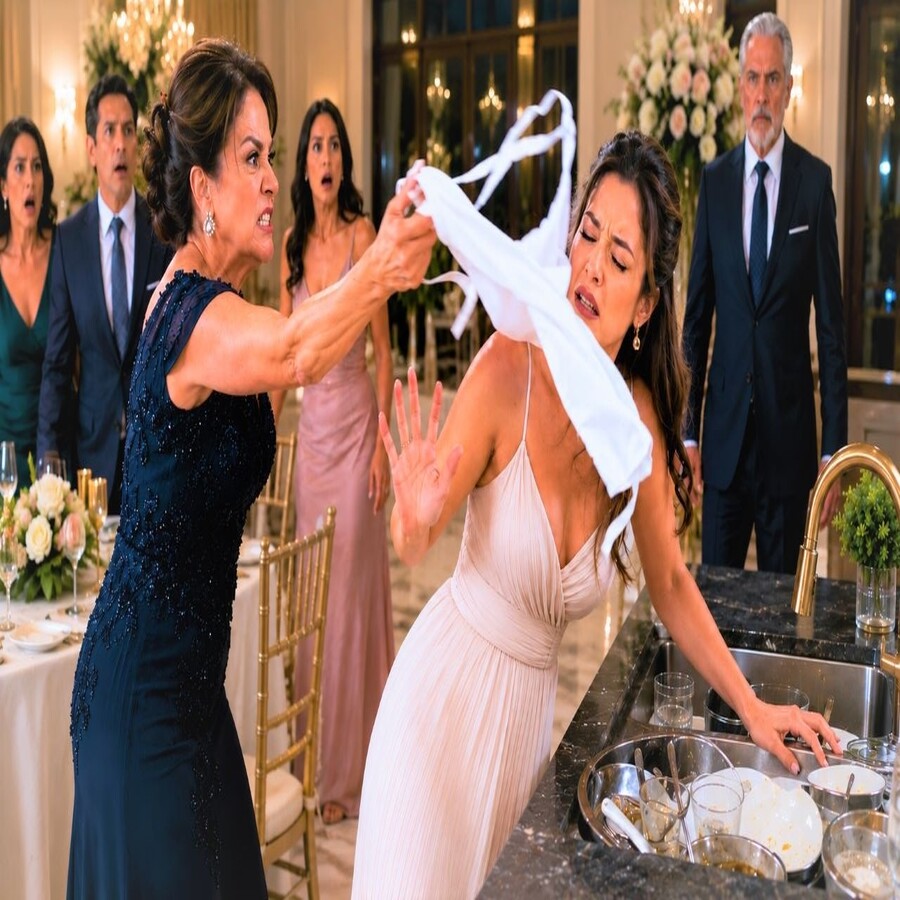
Beside her, Carter was half listening. His eyes still on a conversation he’d just left. Margaret reached behind the long side table and produced a white dish towel.
Crisp and folded. The kind used by professional kitchen staff.
She crossed the room toward Nadia with the slow confidence of someone who had planned this moment down to the last step. She held it out.
“Since our catering team is a little stretched tonight,” Margaret said. Loud enough for the nearest twenty people to hear. “I thought Nadia might help with the dishes after dinner. Given that her mother runs a catering company, I’m sure she’s quite comfortable back there. Some people are just better suited to the kitchen than the dining room.”
The laughter that followed was not loud.
It was the worst kind. Quiet. Appreciative. The sound of people who understood exactly what had just happened and were grateful not to be the one standing there holding the dish towel.
Nadia looked down at the white cloth in her hands. Then she looked at Carter.
He opened his mouth. Closed it. Looked at his mother. Looked back at Nadia. Said nothing.
That silence lasted for four seconds.
Nadia counted them. In those four seconds, eighteen months of smaller silences stacked themselves into something that could no longer be called patience.
She folded the dish towel once. Set it on the table beside her untouched champagne glass. Looked at her mother-in-law with a calm so total it was almost frightening.
“I appreciate the thought,” Nadia said quietly. “But I didn’t come tonight to work.”
Margaret’s smile didn’t waver. “Of course not, darling. I was only—”
“I know exactly what you were doing.”
The room held its breath. And somewhere near the entrance to the estate, a car Nadia recognized pulled slowly up the private drive. A car she had not invited. Had not called. Had specifically asked not to come tonight.
Her father had arrived anyway.
Nadia did not move toward the door. She stood exactly where she was. The folded dish towel still on the table beside her. The room still recalibrating around what had just been said.
Margaret had already turned slightly. Already beginning to redistribute her attention across the room the way a hostess does when she wants a moment to stop existing. But Nadia had seen the headlights through the tall windows.
She had recognized the dark car. The unhurried way it stopped. The particular stillness of a man who never arrived anywhere without intention.
She reached into her small clutch and typed a single message.
“Not yet. Please wait.”
The response came in under ten seconds.
“Already out of the car. It’s cold. I’ll stay in the lobby.”
The Hargrove estate did not have a lobby. It had a foyer. Which was a different thing entirely. It was currently staffed by two of Margaret’s assistants and a coat check attendant who would absolutely report to Margaret within minutes that an unscheduled guest had arrived.
Nadia knew this. She also knew that if her father walked into that room right now, while Margaret was still arranging her expression back into gracious authority, everything would tip in the wrong direction. Not because he couldn’t handle it.
Because he could. Completely. And she was not ready to need him to.
Carter appeared at her elbow with the timing of a man who understood something had happened. But not precisely what.
“You okay?” he asked. Low.
Nadia looked at him. “Your mother just handed me a dish towel in front of your colleagues and your senator’s friend and people you went to boarding school with.”
He exhaled. “I know. I’m sorry. She didn’t mean it the way—”
“Carter.” Her voice was quiet. But it had a flaw in it. “Don’t finish that sentence.”
He didn’t.
That was something, she thought. Not enough. But something.
Margaret had moved to the far end of the room. Already laughing at something a silver-haired man in a navy blazer had said. Performing recovery so smoothly that half the room had already decided to follow her lead and let the moment dissolve.
That was Margaret’s particular genius. She could humiliate someone publicly and then create a social atmosphere so immediately warm that witnesses began to doubt their own discomfort.
Nadia had watched her do it three times in eighteen months. Once to a caterer who’d mispronounced a wine. Once to Carter’s younger sister over her choice of fiancé. And once at Christmas to Nadia herself.
When Margaret had opened Nadia’s gift, a hand-selected print by a Ghanaian artist, and said with a smile like a closed door, “How ethnic. How very you.”
Tonight was different in scale. Not in kind.
A woman named Diane, who had been Margaret’s closest friend since 1987 and who wore her cruelty with the same ease she wore her tennis bracelet, drifted toward Nadia with a champagne glass and an expression of theatrical sympathy.
“Don’t take it personally,” she said. “Margaret just has very specific ideas about what it means to contribute to a family. She said something similar to Carter’s first girlfriend. Of course, that girl was from Newport, so it landed differently.”
She smiled and drifted away before Nadia could respond. Which was the point.
Nadia picked up her champagne. Did not drink it. Held it because her hands needed something to do.
In the foyer, according to the text that arrived two minutes later, her father had charmed the coat check attendant, declined to give his name, and was now standing near a painting he found derivative but politely interesting.
She almost smiled at that.
Almost.
The dining room opened and guests began to move through in that self-organizing way of people who already knew where they belonged. Nadia found her place card. Seated between Carter and a man named Jeffrey who imported something, she couldn’t remember what.
Across the long table from Margaret. Which was not an accident.
Margaret had designed the seating plan. Sitting across from Nadia meant she could observe her for the entire meal without turning her head.
The first course arrived. Conversations settled into its grooves. Jeffrey talked about his children’s ski season. Carter talked about a deal closing in March. Margaret talked about the restoration of the East Wing. What did it cost. How the original plasterwork had been nearly impossible to match.
All of it delivered with a tone of someone describing a personal triumph over history itself.
Then she looked at Nadia with the warmth of someone about to deliver a second blow wrapped in the first one’s gift paper.
“Nadia, I’ve been meaning to ask. Your mother’s company, is it still managing those corporate lunch events? I heard the market for that has gotten quite difficult.” She paused. “It must be hard watching a business struggle. Especially one with so much personal meaning.”
The table adjusted. A few people found sudden interest in their soup.
Nadia set down her spoon. “My mother’s company is doing well, thank you.”
“Of course,” Margaret said. “I only ask because I worry. That industry can be so unforgiving to smaller operations. One bad season and it’s very difficult to recover.” She looked at the table generally. As though offering a civic observation. “I always think there’s real dignity in knowing when to step back from something that’s outgrown your capacity.”
Carter said, “Mom.”
One word. Not a sentence.
Margaret looked at him with gentle surprise. As though she had been discussing the weather and couldn’t imagine why it required intervention.
Nadia looked at Carter. Really looked at him. And waited.
He held her gaze for three seconds. Then he reached for his water glass.
She watched his hand close around it. She watched him not speak.
That was the second time that evening she had counted his silence. She was beginning to understand that silences had a cumulative weight.
And that the person they fell on was the one who carried them home.
Chapter 2: The Morning
After the main course, when conversation had loosened with wine and the room had the slightly blurred warmth of a party that had decided to be a success regardless of evidence, Margaret excused herself briefly.
Carter leaned toward Nadia and said, voice low, “I’ll talk to her tonight. I promise.”
Nadia looked at the centerpiece. White roses. Very beautiful. Very deliberate.
“You’ve said that before.”
“This time I mean it differently.”
“How is it different?”
He paused. “Because I saw your face when she handed you that towel.”
Nadia breathed slowly. “You saw it eighteen months ago, too, Carter. Every time.” She set her napkin beside her plate. “Seeing something and doing something are not the same category.”
She excused herself and walked toward the hallway that led to the foyer. She needed sixty seconds of air that didn’t belong to Margaret.
What she found instead, standing near the painting he had apparently decided was after all not entirely without merit, was her father. Tall. Unhurried. In a dark suit that had not been bought to impress anyone.
And impressed everyone anyway.
He looked at her the way fathers look when they have been watching from a distance and have understood everything.
“You’re not okay,” he said. Not a question.
“I’m standing up,” she said.
“I know. I can also see what it’s costing you.”
She looked at him and for a moment said nothing. Because there was too much that could be said. And she didn’t want to cry in the foyer of the woman who had handed her a dish towel.
“How much did you hear?” she asked finally.
Her father’s expression was the quietest version of something that, in another man, might have looked like fury. “Enough,” he said. “To know that Margaret Hargrove has been operating under a significant misunderstanding.”
Nadia looked back toward the dining room doors. “Not tonight, Dad.”
He studied her. “When?”
She thought of the dish towel. Of Carter’s water glass. Of Diane’s smile. Of Margaret’s voice saying some people are just better suited to the kitchen than the dining room.
“When she does it in front of everyone who matters,” Nadia said. “I want her to be looking right at me when she finally understands who she’s been speaking to.”
Her father was quiet for a long moment. Then he said, “You know what I know, don’t you?”
It wasn’t a question, either.
Nadia nodded once. And the thing she knew sat between them like a door that hadn’t been opened yet.
But that when it finally was, would change every room in that house.
The morning after the party, the Hargrove guest house sat quiet at the edge of the property. Where Carter and Nadia had stayed the night at Margaret’s insistence. An insistence that functioned less as hospitality and more as surveillance.
Nadia was awake before 6:00. Sitting at the small kitchen table with a cup of tea she wasn’t drinking. Watching the frost on the grass catch the early light. Listening to the particular silence of a house where something unresolved had been left overnight to harden.
Carter came downstairs at half past 6:00 with the careful movements of a man who knew the conversation was still waiting. He poured coffee. Sat across from her.
Said nothing for almost two full minutes.
Nadia let the silence exist. She had stopped filling his silences for him. That was a recent change. Small and significant.
“I spoke to her this morning,” he said finally.
Nadia looked at him. “Already?”
“She called me at 6:00. She wanted to explain her intentions.” He wrapped both hands around his mug. “She said the dish towel was a joke. That she meant it as a kind of teasing. That you misread the room.”
Nadia absorbed this without moving. “And what did you say?”
Carter looked at the table. “I said it wasn’t a joke.”
“And then?”
“She said I was being manipulated by someone who is overreacting to light-hearted humor because of personal insecurity.”
The frost outside had not yet melted. Nadia watched a bird land on the stone garden wall and then immediately leave. As though it had assessed the atmosphere and found it uncongenial.
She understood the bird completely.
“Did you defend me?” she asked.
The question was simple. The answer was not.
Carter looked up. “I said she owed you an apology.”
“Did she agree?”
A pause that contained its own answer. “She said she would think about it.”
Nadia stood up. Rinsed her cup at the sink. Said without turning around, “She’s not going to think about it, Carter. She’s going to spend today talking to Diane and whoever else was at that table. She’s going to construct a version of last night where I was the one who was difficult. You were the one who was admirably patient. She was simply a mother who loves her son and was misunderstood by a woman who can’t take a joke.”
She turned. “That’s what she’s going to do. Because that is what she always does. And you know that.”
He didn’t disagree. That again was something.
Still not enough.
They drove back to the city by 9:00. Mostly in silence. The kind that wasn’t hostile. But wasn’t comfortable either. The kind that had too many things in it to be broken with small talk.
When Carter dropped her at the building before heading to his office, he held her hand for a moment through the car window and said, “I’m going to do better.”
She looked at him with the expression of someone who has learned to wait for evidence before allowing hope its full height. She said, “I know you want to.”
Which was honest and also not the same thing as agreement.
Upstairs, in the apartment that was hers and Carter’s, but that she had furnished almost entirely alone while he traveled for work, Nadia opened her laptop and found three messages.
One from her mother. Who had heard a partial account from someone who’d been at the party and wanted to know if Nadia was all right. One from Carter’s sister, Jess. Who had not been at the party but had apparently been briefed by Diane.
And wanted Nadia to know that she was furious on her behalf.
And one from her father. Which contained no words at all.
Only a forwarded document with a header she recognized immediately. Because she had read an earlier version of it six weeks ago.
It was a contract. A proposal, to be precise. For the renovation and rebranding of the Hargrove Group’s flagship event venue in Midtown. A property that Margaret had inherited from her late husband.
That still generated enough revenue to fund, among other things, the estate’s perpetually running fountain.
The proposal came from Osage Meridian. Her father’s hospitality development firm. The firm that, as of the previous fiscal year, had become one of the three largest privately held hospitality groups on the East Coast.
The firm whose name Nadia had spent her adult life keeping entirely separate from her own introduction at parties. On first dates. In Margaret Hargrove’s receiving line.
The proposal had been in negotiation for four months. Margaret did not know the identity of the principal behind it. She knew it only by the company name.
Which meant nothing to her. Because Margaret’s relationship to research was limited to things that directly threatened her comfort.
She had been, according to her father’s assistant who had sat in on two of the preliminary meetings, enthusiastic. The venue needed capital. The Hargrove Group needed a partner with vision and liquidity. Osage Meridian had both.
Margaret had told her own attorney that it felt like a gift arriving at exactly the right moment.
Nadia sat with that for a long time.
She thought about the dish towel. She thought about some people are just better suited to the kitchen. She thought about how ethnic, how very you. She thought about Carter’s water glass and his 6:00 a.m. phone call and his mother’s offer to think about an apology.
Which was the Hargrove way of saying no while leaving the architecture of civility intact.
She thought about eighteen months of swallowing things that should have been said. And telling herself that patience was a form of strength. When sometimes it was just a form of waiting for the damage to accumulate quietly enough that no single moment could be named as the breaking point.
She called her father at 11:00.
“The contract,” she said.
“Yes,” he said.
“She doesn’t know.”
“She does not.”
Nadia was quiet for a moment. Outside the apartment window, the city moved with its usual indifference. Cabs. Pedestrians. A man walking a dog that was too large for the sidewalk.
“When is the next meeting?”
“Friday, at the venue. She’ll have her attorney and her operations director. I was planning to send Marcus.”
Marcus was her father’s deputy. Competent, discreet, and entirely unknown to Margaret Hargrove.
“But I could attend myself.”
Nadia thought about Friday. She thought about Margaret in that champagne gown holding a dish towel across a room of witnesses. She thought about what it would mean to walk into a meeting where Margaret expected a business partner.
And found instead the father of the woman she had ordered toward a kitchen sink.
“Don’t go yet,” Nadia said. “There’s something I need to do first.”
Her father waited. He was good at waiting. Which was where she had learned it.
“Margaret is planning a luncheon,” Nadia said. “Next Wednesday. She does it every month. Twelve women. The inner circle. The ones who were at the table last night. Diane will be there. The senator’s wife. Everyone who saw what happened and said nothing.”
She paused. “She’s already started managing the narrative. Just told me this morning that the version circulating through that group is that I made a scene over a harmless joke because I’m insecure about my background.”
Her father’s voice was careful. “What are you thinking?”
“I’m thinking that the people who watched Margaret hand me a dish towel deserve to be in the room when they find out who my father is.” She stood up from the desk and walked to the window. “Not as a weapon. As a correction.”
A pause. “And Carter.”
She pressed her fingers against the cold glass. “Carter needs to choose before he knows the full story. If he chooses right, it means something. If he waits until Friday and chooses because of the contract, it means something different.”
Her father said quietly, “You’re asking him to trust you without the evidence.”
“I’m asking him to do what he should have done the night she handed me that towel.” Her voice didn’t shake. “I want to know if he’s capable of it.”
There was a long pause on the line. The kind that held both respect and worry in equal measure. Then her father said, “Nadia, be careful that this doesn’t cost you more than it cost her.”
She looked at the city below. Indifferent and enormous. Entirely uninterested in the interior lives of anyone standing at a window above it.
“I’ve already paid, Dad,” she said. “I’ve been paying since the receiving line.”
She hung up. Opened a new message to Carter.
“I need to talk to you tonight. Not about your mother. About us. About what comes next.”
She sent it. Then she opened a second message. This one to Margaret’s personal assistant. A young woman named Sophie. Who had been quite kind to Nadia at three separate events. And who Nadia suspected was exhausted by the performance of working for someone who confused control with care.
She typed, “I’d like to attend the Wednesday luncheon. Please let Margaret know I’ll be there.”
She sent that one, too. Then she sat back and waited. Because that was the part she had become, against her own preferences, very good at.
The waiting. The watching. The absolute refusal to let anyone see that she already knew exactly what was behind the door they were all about to walk through.
Chapter 3: The Luncheon
Wednesday arrived the way important days often do.
Unremarkably. Over coffee. With the city doing nothing to acknowledge that something was about to break.
Nadia dressed without theater. A cream blazer. Dark trousers. Small gold earrings. The same ones she had worn to the party. She wanted Margaret to recognize them. She wanted there to be at least one person in that room who understood that Nadia had come dressed for continuity.
Not performance.
She arrived at the estate at noon. Sophie met her at the door with an expression that mixed relief with apprehension. The look of someone who had delivered an unexpected message and wasn’t sure what it had set in motion.
The luncheon was in the garden room. Twelve women around a table set with the kind of effortless simplicity that costs more than obvious luxury. Flowers from the estate garden. Linen that had been pressed that morning. Water in a crystal pitcher that caught the light and threw it gently across the tablecloth.
Margaret was standing when Nadia entered. Her composure was extraordinary.
It was the composure of someone who had prepared. Which meant she had spent some portion of the last few days deciding how to use Nadia’s presence to her advantage. Nadia recognized the calculation because she had been studying Margaret’s face for eighteen months.
And had learned to read the small adjustments that preceded a move.
“Nadia,” Margaret said warmly. “I’m so glad you came.”
The warmth was a signal to the room. See how generous I am. See how I welcome her.
Diane looked up from the end of the table. Her smile was the same one she’d worn when she said it landed differently because she was from Newport.
Nadia smiled at the room generally and sat in the chair Sophie had placed at the far end of the table. Directly opposite Margaret.
She set her phone face down on the tablecloth beside her water glass. The phone was open to a message she had not yet sent.
Her father was twenty minutes away. And Carter, she knew, was already in the building. Not in the garden room. Not yet. But in Margaret’s study down the hall.
Where she had asked him to meet her at 12:15. Before telling him anything about why.
The luncheon began. Conversation moved through its familiar territory. Margaret steered it with the invisible hand of someone who had hosted enough gatherings to understand that a room’s topic was always whatever she was willing to discuss.
And then, between the salad course and whatever came next, she looked at Nadia with a smile that had been waiting since Wednesday morning to be deployed.
“I’ve been thinking,” Margaret said, “about what family really means. About contribution. About the difference between people who build something and people who simply arrive into it.”
She let that settle. “I think it’s important that everyone at this table understand what the Hargrove name has required of the people who carry it.”
Nadia looked at her and said nothing.
Margaret continued. Her voice composed. Almost tender. “Nadia, I say this with love. I think you’ve been struggling to find a place here. And I understand that. Not everyone comes into a family like this with the preparation it requires.”
She looked around the table. Collecting nods. “There’s no shame in that. There’s only the question of whether someone is willing to learn what belonging actually looks like.”
The table was quiet. Diane was very still in the way of someone listening closely enough to report the conversation accurately later.
Nadia reached for her phone. Turned it over. Looked at the unsent message. Looked up at Margaret.
And then the door to the garden room opened.
Carter stood in the doorway. He had not been called in. Nadia had asked him to wait in the study. And he had waited exactly as long as his conscience would allow.
Which turned out to be eleven minutes.
He looked at the table. At the twelve women. At his mother’s composed expression. At Nadia’s very still hands. At the quality of silence that told him he had arrived at the end of something rather than the beginning.
Margaret recovered first because she always did. “Carter, darling, we’re in the middle of—”
“I heard,” he said. A small pause. “You couldn’t have. You were down the hall.”
“Sophie left the door open.” He looked at Nadia. “I heard enough.”
Margaret set down her fork with the careful precision of someone who was deciding in real time how much this moment was going to cost her. “Then you heard me expressing concern for your wife’s well-being. Which is something a mother does.”
Carter walked into the room. He did not sit. He stood at the midpoint of the table. Equidistant from his mother and his wife.
Which was where he had spent the better part of his marriage. And which Nadia could see he had finally noticed.
“What I heard,” he said, “was my mother telling twelve people that my wife doesn’t belong here. Again.” He looked at the table. At Diane. At the women who were there on Saturday night. “The same thing she said with a dish towel in front of our guests. I didn’t speak then. I’m speaking now.”
Diane looked at her water glass. The senator’s wife studied the centerpiece with sudden absorption.
Margaret’s voice dropped to a register she reserved for private corrections. “This is not the time or the place.”
“It’s exactly the time and the place,” Carter said. “Because these are the same people who were there when you humiliated my wife and watched me say nothing. They should hear this, too.”
Nadia looked at her husband. She felt something move in her chest. Not quite forgiveness. Not yet.
But the first condition that would need to exist before forgiveness became possible.
He was late. He was eighteen months and several silences and one dish towel late. But he was standing in the right place. Without knowing what she was about to do. Without the contract. Without her father’s name.
Without any information that would have made choosing her the strategically sensible option.
He was choosing her because she was his wife and she had been wronged. And that finally was enough reason.
She picked up her phone. Sent the message.
Forty seconds later, Sophie appeared at the garden room entrance. Behind her, unhurried as always, in a dark suit and the expression of a man who had learned to enter rooms without announcing himself, came her father.
The shift in the room was immediate and total.
The women who knew the hospitality industry, and several of them did, through boards and foundations and the particular social intelligence of women who paid attention to where money moved, straightened almost imperceptibly. Diane’s expression changed in a way that was too fast to be polite.
Margaret looked at the man in the doorway. For one suspended moment her face was simply open. Reading him. Trying to locate him in the filing system of her social memory.
He was not there. She had never met him. She had only, for the past four months, exchanged documents and pleasantries with his attorney.
And found him, as an entity, entirely satisfactory as a business partner.
“Margaret,” Nadia said. Her voice was the quietest it had been all day. “I’d like you to meet my father. Elliot Osay.”
The name landed.
Diane made a sound that was not quite a word. The woman to her left leaned almost imperceptibly forward. Margaret’s hand, resting on the table, became very still.
Because Margaret knew that name. She knew it the way anyone in her world knew it once it was said aloud in context. The same way you suddenly see a shape in a photograph you’ve looked at a dozen times without seeing it.
Elliot Osay. Osage Meridian. The firm she had called a gift arriving at exactly the right moment. The partner she had told her attorney she was excited to finalize terms with.
The contract she needed more than she had admitted to anyone. Because the Hargrove Group’s Midtown venue had been running at a loss for two years. And the estate’s fountain was not the only thing requiring maintenance that pride had refused to acknowledge.
Elliot walked to where Nadia was sitting. He rested one hand briefly on her shoulder. Not a gesture of ownership.
Of presence. The difference was everything.
Then he looked at Margaret with the calm of someone who has decided in advance exactly how much of himself this situation deserves.
“I’ve heard a great deal about you,” he said. “Primarily from my daughter. And recently from the recording.”
Margaret blinked. “I’m sorry?”
Nadia set her phone on the table. Screen up.
“Sophie,” she said gently, “has been very uncomfortable for a very long time.”
Sophie, from the doorway, said nothing. Her expression said everything. Margaret looked at her assistant with the expression of someone recalculating an enormous sum.
And finding the total catastrophically different from what they expected.
She looked at the phone. At Nadia. At Carter, who had not moved from his position at the midpoint of the table. At the twelve women who were now entirely still.
The way people are still when they understand they are witnessing something that will be discussed for years.
“What exactly,” Margaret said, and her voice had lost some of its evenness, “do you think you’re doing?”
Nadia did not raise her voice. She had not raised it once that day. Nor the night of the party. Nor in any of the eighteen months preceding it.
She had learned, growing up as Elliot Osay’s daughter, that volume was for people who hadn’t yet figured out that precision was louder.
“I’m not doing anything,” she said. “I’m letting you see what was already true.”
She looked around the table. “My father’s firm has been in contract negotiations with the Hargrove Group for four months. You called it a gift. You told your attorney it arrived at exactly the right moment. You were right. It did.”
She paused. “The same week you handed me a dish towel and told this room that some people are better suited to the kitchen.”
Diane had stopped performing composure. She was simply sitting very quiet. Apparently discovering that her water glass required no further study.
Carter said low, “Mom.”
Margaret looked at her son. Something crossed her face that was not quite the expression she had worn during any previous moment of the story. Not the gracious hostess composure. Not the cold precision of a woman managing a narrative.
Not even the private fury of someone losing control of a room.
It was something older and less defended than any of those. It was the face of a woman who had built an entire architecture of pride on a foundation of fear. And who was watching in real time as someone gently removed a single stone.
And let the weight of it do the rest.
“This was planned,” she said. Not an accusation. Almost a recognition.
Nadia answered honestly. “The luncheon was yours. The timing was mine. The rest”—she glanced at Sophie, at her father, at Carter—”the rest just turned out to be people who were tired of watching something wrong happen without saying so.”
Margaret looked at Elliot. Nadia could see her trying to reassemble herself into the version that had managed every room she’d entered for forty years.
“Mr. Osay, I hope you understand that whatever Nadia may have characterized—”
“I understand perfectly,” Elliot said.
He was not unkind. That was the most unsettling thing about him. He had the manner of someone who did not need to be unkind because accuracy was sufficient. “My daughter spent eighteen months in this family without ever asking me to intervene. She asked me not to come to the party. She asked me to wait in the foyer. She asked me to give your son the chance to choose her without knowing who she was connected to.”
He looked at Carter. “Which I’m told he just did.”
Carter met the older man’s gaze and held it. “Late,” he said. “I know that.”
“Yes,” Elliot said. “But present. That counts for something. Provided it continues.”
Margaret opened her mouth. Closed it.
For the first time in Nadia’s experience of her, she did not appear to know what to say next. The women around the table were very quiet. Absorbing the particular atmosphere of a powerful person discovering their power has a limit.
It was Nadia who spoke. And she did it without heat. Without the satisfaction of someone winning and without the performance of generosity that isn’t genuine.
She spoke the way she had learned to speak in rooms where being underestimated was the standing assumption. Clearly. Economically. Without asking for permission to finish her sentence.
“I’m not going to ask my father to withdraw from the contract,” she said. “That decision is his and it’s a business decision and it will be made on business grounds. I’m also not going to use it as leverage because the moment I do, I become the version of this situation that you’ve been trying to make me from the beginning. Someone who’s here for what the name was worth.”
She looked at Margaret steadily. “I was here because I love your son. I stayed when it was hard because I believed that people are capable of being better than their worst moments. I still believe that. But I am not available to be your example of someone who doesn’t belong. Not in this room. Not in any room.”
Margaret was very still.
“The contract,” Nadia continued, “is a conversation for another day and a different table. What happens at this table today is simpler.”
She looked around at the twelve women. At Diane. At the senator’s wife. At the faces that had watched and smiled and stayed silent across eighteen months of smaller moments that had all been building toward this one.
“I think everyone here knows what they saw on Saturday night. And I think most of you knew even then that it wasn’t a joke.”
No one disagreed.
The silence was the most honest thing that had happened at a Hargrove table in years.
Chapter 4: The Fountain
Carter crossed the room and stood beside his wife.
Not behind her. Not slightly apart giving himself exit room. Beside her in the way that means I am here and I am not qualified to ask you to forgive me, only to show you I understand what forgiveness would require.
He didn’t touch her hand or make a gesture designed for the room. He simply stood in the right place.
And let that be the whole of what he said.
Margaret looked at her son beside his wife. At her assistant in the doorway. At the father of the woman she had tried to place in a kitchen. At the twelve women who would carry the story out of the garden room and into every corner of the world she had spent her life carefully constructing.
She looked, finally, at the centerpiece. White flowers. Pressed linen. The effortful simplicity that costs more than it pretends to.
When she spoke, her voice was smaller than anyone at the table had ever heard it.
“I owe you an apology,” she said to Nadia.
The sentence came out without the architecture of justification she had always built around difficult admissions. It was just the sentence. Unsupported.
Standing on its own.
Nadia received it without rushing to make it comfortable. She let it exist in the room at its actual size. Not large enough to repair everything.
Not small enough to be dismissed.
“Yes,” she said. “You do.”
It was not a reconciliation. It was not an ending that erased what had preceded it. It was something more honest than either of those.
A beginning of accountability. Fragile and without guarantee. Which is the only kind that means anything.
The luncheon did not continue in its planned form. Guests found reasons to leave with a tact that was the most considerate thing most of them had managed all season.
Diane left without meeting Nadia’s eyes. Which was its own form of acknowledgement. Sophie was given the rest of the afternoon by a Margaret who could not quite look at her directly.
Which told Nadia everything about how much Sophie had risked. And how much she intended to make sure that risk was honored.
Elliot drove back to the city without asking Nadia what came next. He understood, as he had always understood, that the space after a hard thing needs to belong to the person who lived through it.
Carter and Nadia sat in the garden after everyone had gone. On a stone bench near the fountain that had never once been turned off.
It was cold. Neither of them suggested going inside.
“I have a lot of ground to make up,” he said.
She looked at the water. “I know.”
“I don’t want to do it by saying the right things. I want to do it by being different in situations where different is harder.”
She considered this. “That’s the only version I’m interested in.”
“Okay.”
He didn’t ask if they were going to be all right. He seemed to understand that asking was a form of asking her to manage his uncertainty.
And that she had been managing enough.
They sat in the cold a while longer. The fountain ran.
Three months later, the Hargrove Group signed the final terms with Osage Meridian.
The venue was renovated. The event programming was rebuilt under a philosophy that Nadia had a quiet but significant hand in shaping. One that paid its staff properly. Promoted from within. Did not require anyone to disappear into a back corridor to make the dining room look right.
Margaret attended the reopening. She came without Diane, which people noticed. She wore something understated, which people also noticed.
Though they said nothing. Because some changes are too precise to survive being pointed out.
She spoke to Nadia once. Briefly. Near the entrance. She said that the space looked beautiful.
Nadia said, “Thank you.” And meant it.
Nothing was resolved between them. But something had stopped pretending to be fine in a way that required damage to maintain.
Carter held Nadia’s hand at the reception without being prompted. Didn’t let go when his mother walked past.
That small sustained choice was, she thought, the most accurate thing he had done since the night she sat counting his silences.
She thought about the dish towel sometimes. Not often. She thought about what it was meant to do.
The reduction of a person to a function. The assignment of a place before anyone has asked what the person is capable of.
She thought about how she had folded it once and set it on a table and walked out of a room with her spine straight and her eyes dry. Carrying the full weight of who she was without being permitted to set it down.
She didn’t need the apron. She never had.
What she needed, and what she had spent the long months since claiming peace by careful piece, was the simple and non-negotiable right to stand in any room she entered and be seen as she actually was.
Not as someone’s wife. Not as someone’s daughter. Not as someone whose value required a famous name to become legible to people who had confused pedigree with perception.
Just Nadia.
Fully, at last, and without footnotes.
The fountain at the Hargrove estate was still running when she left that evening. But somehow, standing in the clear air outside a building that had chosen to know her, it sounded less like dominance.
And more like something that had simply forgotten to stop.
She walked to her car. Drove home. Did not look back.
Some doors, once properly closed, do not require a second glance.
Disclaimer : This content may be created by AI for entertainment purposes. Any resemblance to real persons, events, or places is coincidental.






