My Bridesmaids Cut My Wedding Dress To Ribbons, But The Only Thing They Destroyed Was Their Own Future.
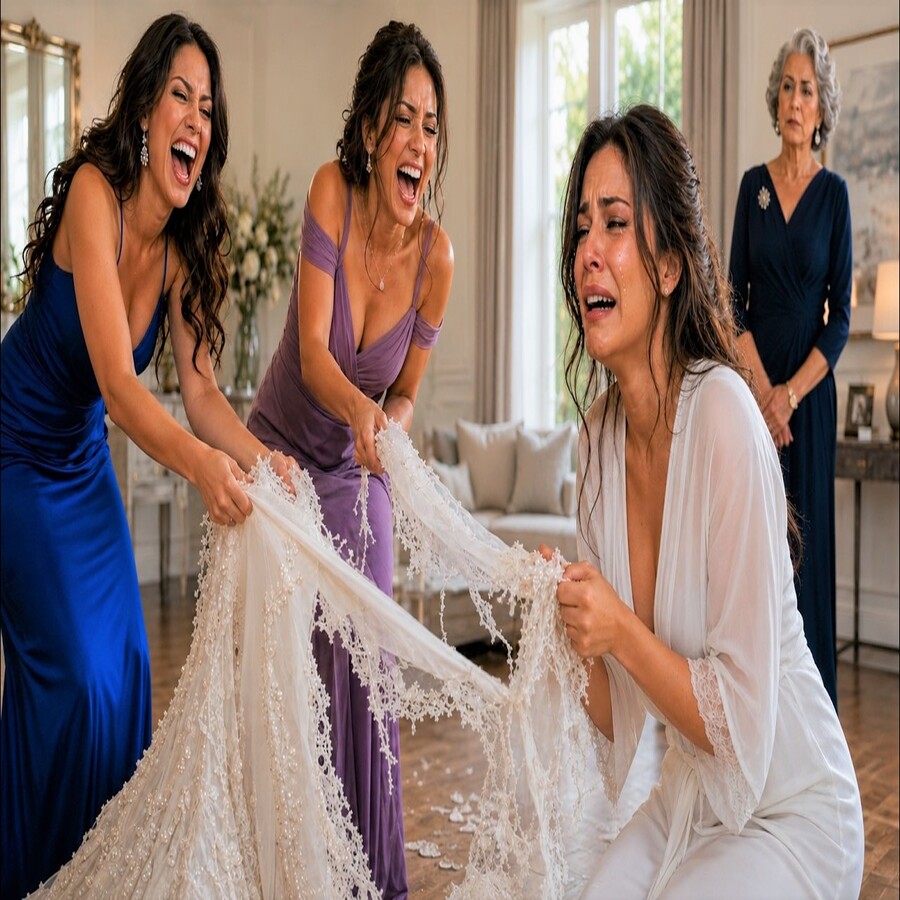
Chapter 1: The Scissors
The first sound I heard on my wedding morning was fabric tearing.
Low and deliberate. Like something being punished.
When I pushed open the dressing room door, my gown was already on the floor. Split down the bodice. The skirt shredded into pale ribbons scattered across a rug that still smelled of steam and hairspray.
My three bridesmaids stood over it with a pair of sewing scissors.
For one long second, nobody said anything at all.
Then Breanna smiled. Not a nervous smile. A satisfied one. Like she’d just finished a job she’d been looking forward to.
I couldn’t breathe.
The room smelled like burnt curling iron and crushed gardenias. And something underneath that. The particular scent of ruined silk. I didn’t know it existed until that moment.
Under my bare feet were seed pearls. A whole trail of them, rolling toward the vents. The hem my grandmother had helped me pin two weeks before she passed was in two separate pieces on the carpet.
Courtney set down her mimosa on the vanity like she was bored.
“Don’t look at us like that, Danny. Somebody had to say something before you humiliated yourself in front of his family.”
Sophia wouldn’t meet my eyes. She just kept turning the scissors over in her hand. Admiring them like they were jewelry.
I looked at the wreckage.
The bodice had two long slashes across the front. One sleeve had been cut clean off and tossed onto the makeup chair like garbage. And above the mirror, written in my own lipstick, in handwriting I recognized as Breanna’s:
“Know your place.”
For about five seconds, I thought my wedding was over.
On the sixth second, I understood something else entirely.
These three women hadn’t destroyed my future. They’d just signed the ending of their own story. In thread and lipstick. Without realizing it.
My name is Danielle Reyes.
Up until that morning, I believed I was marrying Ethan Cole. A quiet contractor who smelled like sawdust and coffee. Always had a pencil behind his ear.
He told me his family kept to themselves. That they didn’t like talking about money. That his father had old-fashioned ideas about weddings being simple.
I didn’t know that Cole wasn’t just a name on a business card.
I didn’t know the Cole family owned half the commercial real estate on the east side of the city. Three regional hotel chains. A private equity fund that had quietly bought out two of my own bridesmaids’ employers within the last year.
I didn’t know that the soft-spoken man who fixed my leaking kitchen faucet on our third date was the only son who’d walked away from boardrooms to swing a hammer instead.
I also didn’t know that his mother, Margaret Cole, had already seen exactly what my bridesmaids were capable of. Weeks before they ever picked up those scissors.
But before that locked door, before the gown on the floor, before the box wrapped in gray satin that would change everything, there were months of small cruelties.
I called them jokes.
I was wrong.
I met Ethan at a community garden cleanup of all places. I was there volunteering with kids from the after-school program I ran. He showed up in work boots with a truck full of donated lumber for the new planter beds.
He wasn’t flashy. He wasn’t trying to impress anyone. He just knew how to build things. He was patient about it. Showing an eight-year-old how to hammer a nail straight. Not caring that he got mud on a two-hundred-dollar watch he never once mentioned was expensive.
That patience is what disarmed me.
In a city where everyone was selling a filtered version of themselves, Ethan talked about joists and grout and soil pH. I fell for the fact that he didn’t need to dazzle anyone.
My mother had been a seamstress her whole life. Working out of a cramped shop that smelled like steam and chalk dust. Dressing brides who wanted for one day to feel like the most important woman in the room.
My father left when I was six.
I grew up learning that grace doesn’t always come from money. Sometimes it comes from standing up straight when someone’s trying to make you apologize for existing.
That’s why Ethan felt like rest.
He never asked what I made a year. He never flinched at my studio apartment with the radiator that clanked all night. The first time he came over, he fixed a cracked flower pot on my fire escape and left a sprig of rosemary on my counter.
“So it smells like something’s growing,” he said. “Even if you don’t have a yard.”
With Breanna, Courtney, and Sophia, everything had quietly become a scoreboard. How much was the ring? Who was paying for the venue? What designer was the dress? They didn’t call it nosiness. They called it looking out for me.
When Ethan proposed, it was in the greenhouse behind his uncle’s nursery. Surrounded by orchids he’d been secretly tending for weeks. No photographer. No string quartet. Just condensation dripping off glass panes.
His hand shook as he opened a small velvet box with a modest emerald ring inside.
He said he didn’t want to buy me a spectacle. He wanted to build me a life.
I said yes before he even finished the sentence.
Breanna was the first to congratulate me. She was also the first to eye the ring like she was pricing it.
“It’s sweet,” she said. “Very handmade-looking.”
The word handmade landed like a needle under my skin.
Courtney added, all sugar. “What matters is he loves you. Not everyone needs a big rock.”
Sophia chimed in that a simple wedding could be charming. As long as I didn’t try too hard to look like old money.
I laughed it off. I still believed back then that they were my friends. That their bitterness was just habit. Not venom.
I was wrong about that, too.
And it would take a woman in a navy dress, standing perfectly still in a ruined dressing room, to show me exactly how wrong I’d been.
The first real warning came three weeks after the proposal. At a dinner Courtney hosted in her high-rise apartment. The kind with a view of the skyline and furniture nobody was allowed to actually sit on.
Breanna brought a bottle of wine that cost more than my weekly grocery budget. Sophia brought flowers, but made a point of mentioning they weren’t from the corner shop.
I brought a batch of lemon shortbread I’d baked myself.
“Oh, how sweet.” Courtney said. Opening the tin like it was something fragile and a little embarrassing.
Sophia set out plates on the marble island. “Ethan doesn’t really have people here, does he?”
“He does,” I said. “They’re just private.”
Sophia rested her fork against her plate. “Private is a very convenient word when there’s not much to show off.”
Courtney laughed through her nose. “Don’t be mean. Maybe they’ve got that whole rustic charm thing going on.”
I didn’t defend Ethan the way I should have. I smiled. Changed the subject. Hated my own restraint the whole drive home.
When I got back to my apartment, I found him kneeling in the hallway. Watering the neighbor’s ferns because she’d sprained her ankle and couldn’t do it herself.
He had dirt on his shoes and a grass stain on his sleeve.
“What happened?” he asked, seeing my face.
“Nothing,” I said.
He set down the watering can. “Every time you say nothing, you look like you’re carrying a box you don’t want to put down.”
I didn’t tell him.
I still wasn’t ready to admit that grown women could make me feel sixteen again. Waiting for approval at a table that would never quite have a seat for me.
As the wedding planning ramped up, the comments got sharper. More specific.
Breanna asked, more than once, whether Ethan could actually afford a real venue. Courtney offered to help me keep things realistic. Sophia insisted I shouldn’t wear a dress with a train.
“Trains are for women with backing,” she said. Watching me measure tulle across my kitchen table.
“Why would people laugh?” I asked.
She touched the fabric with two fingers. Like it might be contagious. “Because some styles need something behind them.”
That word, backing, sat in my chest for days. As if a woman needed a bank account standing guard behind her before she was allowed to be beautiful.
Then came the bachelorette weekend.
I’d asked for something small. Dinner. Music. Cake. They booked a rooftop lounge instead. Everything white and gold and expensive. They called it a gift.
During the toast, Breanna raised her glass and announced that I was proof a woman could marry up even from outside the right circles.
A few guests laughed. Unsure if it was a joke.
I knew it wasn’t.
Later, Sophia put a plastic tiara on my head in the bathroom. “Practice,” she whispered. “Maybe one day it’ll look natural on you.”
I took it off in front of the mirror. Under lights that made my face look tired and small.
Courtney came in a few minutes later. “Don’t get sensitive. Breanna’s just trying to make you laugh.”
It didn’t make me laugh.
She leaned against the sink. “Women climbing up need thick skin.”
I let that one go, too.
I understand now that every insult you let pass without naming it becomes a green light for the next one.
Ethan noticed something was wrong. One night, over reheated soup in mismatched bowls, he asked point-blank if my friends were hurting me.
“They’re just intense,” I said.
He set down his spoon. “Danny, intensity shouldn’t make you shrink.”
I didn’t listen. I wanted an easy path to the altar. One where I didn’t lose friendships. One where I could pretend jealousy was too harsh a word for people who’d once slept on my couch during hard years.
Ethan didn’t push, but he started watching more closely.
Once, while I was on speakerphone with Courtney in the kitchen, he heard her tell me my dress needed to look aspirational without costume.
He set down the knife he’d been using to chop basil. “Put her on speaker,” he said.
I shook my head. “I don’t want to fight.”
“You don’t need to fight to set a boundary.”
I told him he didn’t understand our history. That these women had been there when my mother got sick. That they’d helped me move twice. That we’d survived hard years together.
He listened without interrupting. Then wiped down the cutting board.
“Sometimes,” he said quietly, “the people who were there for your pain think that gives them a say in your joy.”
That line irritated me because it was true.
My dress was born out of that same stubbornness. Not designer. Better. Mine.
I made it with Marisol. A seamstress with small hands and a fierce, exacting eye. The kind who trained under my mother years ago.
I bought ivory silk on clearance. My mother had left behind a box of antique lace before she passed. I used a strip of it along the veil’s edge.
Every fitting felt like a conversation with her.
“The train goes long,” Marisol insisted. Pins in her mouth. While I hesitated in front of the mirror.
“Maybe it’s too much,” I said.
She met my eyes in the reflection. “Too much for who?”
That’s why the dress hurt so much lying on that dressing room floor. It wasn’t just fabric. It was eight months of savings. Memory. Small decisions about dignity stitched into every seam.
The wedding was set at a restored countryside estate outside the city. Ethan said a family friend had offered the venue as a gift. I never asked too many questions.
The grounds had manicured hedge gardens. A stone fountain older than the house itself. A private chapel with carved oak doors that looked like they belonged in a cathedral. Not a backyard wedding.
It felt too beautiful for what Ethan had described as a modest ceremony. But when I raised an eyebrow, he just took my hand.
“I want to see you walk in through the trees,” he said.
I accepted that answer.
I shouldn’t have.
Because two days before the wedding, standing in that chapel admiring the carved doors, I noticed the staff greeted Ethan by name. Not politely. Deferentially. The way people greet someone whose signature means something.
And when I asked the estate’s coordinator a simple question about seating, she looked at Ethan first. Waiting for his nod before she’d answer me at all.
I should have asked more.
I told myself later that trusting someone means leaving their silences intact. I know better now. Some silences are locked rooms with something important behind the door.
And two days before my wedding, I had no idea just how large that room really was.
Margaret Cole, on the other hand, asked questions.
Plenty of them.
I met her properly for the first time at the menu tasting. Four days before the wedding. She arrived without warning. Settled into the chair beside me like she’d known me for years.
Within ten minutes, she had extracted more information than my own mother would have thought to ask. Who were my bridesmaids? How long had I known them? And why, she wanted to know, had Breanna requested private access to the bridal suite two full days before the ceremony?
I blinked. “Requested access?”
Margaret sipped her water. Unbothered. “The coordinator noted it. Said she wanted to drop off gifts early.”
I hadn’t heard anything about gifts.
Margaret didn’t press the point. She just let it sit on the table between us. Like something she expected me to pick up later.
That comment came back to me the night before the wedding. When my bridesmaids arrived at the rehearsal dinner in matching mauve. Smiles just a little too sharp.
Breanna complained the estate felt rustic rich. Like the family was trying too hard to seem understated.
Courtney asked, not quite joking, whether Ethan’s guest list would be mostly landscapers.
Sophia said at least there’d be good flowers.
That was the same evening I met Margaret properly alongside her son. No, that’s not right. I’d already met her. I’m talking about the moment she truly arrived. The way a room adjusts itself around certain people without being told to.
She wore no visible jewelry and didn’t need any. She crossed to Ethan and folded him into a hug with a tenderness that softened something tight in my chest.
“Mom,” he said, “this is Danielle.”
Margaret took both my hands.
“Finally,” she said.
Not welcome to the family. Not you’re lovely. Just finally. Like I’d arrived somewhere that had been waiting for me all along.
Across the room, I saw Breanna lean towards Sophia and whisper something. Sophia laughed, dry and quick.
Margaret saw it, too. Her expression didn’t change. But her eyes lingered on them a beat too long to be nothing.
Later, she asked me to walk the garden with her. She mentioned that Ethan had told her about my mother’s lace.
I nodded. She understood immediately that it wasn’t just a dress.
“Tomorrow,” she said, touching a magnolia leaf, “whatever happens, don’t let anyone talk you into walking in small.”
I thought she meant nerves.
I understand now she meant war.
Chapter 2: The Ruin
The morning of the wedding smelled like fresh bread, wet earth, and cut flowers drifting through the open windows of the bridal suite.
My dress hung near the mirror. Covered in a garment bag. I looked at it before breakfast and for one quiet second felt like my mother was standing in the room with me.
The suite was large with cream curtains and a vanity lined with warm bulbs. Bobby pins. Perfume. A used tissue. An untouched champagne flute. My bouquet resting under a damp cloth.
At the back, a small service door led to a staff corridor. The coordinator mentioned only authorized staff could use it.
Breanna looked at that door a beat too long.
“How practical,” she said while the stylist divided my hair into sections.
I didn’t understand the comment then. I thought she meant moving around without wrinkling the dress. Looking back, I remember Sophia asking where the alteration scissors were kept. I remember Courtney insisting she stay behind alone to tidy the vanity.
Warning signs rarely arrive with sirens. Sometimes they arrive as a casual question and a hand resting too close to a door handle.
Breanna showed up with champagne to relax the bride. Courtney carried a makeup case. Sophia walked in on the phone telling the photographer to avoid angles that were too honest.
I pretended not to hear.
For the first hour, everything felt almost normal. They curled my hair. Dabbed lotion on my shoulders. Arranged the bouquet. Courtney touched the garment bag once. Commented that it must be heavy.
I said only a little.
She used the word brave with a softness that didn’t sound like a compliment. It sounded like a warning.
Sophia put music on her phone louder than the hour called for. Courtney closed the service door without being asked.
I was too busy trying not to smudge my nail polish to notice how deliberately the room was being sealed.
Marisol, my seamstress, had promised to arrive before I put the dress on. Car trouble delayed her. She texted at 9:30.
“Don’t put the dress on without me. That bodice has a soul and a temper.”
I laughed at that message. Then I put my phone away.
If Marisol had arrived twenty minutes earlier, maybe none of it would have happened. But stories don’t break because of one absence. They break because someone decides to use it.
A coordinator knocked and asked me to confirm the processional order. A florist had moved two arrangements. I glanced at the dress, still covered.
“Back in ten minutes,” I said.
Breanna smiled, soft as sugar. “Go ahead. We’ll watch everything.”
Those words were the last bridge before the fire.
The hallway smelled of jasmine and floor wax. From the chapel came the low murmur of arriving guests. A cellist warming up somewhere out of sight.
The flower issue was minor. Two columns swapped. I approved it. Signed a clipboard. Turned back toward the suite.
As I got closer, I heard laughter.
Not nervous laughter. Low, sustained laughter. The kind that belongs to people who don’t expect to be interrupted.
I opened the door and the air left my lungs.
Courtney was holding a champagne flute near the mirror. Sophia had a fistful of torn lace. Breanna still had the scissors open in her hand. Admiring them like jewelry.
On the floor, my train lay in ruins. Pearls scattered. The bodice slashed clean down the front. One sleeve draped over the makeup chair like it had been discarded on purpose.
And across the mirror, written in my own lipstick in handwriting I would recognize anywhere:
“Know your place.”
I didn’t scream.
My throat closed like a hand had reached inside and pressed it shut.
“What did you do?”
Sophia looked at the scissors, then at me. Almost gently. “Corrected a mistake.”
Courtney set the lace down on a chair. “Danielle, please. You were about to embarrass yourself.”
Breanna stepped closer. Using that honeyed voice she saved for cruelty. “A wedding at an estate like this is already borrowed enough. That dress made you look like a little girl playing heiress.”
The word heiress hit me strangely. Like a stone thrown from somewhere I couldn’t see yet.
I stepped toward the wreckage and knelt.
The bodice had a slash exactly where Marisol had hidden a blue stitch for my mother. A private joke between the three of us. My knees pressed into silk still damp with champagne.
“My mother sewed this.”
Courtney sighed. “Don’t use that to guilt us.”
Sophia dropped the scissors onto the table with a hard clatter. “Ethan’s not going to cancel over a dress. Wear something simple. You’ll look more realistic.”
That’s when I understood.
They hadn’t done this to save me from embarrassment. They wanted me to walk in broken. They wanted every guest to compare the estate, the flowers, the beautiful groom, and the improvised bride. To finally confirm what they’d been hinting at for months.
That I didn’t belong.
I stood slowly.
“Put the scissors down. Don’t touch anything else. This is evidence.”
Breanna blinked. “Excuse me?”
My voice came out lower than I expected. But steadier. “Nobody touches anything else.”
Sophia laughed. “Evidence of what? Bad taste?”
The door opened before I could answer.
Margaret Cole walked in. Flanked by two women in gray suits and an older man wearing white gloves.
The hallway noise behind her seemed to fall away. She didn’t look surprised at the ruined dress on the floor.
She looked confirmed.
Her eyes moved from the fabric to the scissors. To my bridesmaids. And finally to me.
“Danielle,” she said. “Are you hurt?”
That was the first adult question anyone had asked me all morning.
I shook my head. “Just the dress.”
Margaret crossed to the table. The man in gloves lifted the scissors carefully into a clear evidence bag. One of the women in gray photographed the ruined gown from several angles. The other closed the door behind them. Quiet and final.
Courtney went pale. “Mrs. Cole, this is a misunderstanding.”
Margaret didn’t look at her yet. “Misunderstandings don’t leave cut lace on the floor.”
Sophia tried to smile. “We were only trying to help. Danielle seemed confused about what suited her.”
Margaret raised a hand. Not sharply. Just enough.
“Don’t ever again call cruelty guidance.”
The silence that followed had a weight.
I stood beside my ruined gown with cold hands. Margaret turned to me. Took both of them in hers.
“Ethan should have told you sooner,” she said. “He’s not simply a contractor. He’s the eldest heir of the Cole family.”
I heard my own breathing.
Somewhere beyond the walls, the cello had begun again. One long note drifting in from another world entirely.
“I don’t understand,” I said.
Margaret held my hands firmly. “He studied construction because he loves building things with his hands. He wanted to be loved without the name attached. But this estate, these gardens, the majority of the hotels your bridesmaids have probably stayed in themselves. They belong to our family.”
Sophia’s smile disappeared.
Courtney’s hand rose to her throat.
Breanna stared at the ruined dress like the price of every cut had just multiplied in front of her.
I thought of Ethan with mud on his boots. Sketching garden beds for elderly women who paid him in cash and lemonade. I thought about every deflected question. Every quiet evasion about his family.
A flicker of betrayal moved through me. But it wasn’t the same shape as theirs.
His had been fear.
Theirs had been intention.
Margaret released my hands. “Now, the important part. That wasn’t the only dress.”
The man in white gloves opened the door again. Two assistants entered carrying a long box wrapped in gray satin. Behind them came a seamstress. A hair stylist. A woman holding a small velvet case.
Breanna stepped back. “This is ridiculous.”
Margaret didn’t blink. “Ridiculous was believing a woman loses her wedding because you three lost your decency.”
The seamstress opened the box.
Inside was a gown the color of aged ivory. Alive somehow. Not gaudy. Simply flawless. The skirt fell like poured water. The bodice held tiny embroidered leaves in silver thread. A row of seed pearls traced a branch pattern at the waist.
Folded beneath tissue paper was a veil. And on a small tray beside it, a delicate tiara set with antique diamonds.
Not a crown.
A promise made visible.
“This belonged to Ethan’s grandmother,” Margaret said. “We restored it years ago. When Ethan told us about you, I asked that it be fitted to your measurements.”
I couldn’t speak.
“Why?”
Margaret glanced at the ruined dress on the floor. “Because a family with money learns to recognize envy. And because I saw exactly how these three looked at you the moment you walked into a room.”
It wasn’t gentle the way she said it.
It was precise.
My bridesmaids all began speaking over each other. Breanna claimed no one had warned them. Courtney insisted it had been a cruel joke gone too far. Nothing intentional. Sophia accused Margaret of setting a trap.
I lifted my hand.
Inexplicably, they all stopped.
“Don’t blame them for not knowing who Ethan was,” I said. “Blame them for knowing exactly who I was and still wanting to destroy me.”
Margaret looked at me like something close to pride.
“Exactly.”
The man in gloves spoke for the first time. “Mrs. Cole, security is ready.”
Margaret nodded. “Not yet. Let them stay until Danielle leaves the room.”
Breanna’s mouth opened. “You can’t hold us here.”
Margaret’s smile was thin. “You’re free to leave. But the hallways have cameras. The scissors are already secured and the destroyed dress will be formally assessed. I’d recommend staying somewhere there are witnesses.”
For the first time all morning, none of them had a quick answer.
The transformation began.
The seamstress, Celia, had white hair and a soft voice. Someone who had dressed crying women more than once. She peeled away my ruined sleeves with practiced calm. The hair stylist reset the pins the earlier struggle had loosened. The woman with the velvet case wiped my hands with a warm cloth.
“Breathe with me,” Celia said.
I tried.
The antique gown was heavier than mine had been. Not with weight, but with history. Sliding into it felt like the silk had been waiting years for exactly this moment.
Celia fastened the tiny buttons up my spine one by one.
Across the room, Sophia’s face had gone pale by the window. Courtney stared at the floor.
I didn’t feel sorry for them.
It disturbed me a little how much I didn’t.
The hair stylist arranged two loose strands around my face and pinned the veil in with pearl clips. Then came the tiara.
When it settled onto my head, I didn’t feel grandeur.
I felt weight. Not the weight of money. The weight of walking in whole.
Margaret stood behind me at the mirror.
“Look at yourself.”
At first, I couldn’t. I was afraid of seeing a stranger.
When I finally lifted my eyes, I saw my pale face. My dried tears. My trembling mouth. And beneath all of it, my straightened shoulders. My intact dress.
A woman who had found another door inside a room that had just been destroyed.
“That’s not her,” I whispered.
Margaret misunderstood. “Who?”
I looked at the ruins of my first dress on the floor. The one they’d wanted me to wear broken. The version they wanted walking through those chapel doors.
Margaret handed me a handkerchief. “Then walk in as the one you actually are.”
Before I left, I knelt beside the wreckage one final time. Celia moved to stop me, but I shook my head. I wasn’t hiding evidence. I only wanted one thing. A single surviving flower of embroidery from my mother’s lace. Small enough to have escaped the blades.
I tucked it into my bouquet.
“This comes with me,” I said.
Margaret nodded. “The rest stays as evidence.”
The suite doors opened.
My former bridesmaids didn’t walk out behind me. Two security staff escorted them down a side corridor instead. No roughness. No raised voices. Just quiet procedural courtesy that stripped away any last chance at making a scene.
Breanna caught my eye just before the hallway split us apart.
“Danielle, please. Don’t do this.”
I almost laughed.
“I didn’t do this. You did.”
Chapter 3: The Walk
Downstairs, past the wide oak doors, an entire chapel full of guests had no idea that a small war had just ended two floors above their heads.
And in a matter of minutes, dressed in a gown built for a family I hadn’t even known existed that morning, I would walk toward a man who owed me the truth. And toward a version of my own life I hadn’t known I had the courage to claim.
The chapel doors closed behind me for one long, private moment before my entrance.
Beyond the carved wood, I could hear the low hum of a hundred conversations. Perfume and silk and expectation pressed into every pew.
My father hadn’t lived to walk me down an aisle. I decided months ago to walk alone. Standing there in a dead woman’s tiara and my mother’s last surviving thread of lace, that choice finally felt less like loss and more like something earned.
The music started.
The doors opened.
The hush that followed was almost physical. A held breath spreading backward through the room. People rose first out of habit, then stayed standing out of something closer to disbelief.
I watched heads turn. Hands pause mid-motion. A few mouths fall open.
Light came through the stained glass in soft gold panels and settled over the embroidered leaves of the gown like something had been poured over me. The veil floated slightly behind each step.
Somewhere near the front row, the tiara caught the light and made an older woman lower her eyes. As if she’d looked directly at the sun.
And at the altar was Ethan.
He wasn’t wearing the simple gray suit I’d expected. He had on a dark, understated jacket that fit like it had been made for exactly this morning. A small pin on the lapel I didn’t recognize yet. The Cole family crest. Small and unassuming.
The kind of detail only certain people in the room would clock immediately.
Around him stood men and women who didn’t look like ordinary guests. They looked like people used to deciding large things quietly.
But Ethan wasn’t looking at any of them. He was looking at me like the air had left his chest.
When I reached him, his eyes were wet.
“Danielle,” he said. Low enough that only I could hear.
This wasn’t a moment for a long conversation. But I needed one sentence.
“You owed me the truth.”
He closed his eyes briefly. “I know. And I owe you a whole life without ever hiding anything from you again.”
I didn’t forgive everything standing there. That would be a lie. But I saw his fear. His shame. And underneath it, love without armor.
I also understood something else. When everything fell apart that morning, his family hadn’t asked me to make myself smaller. They’d given me what I needed to walk in standing straighter than ever.
The officiant waited. Ethan took my hand.
“Do you still want to do this?” he asked quietly.
That question mattered more than anything stitched into the dress.
I looked at the full chapel. At the bouquet holding my mother’s last piece of lace. At Ethan’s uncertain, honest eyes.
“Yes,” I said. “But we’re talking about everything later.”
His mouth trembled into something between a smile and an apology.
“Everything.”
The ceremony continued.
It wasn’t flawless. My heart pounded too hard through every line. Each vow left my mouth tangled with anger and love in equal measure. When Ethan promised to honor me, his voice cracked on the word. When I promised to walk beside him, I added one extra word that wasn’t in the script.
Whole.
The officiant glanced up.
Ethan squeezed my hand tighter.
We’re married, he whispered before the words were officially spoken. When they finally were, the kiss was brief. I didn’t want to turn my pain into a performance.
Still, when we faced the room, applause rose like a wave. A few guests cried without quite knowing why. Others glanced toward the empty seats near the front where my bridesmaids should have been sitting.
The reception moved to the estate’s main garden.
I assumed Ethan would wait until the end of the night to say anything. He didn’t. After the first toast, he asked for a microphone.
The late afternoon sun spread gold across the tablecloths. Glasses caught the light. The music paused.
Before he spoke, a staff member wheeled a narrow table to the edge of the garden entrance. On it sat three folders. A clear evidence bag holding the scissors. Printed photographs of the ruined gown.
Nothing oversized. Nothing meant to shock for its own sake. Just enough that no one could later claim we’d exaggerated.
Breanna spotted the table from across the lawn. Her face changed instantly. Courtney’s tears paused mid-fall. Sophia looked toward the hedges. Calculating an exit that didn’t exist without walking straight past security.
Margaret didn’t sit. She stood near the table like someone guarding a flame in wind.
Ethan took my hand.
“Before we celebrate, I need to say something.”
The garden went quiet.
“This morning, before the ceremony, three women who stood as Danielle’s bridesmaids destroyed the wedding dress she built with her own hands. Using lace from her late mother.”
A murmur rippled through the crowd like smoke.
“I want to be clear,” Ethan continued. “Their failure wasn’t disrespecting my family. Their failure was trying to humiliate the woman I love on the one day she deserved to feel the most supported.”
My throat tightened.
Margaret stood motionless at the front of the garden.
“Cole Holdings will be pursuing damages,” Ethan said. “For destruction of property, unauthorized access, and any applicable liability. But no lawsuit will ever matter as much as this.”
He looked directly at Breanna, Courtney, and Sophia.
“No one gets to make small a woman who already decided to walk in whole.”
That line cracked the afternoon wide open.
Security appeared at the edge of the garden with my three former bridesmaids beside them. No handcuffs. None were needed. Their dresses were wrinkled. Their faces bloodless. Their hands empty of the champagne flutes and phones they usually clutched like armor.
No one shouted insults.
The silence itself was heavier than anything anyone could have said.
Breanna tried anyway. “Danielle, say something.”
I took the microphone from Ethan’s hand.
For one second, I saw them as they’d been years earlier. Young. Broke. Ambitious. Splitting cheap takeout with me on someone’s dorm floor.
I searched myself for sadness.
I found exhaustion instead.
“I trusted you,” I said. “That ends today.”
Sophia’s composure finally broke. “We didn’t know who he was.”
The words rippled discomfort through nearby guests.
I held the microphone steadier. “You knew exactly who I was. That’s the part you couldn’t forgive.”
I didn’t say anything else. I didn’t need to.
Security walked them out slowly. Publicly. Without a single hand raised against them. Just the complete, irreversible collapse of every mask they’d worn for years.
At the edge of the corridor, they scattered. Each one grabbing for a different excuse. Breanna demanded to speak with the estate manager. Courtney claimed she needed to call a lawyer, though she couldn’t remember the number. Sophia insisted the entire scene had been staged by wealthy people looking for a reason to ruin them.
The head of security, a broad, unhurried man named Dorsey, didn’t raise his voice once.
“You’re welcome to make your calls,” he said, “in front of witnesses.”
Sophia gestured wildly toward the garden. “You can’t treat us like criminals.”
Dorsey glanced at the bag of scissors resting on the table nearby.
“Then stop acting like evidence is decoration.”
They were led to a small administrative office inside the estate. No one restrained them. No one raised a hand. They were simply no longer permitted back into the garden to construct a different version of the morning.
The music eventually found its way back into the air. Different now. More honest somehow.
Ethan touched my cheek gently.
“Forgive me,” he said. “For hiding my name.”
The garden smelled of gardenias, spilled wine, and warm earth.
“Don’t ever hide behind a decision that’s mine to make, too,” I told him.
“Never again,” he said.
I didn’t know yet whether this marriage would be easy. That evening, though, I learned something important. Love could carry clumsy, hidden mistakes and still be real. As long as an apology came with the whole truth attached. And with the willingness to face whatever came after.
The celebration continued in a strange, more honest key than before. Guests who’d stood frozen during Ethan’s speech now approached to embrace me. Some crying. Some simply squeezing my hand.
Marisol arrived late. Breathless. Having spent the morning helping document the destroyed gown for the estate’s records. When she saw me in Ethan’s grandmother’s dress, she pressed both hands to her chest.
“Your mother would have wanted to inspect every stitch,” she said.
I laughed and cried at the same time. “She would have criticized at least two of them.”
Marisol touched the small scrap of lace tucked into my bouquet.
“But she’d have loved this.”
“Yes,” I whispered. “She really would have.”
None of us yet knew how far the consequences would travel. How three careers built on borrowed image and social polish were about to collapse in slow motion. One notification. One canceled contract. One dropped sponsorship at a time.
That story was only beginning. And it would prove far more satisfying than anything scissors could ever cut apart.
Chapter 4: The Settlement
Three weeks after the wedding, Breanna, Courtney, and Sophia each received a legal notice by courier.
The assessment of the destroyed dress included hours of skilled labor. Material costs. The value of the antique lace. Documented emotional damages tied to the events of the ceremony.
There was also a separate inquiry into unauthorized access to a restricted area. A hallway camera had clearly captured Sophia lifting the scissors from a locked supply cart meant only for event staff.
None of them went to prison.
This was never that kind of story. But they paid in ways that turned out to be far more permanent than a courtroom sentence.
The settlement wasn’t immediate. First, they tried denying the cuts had even happened with intent. Claiming it had all been a bridesmaid prank that got out of hand.
Then, once the hallway footage and photographs from the suite made that version impossible to maintain, they pivoted. Their lawyer sent a letter claiming I had provoked them. With what he called my air of superiority throughout the engagement.
I read that letter sitting in Margaret’s study. Surrounded by walls of old law books. Ethan beside me, watching my face like he expected the words to wound me again.
They didn’t.
They just made me tired.
“They want me guilty of surviving,” I said.
Margaret closed the folder without hesitation. “Then that gets answered with documents, too.”
And it was.
Marisol testified to the true value of the labor and materials. The event coordinator confirmed the unauthorized request for early suite access. Household staff described the sealed service door. The security company handed over the full corridor footage.
I submitted photographs from every fitting. Along with text messages where my former bridesmaids had mocked the dress in the weeks before destroying it.
The outcome arrived before any explanation could soften it.
They were required to accept financial responsibility and issue a formal written apology.
Afterward came the full breakdown. Materials. Labor hours. The restoration cost of surviving lace. Damage to the ceremony itself. The added expense of the emergency response that morning.
It wasn’t poetic justice.
It was something better. It was verifiable.
They lost more than money.
Contracts disappeared. Invitations stopped arriving. Doors that used to open easily started sticking.
Breanna had built a career styling events for a luxury lifestyle brand. She was suspended within days of the hallway footage reaching her employer. Courtney made her living selling a curated, likable image online. She watched her sponsorships evaporate one by one as the story quietly circulated.
Sophia, who tried hardest to hold onto her old life, eventually had to sell her car just to cover the first installment of the settlement.
Courtney attempted a comeback months later. Showing up again at industry events like nothing had happened. No one banned her from the city. Life doesn’t work that cleanly.
But the brightest doors no longer opened as easily as before. Wealthy clients forgive a great many things. What they don’t forgive is imagining their own daughters crying over a ruined wedding gown.
Breanna posted a long video about mental health awareness. She never used my name. She called herself a victim of a disproportionate backlash.
The comments underneath were cold and specific. Someone wrote that mental health isn’t measured in scissors.
She deleted the video within a day.
Sophia was the only one who truly disappeared. She moved out of the city. Took a logistics job somewhere quiet. Stopped attending anything related to weddings altogether.
A mutual friend mentioned once that she never brought the topic up anymore.
I didn’t ask further. Justice that requires eternal monitoring becomes its own kind of prison. And I didn’t want to live inside one just to watch three women serve out a sentence I no longer needed to witness.
My marriage with Ethan didn’t begin easily, either.
Our first night as husband and wife wasn’t spent in the honeymoon suite decorated with rose petals. We sat on the balcony until sunrise instead. Working through everything he’d kept hidden.
The family fortune. The years spent building a separate identity. The fear that I might love him differently if I knew the name attached to him from the start.
“I didn’t want to buy your love,” he said.
I watched the garden lights dim below us.
“By hiding, you took away my chance to choose with the whole truth in front of me.”
That sentence landed hard. I saw it hit him. He didn’t try to defend himself.
“You’re right,” he said.
That was the first honest brick in something sturdier than what we’d had before.
The second brick arrived with the money itself. Not romantic. But necessary. Ethan wanted accounts, properties, and structures laid out plainly between us. He didn’t ask me to sign anything that first week.
He simply opened folders. Explained holdings. Showed me exactly how much of his life had lived behind the word contractor.
I listened until my head ached. Not from ambition, but from vertigo. Discovering the man you love has more money than you imagined is one thing. Discovering that half the people at your wedding already knew, while you were the only one protected by a gentle lie, felt like its own quiet kind of confinement.
For weeks, Ethan had to learn not to make decisions for me just to spare me discomfort. If a driver was waiting, he’d ask whether I wanted to use the car. If a security guard suggested a route, he explained the reasoning instead of simply steering me along it.
If Margaret sent an invitation, he gave me context before accepting on my behalf.
It wasn’t flawless. Sometimes he moved too fast and I reacted harder than the moment required. But that clumsiness was different from betrayal. Clumsiness gets corrected when two people are willing to look at the same wound together.
Betrayal asks one person to close their eyes so the other can stay comfortable.
I didn’t move into the main Cole estate right away. I stayed in my apartment for three more months. Ethan came by with plants, takeout, and honest answers.
Margaret never pushed. She invited me for lunches and talked about the family like she was handing me a map instead of a set of chains.
My apartment became our neutral ground. No staff. No display cases. No portraits of ancestors with long, important names. Just a leaking bathroom faucet and a wobbly table that tilted if you leaned on the wrong corner.
Ethan learned to fold a napkin under the short leg. Watching him kneel there in an expensive suit with a jeweler’s patience made me laugh more than a hundred apologies could have.
One Saturday, he arrived with a toolbox and repaired the crooked shelf where I kept my sewing thread. He didn’t do it to seem humble. He did it because the shelf was crooked.
That small, unglamorous difference did more for me than any grand gesture ever could have.
Margaret had to earn her place with me, too. Her first visit to my apartment came without expensive gifts. She brought a handwritten recipe book that had belonged to her mother and a bag of lemons. She asked permission before stepping into my kitchen.
That gesture meant more to me than any tiara ever could.
Through all of it, I understood something uncomfortable. My anger wasn’t only about Ethan hiding his name. It was about me. For years allowing other women to decide my worth for me.
The Cole family’s wealth didn’t heal that. It only made the wound easier to see clearly.
One afternoon, Ethan brought me to a private archive room where old family garments were preserved. His grandmother’s gown rested there again. Cleaned and restored.
My small scrap of surviving lace sat beside it. Protected under glass. Beneath it, a plate read:
Danielle Reyes Cole
Walk In Whole
I touched the glass.
“Who wrote that?”
Margaret smiled. “I did.”
For the first time, I hugged her without hesitation.
Chapter 5: The Wide Door
Months later, I opened a small studio with Marisol.
Not high-end couture, though we made some of that, too. We called it the Wide Door. We offered restoration, dress loans, and original designs for women who refused to enter their most important days feeling small because of what they couldn’t afford.
Part of the funding came from Cole Holdings. Part came from my own earnings.
I chose a space with tall windows and worn wooden floors. Not a glossy showroom. But somewhere a woman could breathe before facing a mirror.
Near the entrance, we kept a low table with tea, pins, and soft tissues. Marisol insisted on quality tissues. Crying into rough paper, she said, was its own small indignity nobody deserved.
The first week brought more stories than clients.
A bride whose father said she wasn’t worth the expense. A divorced woman remarrying, worried her daughters might feel ashamed. A young seamstress who couldn’t afford design school, but stitched sleeves like she understood architecture instinctively.
Every gown demanded the same question. Not how much can you pay? Not what are you trying to hide? But how do you want to walk in?
Some chose simplicity. Some wanted shine. Some asked for sleeves, capes, colors their families once called excessive.
I learned quickly not to confuse restraint with fear. A woman can choose something simple because she wants to. It’s cruelty when she’s pushed into it by shame instead.
The first dress we completed went to a rural school teacher. She wanted long sleeves to hide a scar along her arm.
Marisol looked at her the way she’d once looked at me.
“The sleeve isn’t there to hide you,” she told her. “It’s there so you decide when to reveal it.”
That day, I understood my ruined dress hadn’t ended on that dressing room floor. It had simply changed shape.
Breanna once wrote to me nearly a year later.
She didn’t ask to see me. She sent a long message full of guilt, therapy language, and reflections on insecurity. She said she’d envied me long before she ever knew about Ethan’s family. She said cutting the dress had been a panic response. Not real cruelty.
I read it three times.
Then I wrote one line back.
“I got your message. I hope you never call cruelty honesty again.”
Nothing more.
Not every story needs reconciliation. Some just need a door closed with a good luck.
The original dress, or what remained of it, was never thrown away. It sits inside the studio now. Protected in a side display case. Not for spectacle. But for private lessons.
About boundaries.
About trust.
About dignity.
The loose pearls rest in a small glass jar. The scissors remain under legal custody elsewhere. Far from us both.
When a new bride asks why I keep torn fabric on display, I tell her the truth. Because some days someone will try to convince you your story is finished. And sometimes all you need is to look closely at the pieces and decide exactly what you refuse to hand over.
Ethan waits for me most evenings after those sessions end.
Sometimes he brings flowers. Sometimes there’s dirt still on his boots. He still designs gardens. Only now under his full name when it matters. And with his hands buried in soil whenever he simply wants to.
Our marriage didn’t begin perfectly. It began with a ruined gown. A hidden truth. A family that arrived carrying a box wrapped in gray satin.
But it also began with a decision.
Mine.
I chose not to run. I chose to preserve the evidence. I chose to walk through the wide doors with my mother’s lace tucked into my bouquet. I chose to speak when the women who broke me demanded silence instead.
That morning, my bridesmaids cut my dress apart to teach me my place.
What they never understood was that my place was never in the fabric at all.
It was in the way I stood back up.
Looked squarely at the pieces.
And kept walking anyway.
Disclaimer : This content may be created by AI for entertainment purposes. Any resemblance to real persons, events, or places is coincidental.






