“How Dare You… She Is My Mother!” — The Maid’s Toddler Exposed the Fiancée’s True Face In Front Of Everyone
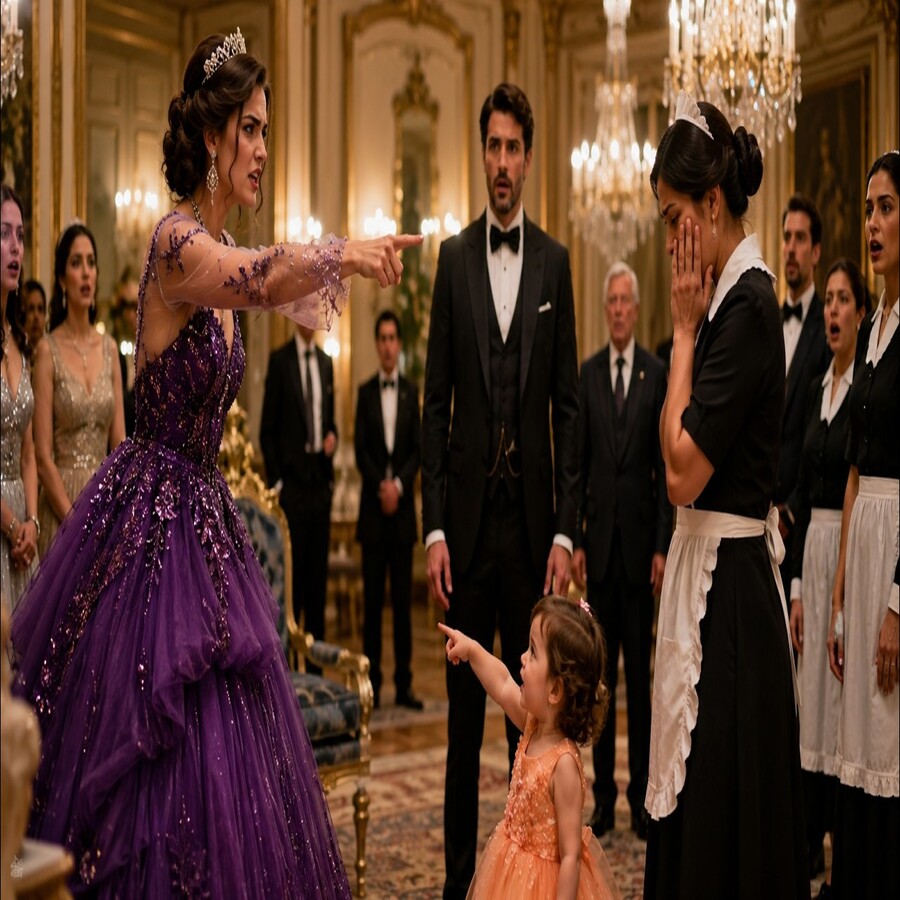
She was three years old. She didn’t know what money was. She didn’t know what power was. She didn’t know that some rooms in that house were off-limits or that some people weren’t supposed to be spoken to. She just knew her mother was crying.
And she walked right into the middle of a dinner party in front of forty guests in a $12 million home and said something so honest, so pure, so devastating that the entire room went silent. The fiancée’s face changed. The billionaire’s hands went still. And suddenly nobody could pretend anymore.
What exactly did that little girl see?
The first cold morning of November had come to Newport, Rhode Island, like it always did. Quietly, without apology. The harbor mist sat low over the water, thick and gray, pressing against the old stone walls of the mansions that lined Bellevue Avenue like they owned the sky—which in a way, some of them did.
The trees had gone copper and rust weeks ago, and now their last leaves clung to the branches with a kind of stubbornness that felt almost human. The air smelled like salt and wood smoke and the particular kind of quiet that comes before something shifts.
Inside Weston Hall—a nineteenth-century estate that had been bought, gutted, and restored by one of the most quietly powerful men in New England—the morning started the same way it always did. The kitchen lights came on at 5:45. The coffee was ground by 6:00. And by 6:15, Maria Delgado had already mopped the East Hallway, started the first load of linens, and was kneeling beside the small portable crib she was never supposed to keep in the laundry room, whispering soft Spanish words to the little girl still sleeping inside it.
Her name was Lily. Three years old. Wild black curls and a laugh that could fill any room she walked into. She slept the way only very young children sleep—completely without reservation, one chubby hand pressed against her cheek like she was thinking about something wonderful. Maria watched her for a moment longer than she meant to. Then she stood up, straightened her uniform, and went back to work.
Maria Delgado was thirty-four years old, though she looked younger in the mornings and older by night. She had come to the United States from Oaxaca eleven years ago, through channels that had cost her family more than money, and she had been working in private households ever since. She was good at her job—not just technically, but in the deeper way that matters in homes like these.
She knew when to be invisible. She knew when a door needed to be left slightly ajar versus firmly closed. She knew which surfaces Mr. Caldwell preferred wiped with a microfiber versus the cotton cloth. And she had never once needed to be told twice.
James Caldwell, the man who owned Weston Hall, the man whose laundry she folded and whose schedule she memorized and whose preferences she had cataloged over four years of quiet service, was forty-five years old and had the kind of presence that made rooms rearrange themselves around him. He wasn’t loud. He wasn’t cruel. He was simply certain in the way that men who have never had to doubt themselves become certain, and that certainty radiated outward in every direction.
He had made his money in logistics and private infrastructure—the unglamorous backbone of how things move from one place to another across the country. He didn’t give interviews. He didn’t attend galas unless forced. He had a small circle, an appetite for solitude, and a house full of expensive things he barely looked at.
Maria had worked for harder men. She stayed because the pay was fair, because the house was orderly, and because—though she never said this out loud—Mr. Caldwell had once seen her crying in the pantry after a phone call from home and had left a card on the kitchen counter the next morning. It didn’t say much. Just: “Take whatever time you need. The house will be here.”
She had kept it.
Lily had arrived at Weston Hall eight months ago, tucked into a carrier on Maria’s chest, because the daycare had fallen through and there was nobody else. Maria had prepared herself to be let go. Instead, Mr. Caldwell had looked at the baby for a long moment, then said simply, “She’s quiet.”
And Maria had said, “Usually, yes.”
And he had nodded and walked away, and nothing more was said about it. That was James Caldwell’s version of welcome.
Lily grew up in the margins of that house—in the laundry room, in the back kitchen, in the staff corridor that ran along the north side of the estate. She learned to walk on those hardwood floors. She learned her colors pointing at the flowers in the formal garden through the window. She knew the names of every room in the house, even the ones she’d never entered, because Maria had told her, “That’s the blue sitting room. That’s the library. That’s the dining hall. We don’t go in there unless someone invites us, okay, mija?”
Lily always nodded very seriously when Maria said things like that. Then she went back to whatever she was doing. The two of them had a rhythm. It was small and private and complete in the way that the lives of people who only have each other tend to become. Maria sang while she worked. Lily followed. They ate lunch together at the small table in the staff kitchen—whatever was simple, whatever was warm.
In the evenings, Maria read to her from a collection of board books she kept in a tote bag under the crib. Lily’s favorites were the ones about animals, especially the ones where the animals were clearly up to something. It was a quiet life. It was a good one, in its own way.
Then six weeks ago, she arrived.
Her name was Courtney Ross. Thirty-one years old. Polished in the way that people who’ve studied being polished become polished. She had been introduced to James at an event in Boston in the spring, and whatever had happened between them had happened quickly. The way things happen when a man who is accustomed to deciding things decides something.
She was not unkind exactly. Not in any way that could be pointed to and named. She smiled at the right moments. She thanked Maria when she brought her coffee. She complimented the way the linens were turned down. But there was something else. Something Maria noticed but couldn’t quite shape into words.
It was the way Courtney’s eyes moved through a room—not taking it in but accounting for it. Cataloging. The way she asked questions that sounded like curiosity but felt like measurement. And it was the way she looked at Lily. Not with warmth. Not even with the mild indifference most guests showed. It was something quieter and colder than that. A kind of awareness. As if Lily were a variable in an equation Courtney was still working out.
Maria told herself she was imagining it. She had learned over eleven years that the imagination of a woman in her position could become her worst enemy if she let it. She had learned to doubt her own instincts in the houses of wealthy people. She had learned to smooth things down. So she smoothed it down. She went back to work. She watched Courtney Voss move through James Caldwell’s house like she was already measuring the walls for new curtains, and she tried not to notice that Lily had stopped singing in the mornings.
Something was changing in the house, and it had the specific texture of change that no one talks about. The kind that happens between the lines of ordinary days.
Started small, the way most things do. Three weeks after Courtney began spending weekends at Weston Hall, James started closing his office door in the mornings. He had never done that before. Maria had always been able to move through the East Hallway freely, collecting the occasional cup he’d left on a side table, straightening the throw on the reading chair by the window. Now the door was closed by 8:00 a.m., and she could hear voices behind it. Low ones. The kind that stop when footsteps approach.
She didn’t think too much about it. What she did think about was the afternoon James stopped her in the main corridor and, with the particular gentleness of someone who doesn’t quite know how to soften a thing, said, “Maria, we’re going to be hosting more. Courtney’s going to be here most weeks now.” He paused. “I’d like the house to feel—” another pause “—different. She has some ideas about the staff arrangements.”
Maria had nodded. “Of course, Mr. Caldwell.”
He had looked at her for a moment like he was going to say something else. Then he hadn’t.
She understood what “staff arrangements” might mean. She had been here before, in other houses, when a new person arrived and the old order had to make room. She had always survived it by being indispensable. She would do that here, too. She would be better, quieter, more precise. She would keep Lily out of the way.
What she hadn’t expected was that Lily would be the one thing that couldn’t be managed.
Because Lily, at three years old, had no concept of staff arrangements or new dynamics or the careful geography of a house that was reorganizing itself around a new center of gravity. Lily had a concept of warm and cold. She had a concept of “this person smells like safety” and “this person makes the air feel different.” And from the very first weekend Courtney had arrived at Weston Hall, Lily had gone quiet around her—with the focused silence of a small animal that has sensed something it can’t name.
Children know. That’s the thing people keep forgetting. They don’t have the words yet, but they have the knowledge. They carry it in their bodies before they can translate it into thought. And Lily, who climbed into the laps of every housekeeper and groundskeeper with cheerful indiscrimination, who had once tried to befriend the exterminator, who greeted the grocery delivery driver by name every Thursday, had never once approached Courtney Voss.
Courtney, for her part, had not encouraged it.
There had been one moment, a Sunday afternoon in October, golden and warm, the kind of day Newport does better than almost anywhere else. Maria had been arranging flowers in the front hall—Courtney’s instructions, specific and exacting—when Lily had toddled in from the back hallway, dragging a stuffed rabbit by one ear. She had stopped in the doorway and looked at Courtney, who was sitting on the settee scrolling through her phone.
“Hi,” Lily had said.
Courtney had looked up. Smiled. The smile did not travel to her eyes.
“Hi,” she said.
And then she looked back at her phone.
Lily had stood there for another second, doing the math that three-year-olds do when the world doesn’t respond the way it’s supposed to. Then she turned around, found Maria’s leg, and held on to it. Maria had kept arranging flowers, but the thing that cracked her open slowly, like a fault line rather than a break, was what happened the following Wednesday.
She had been asked to set up the small sitting room off the main hall for what Courtney called a “planning session.” Maria had brought in a tray of coffee and fruit and set it on the side table. And she had turned to leave when she heard Courtney on the phone in the adjoining room, the door slightly open. She wasn’t trying to listen. She truly wasn’t. But then she heard her name.
Not “Maria.” “The maid.”
And then: “I don’t understand why James allows it. It’s unprofessional. This isn’t a daycare. It needs to be addressed before the engagement dinner.”
Maria had walked out of the room carefully. She had closed the door behind her with both hands because she knew if she didn’t, it would shake. She spent the rest of the afternoon being very precise about every task she completed.
The engagement dinner. That was the next thing.
James had told her about it two weeks prior. A formal gathering, forty guests, the first official introduction of Courtney as his future wife. The kitchen would be catered, but Maria was responsible for the house. The flowers, the candles, the linens, the table setting, the coordination of every detail that made a space feel like it had been waiting for exactly this occasion.
She was good at this. She had done it before. She would do it again. She told herself in those two weeks that she was overthinking everything. She told herself that Courtney was simply a person who liked order. And order and cruelty were not the same thing. She told herself that James was a good man—she knew this, had seen evidence of it—and that good men did not choose monsters to marry.
She told herself a lot of things.
She made arrangements for a neighbor to watch Lily on the night of the dinner. The neighbor confirmed. The plan was set. On the morning of the dinner, the neighbor called. Her own child had a fever. She was so sorry. She couldn’t take Lily.
Maria had stood in the laundry room with the phone in her hand and done the calculation she had hoped she would not have to do. There was no one else. There was no time. The house needed her for the next twelve hours, and there was nowhere else for Lily to go.
She had kept her daughter in the staff quarters all evening, fed her early, read her the animal book twice, got her into pajamas and down in the crib by 7:00, said a quiet, private prayer that Lily would sleep through all of it.
Lily had other plans.
And the house by 9:00 that night was full of people who were about to learn something they hadn’t been invited there to hear.
The dinner was going beautifully. That was the word people would use afterward in the awkward retellings at brunch tables and in text messages sent late at night. It was going so beautifully.
The table was set with ivory linens and low candlelight and the kind of flowers that look effortless because someone spent six hours making them look that way. The guests were the right mixture of old money and new influence. People who knew how to be at a table like this, who knew the difference between enjoying something and performing the enjoyment of it.
James sat at the head. Courtney sat beside him, her hand resting near his on the white cloth. Her dress, the precise shade of burgundy that made her look like she’d been born into this room. She was radiant. She was at ease. She was, in every visible way, exactly the woman that belonged in this house, at this table, beside this man.
Maria moved through the edges of the evening like she always did—present without being seen, attentive without being intrusive. She refilled water glasses and coordinated with the catering staff and straightened a centerpiece that had shifted by half an inch. She checked twice that the staff corridor door was latched. She had been running on adrenaline and prayer for four hours.
It was somewhere between the main course and the dessert service—that long, warm plateau of a dinner where the wine has done its work and the conversation has loosened and people stop being careful—that Courtney stood to make a small toast. It wasn’t planned, or if it was planned, it hadn’t been communicated to Maria.
Courtney tapped her glass with a light, graceful hand, and the room settled into quiet. She spoke beautifully. Of course she did. She talked about James in the way that people talk about someone when they want the room to understand how well they know them. Specific details, warm laughter, the careful construction of intimacy as a public performance. The guests smiled. James looked at her with the expression of a man who had decided and was at peace with the decision.
Maria was standing at the far edge of the room. She heard the staff corridor door open. She looked, and her heart stopped.
Lily stood in the doorway in her pajamas—the ones with the small yellow stars—rabbit tucked under one arm, dark curls loose around her face, blinking in the candlelight with the solemn curiosity of a child who has just woken up in the middle of something large and doesn’t yet know what it is.
Maria moved. She moved immediately, cutting along the wall toward the doorway, willing herself to get there before anyone noticed, before Lily stepped further in, before—
“Who is that?”
It was Courtney’s voice. The room had followed her gaze. Forty heads had turned. Lily stood in the warm glow of the dining hall light, looking out at all of them without fear, because she was three, and she did not yet know that she was supposed to be afraid of rooms like this.
“I’m so sorry,” Maria said, reaching her daughter, reaching for her hand. Her voice controlled and quiet and apologetic in the way she had trained herself to be apologetic in these houses. “I’ll take her back immediately. I’m so sorry for the interruption.”
She felt Lily’s small hand close around her fingers. She was turning. She was almost out. And then Courtney Voss’s voice, clear and carrying and cold as a blade, cut across the room.
“James.” Not a question. A statement of something. “I told you this needed to be handled. I told you weeks ago. This—” A pause, and in that pause was a whole architecture of contempt. “—is not appropriate. She shouldn’t be here. Neither of them should.”
The room went very still. James said nothing. Courtney continued, and her voice had found its edge. Not the warm toast voice, not the gracious hostess voice, but the voice of a woman who had been calculating quietly for months and had decided it was time to collect.
“I have been patient. I’ve been understanding. But I will not have the help bringing their personal problems into my home on the night of—”
“My home.” It was James’s voice. Quiet. Final. A different kind of silence fell. But before anyone could breathe or adjust or smooth the moment over, Lily stepped forward. She stepped out from behind Maria’s leg, and she looked directly at Courtney Voss.
And in the absolute clarity that only very small children and very old people seem to possess, she said:
“How dare you? She is my mother.”
No one moved. Lily had heard the phrase somewhere—perhaps from a movie, perhaps from the television in the staff kitchen, perhaps from some place in the fabric of language that children absorb before they understand—but she had deployed it with a precision that no coaching could have produced. She said it the way she said everything. Simply, completely, without any awareness that it would shatter something.
Courtney stared at the child. Maria’s hand covered her mouth. James Caldwell looked at his fiancée. And for the first time in months—perhaps for the first time in the entire arc of their relationship—he looked at her without the filter of wanting to see something particular. He just looked.
What he saw in her face in that moment was not embarrassment. It was not surprise. It was not even anger, exactly. It was the expression of someone whose mask had slipped. The microsecond rearrangement of a face that has been performing softness for so long that when the performance cracks, what’s underneath is startling not because it’s monstrous, but because it’s simply nothing warm. Nothing warm at all.
It lasted less than two seconds. Then Courtney laughed lightly and said something about children being unpredictable and reached for her wine glass. But the room had seen it. James had seen it. Maria, standing with her daughter’s hand in hers, tears she was refusing to shed pressing against the back of her eyes, had seen it too.
She had seen all of it. The contempt, the calculation, the cold arithmetic behind every smile that had ever been directed at her. She had known it in her body for months and had doubted that knowing and had smoothed it down. And now here it was laid bare in a dining room full of strangers by a three-year-old in star pajamas clutching a rabbit.
Maria looked down at Lily. Lily looked up at her. And then Lily, because she had done what she came to do and she was also very tired, leaned her head against Maria’s leg and said quietly, “Can we go to bed now, Mama?”
Maria picked her up. She carried her out.
Behind her, the dining room remained silent for a long moment. Long enough for everyone to understand that the evening, and possibly much more than the evening, was over.
She hadn’t slept. She hadn’t cried. She just sat with it.
Maria sat in the staff kitchen at 2:00 in the morning with a cup of tea she had stopped drinking an hour ago. The house was quiet now. The caterers had gone. The guests had gone—some quickly, some with the delayed shuffle of people who sense they’ve witnessed something they’ll be talking about for years. She had heard the cars leaving from the window of the laundry room where she had sat with Lily until her daughter’s breathing had gone slow and deep and certain—the way it only was when she was fully, completely asleep.
Then she had come here. She sat with her hands around the cold cup and she went through it all. Not in a spiral, but in the deliberate way of someone who has been surviving hard things for a long time and knows that the only way through is to look directly at what is. She looked at all of it. The phone call she hadn’t made. The door she hadn’t latched properly. The moment she should have picked Lily up and turned around faster before the room had time to turn and see.
And then Courtney’s voice. “The help.” The way she had said it—not spitting it, not hissing it, but dropping it like a thing that had no weight and therefore needed no care. Like a word that meant “below consideration,” “below the line of what requires treatment.”
Maria had heard versions of that word her whole life, in different houses, different states, different languages. She had always known how to carry it. You tuck it somewhere internal, somewhere padded and protected, and you keep moving because the alternative is not available to you. But Lily had said, “She is my mother.” And Maria sat in the kitchen at 2:00 in the morning and let that sentence move through her like something she hadn’t known she needed.
She is my mother. Not a polite correction. Not a plea. A fact spoken by the only person in that room who had no reason to soften it.
The knock came at 6:45. She had been awake. She had not changed. She answered the door to the staff corridor, and James Caldwell was standing on the other side of it in a sweater and jeans, which was not how he had ever appeared at her door before. He looked like he hadn’t slept either. He was holding two paper cups of coffee from the cafe two blocks over, which he had apparently walked to get, which was also not something she had ever seen him do.
He held one out to her. She took it.
“I owe you an apology,” he said.
She didn’t say anything.
“I heard things,” he continued carefully, “weeks ago, about conversations she was having about—” He stopped, restarted. “I didn’t want to see it. I made it easier for myself not to see it. That was a failure, and it affected you and your daughter, and I’m sorry.”
Maria looked at the paper cup in her hands.
“Mr. Caldwell—”
“James.” He looked up. “I need to ask you something, and I need you to answer honestly, even if you think the honest answer isn’t the one you’re supposed to give me.”
She waited.
“Do you want to stay in this house? In this job?” He looked at her directly. “Because I understand if the answer is no. I would understand that completely, and I will give you whatever you need to make leaving easy. But I’m asking because—” He stopped again, and she could see him working something out in real time. The particular labor of a man who has not been wrong often and is learning how to be wrong in front of someone. “Because you have been here four years, and you have never once made this house feel like a place I needed to perform in. And I don’t have many spaces like that.”
Maria was quiet for a long time. Then from down the hallway came the small thumping sound of a child dropping out of a crib onto a floor—which Lily had been doing for months with the confidence of someone who had never once been hurt by it. A moment later Lily appeared in the doorway. She was wearing her star pajamas and carrying the rabbit, and she looked at James Caldwell with the interested assessment of a person evaluating a new situation.
“Hi,” she said.
“Hi,” said James.
Lily considered this. Then she walked over to Maria, wrapped both arms around one of Maria’s legs, and looked back up at James.
“My mama made good coffee,” she said. “She can teach you.”
James looked at the paper cup in Maria’s hands, then at Maria. Something in his face shifted. Not dramatically, not with any announcement, but the way a room shifts when a window is opened and the air changes. He almost smiled.
And Maria realized, standing there in the staff corridor with her daughter attached to her leg and a cup of coffee she hadn’t asked for, that the thing she had been managing—the careful calculus of making herself small enough to be safe—had cracked open somewhere in the last twelve hours. Not dramatically. Not all at once. But enough.
She thought about what it would mean to stay. She thought about what it would cost. She thought about Lily growing up in the margins of a house that was being rearranged around a woman who looked at her child like a variable in an equation. She thought about last night. About the dining room, the candlelight, the cold, contemptuous drop of “the help.” And she thought about what it would mean to let that be the last word.
Then she thought about “She is my mother.” About the utter, uncomplicated certainty in that voice. About the way Lily had stepped forward instead of backward. She thought about what it would mean to have raised a child who, at three years old, in a room full of strangers, when the person who mattered most to her was being diminished, had stepped forward.
She made her choice. She didn’t announce it. She didn’t deliver it like a resolution. She just shifted her weight and looked at James Caldwell and said simply, “I’ll stay. For now.”
He nodded, and she saw in the nod something that was not quite relief, but was close to it. The particular exhale of a man who has been holding something without knowing it and has just been allowed to put it down.
Lily was already wandering toward the refrigerator, rabbit dragging, entirely confident in the outcome of negotiations she had not attended.
The thread was thin. Maria knew that. There was still everything to reckon with. The engagement that had cracked in public. The house that had been reorganizing itself around a center that was now gone. The gossip that would travel and the questions that would come. The new, uncertain geography of what this place was going to be now.
But for this one morning, the coffee was warm and Lily was nearby. And one small thing had been chosen.
Some things can’t be undone. But some things don’t need to be.
It was the second week of December when the house began to feel like itself again. Not the version of itself that had been polished and curated for a performance that was now over. But something older and quieter and more true to what it had actually always been. A large, well-built place that happened to contain the lives of the people moving through it.
Courtney Voss had not returned after the dinner. There had been no dramatic confrontation, no formal ending, no scene worthy of the buildup. James had simply, in the days that followed, gone through the particular quiet work of disengagement. Calls made. Objects collected. A brief and dignified conversation Maria had not been present for and had not asked about. These things ended the way they ended. Whatever had been said between them had stayed between them.
What emerged on the other side was a house that felt, in the absence of all that careful staging, somehow larger. Maria noticed it in small ways. The closed office door was open again. The staff corridor felt like a corridor again, not a perimeter. James stopped appearing at her doorway with the careful energy of someone managing a situation and started appearing at her doorway the way he had before. Briefly, practically, sometimes with a question about the grocery order, sometimes with nothing at all. Just a passing acknowledgement of shared occupancy.
She didn’t read into it. She was careful not to read into it. She had learned, in the way that careful people learn, to hold good things lightly because holding them too tight was how you deformed them. She let the weeks be what they were.
Lily had no such restraint. Lily, having decided that James Caldwell was a person worthy of her interest, proceeded to insert herself into his life with the single-minded persistence of a small mammal who has identified a new food source. She appeared at his office door—now always open—with the regularity of someone who had been given access she had not technically been given. She brought him things. A rock from the garden. A drawing done in purple crayon that was meant to be a dog but looked more like a weather event. A half-eaten cracker offered with the solemnity of a gift.
He accepted all of it. Maria watched this from a careful distance and told herself she was simply observing and was not, under any circumstances, being moved by it.
She was absolutely being moved by it.
The moment she hadn’t expected came on a Tuesday morning two weeks before Christmas, when she was reorganizing the linen closet on the second floor and found, tucked behind a stack of guest towels that hadn’t been moved in years, an old photograph in a small silver frame. It was a picture of a woman she didn’t recognize. Dark-haired, laughing, one hand pressed against her cheek in a gesture that was somehow familiar. On the back of the frame, in small, careful handwriting: “Eleanor, 1999.”
She brought it to James later that afternoon, thinking it had been forgotten in the reorganization. She held it out to him and said simply, “I found this. I thought you’d want it.”
He looked at it for a long moment. “My mother,” he said. He didn’t look up right away. “She died when I was twenty-two. I thought I’d lost this.”
Maria stood there, not sure what to do with the weight of that. She said, “She looks like someone who laughed a lot.”
He looked up then. “She did,” he said. “She really did.”
He held the photograph carefully, the way you hold something you thought was gone. And Maria, standing in the doorway of his study on a December afternoon with cold light coming through the tall windows, understood something she had been circling for months without quite reaching. She understood that James Caldwell was not simply a man with a large house and a good paycheck and a recently dissolved engagement. He was a person who had lost things and who had built a life around the careful management of loss and who had, somewhere in the middle of four quiet years and a toddler who brought him rocks, started to let the management slip.
She also understood, quietly and without drama, that she had done the same thing. She had spent eleven years being so careful, so professional, so precisely occupying the space she was allowed to occupy—no more. She had shrunk herself for so long she’d started to believe the smaller shape was the true one.
Lily had never believed that. Lily, who stepped forward instead of back. Lily, who said “She is my mother” in a room full of people who were betting on Maria’s silence. She thought about what her own mother had told her years ago in Oaxaca, before the crossing, before the hardness that followed. “You don’t have to earn the right to take up space, mija. You were born with it. Don’t give it away.”
She had given it away many times, in many rooms, in many houses where she had made herself invisible because that was the cost of surviving in them. But Lily had held her ground for her. A three-year-old in star pajamas had held her ground. The least she could do was hold it herself going forward.
The Christmas that year was not a party or a performance. It was James and Maria and Lily and the house, which was, it turned out, a perfectly sufficient group of people for a very good meal. Lily wore a dress with a velvet collar and fell asleep at the table before dessert and had to be carried to bed, which James did without being asked, which Maria watched from the kitchen doorway with her arms crossed and something warm and cautious and beginning blooming in her chest.
She didn’t name it. She wasn’t ready to name it. But she let it be there.
The world does not always give us clean endings. It does not always arrange itself around a lesson with clean edges and a bow on top. What it gives us sometimes, if we’re very lucky and we stay awake enough to notice, is a single moment of honesty in a room full of performance, a small hand in ours, a photograph of someone who laughed a lot, a cup of coffee held out by someone who walked two blocks to get it.
And we get to decide what we do with those moments. We get to decide whether we smooth them down and keep moving or whether we let them mean what they mean. Maria had spent eleven years smoothing things down. She thought she’d probably earned the right to stop.
If you’re carrying something tonight that you’ve been making smaller so that others can be more comfortable, maybe this story is the permission you’ve been waiting for. You don’t have to make yourself that small. You never did. The space you take up is not a problem. It is simply you.
And you were here all along.
THE END.
Disclaimer : This content may be created by AI for entertainment purposes. Any resemblance to real persons, events, or places is coincidental.






