The Girl He Called A Cockroach Didn’t Just Fix His Jet — She Exposed The One Secret That Could Destroy Him Forever.
═══════════════════════════════════
Part One: The Girl At The Fence
The wrench felt heavy in Faith’s hand.
She’d borrowed it from Old Tommy at the diesel shop. She’d promised to return it by sunset. The sun was bleeding orange over Houston’s skyline, and she was standing on the wrong side of a chain-link fence, watching mechanics walk past her like she was invisible.
That was fine. Invisible kept her alive.
Three blocks away, her cargo van sat in a gravel lot. Inside it, a sleeping bag, a propane stove, and her grandfather’s canvas tool roll. Everything she owned in sixty square feet.
And here, on two hundred acres of Caldwell Aerospace Industries, stood the problem she couldn’t stop thinking about.
The CA-90.
Twin engines. Next generation executive jet. One hundred million dollars of beautiful, useless metal sitting in Hangar Three like a museum exhibit.
Faith had been watching it for six weeks. She’d read every newspaper article left on park benches. She’d studied the FAA technical bulletins at the Houston Public Library until the librarians started recognizing her face.
Forty-eight days grounded. Fifty mechanics failed. Eight million dollars wasted.
And nobody had checked the crossfeed valve.
Faith pressed her face against the chain-link fence. Squinted through her borrowed binoculars. Hangar Three’s main bay door was open, revealing the jet’s silhouette against fluorescent lights. Mechanics milled around it like ants around a dead beetle.
She knew what they were doing. Running the same diagnostics. Replacing the same parts. Getting the same result.
Ninety seconds. Shut down. Fault code.
She’d seen the pattern from six weeks of observation. Left engine failed first, every time. Symmetrical shutdown within three seconds of each other. That wasn’t an engine problem. That was a system problem.
The system that connected both engines.
The crossfeed valve.
Faith lowered the binoculars. She was trembling. Not from cold. From the certainty building in her chest like pressure before a storm.
She knew what was wrong. She could feel it the way Elton had taught her to feel things. Start with what you hear, then what you smell, then what you feel.
She’d heard the engines from the fence line. The rhythmic stutter every eight seconds. She’d smelled the faint chemical trace in the exhaust. She’d seen the mechanics walk past the wiring harness bracket without touching it.
One bolt. Undertorqued. Three foot-pounds instead of sixteen.
That’s all it was.
Faith exhaled slowly. Her breath fogged the chain link.
She was twenty-two years old. Black. Homeless. She lived in a cargo van and fixed small engines for cash. She had no degree, no credentials, no badge that opened doors.
She had nothing except her grandfather’s voice in her head.
A machine don’t care who you are. It only cares if you’re right.
She tucked the binoculars into her jacket and started walking back to her van.
Tomorrow, she’d come back. She’d find a way in.
She had to.
The first time Faith Brooks entered Caldwell Aerospace, she came through the side gate with a visitor’s pass.
Neil Garrison had arranged it. Senior lead mechanic. Forty-five years old. Quiet hands. Quiet voice. The kind of man who kept his head down and his work clean.
He’d met Faith at the fence the day before. Denise Campbell had brought him there. Denise was the facilities coordinator, a thirty-four-year-old Black woman who showed up early and stayed late. She’d watched Faith study the jet from the perimeter for three straight days.
“She knows something,” Denise had said. “I don’t know how, but she knows.”
Neil hadn’t laughed. Fifty failures made a man flexible.
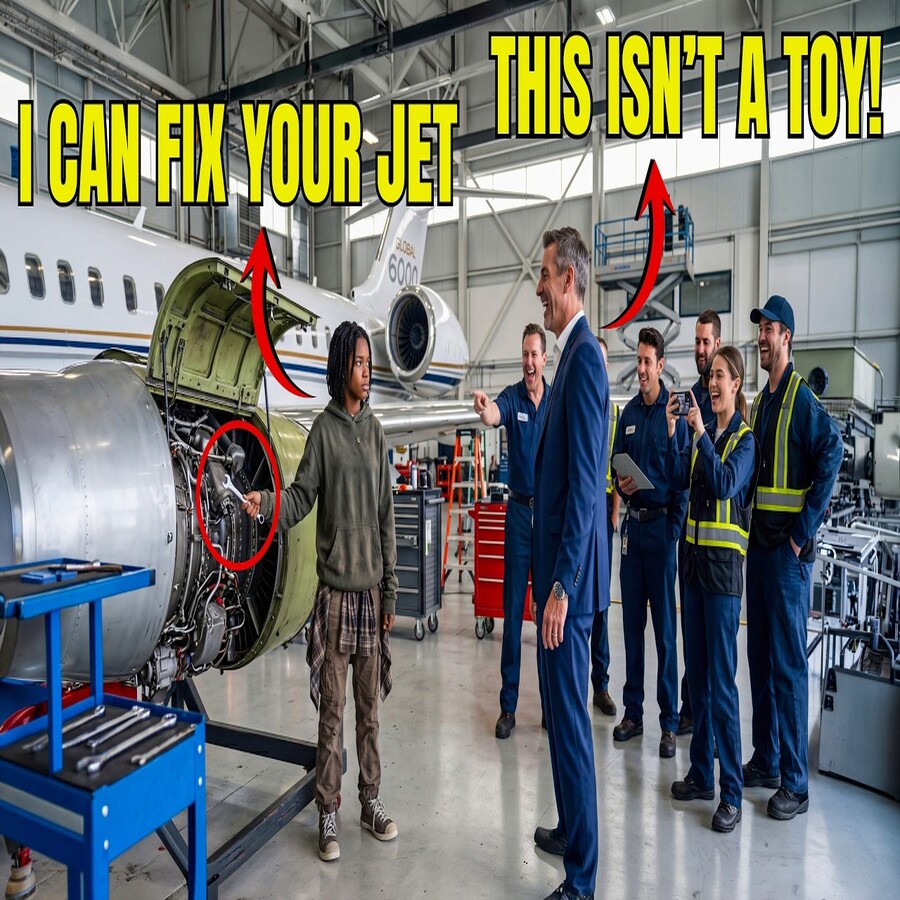
Now Faith stood in Hangar Three, wearing a second-hand mechanic’s jumpsuit, her dreadlocks pulled back, her grandfather’s tool roll under her arm.
The room went quiet when she walked in.
She didn’t look at the mechanics. She didn’t look at the executives. She walked straight past Todd Whitmore—VP of Engineering, thirty-eight years old, measuring people by their badge level—and stopped in front of the open engine nacelle.
She leaned in.
She listened.
The residual tick of cooling metal. The faint whisper of trapped heat escaping. The smell of jet fuel and something else. Something wrong.
She ran one finger along the fuel line. Felt for micro-vibrations. Found none.
She turned to Neil.
“The fuel manifold pressure behavior. When you start both engines, does it dip on the left side first?”
Neil went completely still.
“How did you—”
“Because the shutdown is symmetrical. That’s not an engine problem. It’s a system problem.” She pointed to the crossfeed valve housing. “Has anyone checked that?”
Todd Whitmore stepped forward. His voice carried across the hangar.
“Who let you in here?”
Neil stepped between them. “She’s with me, Todd. Consultant observation.”
Todd looked Faith up and down. Slowly. Deliberately. The way you look at something stuck to your shoe.
“This is a restricted aerospace facility, Neil. Not a community outreach program.”
A few mechanics chuckled.
Faith didn’t respond. She walked past Todd back to the engine nacelle. She pulled out a small flashlight and peered into the wiring harness bracket.
She saw it immediately.
The bolt. Mounted crooked. Slightly raised on one side.
Faith straightened. She looked at Neil.
“Come back tomorrow. I’ll bring my own torque wrench.”
Neil stared at her.
“What did you see?”
Faith met his eyes.
“Someone torqued that bracket to three foot-pounds instead of sixteen. The harness shifts under vibration. Every eight seconds. That’s cycling the crossfeed valve. That’s starving the left engine. That’s your problem.”
The hangar went silent.
Neil slowly pulled off his cap. He pressed it against his chest.
“One bolt,” he whispered.
Todd Whitmore’s smirk was gone.
Something had shifted in Hangar Three. Something nobody could take back.
Part Two: The Demonstration
Dr. Lorraine Sutter arrived on Day Fifty.
She was sixty-two years old. Former NASA propulsion engineer. Thirty years of designing engines that never failed, not because they couldn’t, but because she refused to let them.
Preston Caldwell had brought her in as an independent evaluator. She was the industry’s biggest gun. When Dr. Sutter said an engine worked, the FAA didn’t argue.
Preston had run out of options.
He’d spent fifty days and eight million dollars failing. His $100 million jet was grounded. His Pentagon contract was sixteen days away. His stock had dropped twelve percent.
And now he was in a conference room, sitting across from a homeless girl who claimed she could fix what fifty mechanics couldn’t.
Faith sat with her hands flat on the table. Her grandfather’s tool roll between them.
Dr. Sutter didn’t introduce herself. She didn’t make small talk. She looked at Faith and said:
“Tell me what’s wrong with that aircraft.”
Faith told her.
Six minutes. No notes. No hesitation.
Crossfeed valve system. Fuel distribution architecture. Sensor feedback loop. Specific failure mode in the butterfly valve’s position sensor, triggered by a loose wiring harness bracket that caused a false signal. The false signal cycled the valve every eight seconds. The abnormal cycling overheated the fluoroelastomer O-ring. The degraded O-ring released trace contaminants into the fuel line. The contaminated fuel destabilized combustion in the left engine. The instability cascaded until both engines read a flameout condition and shut down.
She laid it out step by step. Each link in the chain. Each failure compounding the next.
Dr. Sutter asked three follow-up questions.
Each one tested whether Faith truly understood the system or had simply memorized terminology.
Faith answered all three without pausing.
Dr. Sutter removed her glasses. She cleaned them slowly with the hem of her blazer. She put them back on.
“I’d like to see you demonstrate this,” she said.
The next morning, Hangar Three was full.
Dr. Sutter had used her authority as independent evaluator to authorize a diagnostic demonstration. She’d invited Preston, Todd, the entire engineering team, and a freelance tech journalist named Colleen Archer.
Colleen walked in with a recorder and smelled blood in the water.
Preston saw Faith standing near the engine nacelle. His face went dark red.
“Lorraine, you can’t be serious. You’re staking your professional reputation on a street kid?”
Dr. Sutter didn’t look at him.
“I’m staking my reputation on evidence, Preston. Something your team hasn’t produced in fifty days.”
Todd tried to shut it down. Safety protocols. Liability concerns. Security clearance requirements. Insurance restrictions. Every procedural roadblock he could think of.
Dr. Sutter let him finish.
“As independent evaluator appointed by your CEO, I have full authority to approve diagnostic personnel. This demonstration will proceed.”
Todd opened his mouth. Closed it. Stepped back.
Faith stood in front of the CA-90’s open engine nacelle.
Thirty people watched. Preston with his arms crossed. Todd against the far wall. Colleen’s recorder running. Dr. Sutter at the diagnostic console beside Neil.
Faith unrolled her grandfather’s canvas tool kit.
The tools inside were old. Worn. Some re-handled with electrical tape. They looked like they belonged in a museum.
Faith looked at Neil.
“Start the engines.”
Neil glanced at Dr. Sutter. She nodded once.
He initiated the start sequence.
Both engines spooled up. The sound filled the hangar—a deep building roar that vibrated in your chest.
Thirty people held their breath.
Faith closed her eyes.
She listened.
The engines idled rough. Unstable. The same rhythm fifty mechanics had heard for fifty days.
To everyone in that hangar, it sounded like a sick engine doing what sick engines do.
To Faith, it sounded like a conversation.
She held up one finger. Not to the crowd. To Neil.
“Wait.”
Eight seconds passed.
She held up two fingers.
Eight seconds.
Two fingers again.
She opened her eyes.
“Kill the right engine. Keep the left running.”
Neil hesitated. You don’t run a twin-engine jet on one side inside a hangar without safety clearance.
Dr. Sutter gave the nod.
Neil shut down the right engine. The left kept running.
The idle smoothed out. Not perfectly. But noticeably. The stutter that had been cycling every eight seconds reduced to almost nothing.
“Now swap. Right engine only.”
Neil restarted the right. Killed the left.
Same result. The right engine ran rough, but without the rhythmic stutter.
Faith turned to Dr. Sutter.
“It’s not the engines. It’s what happens when both engines run together.”
She asked Neil to pull up the fault logs. Not the summary reports. The raw data. Millisecond-level timestamps.
“Overlay them. Left and right. Same time axis.”
Neil did it.
The data appeared on the screen. Two lines running side by side.
There it was.
A tiny dip in fuel pressure on the left engine lasting three-tenths of a second appearing exactly every eight seconds. Every single dip lined up with a corresponding spike in the right engine’s fuel flow.
Nobody had seen it before.
Because nobody had looked at both engines at the same time.
“Your crossfeed valve is cycling,” Faith said. “Every eight seconds. It pulls fuel from the left engine feed line for three-tenths of a second. Not enough to trigger an alarm. But enough to destabilize combustion. Run it for ninety seconds and the instability cascades. Both engines read it as a flameout condition and shut down.”
The room was silent.
Neil was staring at the overlaid data like he was seeing it for the first time.
Because he was.
Todd Whitmore spoke from the back wall.
“That’s a coincidence, not a diagnosis. A three-tenths of a second fuel dip doesn’t ground an aircraft.”
Faith didn’t look at him.
“Fifty of them in ninety seconds does.”
Part Three: The Smell
Faith asked Neil to restart both engines.
When they spooled up, she did something nobody expected.
She walked away from the diagnostic console. Away from the engine nacelle. She walked downwind, about twenty feet behind the left engine’s exhaust port.
She stood there. Breathing slowly through her nose.
Todd laughed. “What’s she doing now, yoga?”
Nobody else laughed.
Faith stood for forty seconds. Then she came back.
“There’s a chemical in the left engine exhaust that shouldn’t be there. It’s faint. Almost nothing. But it’s there. It smells like burning plastic mixed with vinegar.”
She turned to Neil.
“Your crossfeed valve has a fluoroelastomer O-ring that seals the internal chamber. That O-ring is degrading. The smell is the rubber breaking down under heat stress. It’s been cooking every time the valve cycles.”
She explained it simply.
Fluoroelastomer. FKM rubber. Standard in aerospace fuel systems. Built to handle extreme temperatures.
But it has a limit.
If the valve is cycling abnormally—opening and closing thousands of times more than it should—the O-ring heats past its rated threshold. It starts to decompose slowly. Microscopically.
The decomposition releases trace volatile compounds into the fuel stream. Not enough to trigger chemical sensors. Those sensors are calibrated for major contamination.
But enough to affect combustion stability.
“Pull a fuel sample from the left engine’s direct feed line,” Faith said. “Not from the tank. From the line after the crossfeed valve.”
Neil drew the sample.
He held it under the hangar’s fluorescent lights.
There it was. A faint amber tint. So slight you’d miss it if you weren’t looking for it.
Jet fuel is supposed to be water-clear.
Any discoloration means something is in it that shouldn’t be.
Dr. Sutter stood up from her chair.
“How did you know to smell for it?”
Faith looked at her.
“My grandfather used to say your nose knows before the gauge does.”
Part Four: The Touch
Two findings. Both pointing at the crossfeed valve.
But the question remained.
Why was the valve cycling incorrectly?
A butterfly valve doesn’t malfunction on its own. Something had to be telling it to open every eight seconds.
Faith asked Dr. Sutter for permission to inspect the valve assembly.
Dr. Sutter approved it.
Faith pulled on nitrile gloves. She took a penlight from her grandfather’s tool roll. She reached into the nacelle access panel.
She didn’t go for the valve itself.
She went for the wiring harness.
The bundle of wires that carries the signal from the valve’s position sensor back to the engine control computer.
She ran her fingers along the harness slowly. Inch by inch. The way a doctor palpates for a fracture.
She followed it from the valve housing up to the bracket where the harness was supposed to be secured to the nacelle frame.
She stopped.
“Neil, hand me a torque wrench. Quarter-inch drive.”
Neil handed it over.
Faith placed it on the bracket’s mounting bolt. She turned it carefully until it engaged. She looked at the digital readout.
“Three foot-pounds.”
She held it up so the room could see.
“Spec for this bracket is sixteen foot-pounds. This bolt is finger tight. Someone put it in by hand and never torqued it.”
The room didn’t react yet. They didn’t understand.
Faith explained.
“This bracket holds the wiring harness in position. When the bolt is properly torqued, the harness is locked tight. No movement. Clean signal. But at three foot-pounds, the harness has slack. It shifts under engine vibration.”
She let that sink in.
“Every time it shifts, it sends a noise pulse through the position sensor wire. The engine computer reads that noise as a signal that the fuel tank is low on one side. So it opens the crossfeed valve to balance the tanks. Then the harness shifts back, the noise clears, the computer closes the valve. Eight seconds later, it happens again.”
She laid it out. The full chain. Step by step.
One loose bolt.
The wiring harness shifts. The position sensor sends a false signal. The crossfeed valve opens unnecessarily. The left engine gets starved for fuel for three-tenths of a second. The abnormal cycling overheats the O-ring. The O-ring degrades. Trace contaminants enter the fuel. The left engine destabilizes. The instability cascades. Both engines read a flameout condition.
Shut down.
One bolt. Three foot-pounds instead of sixteen.
That’s what grounded a hundred million-dollar jet for fifty days.
That’s what fifty mechanics, eight million dollars, and three hundred pages of diagnostic logs couldn’t find.
Because everyone was looking at the engines. Everyone was running software diagnostics and replacing turbine components and re-flashing control modules.
Nobody knelt down and put their fingers on the wiring harness.
Nobody checked a secondary mounting bracket that isn’t even on the standard diagnostic checklist.
Nobody listened to the machine.
Neil Garrison pulled his cap off his head. He pressed it against his chest.
“One bolt,” he whispered.
Dr. Sutter closed her notebook. She removed her glasses. She set them on the console.
“Fix it,” she said.
Two words.
That’s all Faith needed.
Part Five: The Fix
Faith started with the bolt.
She placed her grandfather’s torque wrench on the bracket mounting. Tightened it. Slowly. Precisely.
The click of each increment echoed through the silent hangar like a heartbeat.
Three foot-pounds. Five. Eight. Twelve. Sixteen.
The wrench clicked its final stop. Sixteen foot-pounds. Exactly to spec.
Faith tugged the wiring harness gently. It didn’t move. Locked tight. The way it should have been fifty days ago.
Next, the O-ring.
She asked Neil for a replacement. He checked inventory. Standard fluoroelastomer seal for a crossfeed butterfly valve. Part number printed on a label the size of a postage stamp.
Cost: six dollars.
Neil handed it to Faith. She held it up between two fingers so the room could see.
This tiny black ring. No bigger than a quarter. Half the reason a hundred million-dollar jet couldn’t fly.
She removed the degraded O-ring from the valve assembly. It came out discolored. Slightly warped. You could see the heat damage—a faint cracking pattern along the inner surface where the rubber had been cooked by fifty days of abnormal cycling.
Faith seated the new O-ring. Pressed it into place with her thumb. Checked the seal twice. Then a third time.
Her grandfather’s voice. Do it right or do it again.
Finally, the fuel line.
The left engine’s direct feed line had been carrying trace contaminants from the degraded O-ring for weeks. Clean fuel in. Dirty fuel out. Not dirty enough for sensors. But dirty enough to matter.
Faith disconnected the feed line at both ends. She flushed it with clean fuel. Twice.
She reconnected it. Checked every fitting. Wiped each connection point with a clean cloth until there wasn’t a drop of residue anywhere.
Total repair time: three hours.
Total parts cost: twenty-four dollars.
Three hours and twenty-four dollars. That’s what stood between Preston Caldwell and fifty days of failure.
Faith stepped back from the nacelle. She wiped her hands on a shop rag. She rolled up her grandfather’s tool kit slowly. Each tool in its pocket. The canvas folded tight. The leather strap wrapped twice and tucked.
She looked at Neil.
“Start them up.”
The hangar was completely still.
Thirty people standing in a semicircle around the CA-90. Preston Caldwell in the center, arms at his sides. Todd Whitmore against the far wall, close to the door. Colleen Archer’s recorder held at arm’s length. Dr. Sutter at the diagnostic console, her glasses back on, both hands flat on the table.
Neil initiated the start sequence.
The left engine spooled up first. A low whine that climbed in pitch, building through the hangar, filling the space the way a church organ fills a cathedral.
Then the right engine joined.
The two sounds merged into one continuous roar.
The idle stabilized. Smooth. Even. Synchronized.
No stutter. No micro-interruption. No eight-second cycle.
Just the clean, steady hum of two engines doing exactly what they were designed to do.
The diagnostic screens lit up green. Every parameter. Every sensor. Every reading.
Green across the board.
Thirty seconds passed. The point where the stutter usually began.
Nothing.
Sixty seconds.
Ninety seconds. The wall. The exact moment where every previous attempt had ended in shutdown.
The engines held.
Two minutes. The screens stayed green.
Three minutes.
Five minutes.
Faith stood motionless, watching the nacelle. Not the screens. The nacelle. Listening.
Ten minutes.
The engines ran flawlessly.
Neil pulled off his cap and pressed it to his face. His shoulders shook once. He turned away so nobody would see.
Denise Campbell watched from behind a partition near the hangar entrance. She’d come through the side door without telling anyone. Her hand was over her mouth. Her eyes were wet.
Dr. Sutter closed her notebook for the last time. She removed her glasses, set them on the console, and nodded once.
Just once.
The nod of a woman who had spent thirty years in propulsion science and still recognized brilliance when it stood in front of her wearing a second-hand jumpsuit.
Colleen Archer whispered three words into her recorder.
“I got it.”
Preston Caldwell stood alone.
He hadn’t moved in ten minutes. He hadn’t spoken. His eyes were locked on the engine gauges. The numbers were perfect. The numbers had been perfect for ten straight minutes.
And the person responsible for those numbers was a twenty-two-year-old homeless Black woman he had called a cockroach three days ago.
Faith didn’t celebrate. She didn’t raise a fist. She didn’t smile.
She just wiped her hands one more time. Tucked the rag into her back pocket. Picked up her grandfather’s tool roll.
A six-dollar O-ring. A single undertorqued bolt. And a girl from a cargo van who listened when no one else would.
Part Six: The Offer
Dr. Sutter filed her independent evaluation report the next morning.
She didn’t soften it. She didn’t dress it up in diplomatic language. She wrote it the way she’d written NASA reports for thirty years. Clear. Direct. Impossible to argue with.
Root cause: a maintenance error. One undertorqued bracket bolt that triggered a cascading failure across the crossfeed valve system, leading to O-ring degradation, fuel contamination, and symmetrical engine shutdown.
Fifty mechanics missed it because they followed standard protocol. Standard protocol treats each engine independently. The fault existed in the space between both engines—a space no checklist told them to look.
Then she wrote the part that mattered most.
Faith Brooks demonstrated diagnostic methodology that surpassed every credentialed team assigned to this aircraft. Her use of auditory, olfactory, and tactile observation identified a failure chain that eight million dollars in instrument-based diagnostics could not detect.
Dr. Sutter formally recommended that Faith be offered a permanent position in the Caldwell Aerospace Diagnostic Engineering Division. Immediately. No probation period. No conditional terms.
Preston read the report in his office with the door closed. He read it twice.
That afternoon, he sat across from Faith in a conference room. Dr. Sutter was present as a witness. So was Neil.
Preston offered Faith a full-time position.
The title: Diagnostic Systems Specialist. Dr. Sutter had insisted on that title. Not technician. Not assistant. Specialist.
But Dr. Sutter wasn’t finished.
She offered to personally sponsor Faith for the FAA Airframe and Powerplant Certification Program. The A&P license. The credential that would give Faith official standing in the industry. The piece of paper that matched what her hands already knew.
Faith sat quietly for a moment.
Then she accepted.
On one condition.
She wanted to build a mentorship program. A workshop for kids from disadvantaged backgrounds who had talent but no access. Kids like she had been. Kids who could fix anything but couldn’t get through the door.
Preston agreed without negotiation.
He was in no position to say no to anything.
That evening, Faith walked into her new workspace for the first time.
It had a door. A nameplate. Her name printed in clean black letters.
Faith Brooks
Diagnostic Systems Specialist
She set her grandfather’s canvas tool roll on the shelf beside it.
Elton would have liked that shelf.
Part Seven: The Fall
Dr. Sutter’s report had two sections.
The first was about Faith.
The second was about Todd Whitmore.
The undertorqued bolt didn’t torque itself. Somebody left it loose. And somebody signed a maintenance completion form saying every fastener in that nacelle had been checked, verified, and torqued to specification.
That somebody was Todd Whitmore.
His signature was on the work order. Datestamped. Initialed. Filed with Caldwell’s maintenance records exactly the way the FAA requires.
The form stated that all work had been inspected. All fasteners verified. All safety checks completed.
It was a lie.
Todd hadn’t checked the bracket. He probably hadn’t checked half the items on that form. He’d signed it the way he signed everything—quickly, impatiently—because the paperwork was beneath him, and the real work was for people below his pay grade.
Under FAA regulations, the person who signs a maintenance completion record takes personal legal responsibility for the accuracy of that record. It doesn’t matter if a junior mechanic did the actual work. The signature is a guarantee.
Todd’s signature guaranteed work that wasn’t done.
In the FAA’s language, that’s falsification of maintenance records. It carries fines. It carries license suspension. In serious cases, it carries criminal referral.
At Caldwell, there was no dramatic scene. No shouting match. No confrontation in the hangar.
Todd cleaned out his desk on a Friday afternoon while most of the building was in a meeting. He carried one box to his car. He walked past Faith’s new workspace on the way out.
He didn’t look inside. He didn’t make eye contact.
He just kept walking.
That silence said more than anything he could have spoken.
Part Eight: The Reckoning
Preston Caldwell’s reckoning was different.
Slower. Less official. But in some ways worse.
Colleen Archer’s article dropped three days after the demonstration.
It included everything.
Preston’s public comments about Faith. The cockroach remark. The street dog comment. The security guards. All of it. Sourced, quoted, and timestamped from the recordings that Preston himself had ordered.
The cameras he demanded to protect himself became the evidence that exposed him.
The article went viral. Not just in aviation circles. Everywhere. Social media turned it into a symbol. The hashtag #CockroachInTheCockpit trended for three days.
People shared it with one line.
They laughed at her. She fixed their jet.
Preston’s board of directors called an emergency meeting. Not about the jet. About him. About the company’s public image. About the fact that their CEO had been filmed calling a young Black woman a cockroach and a street dog.
And that woman turned out to be the only competent person in his entire organization.
Preston issued a public statement. He acknowledged Faith’s contribution. He announced a new company initiative—the Open Talent Program, designed to recruit skilled individuals regardless of traditional credentials or background.
The statement was polished. Professional. Carefully reviewed by three lawyers and a PR firm.
It was not an apology.
The narrator knows this. The audience knows this.
Some people learn from their mistakes. Some people just manage them.
Preston Caldwell was a manager.
But the door he slammed in Faith’s face was now permanently open.
And he could never close it again.
Part Nine: The Workshop
Six months later, Faith Brooks stood in her workspace at Caldwell Aerospace.
On the shelf behind her: Elton’s canvas tool roll. A stack of FAA study manuals. A framed photograph of a one-room repair shop in Baton Rouge with hand-painted letters on the sign.
In front of her: six kids in matching jumpsuits. Ages fourteen to eighteen. All from shelters. All from neighborhoods where nobody handed you anything.
They were gathered around an open engine, waiting.
Faith picked up a wrench.
She said the only thing that mattered.
“Listen to it. Machines talk to people who pay attention.”
One bolt. One girl. One chance to listen.
If you think talent only lives in resumes and corner offices, you haven’t been paying attention either.
Part Ten: The Question
Now here’s my question for you.
If you were standing in that hangar, would you have given her a chance? Or would you have laughed with everyone else?
Be honest.
Drop your answer in the comments.
And if you watched this far, there’s a detail most people missed. Go back to the moment Faith first walked into Hangar Three. Watch what Neil does with his hands.
Most viewers don’t catch it the first time.
Share this story. Someone in your life needs it today.
And subscribe—because the next story is already coming, and it’s one you’re not going to want to miss.
Three hours. Twenty-four dollars. One bolt tightened to spec.
That’s all it took while fifty mechanics and eight million dollars couldn’t.
Faith didn’t have a degree. Didn’t have connections. She had a canvas tool roll from a grandfather the world never knew—a man who faced engines in a one-room shop for forty years and taught her one thing.
Machines talk to people who pay attention.
That’s the real story here. Not that the system failed. But that the system was never designed to fight someone like Faith.
Every checklist. Every protocol. Every credential gate. All built to keep people like her out.
And the answer was standing on the other side of the fence the entire time.
Talent doesn’t wait for permission. It never has.
So let me ask you something.
How many Faiths have you walked past and never looked twice?
How many times have we let someone’s appearance answer questions we never even asked?
And be honest—if you were standing in that hangar, would you have handed her the wrench?
Drop your answer in the comments.
If this story hit you, share it. Someone needs to hear it today.
Subscribe. Next week’s story: the person they underestimated didn’t just prove them wrong. She made them pay.
Your credentials don’t define your capability.
Capability does.
Remember that.
Disclaimer : This content may be created by AI for entertainment purposes. Any resemblance to real persons, events, or places is coincidental.






