The porch light next door was still the same. That was the first thing I noticed when I pulled into my mother’s cracked driveway after 11 years away. Not the weeds growing through the concrete, not the for sale sign leaning crooked in the front yard, not even the fact that my childhood bedroom window was dark for the first time in my life.
It was the yellow porch light at the Bennett house and the woman standing under it. I killed the engine, sat there with both hands on the steering wheel, and told myself there was no way it was her. Hometown ghosts were supposed to stay where you left them, in yearbooks, in old text threads, in songs you changed too quickly on the radio.
Then she stepped off the porch, crossed the strip of grass between our houses, and stopped at my open car window. Her hair was shorter. Her face was older in the way that made her more beautiful, not less. But her eyes were exactly the same. Hazel, direct, unfair. Then Nora Bennett leaned down and whispered, “You still came.
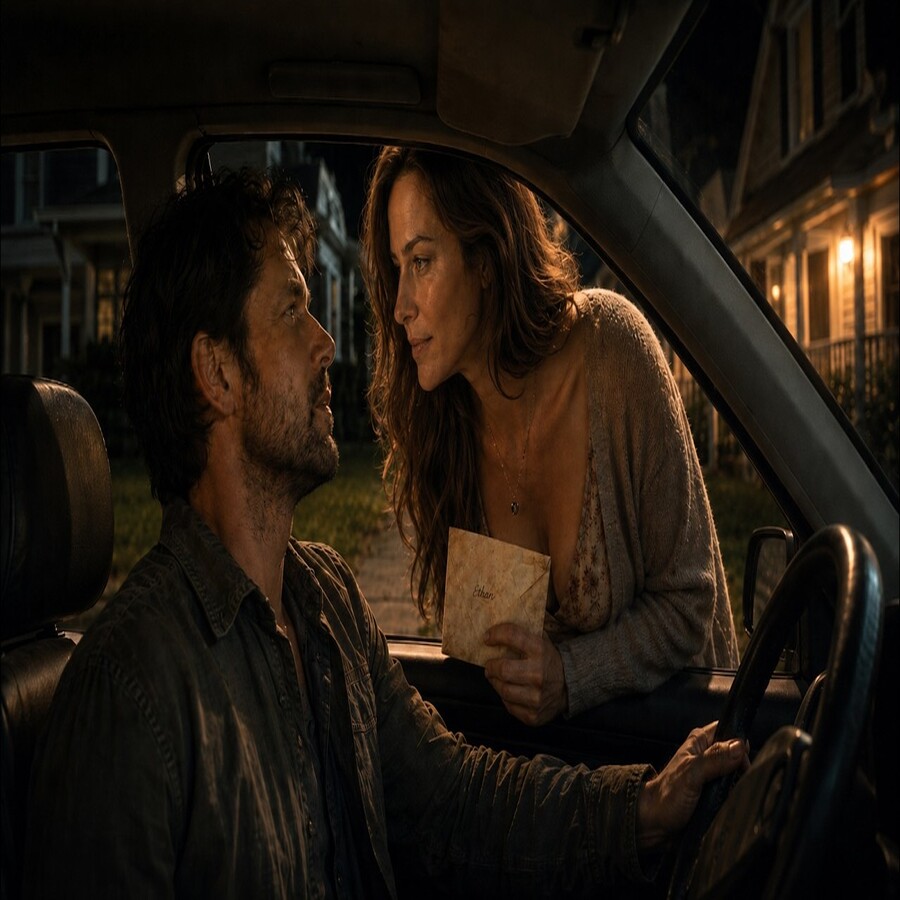
” I’m Ethan Mercer. I was 34 years old, a claims adjuster in Columbus, and up until that night, I had built a pretty respectable life out of never going back. My mother’s stroke changed that. She was alive, thank God, but she couldn’t live alone anymore. My sister lived in Oregon with three kids and a husband who thought emergency meant a delayed golf tee time.
So I came home to Ashford, Ohio to sort the house, arrange care, and pretend the place didn’t still know my name. I had left at 23 with two duffel bags, a broken heart, and a speech rehearsed in my head that I never gave. Nora was the reason I didn’t give it. We had grown up separated by one patchy lawn and two mothers who thought borrowing sugar was a valid social life.
Nora and I had shared bicycles, homework answers, bad pizza, and secrets shouted through bedroom windows after midnight. At 17, she kissed me behind the high school gym after a thunderstorm. At 23, she married someone else. That was the version I had carried for 11 years. Clean, simple, cruel enough to survive.
But standing in my driveway with summer insects buzzing and my mother’s house smelling faintly of dust and old rain, Nora didn’t look like a woman who had won. She looked like a woman who had been waiting too long to exhale. I opened the car door slowly. Nora. That’s all I get? She said, trying for a smile. No dramatic fainting? No, you haven’t changed a bit? You have changed.
Her smile softened. So have you. I stepped out and for one ridiculous second, we were too close. Close enough for me to notice the small silver hoop in her ear. Close enough to remember how she used to smell like coconut shampoo and mint gum. Now it was lavender and sawdust somehow. You okay? I asked. She glanced toward my mother’s house.
I heard about Linda. I’m sorry. Thanks. I cleared my throat. She’s at Cedar Ridge for rehab. She knows where she is half the time and thinks I’m my father the other half, so I guess I’ve aged magnificently. Nora laughed under her breath and the sound hit me worse than sadness. I was going to bring over a casserole, she said.
You cook now? I assemble emotionally supportive pasta. That sounds more believable. There it was, the rhythm. The old stupid ease sitting between us like it had never packed a bag. Then her left hand shifted against her thigh. No ring. I noticed. She noticed me noticing. The air changed. Before I could ask the question that had lived in my chest for more than a decade, a light flicked on in the Bennett house behind her.
A man’s voice called from inside. Nora? Who’s out there? Her face tightened, but only for a second. My brother, she said quickly. Too quickly. He’s staying with me for a while. I nodded like that explained the fear that had flashed across her eyes. She took one step back. You should get inside. You’ve had a long drive.
Nora. She stopped. What did you mean? I asked. When you said you still came? Her throat moved. For the first time all night she looked away from me. Then she reached into the pocket of her cardigan, pulled out an old folded envelope, and pressed it into my hand. My name was written across the front. In my own handwriting.
I kept it, she whispered. Because you never knew the truth. I knew that envelope. I knew the exact slant of my own handwriting, the heavy pressure where the pen had nearly torn the paper. I knew the coffee stain in the corner from the kitchen table where I’d sat at 2:00 in the morning trying to make courage look like ink.
Nora, I’m leaving Friday. Come with me. That was how it started. At 23, I had written everything I’d never said out loud. That I loved her. That watching her date Grant Wilkes had felt like swallowing glass. That I had a job offer in Columbus and $200 saved. And I didn’t care if we slept on a mattress on the floor as long as she was there.
I had folded it, sealed it, and put it in her mailbox the night before I left. Or I thought I had. My fingers tightened around the envelope. Where did you get this? Nora’s eyes moved toward her house again. Not here. The front door next door opened. A broad-shouldered man stepped onto the porch backlit by the hallway.
Nora? He called again. She didn’t turn. Go inside, Mason. So it wasn’t her brother’s voice I’d recognized from nowhere. It was the way she answered it. Quiet, careful, like one wrong tone might crack something. Mason lingered, then went back in. I looked at her. You lied. Not about the part that mattered. What part was that? That I needed you to come home.
The words should have warmed me, instead they slipped cold down my spine. Before I could ask more, she crossed the yard fast, leaving me with the letter and 11 years of anger suddenly rearranging itself into something I didn’t understand. Inside my mother’s house, the air was stale and thick. I flipped on lights that buzzed overhead and stood in the foyer among stacked newspapers, old coats, and the smell of lemon furniture polish.
Everything was smaller than I remembered. The staircase, the living room, even the silence. I opened the envelope in the kitchen. The letter was still inside, but there was another page folded behind it. Not mine. The paper was lined, torn from a notebook, written in my mother’s hand. Ethan, if you are reading this, then I failed to keep old mistakes buried.
I read the rest standing up. My mother had found my letter before Nora did. She had taken it from the Bennett mailbox. She said she’d done it because Nora was not stable. Because her father was drinking again, because I had a real chance if I left Ashford without her dragging me down. Then came the line that made my knees go weak.
Nora came to the house Friday morning. She was crying. She asked where you were. I told her you left without saying goodbye. I gripped the counter until my fingertips hurt. For 11 years, I had hated Nora for choosing someone else. For 11 years, Nora had believed I had abandoned her. My mother had built a wall between us with one stolen letter and one sentence.
There was more. I am not proud of what I did. but there are things you don’t know about that family. Things your father knew. Things I should have told you. The note ended there. No explanation. No apology big enough. Just the weak scratch of a woman whose mind was now drifting in and out like a bad radio signal.
I sank into a kitchen chair and stared through the window at Nora’s house. At her lit upstairs room. At the shadow of a man moving across the curtains downstairs. My phone buzzed. A text from an unknown number. If you’re back in Ashford, don’t open anything your mother left you. Then another. And stay away from Nora Bennett.
I stood so fast the chair scraped the floor. Across the yard Nora’s upstairs light went out. Then in the dark, someone screamed. I was across the lawn before I remembered locking my front door didn’t matter. The scream had been short, cut off. That was worse. I hit Nora’s porch at a run and tried the knob. Locked.
Nora! I pounded hard enough to rattle the glass. Open the door! From inside came a crash, then Mason’s voice. Back off! I didn’t. I stepped off the porch, grabbed the iron bird bath from beside the steps, and swung it through the small window next to the door. Glass burst inward. Pain flashed across my knuckles as I reached through, found the lock, and turned it.
The hallway smelled like whiskey and something burned. Mason stood at the foot of the stairs in a white undershirt, one hand gripping the banister. He was maybe 40 with red eyes and the thick, unsteady posture of a man used to being feared. You don’t belong here, he slurred. Where is she? His mouth twisted.
Always you, huh? Then Nora appeared behind him on the stairs. Her cheek was red. Her lower lip was split. Everything in me went still. I’m fine. She said quickly. I moved toward her. Mason blocked the stairs. She said she’s fine. Nora’s eyes locked on mine. Not fine. Not even close. I looked back at Mason. Move. He swung before I finished the word.
He was bigger, but drunk. I ducked late, felt his fist glance off my jaw, and drove my shoulder into his ribs. We hit the hallway wall together, knocking down a framed photograph of Nora at maybe 10 years old, grinning with missing teeth. Mason cursed and shoved me back. Then Nora came down two steps and said, “Mason, don’t.
” He turned on her. That was his mistake. I grabbed the back of his shirt and slammed him into the doorframe. He sagged, stunned, and I twisted his arm behind him until he dropped to one knee. Nora was already on the phone. “Yes, I need police,” she said, voice shaking, but clear. “My brother violated the protection order.
” Brother. So, she hadn’t lied. Not entirely. Mason laughed from the floor, breath sour with alcohol. “Tell him, Nora. Tell golden boy why you needed him back.” She went pale. Sirens arrived 7 minutes later. Longest 7 minutes of my life. By the time the officers took Mason away, half the street was glowing with porch lights.
Mrs. Alvarez from across the road stood in her robe holding a baseball bat. Old Mr. Keen pretended to water his dead begonias. Ashford hadn’t changed. Tragedy was still a neighborhood event. Nora sat on the porch steps with an ice pack against her mouth. I stood beside her flexing my bleeding hand, trying not to look as shaken as I felt.
“You should get that cleaned,” she said. “You should press charges.” I did, last month. That’s why he showed up tonight. I sat next to her. The old wood creaked under us. She stared at the police cruiser disappearing down the street. “Mason wasn’t always like this.” Most people aren’t. He got out of prison 6 weeks ago.
That pulled my gaze to her. She nodded once like she’d expected the reaction. Auto theft, assault, some other things. He blamed me because I testified. Against him? And against Grant. The name hit the air between us like a door slamming. Grant Wilkes? The man I thought she’d married? I waited. Nora’s laugh was small and bitter.
I never married him, Ethan. I turned fully toward her. My mother told everyone I had. Said it was easier than explaining why I left town pregnant and came back without a baby. The porch seemed to tilt beneath me. Nora’s eyes filled, but she didn’t let a tear fall. Grant hurt me. Mason helped cover for him. Your father found out.
My father? He was going to go to the police, then he died before he could. My father had died in a one-car accident on County Line Road. That was what I’d been told. Nora reached for my injured hand, careful around the cuts. Her touch was warm and familiar enough to break me. Your mother thought she was protecting you, she whispered.
From me? From all of it. I looked toward my dark house where her note lay open on the kitchen table. And the text I got? I asked. Telling me to stay away from you? Nora’s fingers tightened around mine. From the street my phone buzzed again in my pocket. This time the message had a photo attached. My mother, younger and terrified, standing beside Grant Wilkes.
Under it were five words. Ask her what she buried. The photo looked like it had been taken in our backyard. Not recently. My mother’s hair was darker, her face less hollowed by age. Grant Wilkes stood beside her in a varsity jacket smiling like he owned the world. My mother wasn’t smiling. She was looking at something below the frame.
Something she feared. Nora leaned closer, the porch light catching the bruise blooming along her cheek. “Who sent that?” she asked. “I don’t know.” But my stomach already knew one thing. My mother’s note hadn’t been confession. It had been a warning. I called the number. It rang once, then disconnected. A minute later, another text came through.
“Cedar Ridge, room 214 before morning.” I stood. Nora did, too, wincing. “I’m coming with you.” “No.” Her eyes hardened. “You don’t get to leave me behind again because someone else decided what was safe.” That landed exactly where she aimed it. So we drove through Ashford in silence, past the closed diner, the high school football field, the church where my mother used to sing off-key in the second pew.
Nora sat beside me with my old letter folded in her lap, one hand resting over it like she was afraid it might vanish again. At Cedar Ridge, the night nurse recognized me and frowned when she saw Nora. “Mrs. Mercer’s sleeping.” “Wake her,” I said. The nurse lowered her voice. “Mr. Mercer, she had a difficult evening, confusion, agitation.
” “I need 5 minutes.” Nora stepped forward. “Please.” Maybe it was the split lip. Maybe it was the way she said it. The nurse sighed and led us down the hall. My mother looked smaller than she had that afternoon. White hair loose against the pillow. One hand curled near her chest. Machines hummed softly around her, measuring what was left.
“Mom,” I said. Her eyelids fluttered. For a moment, she looked right through me. Then her gaze sharpened. “Ethan?” “I’m here.” Relief crossed her face. Then she saw Nora. The heart monitor quickened. “No,” my mother whispered. “She shouldn’t be here.” Nora’s chin trembled, but she didn’t step back. “Linda, what happened the night Martin died?” My father’s name changed the room.
My mother squeezed her eyes shut. “I tried to stop him.” “Grant?” I asked. Her eyes opened, wet and frightened. “Your father found the tapes.” “What tapes?” “Wilks Auto,” she whispered. “Back office.” “Grant’s father kept records, payoffs, girls, Mason running cars across state lines.” Her breath hitched. Nora was on one.
Nora went utterly still. I reached for her, but she didn’t seem to feel me. “My father was going to turn them in,” I said. “He made copies.” My mother’s voice cracked. “He hid them.” “Then he called Sheriff Wilks.” “Grant’s father.” “Of course.” Nora whispered. “And Martin died that night.” My mother began to cry soundlessly.
“They ran him off the road.” “I knew. I knew, and I was scared.” “Grant came to the house after the funeral. He said if Ethan stayed, he’d end up like his father.” “So you took my letter,” I said. “I sent you away.” She looked at Nora. “And I sent her away, too.” Nora’s face crumpled for half a second before she rebuilt it.
“My baby,” she said. “Did Grant “No.” My mother shook her head hard, panic rising. “No, I don’t know. I swear. Your mother told me you lost it.” Nora turned away, one hand over her mouth. I felt rage so large it had no shape. “Where are the copies?” I asked. My mother stared at me, and for a moment dementia swallowed her again.
Her gaze drifted toward the ceiling. “Under the roses,” she murmured. “Martin always hated roses.” Then her eyes snapped back to mine. “Don’t trust the police.” The room door opened behind us. A man in a dark jacket stood there with a visitor badge clipped to his chest. Sheriff Grant Wilkes had aged badly, but I knew him at once.
He smiled at my mother. “Linda,” he said gently, “you’ve been upsetting yourself again.” Nora grabbed my arm. Grant looked at her, and his smile thinned. “Well,” he said, “isn’t this a reunion?” Grant stepped into the room like he still owned every frightened person in Ashford. For 1 second, I was 23 again, swallowing anger because men like him always had badges, fathers, friends, alibis.
Then Nora moved beside me. Not behind me. Beside me. “You shouldn’t be here,” she said. Grant’s eyes slid over her bruised face. “Still causing trouble, Nora?” My hand closed around my phone in my pocket. The recorder had been running since my mother started talking. “You killed my father,” I said. Grant smiled.
“Your mother’s confused.” “My father had copies.” That erased the smile. He looked at my mother. “Linda.” She began to shake. I stepped between them. “Under the roses, right?” Grant lunged. He didn’t get far. Nora hit the call button, the nurse shouted from the hall, and I drove Grant back into the wall hard enough to crack the visitor badge under my palm.
Security came running. Then real police from two towns over because the night nurse had enough sense not to call Ashford dispatch. By dawn, Nora and I were in my mother’s backyard with two state investigators and Mrs. Alvarez, who stood at the fence in slippers like she had been waiting 11 years for this. She was the one who had texted me.
Her late husband had been a deputy. He’d kept the photo. He’d never had the courage to speak while Sheriff Wilkes was alive, but when she saw my car in the driveway, she said, “I figured your father’s son might.” Under my mother’s dead rose bushes, we found a rusted coffee tin wrapped in plastic. Inside were three cassette tapes, a ledger, and a photograph of my father standing beside Nora’s father outside Wilkes Auto, both of them looking grim and young and doomed.
Didn’t fix anything. Evidence never does. It only tells the truth loudly enough that liars can’t keep whispering over it. Grant was arrested before noon. Mason tried to bargain his way out and ended up confirming half the ledger. Two former officers went down with them. The town pretended to be shocked, though most people had always known where not to look.
My mother lived long enough to understand that I knew. One week after Grant’s arrest, I sat beside her bed and held her hand. She was lucid that morning, clear-eyed, and terribly frail. “I thought losing you was better than burying you,” she whispered. “I know.” It wasn’t forgiveness, not yet. But it was the first honest thing we had shared in years.
She died in early October while rain tapped softly against the window. Nora came to the funeral in a navy dress with a small scar on her lip and her head held high. When the service ended, she didn’t ask if I was leaving. I didn’t. By the following spring, my mother’s house was no longer for sale. I repaired the porch steps.
Nora planted herbs in coffee cans along her kitchen window. Some nights we ate dinner on my back steps, not saying much, listening to the insects and the distant trains. Healing wasn’t dramatic. It was Nora sleeping through the night. It was me learning not to flinch when someone said my father’s name. It was both of us admitting that love had survived, not untouched, but alive.
One evening in June, we dug up the last of the old rose roots together. The ground was stubborn, packed hard from years of neglect. Nora was sweating, laughing at me because I’d split my jeans at the knee, and the sunset turned her hair copper at the edges. When the final root came loose, she sat back in the grass and looked at the empty patch of earth.
“What should we plant?” she asked. I thought about letters stolen from mailboxes, about babies mourned in silence, about fathers who tried to be brave, about porch lights left on for people who might still come home. “Something that comes back every year,” I said. Nora reached for my hand, and this time nothing stood between our houses but grass, warm light, and the life we were finally allowed to grow.
Disclaimer : This content may be created by AI for entertainment purposes. Any resemblance to real persons, events, or places is coincidental.






