PART ONE: THE ENGAGEMENT PARTY
The night air over Grand Oakwood Estate was thick with the scent of gardenias and salt from the distant Carolina coast. The old plantation house, meticulously restored over three generations, glowed like a jewel box against the velvet darkness. Every window blazed with golden light. Every surface reflected the kind of wealth that didn’t need to announce itself because its very existence was the announcement.
Three hundred guests had gathered beneath the soaring ceilings of the grand ballroom, a space that had once hosted Civil War generals and, later, the Reconstruction-era elite who had rebuilt Charleston from ashes. Tonight, it hosted the engagement celebration of Nathaniel Cole, heir to Cole Industries, and Victoria Hastings, the woman widely considered the most beautiful and accomplished debutante of her generation.
Crystal chandeliers dripped light like frozen waterfalls. White roses, thousands of them, had been flown in from Colombia and arranged in cascading displays that seemed to defy gravity. A string quartet played Vivaldi from a balcony overlooking the dance floor, their music floating down like something from another century. Silver trays of champagne circulated among the guests, who had come from as far away as New York and London to celebrate what everyone called “the wedding of the decade.”
Nathaniel Cole stood near the grand staircase, laughing with his oldest friends from Harvard Business School. At thirty-three, he was the youngest self-made billionaire on the East Coast, a man who had inherited a struggling shipping company from his late father and transformed it into a global logistics empire within seven years. His charcoal suit was perfectly tailored, his dark hair swept back from a face that could have belonged to a Renaissance painting. But it was his eyes, warm and intelligent, that drew people to him. Nathaniel had the rare gift of making everyone he spoke to feel like they were the most important person in the room.
“Three years,” his friend Marcus said, clapping him on the shoulder. “Three years ago, you were a workaholic bachelor who didn’t know how to take a vacation. Now look at you. Engaged to the most beautiful woman in Charleston.”
Nathaniel laughed, shaking his head. “I still don’t know how to take a vacation. Victoria’s the one who’s teaching me.”
“Teaching you? Or training you?”
“Both, probably.” Nathaniel grinned. “She’s good for me, Marcus. She makes me want to be better.”
“She makes you want to be richer, you mean.”
“I’m already rich enough.” Nathaniel’s smile softened. “She makes me want to be someone who deserves her.”
At the center of the crowd, Victoria Hastings floated through the reception like a crimson dream. Her gown was custom-designed, a deep red silk that caught every chandelier light and seemed to pulse with its own inner fire. The diamond on her left hand was a flawless emerald cut, eight carats, the stone Nathaniel had chosen after a year of saving and planning. It sparkled with every gesture, every wave to a passing acquaintance, every practiced smile.
Victoria was twenty-nine, the daughter of Richard Hastings, whose old Charleston family had once controlled half the shipping interests on the Eastern Seaboard before a series of disastrous investments had eroded their fortune. Her mother, Eleanor, had been a Hastings by birth as well, the product of a marriage so carefully arranged that it had been discussed in society columns years before Victoria was born.
But Victoria had been raised on stories of what the family had lost, not what it had once possessed. She had learned early that appearances were everything, that a smile could hide a bankrupt account, that a well-timed laugh could deflect questions about her father’s failing business. When she met Nathaniel at a charity gala three years earlier, she had seen not just a handsome and successful man, but a way out. A rescue. A future that would restore everything her family had lost.
For Nathaniel, Victoria represented something different. She was warmth in his often cold world. She was grace when he felt clumsy. She was the kind of woman who could charm a room of hostile investors and make them forget they’d come to negotiate. He had fallen in love with her smile, her laugh, the way she made him feel like he was the only man in any room she entered.
“What I don’t understand,” Victoria’s mother Eleanor said, drawing her daughter aside near the garden doors, “is why you insisted on this ridiculous party. A simple engagement dinner would have been sufficient. Nathaniel’s already given you the ring. What more do you need?”
Victoria’s smile remained fixed, but her eyes hardened. “I need everyone to see, Mother. I need them to know that I’m marrying Nathaniel Cole. I need them to remember that the Hastings family is still relevant. That we still matter.”
“We are relevant.”
“Are we? Father’s company is drowning. The bank is threatening to call in his loans. And you’re worried about a party.”
Eleanor’s face tightened. “That’s not fair, Victoria. Your father has been trying—”
“Trying isn’t enough.” Victoria’s voice was low and cold. “We need results. And I’m getting them.”
She walked away, leaving her mother standing alone by the garden doors. Later that evening, when her mother approached Nathaniel, Victoria saw the way he smiled at Eleanor, the genuine warmth in his eyes. She saw the way he listened to her mother’s stories about the old days, about the Hastings family’s former glory. But Victoria knew the truth. She knew her mother was performing just as much as she was.
“Victoria,” Nathaniel said, finding her near the champagne tower. “Your mother was telling me about your grandmother’s garden. She said you used to love the roses.”
Victoria’s smile was perfect. “I still do. They remind me of happier times.”
“What times?”
“When I was a child. Before everything got complicated.”
Nathaniel took her hand. “Victoria, I don’t want you to feel complicated. I want you to feel safe. Loved. Secure. That’s what I’m offering you.”
She looked at him, at his kind eyes and honest face, and for a fleeting moment, she felt something that might have been guilt. “Nathaniel—”
“Whatever you need,” he said. “Whatever you want. It’s yours. You just have to ask.”
She wanted to believe him. She wanted to believe that love was enough, that Nathaniel’s wealth would solve her family’s problems, that the prenuptial agreement he’d made her sign was just a formality. But she knew better. She had seen too many women trapped in marriages they couldn’t escape, too many families destroyed by financial ruin. She couldn’t let that happen to her. She wouldn’t.
Rosa Delgado moved through the crowd like a ghost, invisible and efficient. She had been working for the Cole family for six years, arriving as a young widow with a newborn daughter and no prospects beyond her willingness to work hard and stay quiet. Nathaniel’s father, Harold Cole, had hired her personally, impressed by her references and her quiet dignity. When Harold died of a heart attack two years later, Nathaniel had kept Rosa on without question. She was reliable, discreet, and in many ways, the backbone of the household.
Tonight, Rosa wore her usual black uniform, simple and functional, her dark hair pulled back in a neat bun. She moved from table to table, ensuring that no glass remained empty, no plate was left unattended. She had done this a hundred times before, for a hundred parties, for a hundred wealthy guests who never once asked her name.
Only one person in that enormous house truly saw Rosa. Only one person understood that she was more than the uniform she wore. Mia, her three-year-old daughter, sat on a small stool near the service door, her little white dress glowing under the chandelier light. She had been told to stay put, to be quiet, to not bother the guests. But Mia’s eyes missed nothing. She watched the men in their silk ties and the women in their glittering jewelry. She watched the way they laughed and touched and moved through the room as if they owned it.
She watched Victoria most of all.
Mia had been fascinated by the beautiful woman in red since the moment she arrived. Victoria moved through the crowd like a queen, her smile never faltering, her eyes always moving, always calculating. But there was something about her that made Mia’s stomach feel tight. Something that didn’t sit right.
“Mommy,” Mia whispered, tugging at Rosa’s sleeve. “That lady. The one in red. She looks like a princess, but her eyes look like a fox.”
Rosa knelt down beside her daughter, a smile touching her lips despite the exhaustion pulling at her bones. “Mia, that’s Miss Victoria. She’s marrying Mr. Nathaniel. You have to be nice to her.”
“I’m being nice. I’m just telling you what I see.”
Rosa laughed softly, pressing a kiss to her daughter’s forehead. “You’re too smart for your own good, baby. Now stay here. I have to check on the champagne.”
Mia nodded, but her eyes never left Victoria. She watched as the woman in red laughed with a group of older women, her head tilted just so, her hand resting gracefully on her chest. She watched as Victoria took a glass of champagne from a passing waiter, her fingers brushing his in a gesture that seemed almost accidental. And she watched as Victoria’s gaze drifted toward the grand staircase, toward the study where Nathaniel had disappeared minutes earlier.
Something flickered across Victoria’s face. A flash of something that looked almost like anticipation. Mia didn’t understand what it was, but she knew it was wrong. She felt it in her bones.
Fifteen minutes after Nathaniel excused himself, the first scream echoed from the marble foyer.
It was a woman’s scream, sharp and sudden, cutting through the laughter and music like a blade. The string quartet faltered, a violinist’s bow scraping across strings in a discordant shriek. Glasses stopped mid-air. Conversations died in their tracks. Every head in the ballroom turned toward the sound.
“What was that?” someone whispered.
“I don’t know. It came from the foyer.”
“Is someone hurt?”
The questions rippled through the crowd, but no one moved toward the source of the scream. They stood frozen, champagne flutes in hand, their carefully arranged smiles replaced by expressions of uncertainty and dread. They had been trained to handle social emergencies, forgotten place settings, seating chart mishaps, the occasional drunken relative making a scene. But this was different. This was something darker.
Then another scream followed, this one closer, more urgent. “Mr. Cole! Someone call for help!”
The crowd surged forward as one, a wave of silk and evening gowns and expensive cologne flowing through the arched doorway into the grand foyer. And there, sprawled across the cold marble floor, lay Nathaniel Cole. His eyes were closed. His face was pale, almost gray in the chandelier light. His chest, beneath the expensive suit, was still. Horribly, terrifyingly still.
“Oh my God,” a woman gasped.
“Is he breathing?”
“Someone get a doctor!”
The confusion was absolute, a chaos of overlapping voices and trembling hands. A man in a tuxedo knelt beside Nathaniel, pressing two fingers to his neck. His face went pale. “I can’t feel a pulse. Call 911. Now.”
Phones rose in a dozen hands, but the calls were panicked and fragmented, no one able to give clear information. The string quartet had stopped playing entirely, the musicians frozen in the balcony like figures in a painting. A woman in a silver gown began to cry. Her husband pulled her close, his face ashen.
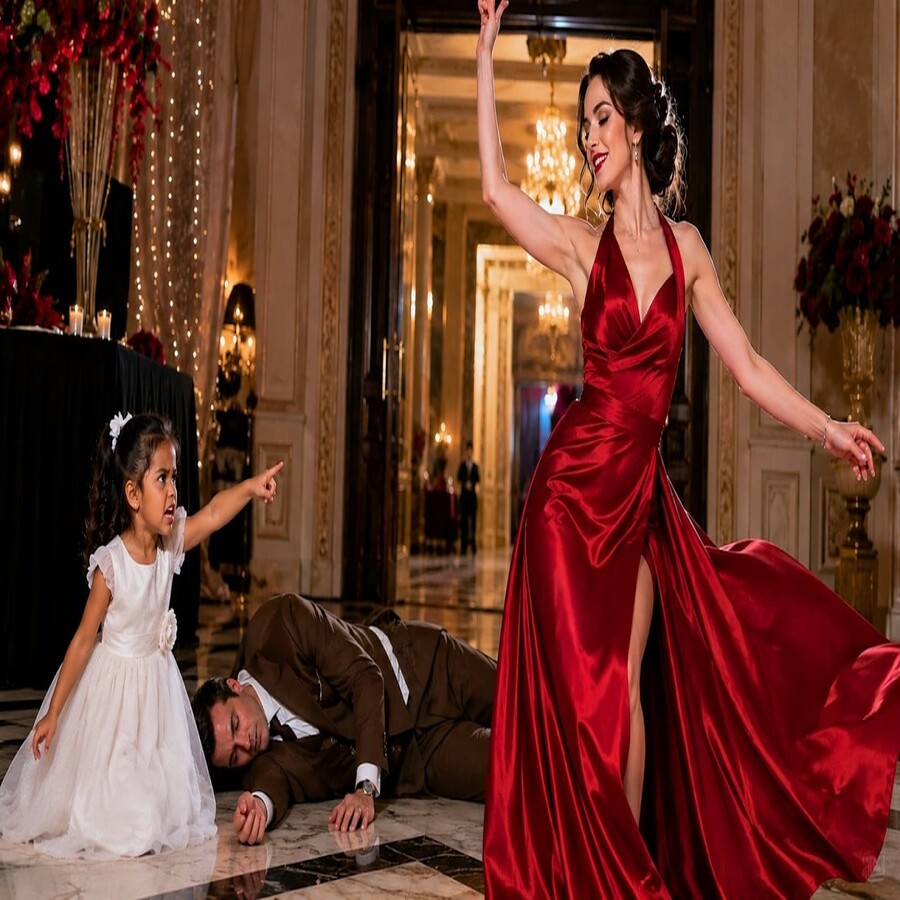
And then, from the top of the grand staircase, Victoria Hastings appeared. She descended slowly, her crimson gown flowing behind her like a river of blood. Her face was calm. Too calm. There was no shock in her eyes. No grief. No fear.
She reached the bottom of the stairs and paused, her gaze sweeping across the scene before her. Three hundred guests had gathered around Nathaniel’s still body, all of them frozen in various stages of panic and disbelief. All of them looking to her, waiting for her to react, to lead, to do something. But Victoria did not rush to Nathaniel’s side. She did not scream. She did not cry.
Instead, she did something no one expected.
As the silence stretched and the chaos held its breath, Victoria began to dance. She lifted her arms slowly, gracefully, her crimson gown catching the chandelier light as she twirled in a slow circle. A smile spread across her face, serene and untroubled, as though the music from the ballroom had followed her out into the foyer. As though she was performing for an audience that had gathered to admire her, not to witness the collapse of her fiancé.
The room erupted into horrified murmurs.
“Is she in shock?”
“Has she lost her mind?”
“Look at her. She’s smiling.”
A man near the back of the crowd, a physician who had been seated at Nathaniel’s table, pushed through the crowd and knelt beside the prone figure. “Move back,” he commanded. “Give him air. Someone get me a glass of water and a cold cloth.”
He pressed his fingers to Nathaniel’s wrist, then to his neck, his brow furrowed with concentration. He checked his pupils, his breathing, his skin. The room held its breath, waiting for a diagnosis that would make sense of the horror unfolding before them.
“His pulse is weak,” the doctor said, “but it’s there. He’s alive. Barely. But alive.”
A collective gasp rippled through the crowd. Relief mingled with confusion. If Nathaniel was alive, why had he collapsed? Why had Victoria danced? And why, in the midst of it all, did a small voice cut through the noise with words that made everyone in the room go still?
“Don’t celebrate his death. He is alive!”
The voice was high-pitched and fierce, trembling but clear. Every head in the foyer turned. Standing at the edge of the crowd, her tiny fists clenched at her sides, her finger pointed directly at Victoria, was Mia. Rosa’s three-year-old daughter. Her white dress glowed under the chandelier light. Her dark eyes blazed with something far older than her years.
Victoria’s serene smile froze on her face. The color drained from her cheeks. For the first time that night, she looked vulnerable. Exposed. Afraid.
“Mi-Mia!” Rosa’s voice cracked as she pushed through the crowd, scooping her daughter into her arms. “I’m so sorry! She’s just a child. She doesn’t understand.” She turned to the crowd, her eyes wild with apology and fear. “Please, forgive her. She’s only three. She doesn’t know what she’s saying.”
But Mia would not be silenced. She wriggled free from her mother’s grasp, planting her small feet firmly on the cold marble. Her chin lifted, her eyes never leaving Victoria’s frozen face.
“She said it on the phone,” Mia said, her voice trembling but steady. “She said, ‘Make it look like an accident.’ I heard her. Mommy heard her, too.”
The accusation hung in the air like smoke.
👉 [Tap here for the Next Part ] 👈
Disclaimer : This content may be created by AI for entertainment purposes. Any resemblance to real persons, events, or places is coincidental.






