The September sunlight streamed through the twenty-foot windows of my TriBeCa gallery, casting golden rectangles across the Italian marble floor. I was bent over an eighteenth-century painting, my magnifying glass hovering inches above the canvas, when the phone rang. Not my business line, which buzzed constantly with collectors and curators. My personal cell. The number I only gave to Sophie’s school and close friends.
“Miss Morrison, this is Dr. Rachel Kim from Mount Sinai Hospital. I’m calling about your registration with the National Rare Blood Donor Program.”
My hand froze over the painting. The magnifying glass slipped from my fingers and shattered against the marble floor. The sound echoed through my gallery like a gunshot.
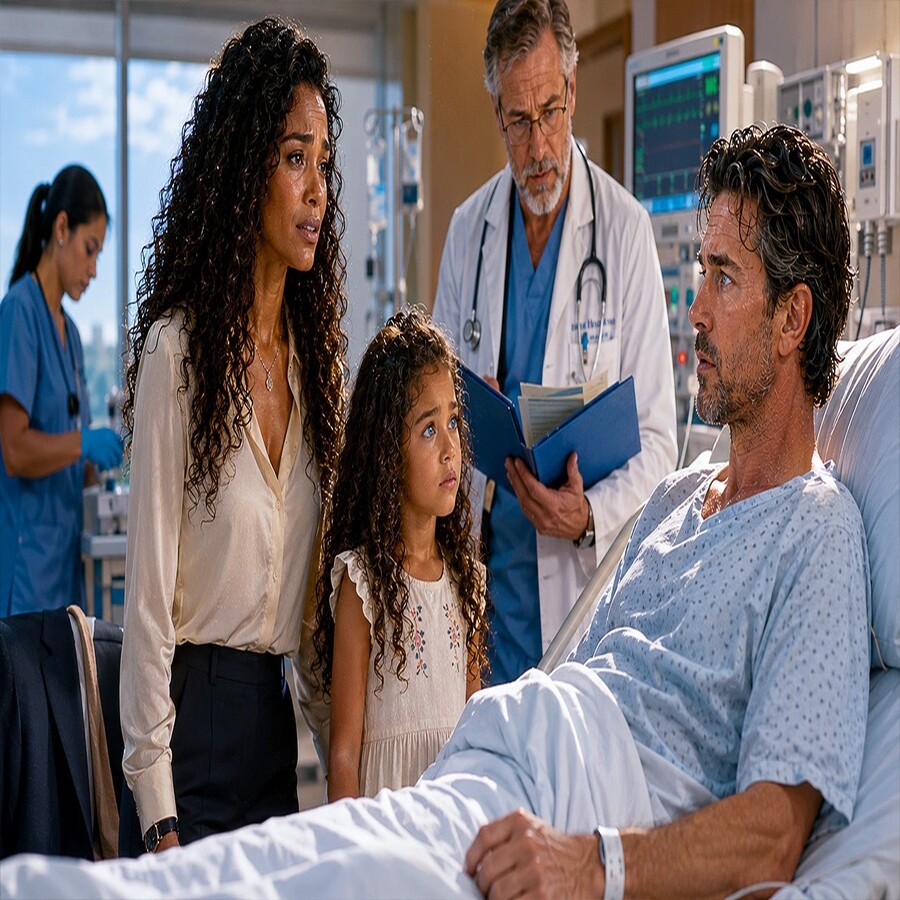
When Sophie was three, we discovered she had an unusual blood variant. AB negative with something called a Vel negative antigen. Rare enough that our pediatrician insisted we register with the National Blood Bank, just in case someone, somewhere, ever needed what only Sophie could give. I never imagined that someone would be her father.
“There’s been a critical accident,” Dr. Kim continued. “A patient needs an emergency transfusion. Your daughter is the only match in our immediate database.”
“What kind of accident?”
“Car crash. Severe. The patient has lost a catastrophic amount of blood. Without a compatible donor, he won’t survive the next two hours.”
“Who is the patient?” I asked, though part of me already knew.
“Dominic Castellano.”
The name hit me like a physical blow. Dominic Castellano. The man who divorced me for being barren. The man who called me defective because I couldn’t give him children. The man who married someone else before our divorce papers were even cold. He was dying three floors above me, and my six-year-old daughter, his daughter, the child he spent years telling me I could never have, was the only person in this city with the rare blood type that could save him.
“Ms. Morrison, I need your answer. Will you allow your daughter to donate?”
Have you ever had to decide whether to save the person who destroyed you? Have you ever been called broken only to become the one person holding the pieces of someone else’s life? This is the story of how I became my ex-husband’s only hope, and he had no idea why.
I drove to Mount Sinai in a daze, my mind racing through the past six years. I had built my life from nothing after Dominic threw me away. My gallery, Morrison Art Authentication, occupied a converted warehouse in TriBeCa with twenty-foot ceilings and natural light that made even forgeries look beautiful for a moment, until I examined them. Until I found the lies. I had gotten very good at finding lies.
Sophie was at school when I picked her up. She chattered happily about her art project, completely unaware of the weight of what was about to happen. I told her we were going to help someone who was very sick. She asked if it would hurt. I said no. She asked if she would get a sticker. I said probably.
At the hospital, Dr. Kim met us in the pediatric wing. Sophie was taken to a room with cheerful murals of cartoon animals. I stood in the hallway, my hands gripping the railing, trying to make a decision that felt impossible.
“I need to see him first,” I said.
“That’s highly unusual, Miss Morrison.”
“I need to see the patient before I make this decision.”
Something in my voice made Dr. Kim reconsider. She led me through a maze of corridors that smelled like antiseptic and fear. Each step felt like walking backward through time. Six years melted away with every footfall. I was twenty-six again, standing in the Castellano penthouse, watching my marriage dissolve. I was twenty-seven, signing divorce papers with morning sickness I didn’t yet understand. I was twenty-eight, holding three positive pregnancy tests, and crying because the man who said I was barren would never know he was wrong.
Dominic lay in a private suite, unconscious and broken. He looked smaller than I remembered. His dark hair was matted with blood. His face was pale beneath bruises and lacerations. His chest rose and fell with the mechanical rhythm of someone whose body was fighting to stay alive. I had loved this man, loved him so completely that losing him had felt like losing myself. Now I felt nothing but a distant, clinical assessment.
“Who are you?” The voice came from the window. I turned to find Vanessa Ashworth Castellano watching me with the cold assessment of someone used to cataloging threats. She looked exactly like I remembered from the society pages. Tall, blonde, perfect. The kind of woman who wore Chanel to her husband’s deathbed and made it look appropriate. But there was something new. Her hand rested on a swollen belly, seven, maybe eight months pregnant. So Dominic had finally gotten what he wanted. An heir. A legacy. Proof that he hadn’t been the problem in our marriage.
“I’m Isabel Morrison,” I said, keeping my voice level. “I’m the mother of the potential blood donor.”
Vanessa’s eyes narrowed. “Morrison, that name sounds familiar.”
“I’m an art authenticator. I work with collectors in your social circle.” It wasn’t a lie, just an incomplete truth.
“The doctors say your daughter is Dominic’s only hope.” Vanessa moved closer, her heels clicking on the tile floor. “What an extraordinary coincidence.”
“Blood types don’t care about coincidence.”
“No, but I do.” She studied my face with the intensity of someone trying to place a half-remembered photograph. “My husband has a rare blood marker. For your daughter to match it so precisely, one might wonder about the likelihood.”
My heart was hammering, but my face remained calm. Years of authenticating art in front of suspicious collectors had taught me to control my expressions. “One might wonder about many things. But right now, all that matters is whether you want your husband to live.”
“Of course I want him to live. The Castellano empire can’t function without its CEO.” Vanessa’s smile was ice. “The question is, what do you want?”
“For the blood donation? Everyone wants something, Ms. Morrison. Name your price.”
I stared at this woman who had everything I once had, and she thought it could all be reduced to a transaction. “My daughter is not for sale.”
“Your daughter is a child. She doesn’t make this decision. You do.” Vanessa’s voice hardened. “And I’m offering you more money than most people see in a year for something that costs you nothing.”
“It costs me everything.”
Vanessa’s eyes sharpened with interest. “What does that mean?”
“It means I need to think about this decision.” I walked out before she could respond.
In the hospital chapel, I called my mentor. Professor Westfield sent the authentication records I needed. Photographs, timestamps, security logs, everything that proved I was innocent of the affair Dominic believed I had. Everything that would have saved our marriage if he had waited one day.
Eleanor Castellano, his grandmother, found me there. She looked older than I remembered, frailer, but her eyes still held that calculating intelligence that had dismantled my marriage with surgical precision.
“I came to tell you the truth,” she said. “I lied about everything. The affair that never happened. The evidence I manufactured. I destroyed your marriage on purpose so Dominic would marry Vanessa and secure a business merger.”
“Why are you telling me this now?”
“Because my grandson is dying, and I find that impending death makes one reflective.”
“If I do this,” I said slowly, “if I let Sophie donate her blood, I want something in return.”
“Name it.”
“I want Dominic to know the truth. All of it. And I want him to know about Sophie.”
“Sophie is his daughter,” I told her. “Conceived two weeks before he served me with divorce papers. Born eight months after he married Vanessa. She has his eyes, his rare blood type, and absolutely no idea who her father is.”
Eleanor’s face drained of color. “I have a great-granddaughter?”
“You have nothing. You lost the right to her when you destroyed her parents’ marriage.”
I let Sophie donate. She was remarkably brave for a six-year-old, barely flinching when the nurse inserted the IV line. She watched with fascination as her blood began flowing through the clear tubes, rich and red and completely unaware of the life it was about to save.
“Will I get to meet the person?” Sophie asked.
“Maybe someday.”
“I hope so. I want to see if they have eyes like mine.”
The nurse’s hand faltered for just a moment. I shook my head slightly. Not now. Not here. For the next thirty minutes, I watched my daughter’s blood flow into collection bags. Each drop was a piece of Dominic’s life being preserved. Each moment was a choice I couldn’t take back.
When it was done, Sophie got a juice box and a sticker that said, “I donated blood today.” She wore it proudly, chattering about how she was definitely a superhero now.
Dominic saw the donor registration form. He demanded to speak with me. He was sitting up in bed, an IV pole clutched in one hand, his face gray with pain, when I walked in. He saw me, saw Sophie asleep in my arms, and asked the question that changed everything.
“Is she mine?”
“Yes,” I said. “She’s yours.”
The room exploded. Vanessa shrieked. Eleanor confessed her lies right there. Dominic’s monitors went wild. He went into shock as the truth finally destroyed him the way it had destroyed me six years ago.
Sophie woke up and asked if that man was her daddy. I told her the truth. She asked if we could call him and show him her paintings.
In the taxi home, I turned off my phone. Dominic left desperate voicemails, begging for a chance. I finally agreed to meet him at my gallery.
“One hour,” I said. “Just us. We talk. That’s all.”
He arrived at exactly 2:00 p.m. He looked different than he had in the hospital. Less formal. More vulnerable. I told him everything. The pregnancy tests. The six years of birthdays and first steps he missed. Why I didn’t tell him.
He admitted he would have accused me of lying, would have demanded a paternity test. “You’re right,” he said. “I would have. And that’s the part I can’t forgive myself for.”
He told me he filed for divorce from Vanessa. He said he had been in love with me for six years while married to someone else.
“Don’t make this about us,” I said. “Make it about Sophie.”
He agreed to meet her properly. Saturday at the park. On time. That was the first test.
Sophie brought her paintings. She showed him “Anger and Joy Fighting,” “Missing Something You Never Had,” and her family tree with a golden branch for him. She asked if he was good at staying.
“I’m going to try so hard to fix it,” he said.
He showed up every Saturday after that. He came to her art show with Eleanor, who had transformed into a remorseful great-grandmother. Sophie won first place. We got gelato. For the first time, Sophie had her whole family in one place.
Dominic started coming to Thursday dinners, soccer games, piano recitals. He was present, consistently, reliably. Against every instinct, I started to trust him.
One night, over dessert, he apologized for everything. “The worst thing I did,” he said, “was calling you barren. I treated you like a failed business transaction instead of the woman I loved.”
“I want a second chance,” he said. “Not just with Sophie. With you.”
“I’m scared,” I admitted. “I’m scared of letting you in and having you leave again.”
“I’m scared too,” he said. “But I’d rather be scared and trying than safe and alone.”
“I’m not ready,” I said. “But I’m willing to see if the space between anger and forgiveness is big enough for something new.”
Three months later, Vanessa gave birth to Lucas. Sophie met her half-brother at a park. Vanessa apologized for trying to buy Sophie’s blood. She said motherhood had clarified what actually mattered.
Dominic took Sophie to the beach for a weekend. He sent pictures every hour. When they returned, he kissed my forehead and said he would keep trying to earn my trust.
The Art Institute of Chicago wanted to feature Sophie in an exhibit. We went together as a family. Sophie charmed critics and signed autographs. That night, Dominic gave me a promise ring. “Not an engagement ring,” he said. “A promise that I’m not going anywhere.”
“I’ll wear it,” I said. “Not as an engagement. But as an acknowledgement that I’m willing to see if we can build something new.”
He proposed a year later at the same park bench where he first met Sophie. I said yes. We remarried in a small ceremony. Sophie was our flower girl.
Our vows were different this time. Promises about truth and trust and choosing each other every day. Sophie painted a massive piece titled “The Space Between,” about how we found our way back to each other. How her blood saved his life, but our choice to forgive saved all of us.
Some things, once broken, stay broken. But some things, with patience and truth and daily choice, can become even more beautiful than they were before.
Belle was called barren by the man she loved. Ten years later, she had a thriving family, a successful business, and a love story that survived betrayal. She learned that you are not defined by what breaks you. You are defined by how you rebuild.
Dominic became the father he should have been. Sophie grew up knowing she was loved by both parents. And Belle finally understood that forgiveness is not about forgetting. It’s about making room for something new.
Sometimes the people who destroy us are the ones who teach us how to rebuild. Sometimes the blood that saves a life is the same blood that binds a family together. And sometimes, the space between anger and forgiveness is exactly where love grows strongest.
The hospital transfusion saved Dominic’s life. But the truth about Sophie saved something even more important. It saved the possibility of a family that had been broken by lies and rebuilt by honesty. It saved the chance for a father to know his daughter. It saved the hope that even the deepest wounds can heal when people choose to fight for each other.
Belle and Dominic’s story is proof that second chances are real. But they don’t come easily. They come through consistent action, through showing up every day, through being willing to face the hardest truths and still choose love. They come through forgiveness that is not blind, but clear-eyed and intentional.
Sophie’s blood saved her father’s life. But her existence saved something even more precious. It saved her parents from a lifetime of regret. It saved them from the prison of pride and lies. It opened a door that had been locked for six years.
And when they finally walked through it together, they found a future they never thought possible. A family built not on perfection, but on truth. A love forged not in ease, but in hardship. A life that proved that some things, once broken, can be made whole again.
Not by pretending the cracks don’t exist. But by filling them with something stronger. Something that shines brighter than the original. Something that lasts.
THE END
Disclaimer : This content may be created by AI for entertainment purposes. Any resemblance to real persons, events, or places is coincidental.






