part one: the phone call
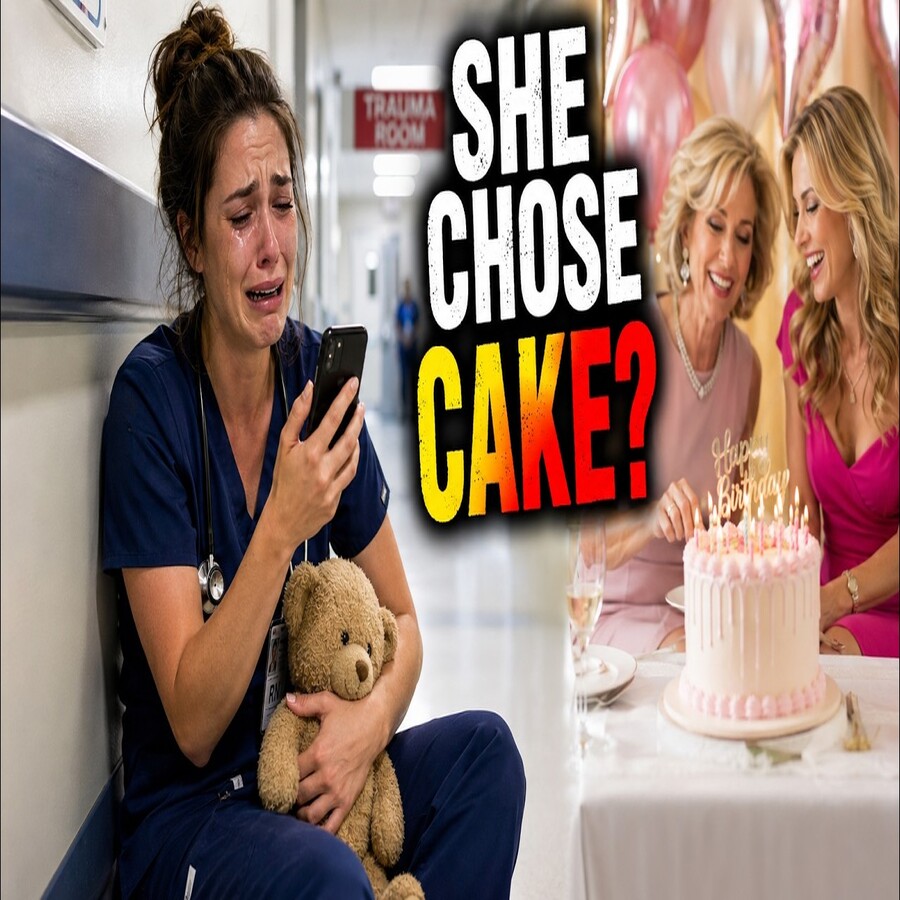
I remember every sound from that hallway. The squeak of a nurse’s shoes on the polished floor. The low murmur of a police officer talking to a doctor. The buzzing fluorescent light over my head. The cheap plastic chair under me that felt too small for the grief trying to rip through my body.
I was still wearing my navy blue ER scrubs. There was iodine on my sleeve. Someone had wrapped a gray blanket around my shoulders, but I kept shivering anyway. My hands smelled like antiseptic. My throat tasted like metal.
My husband, Daniel, was gone. My daughter, Sophie, was gone. My little boy, Eli, was gone.
And my mother chose buttercream frosting.
My name is Claire Bennett. I was thirty-five when my life ended and somehow kept going. I worked as an emergency room nurse at St. Catherine’s Medical Center in Columbus, Ohio. Before that night, I had the kind of life people call ordinary because they do not know ordinary can be sacred.
Daniel was a civil engineer with a laugh that filled every room before he entered it. He had an annoying habit of leaving coffee mugs everywhere, on the garage, on the porch, on top of the washing machine, anywhere except the sink. I used to complain about it. After he died, I found one mug behind a stack of paint cans and sat on the garage floor holding it like a relic.
Sophie was seven. She drew butterflies in everything. Homework margins, restaurant napkins, grocery receipts, the whiteboard in my kitchen. She said butterflies were proof that ugly little things could turn into something beautiful if nobody stepped on them too soon.
Eli was four. He slept with a stuffed bear named Captain Blue, even though the bear was brown and missing one eye. He told everyone he was going to become a doctor for sad hearts. When I asked him what medicine he would give people with sad hearts, he said, “Pancakes.”
We lived in a small yellow house in Westerville with a cracked driveway, a maple tree in the front yard, and toys under every couch. It was not glamorous. It was ours.
My birth family was not like that.
I was the oldest daughter, which in my family meant I was not a daughter at all. I was the emergency contact, the unpaid organizer, the designated driver, the holiday cook, the reliable bank account, the person everyone praised only when I was useful. My mother, Linda, had two voices. There was the soft, syrupy voice she used at church, at baby showers, and in front of people whose opinions mattered. Then there was the clipped, sharp voice she used on me.
“Claire, don’t be dramatic.” “Claire, just help your sister.” “Claire, you know how your father gets.” “Claire, can you bring the food?”
She never asked how my night shifts were. She never came to Sophie’s school concerts. She forgot Eli’s birthday two years in a row, then blamed me for not reminding her properly. But for my younger sister, Melissa, there were balloons, flowers, themed cakes, rented venues, and Facebook posts with captions about “my precious baby girl.”
Melissa was twenty-nine, beautiful in the effortless way that made strangers open doors for her. She had never kept a job longer than six months, never paid back a loan, never apologized without adding a reason it was really someone else’s fault. My mother treated her like a fragile porcelain doll. She treated me like the cardboard box the doll came in.
Daniel saw it clearly from the beginning. At our first Thanksgiving after we got married, I cooked two casseroles, carved the turkey because my father said his wrist hurt, washed dishes for two hours, and missed dessert because Melissa cried in the bathroom over a fight with her boyfriend.
On the ride home, Daniel said, “Your family doesn’t love you like family. They use you like staff.”
I stared out the window at the dark highway. “They’re not that bad,” I said.
He reached across the console and squeezed my hand. “Claire,” he said gently, “you defend them like you’re afraid someone will punish you for telling the truth.”
I laughed it off because that was easier than admitting he was right. The truth was, I had been trained to believe love was something I earned by being convenient. If I was helpful, calm, available, forgiving, and quiet enough, maybe my mother would look at me the way she looked at Melissa. She never did.
The night everything happened was November 18th. A cold rain had been falling since noon, the kind that makes headlights smear across the road and turns every parking lot into a mirror. Daniel had taken Sophie and Eli to their swim lesson because I was finishing a twelve-hour shift.
He texted me at 6:42 p.m. with a picture of Eli wearing goggles upside down and Sophie making a peace sign. “Your son is either ready for the Olympics or deep-sea crime.” I replied, “Give them kisses. I’ll be home by 8:00.”
That was the last message I ever sent my whole family.
They were twelve minutes from home when a drunk driver ran a red light on Cleveland Avenue. His truck hit Daniel’s side of the car so hard that the sedan spun across three lanes and slammed into a utility pole. Daniel died at the scene. Sophie was alive when paramedics pulled her out, but she died in the ambulance.
Eli made it to my hospital.
My hospital.
I was in the nurse’s station signing off on a medication chart when the trauma doors burst open and I heard someone shout, “Four-year-old male, motor vehicle collision, unresponsive.” I looked up because I had looked up at that sentence a hundred times before. Then I saw Captain Blue.
The stuffed bear was clutched against the child’s chest, dark with rain and blood. For one second, my brain refused to understand. It was like seeing your kitchen table in the middle of a battlefield, familiar and impossible. Then I saw Eli’s shoe. A red sneaker with a dinosaur sticker on the side.
My knees went out. My friend Angela, another ER nurse, grabbed me before I hit the floor. Dr. Patel turned and saw my face. The whole room changed. People moved faster and softer at the same time. Someone pulled me back. Someone said my name. Someone said, “Claire, don’t look.”
But I looked. And I wish I had not. I also know I would have hated myself forever if I had not.
They worked on Eli for twenty-three minutes. I counted every compression. I counted every order. I counted every breath that did not come back. When Dr. Patel called time of death, the room went silent in a way hospitals almost never do. Hospitals are machines of noise, monitors, wheels, pagers, vents, phones. But for two seconds after my little boy died, even the machines seemed ashamed.
Angela held me while I made sounds I did not recognize. Not screams. Something lower. Animal. Torn out of me.
A police officer told me Daniel had died immediately. A chaplain told me Sophie was gone too. I nodded like a person receiving information in a language she had studied but could no longer speak.
Then I called my mother.
I do not know why. Instinct, maybe. Childhood programming. When your world burns, you reach for the person who was supposed to be safe before you knew the word “safe.”
She answered on the fifth ring. Behind her, I heard music, laughter, women talking over each other. Someone shouted, “Light the candles.”
“Claire,” my mother said, “make it quick. We’re about to do the cake.”
I pressed the phone so hard to my ear it hurt. “Mom,” I said, my voice barely air. “There was an accident.”
“A what?”
“Daniel is dead.” I swallowed, but my throat would not move. “Sophie and Eli too. Mom, they’re gone. I’m at St. Catherine’s. I need you.”
The background noise faded a little, like she had stepped into another room. I waited for the gasp, the sob, the chair scraping back, the words every daughter thinks she will hear when her children die. “I’m coming.”
Instead, my mother sighed. Not a grief sigh. An inconvenience sigh.
“Oh, Claire,” she said. “That’s horrible.”
I closed my eyes. “Mom, please. I can’t do this alone.”
“Honey, tonight is Melissa’s thirtieth. People flew in. The cake is custom. We can’t just leave in the middle of everything.”
For a moment, I thought the shock had damaged my hearing. “My children are dead.”
“I heard you,” she said, and there was irritation now. “But there’s nothing we can do at the hospital tonight, is there? Call one of your nurse friends. You always have people around you there.”
“Mom.”
“Claire, don’t make me feel guilty. Melissa has been planning this for months. She’ll fall apart if we all disappear. We’ll come tomorrow or the day after. Your father has an early meeting.” Then softer, as if that made it kind, “Try to be strong.”
She hung up.
I sat staring at my phone until the screen went black. I called my father next. He answered from what sounded like the same party.
“Dad,” I whispered, “Daniel and the kids are dead.”
“I know,” he said quietly. “Your mother told me.”
“Can you come?”
There was a long pause. In that pause I heard him choose.
“Claire, I’m sorry. I really am. But your mom says it’s not a good time to upset everyone. We’ll stop by later this week.”
“Dad, I’m at the hospital with their bodies.”
“I know, sweetheart. Just hang in there.”
Then he hung up too.
Melissa did not call. She texted two hours later. “So sorry. I can’t even imagine. We’ll talk tomorrow.” There were three white heart emojis after it.
I threw the phone across the hallway. Angela picked it up, cracked screen and all, and put it in her pocket. Then she sat beside me on the floor. She did not say, “They probably didn’t mean it.” She did not say, “That’s just how your mother is.” She did not ask me to be understanding. She just sat there and cried with me.
👉 [Tap here for the Next Part ] 👈
Disclaimer : This content may be created by AI for entertainment purposes. Any resemblance to real persons, events, or places is coincidental.






