PART ONE: THE MANSION THAT HELD TOO MANY SECRETS
The House That Looked Beautiful But Felt Hollow
There is a kind of silence that only exists in houses with too much money and not enough warmth. You’ve probably never been inside a place like Ethan Caldwell’s estate. And honestly, that’s not a bad thing. It was the kind of home that looked beautiful in photographs and felt hollow in person. Sixteen rooms, marble floors so polished you could see your own reflection walking toward you. A grand piano in the east parlor that cost more than most people’s cars and was played, by Ethan’s own admission, maybe twice a year.
Ethan himself was thirty-eight, built from the kind of quiet discipline that turns a boy with nothing into a man with everything. He had started his first company at twenty-two, sold it at twenty-six, and by thirty he was the kind of name people said in hushed, respectful tones at dinner parties. He wasn’t loud about his wealth. He didn’t need to be. The silence in his house said it all.
He had staff, of course. A chef, a groundskeeper, a rotating roster of housekeepers. And then there was Rosa. Rosa had been cleaning the Caldwell estate for two years. She was soft-spoken, efficient, and carried herself with a kind of quiet dignity that Ethan had noticed, though he never said so out loud. She arrived early, left late, and never asked for more than she was given. In a house full of marble and mirrors, Rosa moved like a ghost—present but invisible, the way people in her position were expected to be.
But Rosa had a daughter. Her name was Lily. Lily was three years old. She had her mother’s dark lashes and a gap between her two front teeth that made every smile look like a tiny celebration. On the days Rosa couldn’t arrange child care, which happened more often than she would have liked, she brought Lily to work quietly, tucked in a corner of the kitchen with a juice box and a small cloth doll named Bea.
The Child Who Loved The Piano
Ethan knew about Lily. He had seen the little girl padding around the hallways more than once. He had never said anything—not to scold Rosa, and not to acknowledge Lily either. He simply let it be, the way men like him often let small, inconvenient things exist at the edges of their lives. Lily, for her part, was curious about everything. She was the kind of child who asked “why” seventeen times in a row, who collected smooth pebbles in her jacket pockets, and who had recently discovered, to her enormous delight, that the big black thing in the east parlor made sounds when you touched it.
Piano.
She had found it three weeks earlier, on a Tuesday afternoon when Rosa was changing the linens upstairs, and Lily had wandered, as toddlers do, toward the sound of her own footsteps on marble floors. She had reached up on her tiptoes, pressed one key with one finger, and frozen completely still—stunned and enchanted by the single resonant note that bloomed into the silence of the room.
After that, she came back every chance she got. She didn’t bang on it. She didn’t pound. She pressed keys the way she touched everything—gently, seriously, like each one was a small mystery worth investigating. She had even begun to find combinations that, to Rosa’s quietly startled ears, sounded almost like something—like the very beginning of a melody trying to remember itself.
Rosa had told her to stay away from it. But three-year-olds and grand pianos are both forces of nature, and nature, as they say, finds a way. On the morning that would change everything, a bright, cold Saturday in November, Rosa had been called in for extra hours. Ethan’s fiancée was coming for the weekend.
Her name was Victoria Haynes. Twenty-eight years old, the daughter of a property developer and a former beauty queen. She had the kind of face that looked better in person than in photographs, which was saying something because in photographs she was extraordinary. She wore her confidence the way she wore her clothes—deliberately and always slightly out of reach.
The Woman Who Saw Only Herself
Ethan and Victoria had been engaged for four months. It had been announced at a charity gala. There were photographs. Ethan had looked proud. Victoria had looked like she’d been preparing for that moment her entire life. Rosa had met her twice before. Both times, Victoria had looked through her the way you look through a window—not at it, just past it toward whatever was on the other side.
So when Rosa heard the sharp click of Victoria’s heels entering the east parlor that Saturday morning, and then the sudden, terrible silence that followed, she felt something cold move through her chest before she even heard the words. She dropped the cleaning cloth, and she ran.
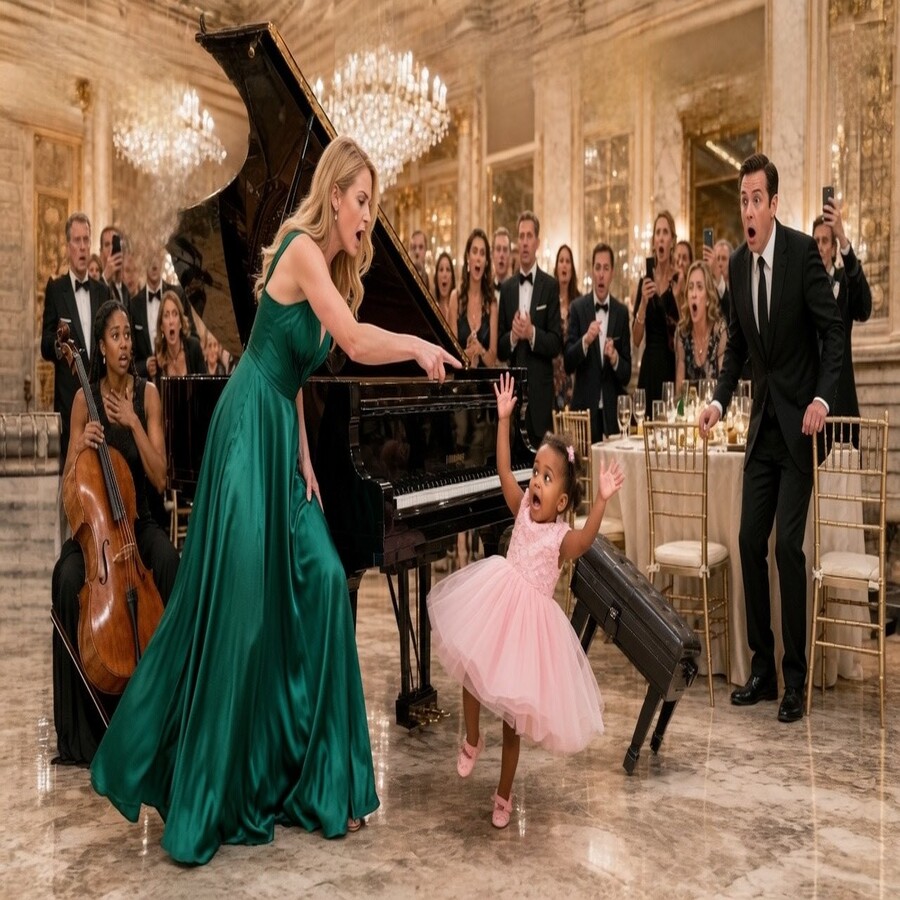
The east parlor was the most beautiful room in the house. That was the cruelest part of it. Floor-to-ceiling windows that looked out onto the garden, pale winter light pooling across the marble in long golden ribbons. At the center of it all, that magnificent piano, black as onyx, gleaming like something alive. And sitting at its bench, her small legs dangling far above the pedals, was Lily.
She had both hands on the keys. She was playing her little almost-melody, the one with three notes that she had found and claimed as her own. Her cloth doll Bea was propped against the side of the piano. Her juice box was on the floor. Her shoes were slightly on the wrong feet because Rosa had been in a hurry that morning. She looked in that moment like the most natural thing in the world.
Victoria did not see it that way. She had walked in expecting silence and elegance. She had walked in to sit with her coffee and her phone and enjoy the particular satisfaction of being in a beautiful room that was soon to be her beautiful room. She had not walked in expecting to find a small, unsupervised child of “the help” pressing fingerprints into a two-hundred-thousand-dollar instrument.
“What are you doing?”
Her voice was sharp, controlled, the kind of sharp that doesn’t need to be loud to cut. Lily turned around on the bench. She looked at Victoria with those enormous, serious eyes. She blinked once. Then she said, with complete sincerity, “Playing.”
Something in Victoria’s expression tightened.
“Get down,” she said. “This isn’t for you. You have dirty hands.”
Lily looked at her hands. They were, in fact, perfectly clean. Rosa was meticulous about things like that. But Lily was three, and she didn’t have the vocabulary yet for the kind of “dirty” Victoria meant. She didn’t move.
Have you ever watched a child be spoken to like that? Do you remember how it felt?
The Push That Changed Everything
Later, Rosa would try to reconstruct the exact sequence of what happened next. The investigators would ask her three times. Each time, her answer was the same. Victoria reached out—one hand, flat palm—against Lily’s small shoulder. And she pushed.
It wasn’t a hard push. Victoria would say that later, voice measured, as though the degree of force was the relevant detail. It was a correction. Removal. The kind of casual, thoughtless gesture you might use to move a vase from one surface to another. But Lily was three years old, and she was sitting on a piano bench with no back, and she had no warning, and she had no way to catch herself.
She tumbled sideways. The sound she made when she hit the marble floor was small and terrible. The silence that followed it was worse.
Rosa appeared in the doorway four seconds later. She would always remember those four seconds—the eternity of them, the way time became something thick and unbreathable as she ran down the corridor toward a sound she couldn’t name but recognized in the deepest part of her body. Lily was on the floor. She was sitting up somehow, staring at Victoria with those big, quiet eyes.
Not crying. Not screaming. Just looking. With an expression of pure, bewildered gravity that no three-year-old should have to know how to wear. Rosa crossed the room in three strides and gathered her daughter into her arms.
“I’m sorry,” she said immediately, reflexively, the way people in her position learn to apologize before they even understand what’s happened. “I’m so sorry. She shouldn’t have been in here. I’ll—”
“No.”
The voice came from the doorway. Both women turned. Ethan Caldwell stood at the entrance to the east parlor. He had come home early. He was still wearing his coat. His car keys were in his hand. And he was looking at Lily—not at Victoria, not at Rosa. At Lily. At her face. At her eyes.
The keys fell from his hand. They hit the marble floor with a sound like a small bell. And his face—composed, controlled, unreadable Ethan Caldwell—went completely, utterly white.
No one moved. The parlor felt suspended, like a snow globe mid-shake, everything still in the air, waiting to fall.
The Question That Broke Everything
Victoria broke the silence first. “Ethan.” Her voice was smooth, recalibrating. “I was just—the child was touching the piano, and I—”
“Rosa.” He didn’t look away from Lily. “Is she hurt?”
Rosa checked her daughter with trembling hands. A small red mark on Lily’s elbow. Nothing broken. She would have a bruise. She was already blinking away the shock of the fall, her lower lip trembling now in the way it did just before the tears came.
“She’s okay,” Rosa managed. “She’s okay.”
“Good.”
Ethan crouched down to the floor. Right there in his coat on the marble. He got down to Lily’s level. The billionaire on his knees. And Lily—perhaps because she was three, and three-year-olds operate on a frequency of pure instinct that adults have long since buried—looked at him. Really looked at him. At his face. At his eyes, specifically.
Then she said it. In that clear, uncomplicated voice that only belongs to very small children and very honest people.
“Why do your eyes look like mine?”
Victoria made a sound. Not a word. Not a sentence. Just a sound. Small and involuntary. Like something had punctured something inside her. Rosa’s arms tightened around her daughter. And Ethan, thirty-eight years old, composed, unreadable Ethan, stayed perfectly still on his knees for a long moment. Then he looked up at Rosa. And Rosa looked back at him.
And in that look—four seconds, maybe five—a secret that had been buried for four years surfaced completely, quietly, and without mercy.
👉 [Tap here for the Next Part ] 👈
Disclaimer : This content may be created by AI for entertainment purposes. Any resemblance to real persons, events, or places is coincidental.






