My Family Thought I’d Quietly Left The Navy, So I Stayed Silent At My Brother’s Seal Graduation — Until A General Suddenly Stiffened, Saluted, And Said, “Colonel… You’re Here?”
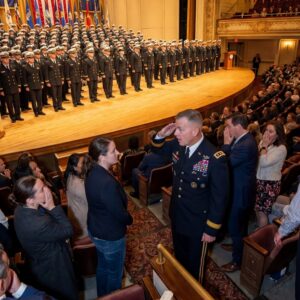
For more than a decade, the prevailing narrative in the Caldwell household was one of quiet, dignified failure. In the eyes of my family, I was the one who couldn’t make the grade—the one who washed out of the United States Naval Academy.
In a family defined by the rigid parameters of military success, “washing out” wasn’t just a career detour; it was a character assessment. The phrase was rarely spoken aloud, but it thrived in the air between us. It lived in the way my father’s eyes would drift past mine during holiday dinners, and in the polite, forced smiles my mother gave to neighbors when they asked what I was doing with my life.
I became a master of wearing that failure. I allowed the myth to settle over me like a heavy coat because the alternative—the truth—was a violation of a sworn oath that superseded my desire for my father’s approval.
I grew up in the shadow of Commander Richard Caldwell (Ret.), a man for whom the Navy was not a profession, but a theology. Our home in Virginia Beach was a shrine to twenty-seven years of impeccable service. The walls were a gallery of brass, silver, and wood—commendations for bravery, photos of gray ships cutting through blue water, and medals polished to a mirror shine.
My father was never a loud man. He didn’t need to be. His discipline was precise, surgical, and utterly controlled. When he was disappointed, he didn’t explode; he simply retracted. The world around him narrowed, and if you were the source of that disappointment, you found yourself standing outside the circle of his respect.
Dinner conversations in our house were tactical briefings. We didn’t talk about feelings or hobbies; we discussed command decisions, the logistical failures of the Gallipoli campaign, or the strategic nuances of Midway. To the Caldwells, service was the only metric of identity.
My younger brother, Ethan, was the perfect heir to this legacy. He was the physical embodiment of a recruitment poster—fast, aggressive, and instinctively tuned to the rhythm of combat. By the time he was twelve, he was studying BUD/S training videos. By eighteen, he was a lock for the SEALs.
I was the outlier. I wasn’t weak, nor was I soft, but my mind was built for the long game. While Ethan was out running miles on the beach, I was in my room mapping out after-action reports and calculating tactical outcomes. I saw the battlefield as a series of shifting variables, a complex web of cause and effect.
“Becca’s sharp,” my father would say with a slight nod. “But combat isn’t a game of chess.” He never meant it as a slight, but in our world, being a grandmaster was worth nothing if you couldn’t kick down a door.
My time at the Naval Academy was, by all public metrics, a success. My academic scores were at the top of my class, my physical rankings were high, and my performance in simulation-based leadership was nearly perfect. It was that perfection that drew the wrong kind of attention.
I was approached in my senior year by two officers who wore no rank and offered no names. Their questions weren’t about my shooting ability or my stamina. They wanted to know how I processed “dirty” data. They wanted to know my threshold for ambiguity and, most importantly, how I felt about being invisible.
They weren’t looking for a line officer. They were looking for someone to disappear into the joint interagency world—someone who could operate in the gray spaces where military force and intelligence gathering overlap.
“There will be no parades, Caldwell,” one of them told me. “No public recognition. Your official record will be a redacted shell. To protect the integrity of the mission, we need you to disappear. And to disappear, you need a cover story that no one will question.”
They suggested the narrative. Failure. It was simple, it was believable, and most importantly, it was final. People don’t look for secrets behind a washout; they just look away out of pity or embarrassment.
I was twenty-one years old. I was being asked to trade my family’s pride for a ghost’s life. I said yes.
The day I told my father I was leaving the Academy, I felt the temperature in the room drop twenty degrees. He didn’t yell. He just looked at me with a devastatingly level gaze.
“You were on the track, Rebecca,” he said.
“It wasn’t the right fit, Dad,” I replied, using the script I had been given.
I watched the light of shared identity go out in his eyes. From that moment on, I was a civilian in a house of soldiers. Ethan looked at me with a mix of confusion and a budding, unintentional arrogance. He had made it; I had quit.
For the next fourteen years, I lived a double life that bordered on the surreal. While my mother told the neighbors I was “finding myself” in various corporate consulting jobs, I was moving through training pipelines that didn’t officially exist. I learned dialects of Farsi and Arabic that I would never speak at a family Thanksgiving. I coordinated strike teams from windowless rooms in Northern Virginia, preventing casualties that would never make the news because the battles were never supposed to have happened.
At Christmas, I would sit quietly while Ethan told stories of jump school or dive training. I would endure my father’s “motivational” talks about perseverance, all while I was carrying the weight of operations that influenced national security.
The hardest part wasn’t the silence; it was how easily they accepted the lie. It fit the version of me they had already written—the academic girl who lacked the “stomach” for the real work.
The facade finally crumbled fourteen years later at the Naval Amphibious Base Coronado. We were there for Ethan’s SEAL Trident ceremony. It was his day—the culmination of the Caldwell legacy.
I stood at the back of the auditorium, wearing a simple blazer and slacks. I had no ribbons, no stars, no proof of the fact that I was currently a full-bird Colonel in Army Special Operations Command, recently transitioned from the shadows to a senior command role. To the families around me, I was just the supportive older sister who hadn’t quite lived up to the family name.
The keynote speaker was Major General Andrew Halvorsen. He was a legend in the SOF community, and unfortunately for my cover, he was a man I had briefed three times in the last six months. I tried to stay in the shadows, but as he stepped off the stage, his eyes swept the crowd and stopped dead on me.
He didn’t hesitate. He walked straight through the crowd of officers and families, ignoring the salutes, and stopped directly in front of me.
“Colonel Caldwell,” he said, his voice carrying clearly across the quiet room. “I didn’t expect to see you here.”
The word “Colonel” hit the room like a flashbang. My father, standing a few feet away, visibly recoiled. I saw his brain trying to reconcile the word with the daughter he thought he knew.
“Sir,” I replied, my posture snapping into a rigid, instinctive attention before I could stop myself. That reflex was the final nail in the coffin of my lie.
“I read your North Sea assessment,” the General continued, oblivious to the domestic carnage he was causing. “Your tactical reroute saved us six operators in the second phase. Outstanding work, Colonel. We need more minds like yours at the Point.”
My mother let out a small, stifled gasp. My father whispered, “Colonel?” with a voice that sounded like it belonged to a different man.
As the General walked away, the silence surrounding my family was deafening. Ethan was the first to speak, his eyes wide with a mixture of shock and a sudden, sharp respect.
“You’re a Colonel? Army? When?”
“Since three years ago,” I said, finally letting the weight of the secret go. “I was recruited out of the Academy. It was a joint-service classified track. I didn’t wash out, Ethan. I was moved.”
I explained what I could—the recruitment, the need for a cover narrative that wouldn’t invite questions, and the fourteen years spent in the dark. I didn’t give them details of missions, but I gave them the reality of the rank.
My father stood perfectly still for what felt like an eternity. His jaw was set so tight I thought it might crack. He looked at me—not at the “failure,” but at the officer standing before him. He realized that for fourteen years, he had been patronizing a woman who was technically his superior in the global hierarchy of command.
He did something then that he had only ever done in the presence of the flag. He took a half-step back, squared his shoulders, and delivered a high-year, crisp salute. It wasn’t the salute of a father to a daughter; it was the salute of a Commander to a Colonel.
I returned it, my eyes stinging for the first time in a decade.
The aftermath was a slow, sometimes painful recalibration. That night at dinner, the air was different. The tactical discussions were no longer one-sided. My father admitted, for the first time in his life, that he was wrong.
“I thought I was motivating you by being hard on you,” he said. “I thought I was pushing you to find your grit.”
“I had grit, Dad,” I said. “I just had to use it to keep a secret from the people I loved most.”
Six months later, the Caldwells gathered again, but this time the venue was different. I stood in a dress uniform as a Brigadier General’s star was pinned to my shoulder. My father stood in the front row, his chest out, a look of fierce, unadulterated pride on his face.
He still doesn’t know the details of what I did in the “washout” years. He never will. But now, when we go to Navy functions, he introduces me without hesitation. “My daughter,” he says, with a voice that rings like iron. “General Caldwell.”
The lesson I learned is that families are built on narratives, and those narratives are often based on incomplete intelligence. We define people by what we can see, forgetting that the most important work is often done in the dark.
I spent fourteen years letting my family believe I was a failure to protect a mission. I learned that silence is a weapon, but it’s also a wall. I carried a war they weren’t authorized to understand, and in doing so, I realized that true service isn’t about the medals on the wall—it’s about the strength to be exactly who you are, even when the world is convinced you are someone else.
Disclaimer : This content may be created by AI for entertainment purposes. Any resemblance to real persons, events, or places is coincidental.






