PART ONE: THE MORNING THAT CHANGED EVERYTHING
The Man Who Had It All
Daniel Whitmore was the kind of man people pointed at in rooms.
Not because he was loud.
In fact, he was remarkably quiet for someone of his status.
He was pointed at because of what he carried.
A presence so certain, so grounded, that even people who had never met him could feel it.
This was a man who had built something real.
And he had.
From a single rented office space in downtown Chicago.
Daniel had grown a real estate development company that now stretched across four states.
He had started with nothing.
Not nothing in the way people casually say when they really mean “a little less than average.”
Actual nothing.
A single mother who worked double shifts.
A childhood apartment where the heating barely worked in winter.
Shoes that he had learned to repair himself because new ones weren’t always possible.
He remembered all of it.
That was the thing about Daniel that surprised people once they got close enough to really see him.
Billionaires were supposed to forget where they came from.
Daniel had tattooed it into his memory like scripture.
He employed over four hundred people.
He funded two youth scholarship programs on the South Side of Chicago.
He had built affordable housing units in neighborhoods that most developers wouldn’t even drive through.
He was, by every measure that mattered, a good man.
And now he was in love.
Or at least that is what he believed.
Her name was Victoria Hale.
And if Daniel was the kind of man who commanded a room quietly, Victoria was the kind of woman who lit it on fire just by walking in.
She was sharp, sophisticated, stunningly beautiful.
Brilliant in that particular way that made you feel smarter just for being near her.
She came from money herself.
Old money.
The kind with portraits in hallways and last names on buildings.
Their worlds fit together the way people always say perfect couples should.
Like two puzzle pieces that don’t just connect, they complete.
Daniel had proposed six months ago on a rooftop in Milan.
She had cried.
He had cried.
His assistant had accidentally cried too, and then pretended she had something in her eye.
The wedding was twelve weeks away.
Everything was planned.
Everything was ready.
His life, every carefully constructed, hard-fought piece of it, was exactly where he had always dreamed it would be.
So, what could possibly go wrong?
The Invisible Guardian
Daniel lived in a four-story townhouse in Lincoln Park.
The kind of home that felt warm despite its size.
Filled with real wood and soft light and books that had actually been read.
He was particular about his space.
He liked things calm.
He liked mornings slow and quiet, coffee strong, and breakfast simple.
For the past two years, that breakfast had been prepared by a woman named Rosa.
Rosa Mendez had come to him through a staffing agency.
At a time when his previous housekeeper had relocated to be closer to family.
She was forty-one years old.
Small in stature, but enormous in presence.
The kind of woman who moved through a house like she genuinely cared about every corner of it.
She was efficient without being robotic.
Warm without being intrusive.
She cooked in a way that made you feel, oddly, like someone was looking after you.
Daniel respected her enormously.
He paid her well above market rate.
Made sure she had full health benefits.
Had given her Christmas bonuses that had made her cry at the kitchen table two years in a row.
Rosa had a daughter.
Her name was Lily.
Lily was three years old.
Technically three and a half, as she would be very quick to tell you if given the chance.
She had enormous dark eyes that seemed to be permanently set to “deeply curious.”
Two uneven pigtails that Rosa tied every morning with small yellow rubber bands.
And a laugh so sudden and full that it startled people the first time they heard it.
On days when Rosa’s daycare arrangements fell through—which happened occasionally, as it does in the lives of working single mothers—she would bring Lily to work.
Daniel had never minded.
In fact, if he was being honest with himself, those were often the better mornings.
There was something grounding about a small child moving through a quiet house.
Something that reminded him, in a way he couldn’t quite articulate, of what mattered.
Lily had taken an immediate liking to Daniel.
She called him Mr. Daniel.
She drew him pictures of houses, which delighted him given his profession.
She once spent forty-five minutes following him from room to room explaining in exhaustive detail why purple was the best color and why he should repaint his living room.
He had seriously considered it.
The Ordinary Morning
That Tuesday morning started like any other.
Rosa arrived at 7:00 a.m.
Victoria was already there.
She had stayed the night, which was becoming more and more common in these final weeks before the wedding.
Daniel came downstairs in a gray sweater.
Hair slightly disheveled.
Phone already in one hand.
Heading toward the coffee he could already smell from the second-floor landing.
Victoria was at the kitchen island.
Dressed impeccably even at this hour.
Scrolling through something on her tablet.
Rosa was at the stove.
Lily was in the corner of the kitchen.
Cross-legged on the small cushion Rosa always brought for her.
Crayons spread around her like a tiny colorful kingdom.
It was ordinary.
It was calm.
It was the last ordinary moment Daniel Whitmore would have for a very long time.
Rosa moved through the kitchen the way she always did.
With the kind of practiced efficiency that comes from years of making a home function beautifully without anyone having to ask.
The breakfast she was preparing was simple.
Poached eggs.
Whole grain toast.
Sliced avocado.
And a small bowl of mixed fruit.
The same breakfast Daniel had three times a week.
But this morning something was slightly different.
Rosa couldn’t have told you exactly what it was.
It wasn’t a sound.
It wasn’t a visible action.
It was something closer to a feeling.
The kind that lives beneath language.
In a part of human instinct that evolution built into us long before we had words for it.
Victoria had been in the kitchen before Rosa arrived.
That wasn’t entirely unusual.
Victoria was an early riser.
She sometimes made herself tea in the mornings.
Moving around the kitchen with a casual confidence.
Of someone who expected to be living there permanently very soon.
Rosa had never had a problem with that.
But this morning Rosa had noticed something.
When she had come in through the side entrance carrying Lily and her bag and her small cushion, she had pushed the door open to find Victoria standing very close to the counter.
Not doing anything obvious.
Not doing anything that could be described with certainty.
Just standing close to the counter.
Near the prep area.
Near the small array of spices and supplements that Daniel kept in a wooden rack by the window.
Victoria had turned when she heard Rosa enter.
She had smiled.
Warm.
Easy.
“Morning, Rosa. Cold out there today, isn’t it?”
“Yes, ma’am. Very cold.”
And that was all.
Rosa had set Lily down, tied on her apron, and begun preparing breakfast.
She told herself she was imagining things.
She told herself that a woman standing in her own—soon to be her own—kitchen was not suspicious.
She told herself that the slight uneasiness she felt in her stomach was just the cold morning air she had walked through.
She almost convinced herself.
Almost.
Because as she was plating the eggs, as she was arranging the food with a care she always brought to even the simplest tasks, she noticed something.
The small glass container of Daniel’s morning supplement powder.
The one his doctor had prescribed for a circulation condition he managed quietly.
Had been moved.
Not dramatically.
Not obviously.
Just slightly.
Just enough that someone who had placed it in its precise spot every morning for two years would notice.
Rosa stared at it.
She picked it up.
She turned it slowly in her hands.
She told herself she was being paranoid.
She told herself that Victoria had probably just moved it while looking for something.
She told herself a thousand small, reasonable things.
She set the plate down in front of Daniel’s usual chair.
And then she turned back to the stove.
And she quietly, without making any decisions she was fully conscious of, did not add the supplement powder to Daniel’s food that morning.
She didn’t know why, exactly.
She just didn’t.
The Scream
Daniel came to the table.
He picked up his fork.
He was reading something on his phone, half distracted.
The way busy people eat breakfast.
Present in body but miles away in mind.
Victoria sat across from him, still scrolling her tablet.
Everything was normal.
Everything was calm.
And then Lily looked up from her crayons.
Later, Rosa would think about this moment more times than she could count.
She would think about the fact that children, especially very small children, do not filter what they perceive.
They have not yet learned to talk themselves out of their instincts.
They have not yet been taught that somethings are too uncomfortable to say out loud.
They just see, and they react.
Lily had been watching.
Not with suspicion.
Not with any understanding of what she was seeing.
She had simply been watching the room the way children watch rooms.
With wide, unedited attention.
And somewhere in her small, uncomplicated mind, a connection had formed.
She had watched Victoria near the food.
She had watched Victoria’s face when Rosa walked in.
She had watched the way Victoria’s eyes moved to the plate when Rosa set it on the table.
Lily was three years old.
She did not have the vocabulary for deception.
She did not have the framework for poison or betrayal or the complicated architecture of adult cruelty.
But she had eyes.
And she had love for the man who called her drawings masterpieces.
Who once spent an entire afternoon letting her explain purple to him.
She looked up.
She looked at the plate.
She looked at Daniel’s fork moving toward the food.
And something in her small chest tightened in a way she had no name for.
So she did the only thing she knew how to do.
She screamed.
“No! Don’t eat it, Mr. Daniel! Don’t eat it!”
The fork froze halfway to his mouth.
The kitchen went absolutely silent.
And Rosa—Rosa who had been standing at the sink with her back turned—felt every hair on her body stand up at once.
Daniel put down his fork slowly.
He turned and looked at Lily.
She was standing now, having abandoned her crayons entirely.
Her small hands balled into fists at her sides.
Her face was doing the complicated work of a child trying to hold onto something urgent that they don’t have the words to explain.
Her eyes were full not of tears exactly, but of something that looked very much like fear.
“Lily,” Daniel said, and his voice was very gentle.
“Come here.”
She walked to him immediately.
No hesitation.
She stopped at the edge of his chair and looked up at him with those enormous dark eyes.
“What’s wrong, sweetheart?” he asked.
She did something.
Lily said, barely above a whisper.
“Who did something?”
Lily’s eyes moved just briefly, just for a fraction of a second, across the table to Victoria.
Daniel didn’t follow the look immediately.
He kept his eyes on Lily.
The way you do with a child when you want them to feel safe enough to keep talking.
“What did she do?”
Lily pressed her lips together.
She was trying very hard to find the right words.
And coming up against the brutal limitation of being three years old.
“She put something,” Lily said finally, “in the food. I saw.”
The kitchen was so quiet that Rosa, still frozen at the sink, could hear her own heartbeat.
Daniel was still.
The particular kind of still that comes not from calm, but from a mind moving very, very fast beneath the surface.
That has decided not to react yet.
Victoria set down her tablet.
“Daniel,” she said, and her voice was smooth.
The practiced smoothness of someone who had spent a lifetime in rooms where composure was currency.
“She’s three. She’s been playing with crayons all morning. She doesn’t know what she’s saying.”
“I know what I said,” Lily said firmly.
Despite everything, Rosa almost smiled.
Daniel looked up at Victoria then.
And the thing that Rosa noticed, the thing that would stay with her long after that morning had become a story they were all still living, was that Daniel didn’t look angry.
He looked heartbroken.
Just for a moment.
Just behind his eyes.
Like a man who had already, in the span of fifteen seconds, begun the devastating process of understanding something he had not wanted to understand.
He stood up from the table.
“Victoria,” he said calmly.
“I’d like to have the food tested.”
The temperature in the room dropped ten degrees.
“That’s absurd,” Victoria said.
Still smooth.
Still composed.
But something had shifted at the very corners of her expression.
Something so small that only someone watching very carefully would have caught it.
Rosa was watching very carefully.
“It’s not absurd,” Daniel said.
“It’s a reasonable thing to do.”
He took out his phone.
He called his personal physician, a man named Dr. Hargrove, whom he had known for fifteen years.
And explained the situation in four sentences.
Then he looked at Victoria.
“While we wait,” he said, “do you want to tell me anything?”
The Unraveling
Victoria stood up.
She was extraordinary, Rosa thought, in a way that was beginning to feel frightening rather than admirable.
Even now, even in this moment, she looked like a woman at a business meeting rather than a woman whose fiancé had just asked a question that had no good answer.
“I want to tell you,” Victoria said slowly, “that a three-year-old child just accused me of something monstrous based on nothing. And instead of defending me, you’re calling a doctor. And I think you should think carefully about what that says.”
It was masterful.
Rosa had to give her that.
The pivot, the reframe.
Turn the accusation back into a question about trust.
About Daniel’s character.
About who he was choosing to believe.
A child with crayons or the woman he was about to marry.
It was exactly the right move.
And it almost worked.
Almost.
Except for one thing.
Daniel looked down at Lily, who was still standing beside his chair.
Who had not moved.
Who was looking up at Victoria with the unfiltered clarity of a child who does not yet know that the truth is supposed to be complicated.
“Lily,” Daniel said quietly, “where exactly did you see her? Where were you when you saw this?”
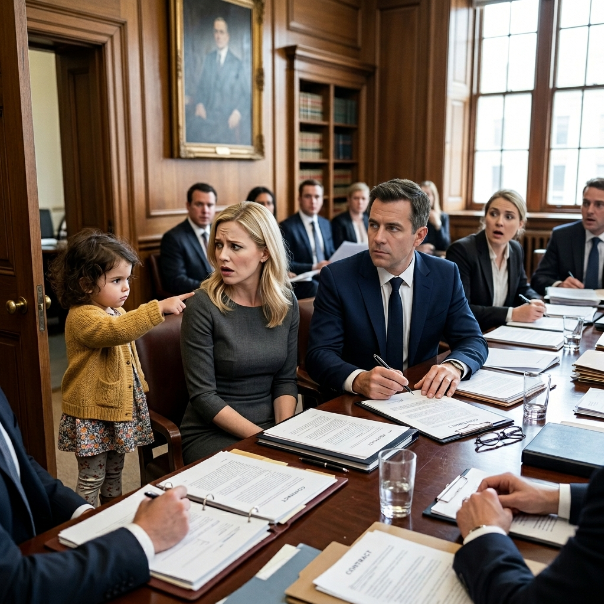
“I was there,” Lily said, and pointed at her cushion in the corner.
“And she was there.”
She pointed at the counter, at the exact spot near the supplement rack.
“And she had a little bottle, a small one, and she put it—”
Lily mimed shaking something, tipping it, adding it to a container.
The supplement powder.
Rosa’s throat tightened so sharply she had to grip the edge of the sink.
Because that was what she had moved.
That was what had been displaced.
Daniel turned and looked at the supplement rack.
Then he looked at Victoria.
And Victoria, for the very first time that morning, said nothing at all.
PART TWO: THE TRUTH
The Investigation
Dr. Hargrove arrived within forty minutes.
He tested the food.
He tested the supplement powder.
He took the results to a colleague at a lab within the hour.
And what they found in that small glass container—the container that Daniel took every single morning, the one that had been moved by just a few inches from where Rosa always placed it—changed every single thing.
The substance found in Daniel’s supplement container was a compound that, at the quantities present, would have been difficult to trace in a standard tox screen following a cardiac event.
It was not something a person bought at a pharmacy.
It was not something that found its way into a kitchen by accident.
Dr. Hargrove was a careful man, a precise man.
He delivered the information to Daniel in the quiet of his study on the second floor.
Speaking in the measured tones of someone trained to deliver news that falls like a hammer.
Daniel sat in the leather chair behind his desk.
He did not speak for a very long time.
What do you do with information like that?
What does a mind do when handed evidence that the person it was building a future with had been engineering an ending?
There is no preparation for that moment.
There is no version of being smart or experienced or successful that makes you ready for it.
Daniel was one of the most composed people Rosa had ever known.
She had seen him navigate hostile negotiations, sudden financial crises, personal betrayals in business that would have destroyed lesser men.
He had always been still at the center.
But when he came back downstairs that afternoon, after the police had come quietly, after statements had been made, after Victoria had left the house in the company of two officers without ever losing her remarkable composure, he walked back into the kitchen where Rosa was sitting with Lily, and he sat down at the table, and he put his face in his hands, and he stayed like that for a long time.
Rosa didn’t say anything.
She just put on the kettle.
She made him tea the way she had learned he liked it.
Strong with a single spoon of honey.
And she set it beside him without a word.
Lily climbed up onto the chair beside him.
She put one small hand on his forearm.
“It’s okay, Mr. Daniel,” she said very seriously.
“The bad part is over now.”
He looked at her, and something behind his eyes broke open in a way that Rosa knew, instinctively, was not entirely a bad thing.
Some things need to break before they can heal.
“You think so?” he said. His voice was rough.
“Yes,” Lily said with the absolute certainty of a child who has not yet learned to doubt the things she knows.
“My mama says that when the hard part comes, it’s because something better is getting ready.”
Rosa pressed her lips together and looked firmly at the window.
The Full Picture
The investigation that followed was thorough and, as these things go, swift.
Victoria Hale, composed, polished, old-money Victoria, had debts.
Not personal debts, not the kind that showed up in her own accounts, which were, by all appearances, perfectly healthy.
But a different kind of debt.
The kind that accumulated when an inheritance that was supposed to sustain a lifestyle of a certain scale turned out to have been dramatically, catastrophically overstated.
The Hale family fortune, it emerged, had been quietly dissolving for nearly a decade.
Bad investments.
Worse decisions.
A series of financial choices that had been papered over and hidden behind the kind of surface presentation that old money had spent generations perfecting.
Victoria had known.
She had known for years.
And she had constructed, with remarkable patience and precision, a plan.
Daniel’s company had a life insurance policy that covered its principal.
It was standard for businesses at that scale.
But in the months following their engagement, Victoria had quietly, through channels that took investigators some time to untangle, worked to have herself named as a beneficiary under terms that she had presented to Daniel as routine corporate restructuring.
Daniel had signed.
Why wouldn’t he?
He was marrying her.
He trusted her.
That was what love was supposed to mean.
What she had been building, what that small glass container was the final piece of, was a financial rescue mission.
Not for their future together.
For her own survival.
She had never loved him.
Or, and this was the part that Daniel would quietly wrestle with for months afterward, perhaps she had, in some fractured, complicated way, alongside everything else.
Perhaps love and calculation had coexisted in her the way contradictions sometimes do in people who have been taught that survival requires whatever it requires.
It didn’t change what she had done.
It didn’t make the supplement container less real.
But it made the grief more complicated.
And grief that cannot be simple takes much longer to move through.
The Healing
Rosa watched Daniel in the weeks that followed.
She watched him the way you watch someone you care about from a respectful distance.
Not intruding.
Not offering words where silence was more honest.
But simply being present.
Making breakfast.
Keeping the house steady.
Ensuring that the life he came home to each day was, in its small, ordinary details, a place that felt safe.
Lily helped.
Lily helped the way only children can.
Not by understanding the pain or addressing it or asking thoughtful questions about it.
But simply by continuing to be exactly herself.
By bringing him drawings.
By explaining purple again, in case he’d forgotten.
By falling asleep on the couch during cartoons and needing to be carried to Rosa’s room.
In a way that seemed somehow to give Daniel something he needed.
Something to take care of.
Something to be gentle for.
Six months passed.
The legal proceedings moved forward without Daniel needing to be deeply involved.
His attorneys handled what needed to be handled.
Victoria, through her own representation, reached the kind of conclusion that the evidence made inevitable.
Daniel did not attend any proceedings.
He had said what he needed to say in the initial statements and then let the system do its work while he focused on the harder, more private work of rebuilding the interior of his life.
He threw himself into his company.
He launched a new affordable housing initiative, larger than anything he’d done before, in three new cities.
He started mentoring a cohort of young entrepreneurs from low-income backgrounds.
Meeting with them every other Saturday in a conference room that he had redesigned specifically for those sessions.
Casual, welcoming, stripped of the corporate formality that could make people like his younger self feel out of place.
He was functioning.
He was even on many days content.
But Rosa watched him come home to an empty house every evening.
She watched him eat the dinner she left covered on the stove alone at the kitchen table.
Reading.
She watched him pause sometimes in the middle of ordinary moments with an expression on his face that she recognized because she had worn it herself after Lily’s father had left.
In the year when she had been learning to rebuild her own life from materials that felt insufficient.
It was the expression of someone who had stopped trusting their own instincts.
Who had looked at what they had built with so much care and faith and love and found it empty.
And was now quietly, painfully uncertain about whether they were capable of building again.
She understood it completely.
And she also understood something else.
That understanding someone’s pain does not mean you are the right person to address it.
Some things need to be left alone.
Some healing requires a kind of quiet respect that keeps its distance.
So she said nothing.
She kept coming.
She kept cooking.
She kept bringing Lily on the days when daycare fell through.
She kept the house exactly the way Daniel liked it.
Calm, warm, full of soft light and the smell of good coffee.
She did her job.
She did it with love.
And she kept the love private.
But children are not good at keeping things private.
PART THREE: THE NEW BEGINNING
The Question
One Saturday morning in November, seven months after the Tuesday that had changed everything, Rosa was in the kitchen and Daniel was at the table, half working and half watching Lily, who had set up what she was calling an “art studio” across most of the kitchen floor.
“Mr. Daniel,” Lily said, not looking up from her work.
“Yeah.”
“Do you like my mama?”
Rosa went completely still.
“Lily,” she began.
“I’m asking Mr. Daniel,” Lily said, with a firmness that was so precisely like Rosa’s own voice that Rosa had to look away to compose herself.
Daniel looked up from his laptop.
He looked at Lily.
Then, slowly, he looked at Rosa.
She met his eyes for exactly one second before looking back at the counter.
But one second was enough.
“Yes,” Daniel said, very quietly.
“I do.”
“Good,” said Lily, with the tone of someone who had just resolved a matter that had been pending far too long.
“Because she likes you, too. She just doesn’t say it because she’s being—” Lily paused, searching for the word she had heard. “Professional.”
The kitchen was very quiet.
And then Daniel laughed.
A real laugh.
The kind that comes from somewhere unexpected.
From a place in the chest that has been closed for a while.
The kind of laugh that sounds almost like relief.
Rosa covered her face with one hand.
“Lily,” she said into her palm.
“I’m helping,” Lily said simply, and went back to her drawing.
The Conversation
What followed was not a dramatic declaration.
It was not cinematic in the way films make love look.
It was a conversation, halting and honest and long overdue, between two people who had been living in close proximity to each other’s genuine selves for two years.
And had each, in their own way, noticed.
Daniel said, “I don’t want to complicate your life. I know what your situation is. I know what mine has been.”
Rosa said, “I know. I’m not asking for anything. I just—I think you should know that you are a good man, Daniel. I have watched you be a good man for two years. That is not nothing.”
He looked at her for a long time.
“No,” he said. “It’s not nothing.”
It started slowly.
It was careful and deliberate and occasionally awkward in the way that all real things are awkward before they find their shape.
He asked her to dinner.
Not as employer to employee.
But as himself to her.
She said yes.
And then immediately said she was going to need a moment because she had not expected to say yes so easily, and she wanted to gather herself.
He waited.
He was good at that.
Lily, when told, said, “Finally.”
And then asked if this meant she could have a dog.
The Wedding
Two years later, on a Saturday in October, when the trees in Lincoln Park had gone amber and gold, and the kind of light that only autumn produces was falling through the kitchen windows, Daniel Whitmore married Rosa Mendez.
Not in a grand venue.
Not in the kind of place that required a seating chart for four hundred people and a floral budget that could fund a small country.
In the garden behind his house.
Their house.
With thirty-seven people who genuinely loved them.
Standing on the grass in their good clothes, holding glasses of champagne, and crying in the completely unselfconscious way that people cry when they are watching something that is unmistakably true.
Rosa wore a dress the color of winter cream.
Her hair, usually pulled back for work, fell loose around her shoulders.
She looked like herself.
Which was, Daniel had said in his vows, the most beautiful thing he had ever seen in his life.
“I have had the kind of life,” he said, standing in front of her with the voice of a man who is choosing each word because it is the exactly right word, “that looks from the outside like it has everything. And for a long time, I believed that, too. I built things, big things, and I was proud of them. But the truest thing I have ever had, the warmest, most real and sustaining thing, I almost didn’t see.”
“You were there every morning. You made the coffee. You kept the house. You brought your daughter, who is—I need to say this officially and on the record—the bravest, most extraordinary person I have ever met.”
“You never asked me for anything. You never tried to be anything other than exactly what you were. And slowly, without me even knowing it was happening, you became the thing I was most grateful to come home to.”
“Rosa, you saved my life. And I don’t mean the morning your daughter screamed across the kitchen, though I also mean that. I mean the two years after. The steadiness of you. The simple, unshakable goodness of you. You showed me what it felt like to be near someone who loves you without agenda. I didn’t know how hungry I was for that until I had it.”
There was not a dry eye in the garden.
Lily, who is now five and wearing a dress she had selected herself, yellow because purple had been dethroned, stood at Rosa’s side as flower girl.
She made it approximately forty-five seconds into Daniel’s vows before beginning to cry.
Then became annoyed at herself for crying.
Then leaned against Rosa’s leg and cried anyway.
Daniel adopted Lily eleven months after the wedding.
He had asked her first.
Properly, formally.
Taking her out for ice cream and sitting across from her in a booth and saying, “I would very much like to be your dad. If you want that. But only if you want it.”
Lily had considered this for approximately three seconds.
“Do I get a dog now?”
He got her a dog.
A golden retriever named Captain.
Who immediately became the unofficial fourth member of the family.
And destroyed two couch cushions and one very expensive shoe before anyone worked out a system.
The Legacy
Daniel also did something else.
He set up a trust fund in Lily’s name.
Fully funded, enough to cover university and beyond.
Signed on the same day as the adoption papers.
He did it quietly, without ceremony.
The way he did most of the things that mattered most to him.
When Rosa found out, she sat down at the kitchen table.
The same table where everything had changed two years before.
And looked at him with an expression he had come to understand.
“You didn’t need to do that,” she said.
“I know,” he said.
“It’s too much.”
“It’s not enough,” he said. “Not even close.”
He looked toward the living room, where Lily was on the floor with Captain, explaining to the dog, with great seriousness, why yellow was now the best color.
“She saved my life,” Daniel said quietly.
“She walked into the middle of everything, a tiny little person with crayons and pigtails, and she told the truth when every adult in the room was either too afraid or too compromised to say it. She trusted her instincts. She trusted what she saw. She trusted me.”
He shook his head slightly.
“How do you repay something like that?”
Rosa reached across the table and took his hand.
“You already have,” she said.
“Every single day.”
EPILOGUE: The Question
And that is the truth at the center of this story.
The thing I want you to sit with after this story ends.
We spend enormous amounts of our lives building walls around our hearts.
Learning to protect ourselves.
Learning to perform composure when we are terrified.
Learning to second-guess the things we know to be true because the knowing of them is inconvenient or uncomfortable or frightening.
And sometimes, not often enough, but sometimes, a three-year-old girl with crayons and yellow rubber bands in her hair looks up from the corner of the room and says the true thing that everyone else has been too complicated to say.
She didn’t have strategy.
She didn’t have an agenda.
She didn’t calculate the risk or weigh the consequences.
She just loved someone.
And she told the truth.
And that was enough to change everything.
There is a version of courage that doesn’t look like courage.
It looks like a child who stands up from her cushion and shouts across the kitchen.
It looks like a woman who quietly doesn’t add something to a plate because her body told her something wasn’t right.
It looks like a man who puts down a fork and says, “Something is wrong and I’m going to pay attention to that.”
Courage doesn’t always arrive loudly.
Sometimes it arrives in yellow pigtails.
Here is what I want you to carry with you tonight.
Not everyone who smiles at your table wishes you well.
And not everyone standing quietly in the corner is invisible.
Sometimes the people who are watching over you are the ones we overlook.
The ones we assign smaller roles in the story of our lives.
When really they were the most important characters the whole time.
Pay attention to the ones who show up.
The ones who stay.
The ones who don’t ask for anything but give everything.
And if you have a Lily in your life, a person who told you the truth when it was hard, who stood up for you when they had every reason to stay small and quiet and safe, tell them.
Tell them what they meant.
Tell them what that truth cost them and how much it was worth.
Because some people save your life and never even know they did it.
And here is the question I want to leave in your mind.
The one that I hope follows you to sleep tonight.
Is there someone in your life who has been quietly protecting you, showing up, staying steady, telling the truth while you were looking somewhere else?
THE END.
Disclaimer : This content may be created by AI for entertainment purposes. Any resemblance to real persons, events, or places is coincidental.