The Last Thanksgiving I Stayed Silent
The microphone wasn’t real.
It was just a glass of wine, raised in the air, catching the chandelier light. Fourteen guests around a table draped in Patricia’s best white linen. Candles flickering. Silverware gleaming. Everything arranged to look like a family that had it all figured out.
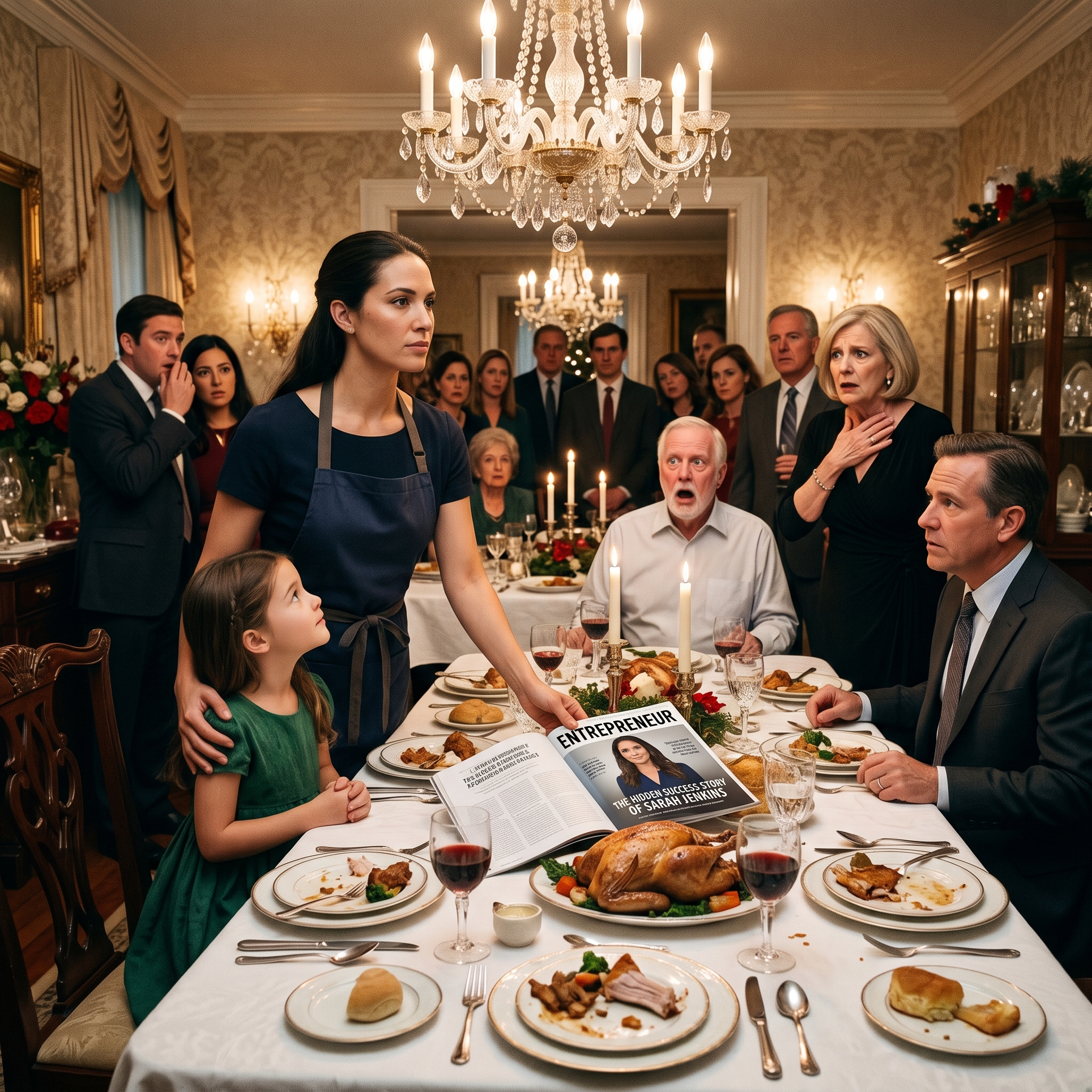
My father stood at the head of the table.
Richard O’Neal, sixty-three years old, Rotary Club president, deacon at the First Methodist Church, the man whose name opened doors in Milbrook, Virginia, the way other men used keys.
He tapped his glass with a fork.
“I want to give thanks,” he said, his voice carrying that Sunday sermon warmth he put on for company. “For this family. For this home. And especially for my Meredith. Dr. Meredith O’Neal Hartley. Who makes us all so proud.”
Applause. Warm. Automatic. Like clapping at church.
Meredith smiled. Tight. Practiced. Beside her, Donald stared at his plate. His jaw was clenched. Nobody noticed.
Richard wasn’t done.
“And of course, Thea.”
He paused. Let the beat land. Grinned.
“One daughter is a doctor. The other one is a maid.”
He laughed.
That low, self-satisfied chuckle I’d heard a hundred times. A few people laughed with him. Cousin Ray. Uncle Jim. The nervous, reflexive kind of laughter that fills the space when nobody knows what else to do.
Most of the table went quiet.
Pastor David looked down at his napkin. Ruth pressed her lips together. Donna Callaway shifted in her seat.
Frank Callaway, sitting three chairs to my right, didn’t laugh.
He looked at my father, then he looked at me.
Under the table, Lily’s hand found mine. Her small fingers were cold.
I squeezed them.
Didn’t speak. Didn’t react.
Not yet.
My eight-year-old daughter tugged my sleeve. Her voice was small, confused, breaking something inside me that had been cracked for years.
“Mommy, is being a maid bad?”
That was the last Thanksgiving I stayed silent.
The Cottage On My Father’s Land
The drive from Richmond to Milbrook takes about two hours if you don’t stop.
I stopped three times.
Lily kept crying. She was two. She didn’t understand why Daddy wasn’t in the car. Honestly, neither did I.
My ex-husband left on a Tuesday. Cleared the checking account on Wednesday. Filed from his mother’s address on Thursday. By Friday, I was standing on my parents’ porch in Milbrook, Virginia, holding a diaper bag and whatever dignity I had left.
My father opened the door.
He looked at the suitcases, then at me, then at Lily.
“The cottage out back is empty,” he said. “This is temporary. Don’t turn it into a habit.”
No hug. No “are you okay.” Just terms.
The cottage was three hundred square feet. One bedroom. A kitchenette. A bathroom with a shower that ran cold after four minutes. But it sat on my parents’ land, and there was no lease, no paperwork, just my father’s word.
At the time, I didn’t think that mattered.
Within a week, I was knocking on doors, cleaning houses. Fifteen dollars an hour, cash. While a neighbor watched Lily. I scrubbed bathtubs, mopped hardwood, organized pantries for women who had the life I thought I’d have by now.
That same month, Meredith finished her dermatology residency.
My parents threw a dinner for twenty people. I showed up late because I was still wiping bleach off my hands at a client’s house across town.
My father didn’t miss the chance.
He stood at the head of the table and said, loud enough for every guest to hear, “Sorry, Thea’s late. She was scrubbing someone’s bathtub.”
Everyone chuckled.
Meredith looked away.
I sat down and didn’t say a word.
That was the first time.
It would not be the last.
The Architecture Of Invisibility
The thing is, the jokes didn’t start when I moved home.
They started long before I ever left.
Growing up, Meredith was the one who got SAT tutoring, AP summer camps, college visits to Duke and UVA. When she got accepted to medical school, my father took out a second mortgage to cover her tuition. Every penny. No hesitation.
When it was my turn, he sat me down at the kitchen table and said, “Community college is plenty for someone like you.”
Someone like me.
I still hear that phrase when I close my eyes.
I went to Blue Ridge Community College. I paid for it myself. Waitressing. Babysitting. Cleaning the church on Sundays. I graduated in two years with honors.
Nobody came to the ceremony.
Every Thanksgiving, every Christmas, every Easter brunch, my father would introduce us the same way.
“This is my daughter, Dr. Meredith O’Neal Hartley.”
Then he’d turn, almost as an afterthought.
“And this is Thea.”
Not Thea, who graduated with honors. Not Thea, who’s raising a child on her own. Just Thea.
My mother never once corrected him.
When I brought it up, Patricia would sigh and press her fingers against her temples. “Your father just wants the best for both of you. Don’t be so sensitive.”
Here’s what nobody at those holiday tables knew.
Meredith’s medical school cost four hundred thousand dollars. My father covered about half. The rest—federal loans, one hundred eighty thousand dollars in debt—that Meredith was still carrying silently, invisibly, while everyone called her the successful one.
But at the O’Neal table, image was everything.
And my image had already been decided for me.
At least that’s what they thought.
The Pattern
It happened the way most things happen when you’re desperate.
Not with a plan. With a pattern.
By my second year back in Milbrook, I’d cleaned over sixty homes. And I started to notice something. The Shenandoah Valley was full of vacation estates. Big properties owned by people who lived in DC or Richmond and visited maybe four times a year.
These houses needed more than cleaning. They needed managing. Groundskeepers. Maintenance schedules. Guest turnover. Somebody who could walk a plumber through the front door at seven in the morning and lock up after the caterer at midnight.
Nobody was doing it well.
I filed for an LLC. Built a website at two in the morning while Lily slept. Named the company Magnolia Estate Services. It sounded bigger than it was, which at the time was just me and a secondhand laptop.
I signed my first three property contracts in the same month.
Not huge. But real.
I told my mother. I was excited.
“Mom, I just signed three clients. I’m building something.”
Patricia nodded. “That’s nice, honey. Meredith just got invited to speak at a dermatology conference in Boston.”
I stood in the kitchen holding my phone with the contract confirmation still open, and I understood completely, finally, permanently, that nothing I built would ever register in this house.
I could cure cancer, and my mother would ask if Meredith had cured it first.
The Aunt They Erased
That night, after Lily was asleep, my phone rang.
An unknown number with a 540 area code.
“Hi,” the voice said. “I’m Gloria. I’m your father’s sister, and I think we need to talk.”
I almost dropped the phone.
In this family, Gloria Ashford was a name you didn’t say out loud. My father had a sister. Past tense, at least in his version.
Gloria divorced her husband ten years before my call. In a town like Milbrook, where the Rotary Club still opened meetings with a prayer and couples who separated moved to different counties, that was enough to become a scandal.
But Gloria didn’t move. She stayed. Opened an antique shop on Birch Street. Lived alone. And liked it.
Richard cut her off completely. Told us she was a disgrace to the family name.
I hadn’t spoken to her in a decade.
“I heard about you from a mutual client,” Gloria said over coffee the next week. Her shop smelled like cedar and old books. “A woman whose lakehouse you manage. She couldn’t stop talking about you. Small towns. Everyone knows someone who knows someone.”
Gloria didn’t waste time.
“I want to invest in your company. Fifteen thousand dollars. Not a loan. Equity. Because somebody should have believed in you a long time ago.”
I stared at her. Fifteen thousand was more than I’d made in the last three months combined.
“I’m not doing this to spite your brother,” she added, like she could read my mind.
“Then why?”
“Because I know what it’s like to be erased from a family for choosing your own life.” She set her cup down. “Sound familiar?”
I took the money. Hired two part-time employees. Started running operations like a real company instead of a one-woman scramble.
Before I left, Gloria said something that stayed with me.
“Family should be a safe place, Thea. Not a cage.”
Then she paused.
“There’s something I know about your father that you don’t. But not yet.”
I drove home with more questions than answers and a check that would change everything.
The Threat
Two years.
That’s how long the quiet lasted.
By twenty-seven, I had five employees. Eight properties under contract. A growing reputation in the valley. Magnolia was still small, but it was real. I reinvested every dollar. Bought a proper work van. Printed business cards with a logo. Lily helped me pick it—a white magnolia on dark green.
I was still living in the cottage. Still on my father’s land. Still without a lease.
That’s when Richard decided to remind me.
It was a Sunday dinner. The only kind my parents hosted where they didn’t invite an audience. Meatloaf. Mashed potatoes. Meredith and Donald across the table. Lily coloring in the corner.
Midway through the meal, Richard set his fork down.
“That land out back is worth something now,” he said. Casual, like he was commenting on the weather. “I might need to rearrange things.”
I looked up. “Rearrange things? How?”
“Don’t worry about it. Just know that nothing is permanent.”
The room went quiet. Meredith stared at her plate. Donald took a long drink of water. Patricia busied herself with the salt shaker.
Nobody said a word.
Because in this family, when Richard made a statement, it wasn’t a conversation. It was a verdict.
Later that night, after Lily was in bed, Patricia called me. Her voice was strained, halfway between apologetic and instructional.
“Someone came to look at the property last week,” she said.
“A developer?”
“I don’t know the details. Your father handles these things.” A pause. “It’s probably nothing. I shouldn’t have mentioned it.”
She hung up.
I sat on the edge of my bed in the cottage on land I didn’t own in a house with no lease, and felt the ground shift beneath me.
The Search For A Way Out
I started looking for a rental.
Something near Lily’s school. Something I could afford.
The problem with Milbrook is that it’s a small town with a tight housing market. Three-bedroom rentals near Jefferson Elementary were almost non-existent. The ones that were available cost twice what I could swing without pulling money out of the business.
Patricia found out within a week. In a town this size, the realtor I called was her friend’s daughter.
The phone rang at eight in the morning.
“You’re looking at apartments?” Patricia’s voice was shaking. “You’re going to take Lily away from us.”
“Mom, I’m not taking anyone away.”
“Your father will be devastated after everything we’ve done for you.”
I wanted to ask what exactly they’d done, but I didn’t.
That evening, Richard called. No preamble.
“You move out, you’re on your own completely.” His voice was flat, factual. “Don’t expect us to babysit Lily on weekends. Don’t expect Thanksgiving invitations.”
“Are you serious?”
“I’m being practical.”
He knew exactly where to press. Lily called my parents every night before bed. She drew pictures of Grandpa’s garden. She counted the days between visits. Cutting that connection wasn’t something I could do to my daughter, and he knew it.
So I stopped looking.
I wasn’t staying because I was weak. I was staying because leaving at the wrong time would have cost me everything I’d built. In a small town, Richard O’Neal was respected. If I left, he’d frame it as abandonment. The ungrateful daughter who took our granddaughter away.
That narrative would reach every potential client within twenty miles.
I needed to be strong enough that when I finally walked out, I wouldn’t need anything from him. Not his land. Not his babysitting. Not his version of the story.
That day wasn’t here yet.
But it was coming.
The Crack In My Daughter’s Confidence
The cracks started showing in Lily first.
Her teacher called me in on a Wednesday. Mrs. Patterson, kind woman, twenty years in second grade.
“Lily’s been quiet at lunch,” she said. “The other kids asked what her mom does for work. She didn’t answer. She just shrugged and looked away.”
I sat in that tiny plastic chair and felt something inside me splinter.
My daughter. Eight years old. Already learning to be ashamed of me.
That night, I tucked Lily in and she asked, “Mommy, do you like your job?”
“I love my job, baby.”
“Then why does Grandpa always say it funny?”
I kissed her forehead and turned off the light. Then I went to the kitchen, sat at the table, and stared at the wall for an hour.
This wasn’t about me anymore.
Richard’s jokes, his little performance at every holiday—they were seeping into my daughter’s bones. She was eight, and she was already learning that her mother wasn’t worth being proud of.
The Opportunity
That same week, an opportunity landed in my inbox.
A new luxury development in the valley. Twelve vacation homes. Full-service management contract. The owner was looking for a single firm to handle everything.
Annual value: three hundred forty thousand dollars.
Enough to double my revenue. Enough to hire a full team. Enough to leave the cottage for good.
I called Gloria. Told her about the opportunity and about Lily.
She was quiet for a moment.
“Fear is a landlord too, Thea. And the rent keeps going up.”
That night, I picked up the phone and dialed the developer.
Two rings. A voice answered. Steady, professional, unhurried.
“Frank Callaway, Callaway Development. What can I do for you?”
I took a breath and I pitched.
Frank Callaway didn’t say yes on the first call. He said, “Send me your portfolio.”
So I did. Every property photo, every client reference, every maintenance report I’d ever filed. I formatted it like a woman who had something to prove.
Because I did.
Three days later, Frank called back.
“I asked around,” he said. “Three different property owners in the valley told me the same thing. If you want it done right, you call Magnolia.”
We met at his office in Staunton the following Monday. I wore the one blazer I owned, the one that still smelled faintly of dry cleaning chemicals because I’d only had it cleaned once.
Frank shook my hand, looked me in the eye, and said, “You’re the real deal, Thea. Let’s do this.”
I signed a two-year management contract for three properties, the initial phase of his development. Just like that, Magnolia went from a one-van operation to a company with real infrastructure.
I hired four new people that month.
The Move-Out Agreement
That same week, at home, the other shoe dropped.
Richard called me to his study. The room smelled like pipe tobacco and old leather. The room where he made pronouncements, not requests.
“I need you to sign some papers,” he said.
“What papers?”
“An agreement that you’ll vacate the cottage by March.”
“March? That’s four months away.”
“Plenty of time.”
I looked at the document on his desk. Professional letterhead. Legal language. A move-out date printed in bold.
“Why?” I said.
He leaned back. “Because it’s my property. That’s why.”
I didn’t yell. I didn’t cry. I stared at that document and noticed the name of a law firm. Not a family attorney. A commercial real estate firm.
Someone was buying this land.
“I’m not signing anything tonight,” I said. “I’ll read it first.”
I walked out. My hands were steady. My heart was not.
Patricia’s approach was always softer. That was what made it worse. She invited me for tea the next morning. The kitchen smelled like chamomile. She’d set out the good cups, the ones with the gold rims. A peace offering wrapped in porcelain.
“Your father is under a lot of stress,” she began. Eyes damp. Hands folded. The performance of a concerned mother rehearsed to perfection. “His investments haven’t been doing well. He needs to sell that land.”
“Thea, then why didn’t he just talk to me?”
“We are talking. You’re just not listening.”
I set my cup down. “You’re asking me to move my daughter out of the only stable home she’s known in four months without telling me why until I found out on my own.”
Patricia’s expression shifted. The softness thinned.
“Meredith would never make things this difficult.”
“Meredith doesn’t live in a cottage on Dad’s land.”
“Exactly.” She looked straight at me. “Because Meredith made something of herself.”
The words landed like a slap. Not because they were cruel. I’d heard worse. But because they came from my mother. The woman who used to braid my hair before school. The woman who was supposed to be safe.
I stood up. I left the tea on the table. I didn’t slam the door.
I just closed it behind me, which somehow felt louder.
Meredith’s Confession
That night, sitting on the cottage porch while Lily slept, my phone buzzed.
A text from a number I hadn’t seen in months.
“Meredith: Can we talk privately?”
I stared at the screen for a long time. My sister hadn’t texted me in over a year. Not for my birthday. Not for Lily’s. Not for anything.
And now, out of nowhere, she wanted to talk.
Something was wrong. I just didn’t know which part yet.
We met at a coffee shop in Waynesboro. Twenty minutes from Milbrook. Far enough that nobody would report back.
Meredith looked different. Not bad, exactly. Just reduced. Her hair was pulled back. No earrings. The confident posture I’d grown up envying had softened into something closer to exhaustion.
She ordered black coffee. I ordered the same. We sat near the window, and for a full minute, neither of us spoke.
Then she said it.
“Donald wants a divorce.”
I blinked. “Since when?”
“Since July. We’ve been pretending for four months.”
“Why are you telling me?”
She looked at her cup. “Because you’re the only person in this family who knows what it’s like to start over.”
I didn’t expect that to hit as hard as it did. Meredith, the golden daughter, the one whose name opened every toast, was sitting across from me in a coffee shop asking me how to survive.
Another silence. Then quieter.
“I know they treat you differently. I never said anything. I should have.”
I didn’t tell her it was okay. Because it wasn’t.
“How much debt are you carrying?” I asked instead.
She flinched. “One hundred eighty thousand in federal loans. Donald managed the payments. If we split—”
She trailed off. I could fill in the rest.
She asked if I knew a good divorce lawyer. I gave her a name. The same one I’d used five years ago. She wrote it down on a napkin, folded it into her purse, and for a moment looked exactly like the scared nineteen-year-old I remembered from before medical school turned her into a title.
I didn’t feel sorry for her. But I didn’t feel satisfied either. I just felt tired.
Driving home, I thought about how funny it was. Both O’Neal daughters sitting in coffee shops trying to figure out how to survive men who failed them.
The Magazine Feature
Three months before Thanksgiving, that’s when the phone call came.
Magnolia had grown. Twelve employees. Fifteen luxury properties across the Shenandoah Valley. Revenue had crossed the two million mark earlier that year.
I was running a real operation. Scheduling software. Uniformed crews. Quarterly client reviews. The girl who scrubbed bathtubs for fifteen dollars an hour now signed contracts over lunch.
Nobody in my family knew the scale. To them, I was still Thea, the one who cleans houses.
Then a journalist called.
“Hi, Miss O’Neal. I’m with the Shenandoah Business Journal. We’re doing a feature on local entrepreneurs under thirty-five. Your name came up three times from different referrals.”
Three different people had recommended me. Not Meredith. Not my father’s Rotary contacts. Me.
I agreed to the interview on one condition.
“Please don’t mention my family or my personal background. This is about the business.”
The reporter, a young woman named Kelsey, spent two hours with me at one of the estate properties I managed. She took photos of the team at work. She asked about revenue, growth strategy, client retention. She treated me like a CEO.
Because that’s what I was.
“This issue publishes the week of Thanksgiving,” Kelsey said as she packed up. “You’ll get an advanced copy.”
Thanksgiving. The timing felt almost poetic.
I didn’t tell my parents. I didn’t tell Meredith. The only person I told was Gloria, who listened on the phone and then laughed, a warm, surprised laugh.
“Well,” she said, “that’s going to make for an interesting holiday.”
For the first time in six years, someone was asking about my work. Not as a punchline. But as a success story.
And I carried that feeling quietly, tucked inside my chest like a lit match in a dark room, waiting.
👉 [Tap here for the Next Part ] 👈
Disclaimer : This content may be created by AI for entertainment purposes. Any resemblance to real persons, events, or places is coincidental.






