The CEO Laughed at a Single Dad’s Car Buried for 40 Years—Until Experts Uncovered the Truth
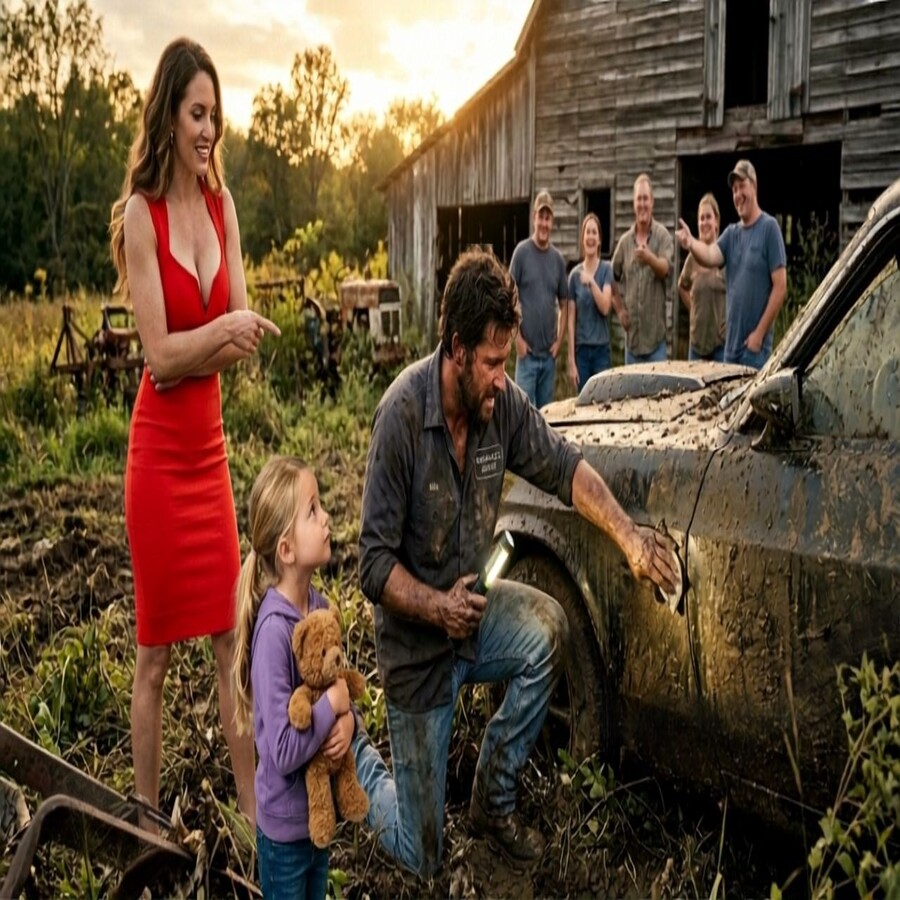
They called him crazy. They laughed in his face at the biggest conference in the industry. They broke into his shop and stole everything he’d spent months building. And then they thought it was over. But they were wrong. Because underneath the mud, underneath 40 years of weeds and silence and forgetting, something was waiting.
The engine wasn’t running when Ethan Walker pulled his truck off the county road and onto the gravel shoulder. It hadn’t been running right for 3 weeks. There was a tick somewhere deep in the valve train. subtle, almost polite, the kind of sound that a lesser mechanic might ignore. Ethan couldn’t ignore it.
He’d been listening to engines the way other people listen to music since he was 9 years old, sitting on an overturned milk crate in his grandfather’s garage in Harland County. And the tick followed him all the way from his shop in Corbin, Kentucky, through two-lane roads flanked by August tired fields to the rusted mailbox at the edge of a property he’d never once set foot on.
The mailbox said Callaway in letters that had mostly given up. He sat there for a moment with the truck idling, one arm resting on the open window, looking at the lane that disappeared into a wall of overgrown cedar and honeysuckle. His phone had a PDF of the inheritance documents his lawyer had emailed 3 weeks ago, and he’d read them maybe a dozen times, mostly trying to find a reason why a man named Gerald Callaway, who Ethan could only place as some cousin of his mother’s father, a man he’d met once at a funeral when he was 11, would leave him anything
at all, let alone 38 acres of farmland in Laurel County. He hadn’t found a reason. He’d driven down anyway. The lane was worse than it looked from the road. His truck bottomed out twice on ruts that had been left to deepen through seasons of rain and neglect, and the overhanging branches scraped the roof the whole way in.
When the lane opened up, it opened into a kind of sad clearing, a farmhouse with a collapsed porch roof, a detached garage whose doors had rotted off the hinges and lay flat in the weeds like something that had just given up standing. and beyond that, a barn with half its tin roof peeled back like a sardine can. Ethan got out.
The air smelled like wild onion and old wood and something underneath that he couldn’t name yet. He was 32 years old, 6 feet and 200 lb with the kind of hands that told the story of what he did for a living before he ever said a word. permanently stained along the knuckle lines, a scar on his left thumb from a fan belt incident in 2019, and a general roughness that no amount of gojo had ever fully addressed.
He was not a man who looked particularly comfortable in offices or conversations that required him to sit still. But he was deeply, almost unnaturally comfortable in places like this. He walked the property slowly, the way you do when you’re not entirely sure what you’re looking for. The house was a loss.
He could see that from the porch steps, which creaked and flexed under his weight in a way that said, “Don’t push this.” The interior smelled like decades of closed windows, and whatever had been living in the walls since the heat stopped working, and there were places where the ceiling had come down and taken part of the floor above with it. He noted it and moved on.
He wasn’t there for the house. The garage was more interesting. The rotted doors had actually protected the floor underneath them from weather to some degree. And the concrete slab inside, while cracked, was still level. There were tool marks on the walls where pegboards had hung. Oil stains on the floor in the particular shape that a single vehicle makes when it sits in the same spot for a very long time.
Front wheels here, rear wheels there, a drip pattern at the back that suggested a rear main seal that had been weeping for years. Something had lived in here. He crouched and looked at the oil stains the way a tracker looks at prints. They were old. Really old. But the shape was interesting. The wheelbase suggested something long.
Not a truck, not a station wagon, a car, and a large one with a rear end that hung back farther than average production cars of most eras. He stood up, looked at the back wall of the garage, which had a door that opened into what was probably once a storage area and was now completely buried under 30 years of bramble growth. Then he walked around the outside of the garage, following the wall of green, and found it.
It wasn’t visible at first, not really. It was just a shape in the vegetation, a rectangular mass that the honeysuckle and wild grape had colonized so completely that it had become part of the landscape. the way a stone wall eventually stops looking like something man-made and starts looking like a feature of the earth. Ethan almost walked past it.
He stopped, reached out and pulled a fistful of vines aside. Underneath was metal, rust orange and pocked, but metal. He could see the curve of a roof line, a C-pillar angle that was, and this was the thing that made his brain do something strange, some involuntary recalibration that was not quite right for anything he could immediately name.
He stood there for a long time, not moving, just looking. He drove back to Corbin with the tick still in the valve train and his mind somewhere else entirely. His daughter Maya was at the kitchen table when he got home doing homework with her headphones on and her hair piled in a bun that was actively falling apart on one side.
She was 15 and she had her mother’s eyes and her father’s stubbornness and she did not look up when he came in. “You eat?” he said. “There’s no food,” she said without removing the headphones. “There’s eggs. There’s also nothing to make with eggs. That’s not how eggs work. She finally looked up, studied him for a second, the way she sometimes did, like she was running a diagnostic.
What happened? You look weird. I went to the property. The farm thing from the dead cousin. He wasn’t my cousin. He was my mother’s. Ethan stopped. It’s complicated. Was it terrible? The house is bad. The rest is He pulled out a chair across from her and sat down. There’s a car on the property.
Maya pulled one earbud out. This was significant. What kind of car? I don’t know yet. Okay, but ballpark. I can’t ballpark it. That’s the thing. I’ve been looking at cars my whole life, and I can’t ballpark it. The roof line is He stopped again, frustrated by the inadequacy of words for what he’d seen. The SE-pillar angle is off from anything I can readily identify.
And the wheelbase based on the oil stains in the garage. You’re describing oil stains to me. The wheelbase is long, Maya. Like factory performance platform long. And the way the hunches, he saw her expression. It’s significant. I believe you, she said, putting the earbud back in. I’m going back Saturday. Cool, she said, already gone.
He made eggs. Aid. He ate them standing over the sink, which he knew was a bad habit and did anyway. He thought about seaillars. He thought about oil stains. He thought about the way a car could disappear so completely into a piece of land that it became indistinguishable from the earth around it and whether that was accident or intention.
He couldn’t sleep until almost 2 in the morning. Bus Saturday. He brought tools. Not restoration tools. Not yet. Not even close to yet, but the kind of basic equipment you bring when you need to fight through vegetation to reach something and then document what you find. Work gloves, loppers, a good flashlight, his phone for photos, a measuring tape, a notebook, actual paper, because there were situations where he trusted a notebook more than he trusted technology.
He spent the first 3 hours just clearing. The honeysuckle fought him. The wild grape fought him harder. There were blackberry canes in there that seemed personally offended by his presence and left long red scratches on his forearms through his shirt sleeves. But he worked steadily and without rushing, the way he did everything mechanical, with a patience that people who didn’t know him sometimes mistook for slowness.
What emerged from the vegetation as the morning wore on was not what he expected. He’d expected decay. He’d expected a vehicle so far gone that the identification would be mostly archaeological shapes and dimensions and inference the way you reconstruct an animal from bones. And the car was bad, no question.
The surface rust was comprehensive. The tires had deflated and rotted away to flat rings of degraded rubber. The glass was frosted with oxidation on the outside and filmed with something organic on the inside. The chrome where it existed had gone chalky white, but the body panels underneath the rust. And this was the thing.
The body panels were not collapsing. The steel had surface corrosion, but not the deep structural pitting he would have expected from 40 plus years of outdoor exposure, even covered exposure. Either the car had been protected better than its appearance suggested, or it had been built with unusually heavy gauge steel, or both.
👉 [Tap here for the Next Part ] 👈
Disclaimer : This content may be created by AI for entertainment purposes. Any resemblance to real persons, events, or places is coincidental.






