Two hundred engineers had failed.
Six days had passed.
The $75 million private jet sat dead in the hangar like a beautiful corpse.
Then a single father with grease under his fingernails walked in to make a delivery — and saw the one thing every expert had missed.
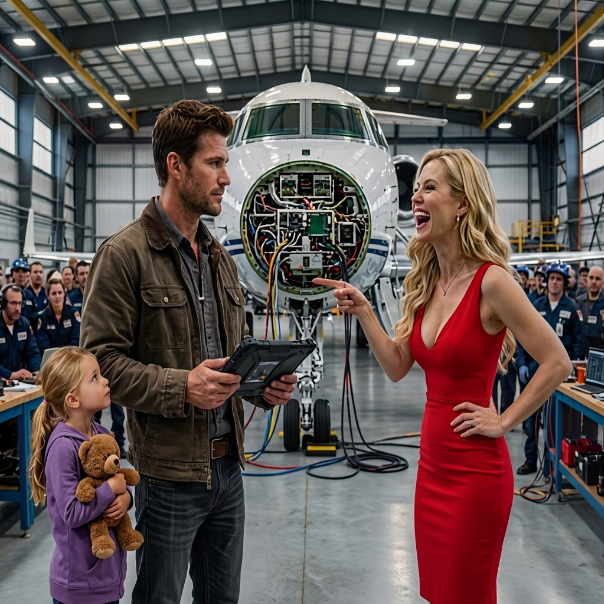
The Dead Jet
Victoria Ashford received the call at 4:47 in the morning.
She was already awake.
Sleep had become a luxury for people with smaller problems. People who did not own an aviation company losing millions of dollars every day. People whose flagship aircraft was not sitting silent in a private hangar while contractors from three countries failed to make it breathe.
Her phone lit up on the nightstand.
Raymond Holt.
Her head of technical operations.
Victoria answered on the first ring.
“Tell me it started.”
There was a pause.
That pause told her everything.
Raymond had worked for Ashford Aviation for eleven years. He was not dramatic. He did not waste words. He did not pause unless the truth was bad enough to need a moment before delivery.
“No,” he said. “It didn’t start.”
Victoria closed her eyes.
“Day six.”
“Yes, ma’am.”
She sat up, swung her legs over the side of the bed, and pressed her bare feet to the cold hardwood floor.
Cold helped.
Pain helped.
Anything that reminded her she was still standing helped.
“How’s the team?”
“Tired.”
“What did the Stuttgart contractors say?”
Another pause.
“Raymond.”
“One of them said there is nothing mechanically wrong with the aircraft.”
“And?”
“He said if nothing mechanical is wrong, then maybe the jet is cursed.”
Victoria almost laughed.
Almost.
The Meridian G9 was not cursed.
It was worse than cursed.
It was expensive.
Seventy-five million dollars of white and silver engineering perfection. The most advanced private jet Ashford Aviation had ever produced. A machine designed to prove that the company her father built could still lead the industry after his death.
Instead, it had become a silent monument to failure.
Two hundred engineers.
Six days.
Zero answers.
“Get everyone back in the hangar by seven,” Victoria said. “And find me coffee.”
She ended the call before Raymond could answer.
By 6:15, she was walking across the private terminal lot under a dark sky.
Rental cars crowded the pavement. Equipment vans sat in crooked rows. Foreign contractors smoked near the loading dock with the hollow eyes of people who had slept too little and failed too long.
Victoria walked past all of them.
Inside the main hangar, the smell hit her first.
Aviation fuel.
Machine oil.
Sweat.
Exhaustion.
The Meridian G9 stood in the center of the hangar beneath industrial lights.
It was magnificent.
It was dead.
Diagnostic machines surrounded it like doctors around a patient no one wanted to pronounce gone. Laptops glowed. Cables ran across the floor. Engineers stood in tight groups speaking in low voices, German, English, technical language, frustration.
Raymond met her near the aircraft stairs. His tie was gone. His collar was open. The dark circles under his eyes looked permanent.
He handed her coffee without a word.
“Walk me through it again,” she said.
He rubbed the back of his neck.
“Six days ago, final pre-delivery inspection. Standard engine start sequence. Phase one normal. Phase two normal. Phase three triggers an automatic safety lockout. Engines don’t ignite. Everything shuts down.”
“And you checked?”
“Everything.”
“Say it.”
“Both engines. Fuel system. Hydraulic lines. Primary electrical. Secondary electrical. Avionics stack twice. Landing gear sensors. Structural stress triggers. Passive safety sensors. Full diagnostic suites from Rolls-Royce, Honeywell, and two outside software vendors.”
Victoria looked at the jet.
“And every test says nothing is wrong.”
Raymond exhaled.
“Every test says the aircraft is functional.”
“And yet it won’t start.”
“And yet it won’t start.”
Victoria took a sip of coffee.
Too bitter.
She drank it anyway.
“Who do we still have on site?”
Raymond checked his tablet.
“Our in-house avionics team. Two Pratt & Whitney engineers. Flight control systems. Navigation vendor. Software engineers.”
“Software engineers?”
“We brought them in on day four.”
“What did they do?”
“Standard avionics software diagnostics.”
Victoria turned slowly.
“Did anyone read the initialization logs?”
Something flickered across Raymond’s face.
Not guilt.
Worse.
Recognition.
“They ran standard diagnostics.”
“That is not what I asked.”
“The scanner checks for error codes. If there are no error codes, the protocol does not require manual review of the full log sequence.”
Victoria set her coffee down on a service cart.
“Pull the logs.”
Raymond looked at her.
“All of them,” she said. “And get me someone who actually reads them. Not scans them. Reads them.”
What Victoria did not know yet was that the person who could read them was not in her hangar.
He was not on her engineering team.
He was not one of the experts flown in from Europe.
He was not even supposed to be there.
He was driving a white delivery van past the airport service road.
The Man Who Wasn’t Supposed To Be There
Ethan Walker expected that Tuesday to be ordinary.
Three avionics component boxes in the back of his van.
One delivery to a parts supplier near the airport.
Two repair tickets waiting back at his shop.
One school project his daughter Sophie needed help finishing before bed.
That was his life.
Not glamorous.
Not headline-worthy.
Just work, bills, fatherhood, and the quiet discipline of keeping everything from falling apart.
Walker Avionics Service sat on the ground floor of an old two-story building in a part of town real estate agents called “up-and-coming” because “still struggling” did not sell as well.
The sign above the door was hand-painted and slightly crooked.
Ethan had painted it himself one Saturday while Sophie drew chalk animals on the sidewalk.
He kept meaning to fix it.
He never did.
The shop was small, cluttered, and perfectly organized in a way only Ethan understood. Shelves of components. Half-finished repairs. Coffee mugs used as paperweights. A corkboard with service tickets, sticky notes, Sophie’s second-grade photo, and one faded picture of Ethan’s father in uniform beside an aircraft that no longer flew.
James Walker.
Master Sergeant.
United States Air Force.
Twenty-one years as an avionics technician.
A man with rough hands, impossible standards, and the strange gift of finding faults official procedures insisted should not exist.
Ethan had his father’s hands.
Square palms.
Long fingers.
Permanent oil stains around the knuckles.
He had his father’s patience too. That quiet stillness that let him sit with a broken system until the system finally told him what was wrong.
What he did not have was his father.
James had died six years earlier from a stroke that arrived without warning on an ordinary Thursday.
The loss left Ethan with grief, a shop, a daughter, and eleven notebooks.
His father’s notebooks.
Not official manuals.
Not military reports.
Personal records.
Observations.
Case studies.
Hard-earned lessons.
Every strange failure James had seen. Every assumption that had led good technicians in the wrong direction. Every reminder that machines sometimes lied about why they were broken.
Ethan kept the notebooks on the top shelf above his bench.
He saw them every day.
And did not see them.
Because some grief stayed visible only if you looked directly at it.
That morning, as Ethan drove past the main Ashford hangar, the doors were wide open.
He slowed without meaning to.
Inside, even from the service road, he could see the chaos.
Engineers.
Cables.
The Meridian G9.
And a monitor near the port side of the jet.
He could not read the data from that distance.
But he could see the shape of it.
Columns.
Clear results.
Automated diagnostic output.
Finished-looking data around a problem that was obviously not finished.
Something in his mind clicked.
Small.
Quiet.
Like a lock beginning to open.
His father’s voice came back to him, not as a memory exactly, but as habit.
You heard something, didn’t you? That’s why you slowed down. Don’t walk past that.
Ethan pulled over.
He sat behind the wheel for a moment.
Then he got out.
A security guard stopped him before he reached the hangar entrance.
“Restricted area, sir.”
“I know.”
“You with one of the teams?”
“No. I run a small avionics shop. Walker Avionics. I was making a delivery.”
“Then you need to step back.”
Ethan looked past him at the monitor.
“Who do I talk to if I think I have an idea?”
The guard gave him the tired look of a man who had heard too many ideas from too many people.
Then a woman’s voice cut through the hangar.
“Raymond.”
Everyone near the door turned.
Victoria Ashford stood near the aircraft stairs, sleeves rolled to her elbows, hair tied back, face pale from six days of pressure and no sleep.
Her presence changed the air without raising the volume.
She looked at Ethan.
Then at the guard.
“Who is he?”
“Delivery driver, ma’am. Says he runs an avionics shop.”
Victoria walked over.
“Avionics?”
“Small shop,” Ethan said. “Nothing like this.”
Her eyes sharpened.
“What’s the problem?”
“If two hundred engineers haven’t found it in six days,” she said, “I’m not sure.”
Ethan looked past her at the monitor.
“What are those logs showing?”
Raymond stepped forward.
“You can read those from here?”
“No. But I can see the display structure. That’s automated diagnostic output.”
“It is.”
“Has anyone read the raw initialization logs manually?”
Silence.
It was the kind of silence that answered the question better than words.
Victoria looked at Raymond.
Raymond looked at the floor.
Then Victoria looked back at Ethan.
“Come inside.”
The Four Minutes
Raymond pulled up the full initialization logs at monitor station four.
Not the summary.
Not the scanner report.
The raw data.
Pages and pages of timestamped system events from every failed startup attempt over six days.
Ethan sat on a stool and did not touch the keyboard.
He looked.
That was the first thing his father had taught him.
Before testing.
Before replacing parts.
Before changing anything.
Look.
Let the system speak before you decide what it is saying.
Around him, the hangar moved uneasily. Engineers watched with crossed arms. A German specialist named Klaus stood nearby, silver-haired and skeptical. Raymond hovered like a man who wanted hope but no longer trusted it.
Ethan read slowly.
Startup sequence for an aircraft like the Meridian G9 was a choreography.
Hundreds of systems.
Each one waking in the correct order.
Each one feeding information to the next.
A diagnostic scanner looked for error codes. Failed component. Voltage out of range. Sensor fault. Communication loss.
But scanners only looked where they were told to look.
They did not look between systems that were individually fine but collectively fighting.
Ethan read the sequence once.
Then again.
Then he saw it.
Small.
Easy to miss.
Phase three.
Primary navigation initialization.
Secondary navigation initialization.
Same timestamp.
That should not happen.
There was supposed to be a timing gap between them. A clean sequence. Primary first. Secondary second. The timing file controlled that order.
But the timing file had a corrupted entry.
Not missing.
Not broken enough to create an error code.
Just malformed.
A single bad timestamp telling both navigation systems to initialize at the same moment.
The aircraft interpreted the simultaneous signal as a fault.
The safety lockout engaged.
The engines never started.
Every engine test had passed because the engines were fine.
Every fuel test had passed because the fuel system was fine.
Every hydraulic test had passed because the hydraulics were fine.
The jet was not mechanically dead.
It was being stopped by one tiny corrupted line no automated scanner had bothered to question.
Ethan leaned back.
“I think I know what it is.”
Raymond turned.
“Already?”
“Your timing file has a corrupted entry. It’s triggering both navigation systems at once. The safety lockout reads the conflict as a fault condition. It’s not hardware. It’s not fuel. It’s not sensors. It’s a data conflict in a file your scanner doesn’t check because the file itself doesn’t generate an error.”
Raymond stared at him.
Klaus stepped closer.
“That is impossible. We reviewed avionics software.”
“Did you manually review the initialization timing file?”
Klaus said nothing.
Ethan turned to the navigation engineer.
“Show me the configuration directory.”
The engineer hesitated.
Then pulled it up.
It took four minutes.
The corrupted entry was exactly where Ethan said it would be.
One malformed timestamp.
One microscopic error.
Six days of failure.
Klaus leaned toward the screen, jaw tight.
“Five days,” he said quietly. “We looked at everything.”
Ethan’s voice stayed neutral.
“You looked everywhere the procedure told you to look.”
Klaus did not argue.
Because the proof was on the screen.
Raymond called Victoria.
She arrived in under two minutes.
That told Ethan something about her.
Raymond explained the finding.
Victoria listened without interrupting.
When he finished, she looked at Ethan.
“You’re confident?”
“I’m not a betting man,” Ethan said. “But yes.”
“What made you look there?”
He thought of the notebooks.
His father’s cramped handwriting.
The old lesson written more than once.
The machine will tell you it is broken. The machine may be wrong about why.
“My father was military avionics,” Ethan said. “He used to say software problems hide inside hardware diagnostics because hardware diagnostics are not looking for software problems. A scanner looks only where it is programmed to look. If the problem is somewhere else, no one finds it.”
Victoria held his gaze for one long second.
Then she turned to Raymond.
“Let him work.”
The Sound Everyone Had Been Waiting For
Fixing the file was not dramatic.
That was what no one understood.
The discovery was dramatic.
The repair was careful.
Ethan deleted the corrupted timing file.
Rebuilt the initialization sequence from clean backup configuration.
Verified each value manually.
Then verified again.
This was where patience mattered more than genius.
Rushing toward a solution was how people created the next failure.
When he finished, the chief technician climbed into the cockpit.
The hangar went quiet.
People stopped talking.
Stopped typing.
Stopped pretending they were not watching.
Victoria stood near Ethan at the monitor station.
“How long?” she asked.
“Ninety seconds.”
“And if it doesn’t work?”
He watched the screen.
“Then we look again.”
She nodded.
Not comforted.
But maybe respected by the honesty.
The startup sequence began.
Phase one: nominal.
Phase two: nominal.
Phase three.
Primary navigation initializing.
Complete.
A beat of silence.
Secondary navigation initializing.
Sequential.
Correct.
No conflict.
Ethan exhaled.
Phase four.
Phase five.
Then came the sound.
Low at first.
A rising whine.
The first engine spooling.
Catching.
Building.
The sound filled the hangar like a storm waking up.
Then the second engine joined it.
Two turbines running in perfect rhythm.
After six days of dead silence, the Meridian G9 roared alive.
For one moment, two hundred professionals stopped being professionals.
Someone shouted.
Someone laughed.
Someone cursed in relief.
Klaus stood with his arms crossed, staring at the jet like it had personally humbled him.
Raymond turned toward Ethan.
He opened his mouth.
Closed it.
Then said only, “Six days.”
Ethan looked at the monitor.
Every system nominal.
Every value correct.
The $75 million jet was alive.
Not because he was smarter than everyone in the room.
Because he had looked where the procedure had stopped looking.
His phone buzzed.
A message from Sophie’s school.
Reminder: Sophie’s class project presentation is tomorrow. Please ensure materials are ready.
Ethan almost laughed.
He put the phone away and turned to Raymond.
“I still have a delivery to finish.”
Raymond stared at him.
“Ms. Ashford is going to want to speak with you first.”
Ethan picked up his jacket.
“I figured that wasn’t a suggestion.”
“It isn’t.”
The Million Dollar Question
Victoria took him to a glass-walled conference room above the hangar.
Below them, engineers moved around the Meridian G9 like people recovering from a miracle they could not admit was a miracle.
Victoria sat across from Ethan at a table built for twelve.
The distance between them felt absurd.
Neither moved closer.
“You saw something from the service road,” she said.
“Yes.”
“What?”
“The diagnostic output looked finished.”
She frowned.
“That told you something was wrong?”
“When a diagnostic report says everything is fine on a machine that still does not work, that report becomes dangerous. It gives everyone permission to stop looking.”
Victoria went still.
“Your father taught you that.”
“Yes.”
“He’s gone?”
“Six years.”
“I’m sorry.”
“Thank you.”
A brief silence passed between them.
Then Victoria leaned back.
“You know about the reward.”
Ethan looked at her.
“The million dollars.”
“Yes.”
“I saw it on the news.”
“Then you know what you’re owed.”
“I know what you offered,” he said. “That is not the same thing.”
Her eyes sharpened.
“How is it different?”
“I didn’t come in looking for money. I came in because something caught my eye and I couldn’t drive past it.”
“You have a daughter.”
“Yes.”
“A small shop.”
“Yes.”
“Bills.”
“Plenty.”
“And you are telling me one million dollars was not part of your thinking.”
“If I were calculating, I would take the check.”
“You haven’t said you won’t.”
Ethan looked down at his hands.
Grease-stained.
Plain.
The same shape as his father’s.
“My father left me eleven notebooks,” he said. “Everything he learned in twenty-one years. Problems he solved. Mistakes he made. Ways of thinking that never made it into official manuals.”
Victoria waited.
“He believed knowledge should not die with the person who earned it.”
Ethan looked through the glass at the hangar below.
“There are kids in this city who could do what I do. Kids who could do what your engineers do. But they will never reach the room where anyone finds out because no one hands them the tools. No one lets them near the machines. No one gives them the notebooks.”
Victoria’s expression changed.
Not much.
Enough.
“What are you asking for?”
“I’d rather the money build those rooms than sit in my account.”
“You’re describing a training program.”
“I’m describing an idea,” Ethan said. “You’re the one who knows if it can become a program.”
For the first time that morning, Victoria Ashford looked less like a CEO and more like a person who had been surprised by goodness.
“I was prepared to write a check,” she said. “I was not prepared for this conversation.”
“Sorry.”
“Don’t be.”
She picked up her water bottle, realized she had not opened it, and set it back down.
“Give me two days.”
The Daughter Who Understood Before Everyone Else
Ethan finished the delivery the next morning.
By noon, rumors had already spread.
A nobody walked into Ashford’s hangar.
A delivery driver fixed the impossible jet.
A single dad solved in twenty minutes what two hundred engineers missed in six days.
By 3:15, Sophie came home from school, dropped her backpack in the hall, and walked into the shop.
“You weren’t here for dinner last night,” she said.
“I know.”
“Mrs. Calloway made pasta with the cheese on top.”
“You like that pasta.”
“I liked it the first four times.”
Ethan smiled.
She climbed onto the taped-up stool beside his workbench.
“Where were you?”
“A job came up.”
“A big one?”
“Bigger than usual.”
“How big?”
He set down his tool.
“You know Ashford Aviation? The company with the white private jets?”
“The fancy ones?”
“Yes. One of their jets had a problem no one could fix.”
“And you fixed it?”
“I think so.”
“You think so or you did?”
“I did.”
Sophie nodded as if confirming expected data.
“What was wrong?”
He explained it the way his father had explained things to him.
Simple.
Straight.
Never talking down.
“A file was supposed to tell two systems when to start. The file had a mistake. The mistake made both systems start at the same time. The aircraft thought that was dangerous and shut everything down.”
Sophie listened carefully.
“Why didn’t they just look at the file?”
“Because the scanner they used didn’t check that file.”
“Why not?”
“Because nobody told it to.”
She thought about that.
“So the problem was that they were only looking where they already thought the problem would be.”
Ethan looked at his daughter.
“Yes,” he said softly. “That is exactly what the problem was.”
She picked up a test connector from the bench, turned it over, then placed it back exactly where she found it.
“Grandpa would have found it.”
“He taught me how,” Ethan said. “So in a way, he did.”
Sophie slid off the stool.
“Are you going to be rich now?”
“No.”
“Okay.”
She left to finish her project.
That was Sophie.
Eight years old.
Too serious for most adults.
And somehow already more interested in the truth than the reward.
That evening, Victoria called.
No assistant.
No email.
A direct call.
“I’ve been researching aviation training programs,” she said without greeting.
Ethan leaned against the counter.
“And?”
“There is a gap. A serious one. Most programs are academic. Flight theory. Compliance. Regulations. Not enough hands-on technical training for people without money or industry access.”
“That is the gap.”
“I want to build the program with you. Not around you. With you.”
He was quiet.
“I have a shop I cannot close. A daughter I pick up from school. Dinners to make. Repairs already scheduled. I cannot become some speech-giving foundation mascot.”
“Good,” Victoria said. “I have enough of those.”
He did not know what to do with that.
“Come in Thursday,” she said. “You, me, our foundation director. We start building something real.”
Then she paused.
“And bring Sophie.”
“My daughter?”
“She asked the right question.”
“You haven’t met her.”
“You told me what she asked. That was enough.”
The Room Where He Finally Belonged
On Thursday, Ethan picked Sophie up from school at noon.
Her teacher looked skeptical.
“A business meeting?” Mrs. Brennan asked.
“Yes.”
“And Sophie is attending?”
“Yes.”
Mrs. Brennan looked at Sophie.
Sophie looked back with the calm patience of a child waiting for adults to finish being complicated.
“All right,” the teacher said, choosing her battles.
In the van, Sophie put her feet on the dashboard.
“What kind of business meeting?”
“The kind where we figure out how to teach kids to fix aircraft.”
“What kind of kids?”
“Kids who don’t have money. Kids who might be good at it but never get close enough to find out.”
“Like you with Grandpa?”
“Yes.”
She looked out the window.
“What if they don’t know they’re smart yet?”
Ethan glanced at her.
“What do you mean?”
“What if they don’t know they’re smart about airplanes because nobody ever showed them an airplane?”
He drove in silence for a few seconds.
“That is a good point.”
“I know.”
Not arrogant.
Just factual.
At Ashford Aviation’s main building, the receptionist led them upstairs.
Victoria was waiting with Dr. Patricia O’Shea, the foundation director, and David Park from legal partnerships.
Victoria stood when they entered.
“You’re Sophie.”
“Yes.”
“I’m Victoria.”
“I know. You’re the one who offered the million dollars.”
David Park coughed into his fist.
Victoria almost smiled.
“That’s correct.”
“My dad didn’t take it.”
“Also correct.”
They sat around a round table.
Patricia opened first.
“I want specifics. Not inspiration. What does good hands-on technical training look like? What does a student need to learn first? Where do existing programs fail?”
Ethan liked her immediately.
No fluff.
No charity language.
No performance.
“Before that,” he said, “what is the goal? A pipeline into aviation jobs, or a program that teaches students how to think independently in the field? Those are not the same.”
“Why can’t it be both?” David asked.
“It can,” Ethan said. “But you need to know which one you are optimizing for. A pipeline produces workers who can follow industry pathways. Independent training produces people who can reason when the pathway runs out.”
Sophie spoke then.
“What did Grandpa teach you? The pipeline one or the independent one?”
Everyone looked at her.
Ethan answered honestly.
“The independent one.”
“That’s why you found the problem,” Sophie said. “Because you knew how to look without being told where to look.”
Patricia set down her pen.
She looked at Sophie.
Then at Ethan.
“Your daughter can stay.”
They worked for hours.
Not in slogans.
In details.
Workstations.
Aircraft access.
Student stipends.
Recruitment.
Mentors.
Certification.
Failure points.
The philosophy behind the program.
Ethan talked about his father’s method. Not lectures first. Not procedures first. Proximity first. Watch. Hold the flashlight. Ask questions. Understand what a system is trying to do before learning what to do when it fails.
Victoria listened.
Wrote notes.
Asked precise questions.
At 3:30, she set down her pen.
“This is substantial,” she said. “The million dollars is a foundation. Not the whole solution. I will commit more company resources, but the board needs a coherent proposal.”
“How long?” Ethan asked.
“Six months to do it right.”
He looked at Sophie.
“What do you think?”
She rested her chin in her hand.
“I think you already decided in the van.”
He could not argue.
“Okay,” he said. “Six months. But my shop stays open.”
“Fifteen hours a week,” Victoria said. “Flexible. Around your business.”
“And Sophie’s schedule.”
Victoria nodded.
“And Sophie’s schedule.”
Sophie nodded approval like she had just negotiated acceptable terms.
The Man Who Heard The Silence
Four days later, the story broke.
At first, aviation sites covered it.
Independent technician solves Meridian G9 mystery.
Then general news outlets found the emotional hook.
Single Dad Fixes $75 Million Jet In Minutes — Then Turns Down $1 Million Reward
By noon, Ethan’s phone had seventeen voicemails.
Journalists.
Producers.
Strangers.
People who wanted the hero version.
Single father.
Dead father.
Genius moment.
Million-dollar refusal.
It was not false.
It was incomplete.
Victoria called at 12:30.
“You’ve seen the coverage.”
“Some.”
“What’s your read?”
“They are flattening it.”
“How?”
“They want it to be about a single dad saving the day. That is context. The story is that a technical problem got solved because someone looked where standard procedure said not to bother looking.”
Victoria was silent for a moment.
“We can use the attention for the program. If you are willing.”
“One interview,” Ethan said. “One. With someone who will let me talk about the actual gap. Not just me.”
“I’ll find the right person.”
The journalist’s name was Carol Vance.
She came to Ethan’s shop, not Ashford’s office.
That mattered.
She sat at his workbench with a recorder and said, “Start wherever you want.”
So he started with his father.
Not the jet.
Not the money.
James Walker.
The garage.
The notebooks.
The way his father approached machines like conversations, not enemies.
“The most dangerous thing in diagnostics is not ignorance,” Ethan said. “It is false certainty. Being so sure where the problem should be that you stop seeing where it actually is.”
Carol listened.
When she asked about the moment the jet started, Ethan looked at his hands.
“I was thinking about my father,” he said. “Not that I had done it. That he had. What he learned and passed on to me had just fixed a $75 million aircraft no one else could fix.”
“And the money?”
“It was not the right thing to do with it.”
“Why?”
“My father’s knowledge should not end with me.”
Three weeks later, the article ran.
The Man Who Heard The Silence
It was not as viral as the first wave.
But it reached the right people.
Retired technicians.
Teachers.
Parents.
Students.
People who understood that the real story was not one man finding one corrupted file.
The real story was how many brilliant people never got close enough to a machine to discover they could understand it.
The Program
The board presentation happened six weeks later.
Victoria stood at the front of a long conference room with a full proposal.
Training facility.
Aircraft access.
Student stipends.
Mentorship model.
Certification partnerships.
The board listened carefully.
Some were moved.
Some were skeptical.
One senior board member, Gerald Fitch, leaned forward.
“This program deviates from standard technical aviation training. Why?”
Victoria looked at Ethan.
Ethan had chosen not to sit at the table. He sat against the wall, hands on his knees, watching like he watched diagnostic screens.
Now he looked at Fitch.
“Because standard training produced two hundred engineers who spent six days unable to find a problem sitting in a log file no one opened.”
The room went still.
“I am not saying they were bad engineers,” Ethan continued. “They were good engineers. They followed their training. Their training did not tell them to look where the problem actually was.”
Fitch studied him.
“And your approach would have?”
“My father’s approach would have. Procedure is the floor, not the ceiling. You follow it because it covers most cases. But when the case in front of you is not covered, you need to think from first principles.”
“How do you assess that?”
“You give students problems the procedure does not cover,” Ethan said. “Then you watch how they move through the question. Not whether they get the answer immediately. How they think when the map runs out.”
Fitch was quiet.
Then he said, “I have more questions. But not objections.”
The board voted that afternoon.
Twelve in favor.
None opposed.
Two abstentions.
The program passed.
Victoria called Ethan from the parking lot.
“It passed.”
“I know. Raymond texted me.”
“Of course he did.”
She paused.
“Your father would be proud.”
Ethan did not answer right away.
“You didn’t know him.”
“No,” she said. “But I know what he built. Eleven notebooks, one son, and now this.”
Ethan sat in his van, watching the sun lower over the airport complex.
“Yeah,” he said quietly. “Okay.”
The Room With The Right Light
They looked at two possible facilities.
The first was clean, efficient, and wrong.
Rows of desks.
Harsh lighting.
A classroom that had already decided what learning looked like before any student entered.
“No,” Ethan said after five minutes.
Victoria looked around.
“Give me more than that.”
“This room already knows what it is. Students who have been told this field is not for them do not need a room that agrees. They need a place that feels open.”
The second space was a former maintenance staging area.
Concrete floors.
Old oil stains.
Exposed beams.
Uneven light.
A row of high windows along the eastern wall.
Ethan walked in and stopped.
“This one.”
Victoria looked at the stains.
“It needs renovation.”
“Not as much as you think. Keep the bones. Work with what is here. The windows matter.”
“The windows?”
“Natural light changes how people feel about where they are.”
Victoria looked at the windows.
Then at him.
“Okay.”
The renovation took eleven weeks.
Workstations were arranged in a horseshoe, not rows. Students could see one another work. They could see that others were struggling too. The room became less like a classroom and more like a shop where thinking happened out loud.
Seven weeks into renovation, Ethan brought Sophie.
She stood in the middle of the space and looked around slowly.
“It smells like Grandpa’s garage.”
Ethan had not noticed until she said it.
Then he did.
Concrete.
Metal.
Old oil.
New tools.
She walked to an unfinished workstation and touched an empty tool hook.
“Who are the first kids?”
“Twelve to start.”
“What if none of them are good at it?”
“Then we teach better.”
“What if some of them are really good and don’t know yet?”
Ethan looked at his daughter.
“That is who we are building this for.”
The First Twelve
The first cohort started in March.
Twelve students.
Ages seventeen to twenty-two.
Some came from schools that had cut vocational programs years earlier. Some came from families where survival had always mattered more than dreams. One young woman had been helping support her mother since she was fifteen. One young man had never been near an aircraft but wrote in his application that he liked fixing broken fans because “at least fans tell the truth when they stop working.”
Ethan stood at the back of the room on the first morning.
The students came in trying not to look nervous.
That meant all of them were nervous.
Marcus Webb, a retired avionics technician with thirty years of experience, led the first session.
He waited until they settled.
Then said, “I’m going to tell you something true. You’re going to be bad at this for a while.”
The room went still.
“Not because you are not capable. Because this is hard and you are new. Being bad at something new is not a character flaw. It is physics.”
A few students looked up.
“We are not here to make you feel good about yourselves. We are here to give you useful tools. Feeling good comes later, when you become good at something hard.”
One student, Deshawn, raised his hand.
“How long does the struggling part last?”
Marcus looked at him.
“Never fully stops if you are doing it right. You just get better at staying with it.”
Deshawn nodded slowly.
Not happy.
But respectful.
That was enough.
The first months were hard.
Students got frustrated.
Some argued.
Some shut down.
In week five, a student named Priya told Marcus she might quit because she was the worst one in the room.
Ethan asked to speak with her.
They sat in the break area.
“Tell me what happened,” he said.
She explained the exercise. A navigation fault. She followed every procedure. Got nowhere.
“What did you try after the procedure?”
She stared at him.
“What do you mean?”
“When the standard method stopped working, what did you do next?”
“Nothing. I thought I had failed.”
Ethan nodded.
“That is the lesson.”
“I failed?”
“No. You found the edge of what you know. That is where learning starts. Everything before that is review.”
Priya stayed.
By the final assessment months later, she became the strongest diagnostic thinker in the cohort.
Ethan never told her that.
He let her find it in her own results.
The Ending That Was Only A Beginning
Nine months later, the first cohort completed the program.
The ceremony was held in the training facility itself.
No gowns.
No stage.
No auditorium.
Just the oil-stained floor, the horseshoe workstations, the tool hooks, the clean eastern windows, and the morning light coming through.
Each student spoke for three minutes.
Not about success in general.
About one moment when something changed.
Deshawn talked about the day he almost walked out and Marcus sat beside him without saying a word.
“He showed me staying with something hard was not something you had to do alone.”
Priya talked about finding the edge of her knowledge.
“That was the first time I understood that not knowing was not the same as not belonging.”
Terrell, the quietest student, talked about his grandfather, a factory mechanic who had died with decades of knowledge no one had written down.
“I think about what was lost,” Terrell said. “This place is an answer to that loss. Not for him. It is too late for him. But for the next person like him.”
The room fell quiet.
Sophie sat beside Ethan.
She leaned toward him and whispered, “Terrell’s grandfather sounds like Grandpa.”
“A little.”
“Grandpa passed it on, though.”
“To me.”
“And you’re passing it on to them.”
“Trying to.”
She looked across the room at the twelve students.
“And someday they will pass it on.”
It was not a question.
Sophie said it like a fact.
Ethan looked at his daughter, morning light across her shoulder, his father’s old expression somehow alive in her face.
He thought of James Walker in a garage with a flashlight.
Of eleven notebooks waiting on a shelf.
Of the service road where he almost kept driving.
Of the monitor that looked too finished.
Of the problem no one found because no one looked where the scanner had not been told to look.
He thought of the million dollars he did not take.
And everything it became.
“Yeah,” he said. “They will.”
That evening, after Sophie went to bed, Ethan sat at the kitchen table and opened the seventh of his father’s notebooks.
Halfway through a case study, James Walker had written something that was not really about aircraft at all.
The hardest thing in this work is not the technical content. The technical content is learnable. The hardest thing is learning to trust your own perception when it contradicts the official conclusion. The voice that says “look again” is usually the honest one. Listen to it, even when listening is harder than stopping.
Ethan read it twice.
Then he closed the notebook and looked around the quiet kitchen.
Outside, the city moved on.
Traffic.
A distant siren.
Evening settling into the neighborhood.
The shop sign was still crooked.
Sophie’s drawing still hung on the refrigerator.
The remaining notebooks waited on the shelf.
Some things took the time they needed.
Some knowledge traveled slowly.
Father to son.
Son to daughter.
Technician to stranger.
Garage to hangar.
Notebook to classroom.
A $75 million jet had started because one man refused to walk past something that looked wrong.
But that was never the whole story.
The whole story was this:
Someone had been careful enough to write down what he learned.
Someone else had been patient enough to read it.
And because of that, a room full of young people would never have to wait outside the hangar, wondering if the work inside was meant for them.
The door was open now.
And Ethan Walker, the single father who had once walked in by accident, had made sure it would stay open for the next person who knew how to look again.
THE END.
Disclaimer : This content may be created by AI for entertainment purposes. Any resemblance to real persons, events, or places is coincidental.






