The CEO Entered His Own Restaurant as a Homeless Man… Only One Waitress Saved Him a Seat
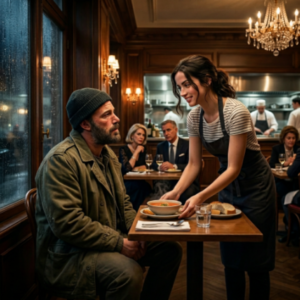
The rain had been falling over Chicago for nearly six hours.
Not the violent kind of rain that arrives with thunder and drama.
This rain was patient.
Cold.
Persistent.
The kind that slowly worked its way through coats, shoes, and skin until a person forgot what it felt like to be warm.
Julian Mercer stood across the street from Marrow & Finch and watched people hurry through the storm.
Some carried designer umbrellas.
Some stepped out of black luxury cars.
Some laughed as they rushed toward the golden lights shining through the restaurant windows.
Not one of them noticed the man standing alone beneath the awning.
And why would they?
To them, he was invisible.
His coat was stained.
His beard looked unkempt.
His shoes were worn.
His shoulders sagged beneath the weight of a life nobody wanted to imagine.
At least that was what they believed.
What they couldn’t see was that the man they ignored owned the building.
The restaurant.
The company.
The entire empire.
Julian Mercer was worth nearly a billion dollars.
Yet for the first time in years, he felt poorer than everyone walking past him.
Because money had bought him almost everything except the one thing he suddenly realized he no longer understood.
People.
Three days earlier, an anonymous letter had arrived at his office.
No signature.
No return address.
Just seven words written in black ink.
“Your restaurants stopped serving people years ago.”
That should have annoyed him.
Instead, it haunted him.
The sentence followed him through board meetings.
Through investor calls.
Through sleepless nights staring at the ceiling of a penthouse apartment large enough to feel empty.
Especially because it reminded him of his father.
Arthur Mercer had opened a tiny diner forty years earlier with borrowed money and impossible optimism.
The original Mercer Diner only had twelve stools and six booths.
The coffee was terrible.
The menus were crooked.
The neon sign flickered constantly.
But every night, Arthur kept one booth empty.
When Julian was a child, he once asked why.
His father smiled.
“Because sometimes people need a place before they need a meal.”
Julian never forgot those words.
At least he thought he hadn’t.
Yet somewhere between opening his twentieth restaurant and signing contracts worth millions of dollars, something had changed.
The company became sophisticated.
Elegant.
Award-winning.
Profitable.
And perhaps without realizing it…
It had become cold.
Tonight he intended to find out.
He pulled his knit cap lower over his forehead.
Adjusted the fake beard.
Then crossed the street.
The hostess spotted him immediately.
For a brief moment she smiled.
Then she looked closer.
The smile disappeared.
Julian recognized that look.
Most people never noticed it because they had never been on the receiving end.
It was the exact moment someone decided your appearance was worth more consideration than your humanity.
“Good evening,” Julian said quietly.
“I’d like a table.”
The hostess glanced at his coat.
His shoes.
His beard.
Everything except his eyes.
“I’m sorry, sir.”
Her voice became carefully professional.
“We’re fully booked tonight.”
Julian looked past her.
Four empty tables.
Maybe five.
The hostess followed his gaze.
“They’re reserved.”
“I can wait.”
She shifted uncomfortably.
Something in her expression suggested the problem wasn’t availability.
The problem was him.
The realization stung more than Julian expected.
Not because he was offended.
Because he suddenly wondered how many people had heard those same words inside his restaurants.
How many had walked away believing they simply didn’t belong.
Before the hostess could respond, another voice appeared behind her.
Smooth.
Confident.
Dangerously practiced.
“Is there a problem?”
Julian turned.
Graham Pierce.
General Manager.
Top performer.
Excellent financial reports.
Quarterly bonus recipient.
One of the most celebrated managers in the company.
A man Julian had personally congratulated less than a month ago.
Now Graham looked at him the same way someone might look at a stain on an expensive carpet.
Not angry.
Not cruel.
Just inconvenienced.
Which somehow felt worse.
Julian explained again.
“I’d like a table.”
Graham smiled politely.
The smile never reached his eyes.
“Sir, I don’t believe this establishment is the right fit for your needs.”
The words were delivered perfectly.
No insults.
No raised voice.
No obvious discrimination.
Yet everyone understood exactly what they meant.
The nearby bartender laughed.
A couple waiting for their coats exchanged uncomfortable glances.
Someone near the bar lifted a phone.
Julian felt something unfamiliar tighten in his chest.
Not humiliation.
Recognition.
This wasn’t one rude manager.
This was culture.
A culture he had built.
A culture polished until cruelty looked professional.
And then everything changed because of one voice.
“Table nineteen is open.”
The room fell silent.
Julian turned.
A young waitress stood near the kitchen corridor holding a tray of water glasses.
Dark hair.
Tired eyes.
Worn shoes.
The kind of exhaustion that comes from carrying responsibilities too heavy for one person.
Yet she stood straight.
Unafraid.
Or perhaps afraid but unwilling to retreat.
Her name tag read:
NORA HAYES
Graham stared at her.
“Excuse me?”
Nora carefully placed the tray down.
“Table nineteen is available.”
“That table isn’t for him.”
Nora’s jaw tightened.
For one second Julian saw the conflict in her eyes.
Fear.
Bills.
Rent.
Responsibility.
A job she clearly couldn’t afford to lose.
Then she looked directly at Graham.
“If someone walks through our doors hungry, they’re a guest.”
The restaurant became so quiet that even the rain against the windows seemed louder.
Julian felt something shift inside him.
Not because of the words.
Because of what they cost her.
Most people imagine courage as something dramatic.
A heroic speech.
A grand sacrifice.
But real courage often looks smaller.
A waitress risking next month’s rent.
A young woman standing alone.
A simple sentence spoken when silence would be safer.
“If someone walks through our doors hungry…”
For the first time in years, Julian Mercer remembered exactly why his father had built restaurants.
Disclaimer : This content may be created by AI for entertainment purposes. Any resemblance to real persons, events, or places is coincidental.






