The heavy ceramic cup struck the polished marble counter with such violent force that the plastic lid cracked, sending a spray of lukewarm oat milk and vanilla across the pristine surface. Naomi didn’t flinch as the woman’s manicured hand—still trembling from the sheer arrogance of the throw—hung suspended in the air, but the silent, icy resolve in Naomi’s eyes was the only warning the room needed.
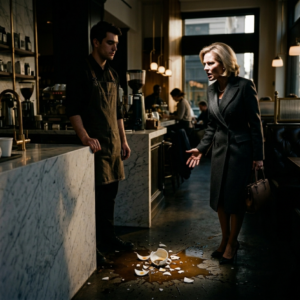
The Kingswell Tower Cafe was not just a place to get coffee; it was the frantic heartbeat of the city’s financial district. It was a space defined by the rigid hierarchies of corporate life, where senior analysts whispered sensitive trade secrets and vice presidents brokered billion-dollar mergers over double-shot espressos. In this world, you were either the person being served or the person serving, and that distinction was reinforced every single time a door opened.
Camille, the sophisticated, flawlessly dressed fiancée of Brandon Pierce—the man currently third in line for the company’s incoming presidency—stood at the counter. She was the absolute picture of elite entitlement, a woman who carried herself through the world as though it had been personally arranged for her convenience and comfort. She didn’t just walk into a room; she colonized it.
“Do it again,” Camille commanded, her voice cutting through the morning rush like a serrated blade through silk. “The foam ratio is entirely incorrect. I certainly do not pay premium prices to drink something that a college dropout could have whipped up in a gas station.”
A ripple of nervous, sycophantic laughter moved through the nearby leather seating area, where Brandon Pierce sat, observing his fiancée’s public performance with the relaxed, indulgent half-smile of a man who had never once been told “no” in his entire life. Naomi, the woman behind the stainless-steel counter, didn’t look for the source of the laughter. She remained anchored in the stillness of her role, her face a mask of professional, stoic neutrality.
The Performance of Power
Camille leaned casually against the counter, her posture predatory. “You really should smile more when you’re preparing the drinks, dear,” she murmured, her tone dripping with the kind of fake, condescending concern that is specifically designed to make a person feel small. “It truly helps with the energy of the room, and I can always taste when someone is genuinely unhappy. It ruins the palate.”
Naomi remained entirely silent, her movements rhythmic, measured, and precise. She positioned the portafilter into the machine, tamped the espresso to perfection, and initiated the pull. The machine hissed, a sharp, mechanical sound that served as the only response to Camille’s provocation.
Brandon Pierce finally deigned to speak, though he didn’t address Naomi directly. “She’s just particular, Camille. Don’t take it personally,” he said to the room, his voice loud enough for every nearby assistant and analyst to hear.
It was the classic move of a man who viewed his subordinates as background furniture. He offered his “absolution” as though the situation were a settled matter of fact, as though Naomi were a machine that had simply malfunctioned and needed a reboot. Naomi placed the second cup on the marble counter without a single word, her hands steady.
Camille picked up the cup, took one slow, deliberate sip, and tilted her head like she was considering whether to grant her gracious approval. “Better,” she finally declared. “See? All you truly needed was a little bit of correction. It’s important to know your place.”
She walked back toward Brandon with the cup, and the room—filled with people carrying the crushing, daily weight of performance reviews and impossible quarterly targets—quietly exhaled. They returned to their coffees, pretending they hadn’t just watched a human being be reduced to a tool for someone else’s amusement.
The Hidden Architect
Peter, a twenty-three-year-old junior analyst just three months into his grueling tenure, watched the entire scene from the end of the counter. He caught Naomi’s eye for a fleeting second. She gave him absolutely nothing—no flicker of anger, no sign of relief, just an unsettling, absolute stillness.
What Peter didn’t know—what absolutely nobody in that entire sprawling building knew—was that the woman standing behind that coffee machine had walked into Kingswell Tower seventeen days ago carrying a resume that didn’t technically exist, a basic barista certification pulled from a neighborhood community program, and a singular, deliberate purpose.
Naomi Sinclair was the actual founder and CEO of Kingswell Group.
She had built the empire from a single, struggling logistics consultancy operating out of a borrowed office in her late twenties into a corporation managing four major verticals across eleven different countries. The company was currently only three weeks away from the largest internal restructuring in its history: a billion-dollar infrastructure expansion into Southeast Asia, which required the appointment of a new company president.
That appointment would shape the trajectory of Kingswell’s next decade. Naomi had learned twice in her high-stakes career that the most dangerous aspect of power is the people who orbit it. Titles told her what a person could do, but she desperately needed to know exactly who they were.
So, she had done what very few leaders were ever willing to do. She came down.
The cafe at the base of the Kingswell Tower served every single floor. Executives passed through it four, five, sometimes six times a day. It was the one place in the building where rank was supposed to become invisible, or at least, where it should have.
She had worked it quietly, learning the authentic rhythms of the room, cataloging everything she saw. She noted who thanked the staff, who looked through them like they were glass, who made small courtesies, and who made small, calculated cruelties. She watched to see whether people behaved differently when they believed no one of consequence was watching.
The hidden cameras had been professionally installed before she started her “shift.” The board chairman, Gerald Owen, was the only other human in the world who knew her secret. She had already filled twelve pages of a private notebook.
Brandon Pierce had appeared on those pages six times in seventeen days. It wasn’t for dramatic, headline-grabbing offenses; it was for the texture of his character. She noted the way he left his cups at the very edge of the counter rather than the designated collection point—always three inches too far for comfort, but close enough to maintain plausible deniability.
She noted how he spoke to female staff versus male staff. She noted the way he laughed when others were clearly uncomfortable. Then Camille started coming.
The first visit was manageable. The second had escalated. Today was the third, and it was different in a way Naomi had been quietly anticipating.
She had seen enough of Camille to know she was the kind of person who mistook a witness for an endorsement. Camille performed for Brandon; Brandon performed for the room; and the room, composed of people with mortgages and performance reviews and quarterly targets, performed a pathetic, silent compliance.
The Crack In The System
Naomi refilled the coffee beans and began preparing for the next order. Across the room, Peter was stacking cups with a focused, unnecessary precision that told her he was still shaken. Near the service door, an older janitor named Maxwell moved slowly with a mop, navigating the heavy foot traffic without interrupting it, the way he always did.
He was invisible to everyone except Naomi, who had spoken to him almost every morning and noticed every time the quiet dignity with which he moved through a building that barely acknowledged his existence. She had written his name down in her notebook on the second day.
The next hour passed without incident. The rush thinned out, and Brandon and Camille settled into the lounge area near the tall windows. Naomi could hear fragments of their conversation between orders.
They were discussing an announcement for the following week, a dinner reservation for Thursday, and what Camille should wear to the boardroom event. “It’s basically confirmed,” Brandon was saying, his voice carrying just enough to reach her. “Gerald told me, ‘I’m the front-runner.’ The president’s role. It’s mine.”
Naomi pulled a shot of espresso, watched the rich crema form in the cup, and kept her face exactly where she had learned to keep it in seventeen years of intense boardrooms. Composed, revealing nothing, reading everything. Her phone buzzed once in her apron pocket. A message from Gerald. Still on track for Friday? She typed back with one thumb without looking up: Yes.
The incident that changed the entire room happened on a slow afternoon. When the cafe had thinned to a handful of people nursing cold drinks and staring at laptop screens, Camille returned alone. She walked in with the particular energy of someone who had been waiting for an audience to thin—not because she wanted privacy, but because she wanted absolute control of the stage.
She approached the counter without joining the queue, stepping around a young receptionist named Helen, who had been waiting quietly for two minutes. “I’ll have the same as this morning,” Camille said to Naomi. “And make sure it’s right this time.”
Helen blinked but said nothing, just moved slightly to the side. Naomi began making the drink. “You know,” Camille said, setting her expensive bag on the counter with a soft thud. “I’ve been watching you. You have the look of someone who thinks they’re above this job.”
Naomi said nothing. “I’ve had assistants like that,” Camille continued. “They think being quiet makes them seem deep. It doesn’t. It just makes them seem difficult.”
She tilted her head. “Where did you study? Or did you?”
“I studied,” Naomi said simply.
“And this is where it got you?” Camille smiled like she was doing her a favor. “There’s no shame in that. Not everyone has the mind for real work. This is honest work, as long as you’re grateful for it.”
From behind a laptop near the window, a junior analyst named Priya had stopped typing. She was looking at her screen but not reading it. Naomi set the finished drink on the counter. Camille looked at it, then looked at Naomi with genuine contempt.
“I want it with regular milk,” Camille said. “You ordered oat milk,” Naomi countered. “I’m changing my order,” Camille replied, pausing for effect. “Is that a problem?”
Naomi held her gaze for a single beat, then took the cup back. Camille watched her with the patient expression of someone who enjoyed waiting because the waiting itself was the point.
“You’re replaceable, you know,” Camille said conversationally, as though she were remarking on the weather. “Every single person in a job like this is replaceable. I’m not saying that to be cruel. I’m saying it because I think you need to hear it.”
Maxwell, who was passing behind Camille with his cart, paused. He looked at her slowly, then looked at Naomi. “Ma’am,” he said quietly. “There’s no need for that kind of talk.”
Camille turned to look at him the way someone turns to look at a sound they’re deciding whether to acknowledge. “Excuse me?”
“She’s doing her job,” Maxwell said. “Speak to her properly.”
The room was still. Even the espresso machine seemed to lower its noise. Camille’s expression shifted, not to anger exactly, but to something colder. “I don’t need guidance on how to speak to the cleaning staff.”
Maxwell looked at her for one more moment. Then he nodded once slowly and moved on with his cart—not in defeat, but in the particular way of someone who has said what needed to be said and doesn’t require anything from the response. Naomi placed the new drink on the counter without a word. Camille took it, looked at her, and left.
The Inevitable Reckoning
Three days before the boardroom announcement, Camille returned with Brandon. The dynamic between them had shifted in a way Naomi recognized. It was the way couples shift when one of them has been promised something and both are already spending it.
Brandon was looser, more expansive, working the room with a warmth he rarely produced organically. He shook hands with a senior manager passing through; he laughed loudly at something an assistant said. He was rehearsing.
Camille moved beside him with the ease of someone who had fully arrived. They ordered. Naomi made the drinks. The exchange was unremarkable until Camille, mid-conversation with Brandon, gestured with her cup and caught the edge of a standing display, tipping it over.
Cups and branded napkins scattered across the service floor. The moment hung for a second. Then she looked at Naomi. “You’ll want to clean that.”
It wasn’t a request. It wasn’t even a command in the usual sense. It was just a declaration of how the world was ordered, delivered without heat because it didn’t need any. Brandon glanced at the floor, then away.
Naomi came around the counter with a cloth. As she crouched to collect the scattered cups, Camille’s voice came from above her. “See, Brandon, she doesn’t complain. That’s all I ask. Just do the job.”
Peter, restocking cups at the far end, had gone very still. Priya, back at her table, had closed her laptop. Naomi stood up slowly, items collected, expression unchanged.
She looked at the counter, not at Camille. “I’ve seen enough,” she said quietly, more to herself than to anyone in the room.
Camille didn’t hear it or didn’t register it, but Peter did, and he wasn’t sure why, but the words made the back of his neck go cold. The email went out at 7:00 the following morning, distributed simultaneously to all senior staff, directors, and board members.
It announced a mandatory all-hands presentation in the main boardroom. Friday at 11:00. No agenda was listed, only a note at the bottom: Attendance is required. Conducted by the office of the chairman.
Brandon read it in his car and called Gerald immediately. “Is this the announcement?”
“Come to the boardroom at 11,” Gerald said. “You’ll have your answers there.”
Brandon hung up, smiling. He texted Camille one word: Friday.
In her corner office on the 32nd floor—a floor that no one in the cafe had ever connected to the woman who made their coffee—Naomi Sinclair read Gerald’s confirmation email, closed her laptop, and looked out over the city for a long moment. She found the barista apron she had folded and brought home the day before and laid it across the back of her chair.
She wasn’t finished with it yet.
The Boardroom Presentation
The boardroom on the 41st floor held forty people comfortably and felt designed to make visitors feel the gap between where they sat and where the decisions were made. By 10:55, every seat was filled. Senior directors, department heads, the board’s inner circle, assistants, and junior managers were pressed along the sides of the room.
Peter stood near the door, holding his tablet against his chest, trying to look like he understood why he was there. Helen sat three seats from the front, spine straight, hands folded. Maxwell had been personally walked to the room by Gerald’s assistant and seated in the second row, and nobody in the room seemed to know what to make of that.
Brandon arrived at 10:58. He had changed into his best suit—charcoal, double-breasted, the one he saved for client presentations. Camille was not in the room; she was outside in the lobby, having convinced the front desk to let her wait near the boardroom entrance. She had dressed for an announcement.
Gerald Owens stood at the front of the room with two members of the board, speaking to no one, looking at the door. The screens behind him were dark. At 11:00 exactly, the door opened.
The room didn’t register her immediately. She walked in from the side entrance, not the main double doors, but the narrow staff-adjacent door near the presentation wall—and she was still wearing it.
The barista apron. Stained faintly at the left side where coffee had splashed across it two days ago. Her posture was the same as it always was. But the room around her rearranged itself in real-time as faces turned and understanding moved through the space like a current.
A senior director who had been in the cafe that week inhaled sharply. A woman near the back pressed her hand over her mouth. Peter felt the floor tilt slightly beneath him.
Brandon’s face ran through four expressions in three seconds: confusion, then amusement, then something uncertain, then the slow and nauseating arrival of comprehension. Gerald stepped forward.
“Good morning. I want to thank you all for being here. Before we begin, I’d like to make an introduction. For those of you who don’t know her by sight, and it appears many of you do not, allow me to present the founder and chief executive officer of Kingswell Group.”
He turned slightly toward her. “Naomi Sinclair.”
Silence. Not the polite silence of a formal introduction, but the held-breath silence of a room in which multiple people were simultaneously recalculating everything they had said and done in the past three weeks. Naomi moved to the podium without hurry.
She set a small notebook on the surface—the same one from her apron pocket, slightly worn at the corners—and looked at the room. “I spent eighteen days in this building’s cafe,” she said. “I made coffee. I cleaned counters. I restocked supplies and I watched.”
She reached forward and pressed the remote. The screens behind her came to life.
The footage was clean and timestamped. The cameras had been professionally placed at the ceiling corners near the service area, angled to capture faces clearly. The first clip loaded in silence, and the room watched Camille’s first visit play across four screens simultaneously.
Her voice was clear. Her words were precise. Each insult landed in the boardroom with a weight it had not been allowed to carry the first time. The clip of the spilled display. Camille’s deliberate tone. You’ll want to clean that.
The clip from the morning rush. Replaceable. No shame in that. And then the clip of Maxwell. Quiet and unhurried. Stopping his cart. Ma’am, there’s no need for that kind of talk.
Someone in the back of the room exhaled audibly. Naomi let the footage run until it reached the moment she had said quietly, I’ve seen enough, and then she stopped it.
“I did not come down to that cafe looking for failures,” she said. “I came looking for character. Those are not the same thing and I want to be precise about the distinction because it matters.”
She looked at Brandon directly for the first time since entering the room. He had not moved. He was sitting with the stillness of someone who understood at last that movement of any kind would be costly.
“The presidency of Kingswell Group requires someone who understands that the way you treat people with no visible power is the most accurate measure of your leadership. Not your results, not your strategy documents, not the deals you’ve closed.”
“The measure is this. What do you do when you believe no one important is watching?”
She closed the notebook. “Brandon Pierce’s employment with this company is terminated effective today.”
“His department will be restructured under interim leadership pending a full conduct review. That review will also examine the broader culture of his floor, which this footage suggests has been a problem for longer than eighteen days.”
Brandon stood. “Naomi, I didn’t…” He stopped. Whatever sentence he had started, he couldn’t find the end of it.
“You have nothing to add,” she said without cruelty—just fact. He sat back down.
She moved on with the precision of someone who had been building toward this for weeks and had no interest in dragging it out. The promotions that had been pending were reshuffled. Two project leads who had treated staff with consistent respect were elevated. A junior manager who had quietly apologized to Naomi after a difficult customer without knowing who she was was offered a senior development track.
Then she looked toward the second row. “Maxwell has worked in this building for eleven years. In eighteen days, he was the only person in that cafe with the standing to intervene in a public humiliation. Who actually did? With no guarantee of protection, no audience to perform for?”
“He simply thought it was wrong and said so.”
She let the room sit with that. “Maxwell has been enrolled in Kingswell’s management training program beginning next month. With full salary adjustment.”
Maxwell looked at his hands for a moment. Then he looked up, and his expression was not surprised exactly. It was the quiet acknowledgement of a man who had known for a long time that he was worth more than the work he’d been given and had simply waited.
The Aftermath of Truth
The boardroom cleared slowly. People moved with the particular care of those processing information that required recalibration of long-held assumptions. Some stopped to speak to Gerald quietly. Others left without a word, staring straight ahead.
Peter stood near the door for a full minute after being dismissed before his legs agreed to carry him out. Brandon left through the side exit. Naomi did not watch him go.
Camille was escorted from the lobby before the boardroom formally closed. She had been standing outside the glass doors when the footage began playing, and someone on the board’s security team had quietly asked her to leave the premises.
She did not cause a scene in the lobby. Whatever she had imagined Friday would look like, she had not imagined this—and imagination requires a picture to fall back on when reality fails you. She had no picture for this.
The room had nearly emptied when Peter came back through the door. He stood at the edge of the space, tablet still in hand, and looked at Naomi with an expression that had several feelings in it, competing for the front position.
“Can I ask you something?” Naomi was gathering the notebook from the podium. She looked at him. “Go ahead.”
“Why? I mean, you could have just reviewed files, hired consultants. You have access to every performance report in this company. Why do it like this?”
Naomi looked at the apron still draped over the podium where she’d said it before speaking. “Because files tell me what people accomplish,” she said. “What I needed to know was what they are.”
She picked up the apron and folded it with a careful, deliberate motion. “People behave differently in front of power. They straighten up. They choose better words. They remember to be gracious.”
“That version of themselves is not useless, but it’s not what I needed to see. I needed to see what they do with people they think don’t matter.”
Peter was quiet for a moment. “And me? I didn’t… I didn’t do much. I offered napkins. I watched.”
“You also looked uncomfortable,” she said. “Every single time. There’s a version of the story where that doesn’t mean much, but you’re twenty-three. You’re new. And the cost of speaking up in that environment for someone in your position was real. I watched you choose wrong and feel it.”
She looked at him carefully. “That tells me you’ll choose differently when you have standing to protect you.”
“That’s nothing.”
He nodded slowly then because he couldn’t help it. “I recognized you the second week. I’d seen you in the company newsletter.”
“I know,” she said. “You didn’t say anything.”
He blinked. “You knew? You avoided eye contact with me for two days afterward,” she said. “And then you went back to normal. That also told me something.”
He laughed once, a short breath of disbelief, and shook his head. He thanked her and left. The room was empty now. Naomi stood alone with the afternoon light coming through the tall windows.
She thought about Maxwell moving through the building for eleven years, quiet and consistent, waiting for a room that saw him. She thought about what it cost an organization to waste that. She picked up her notebook and walked out of the boardroom.
The apron she left on the table. She didn’t need it anymore. The work it had been hired to do was finished.
The Universal Lesson of Character
This story is not about coffee, or boardrooms, or corporate hierarchy. It is a fundamental exploration of the true measure of a human being: what they do when they believe they aren’t being watched.
We live in a world that heavily incentivizes performance. We are trained to impress those above us, to carefully curate our appearance, and to use language that signals our importance. Brandon Pierce and Camille Voss were masters of this performance. They understood how to manipulate the atmosphere of a room, how to leverage their status, and how to command attention.
Yet, their entire structure crumbled in an instant because it was hollow. It was built on the assumption that power only exists where it is formally recognized, and that dignity is a privilege that only certain people possess. They failed to understand that by dehumanizing others, they were eroding their own integrity.
Naomi Sinclair’s approach represents a radical shift in leadership. By coming down to the “café” level, she wasn’t just observing behavior; she was testing the internal culture of her company. She knew that any organization, no matter how profitable or “strategic” it appears, is only as strong as its smallest interaction.
If your culture permits the dehumanization of the janitor, the barista, or the junior analyst, it is a matter of time before that rot reaches the boardroom. The people who treat the marginalized with cruelty are the same people who, when the stakes are high enough, will deceive their own partners and stakeholders.
True strength is not found in the ability to coerce, but in the capacity to see. It is found in the janitor who speaks up when no one else dares, and in the leader who builds a company where such courage is not just allowed—it is rewarded.
We all have moments where we are the “barista” in someone else’s story—those moments where we are undervalued, overlooked, or treated as invisible. We also have moments where we are the “Brandon” or the “Camille”—those moments where we are in a position of relative comfort or power, and we have a choice about how we treat those around us.
If this story touched your heart, share it with someone who believes that respect should never depend on status. Subscribe for more powerful stories about hidden truth, earned consequences, and the people others underestimate. Let’s keep this conversation going.
Disclaimer : This content may be created by AI for entertainment purposes. Any resemblance to real persons, events, or places is coincidental.






