The expensive champagne glasses clinked like delicate, fragile windchimes across the dimly lit ballroom, but to Emily, the sound felt like a warning bell. She nervously wiped her clammy palms against the stiff, unforgiving black fabric of her uniform for the hundredth time that evening.
CHAPTER 1: THE IMPOSTOR IN THE BALLROOM
Six months into her job at The Grand Meridian, Emily still felt like a glaring impostor among the shimmering crystal chandeliers and the hushed, arrogant conversations about soaring stock portfolios and sprawling vacation homes.
“Table 7 needs attention, Emily,” the manager hissed, his voice sharp as he brushed past her, balancing a massive tray of appetizers that cost more than her entire monthly rent. “Mr. Kingston’s daughter just arrived.”
Emily’s stomach tightened violently at the name. Everyone who worked at The Grand Meridian knew exactly who the Kingston family was. They didn’t just own the venue; they effectively owned half the state. They were the kind of people who never showed their faces in public without a very specific reason, and certainly never without a wall of silent, intimidating security.
She grabbed a pitcher of ice water and approached Table 7, keeping her eyes firmly downcast as she had been relentlessly trained to do. The table occupied the most secluded corner of the ballroom, partially obscured by an ornate, heavy wooden screen. Even the lighting seemed different in that corner—warmer, somehow more forgiving, as if the very air knew it had to flatter its occupants.
“Would you like some water, Miss Kingston?” she asked, her voice barely audible above the pianist playing softly in the background. When she finally allowed herself to look up, she was struck by how incredibly young the girl seemed—maybe twenty at most. She wore a simple, elegant black dress that probably cost more than Emily’s entire car. Her dark hair was pulled into a sleek, tight ponytail that emphasized her sharp, porcelain cheekbones.
But it was her eyes that caught Emily completely off guard. They were wide, alert, and darting around the room with an intensity that seemed entirely out of place for someone her age.
“Thank you,” the girl said, watching Emily with surgical precision as she poured. She didn’t smile. Emily noticed she was completely alone at the large, formal table—an unusual sight for the Kingston family.
Before Emily could even begin to wonder about this solitude, the heavy double doors at the top of the main staircase swung open. The room fell into a heavy, expectant silence. The host announced the entrance of the evening’s honored couple.
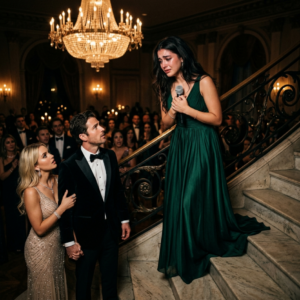
Emily raised her microphone, and then her eyes found the staircase. Her body stopped working.
He was wearing a deep charcoal tuxedo. His hair was groomed exactly the way she had always known it. He was smiling the wide, public smile he used for ballrooms—not the private one she had spent years collecting. And beside him, her hand resting in the crook of his elbow, was Sophia Kingston—young, radiant in an ivory gown, completely unaware that the woman hired to sing at her engagement party was the woman her fiancé had proposed to only eight weeks earlier.
The applause rose through the ballroom like a wave. Ethan walked his future bride down that staircase without once looking toward the stage.
Then, he did.
Their eyes met across the full width of the ballroom. His smile did not fall dramatically. It simply stopped. Switched off.
What replaced it was not guilt, not panic, but something colder and faster. A calculation. She could almost see it happening behind his eyes—the rapid assessment of options, the measurement of risk, the search for the fastest exit from a situation he had not prepared for.
And standing there with a microphone in her hand, and $62,000 of her late father’s legacy sitting in this man’s bank account, Emily felt something shift inside her that had nothing to do with heartbreak. It was clarity—sharp, total, and completely without mercy.
At this moment, anyone would have walked away, but Emily couldn’t. Would you?
CHAPTER 2: THE TRUTH BEHIND THE TUXEDO
She did not cry. She did not leave. The thing about a woman who has spent years holding everything together is that when the ground disappears, she does not fall. She stands on the air and she decides.
As Ethan and Sophia reached the center platform and the host gestured for Emily to begin, she stepped forward. The room settled into expecting quiet, but she leaned into the microphone.
In a voice that did not shake—not one syllable of it—she said, “Before this evening continues, I need to say something to everyone in this room.”
The applause died instantly. Sophia frowned. Richard Kingston sat down his glass with a quiet precision that suggested he was a man who had learned to pay attention to unexpected silences. Ethan’s jaw stayed positioned, but his eyes shifted, still running that calculation, still looking for the door.
“The man standing on that platform,” Emily said, “proposed to me two months ago. He gave me this ring.” She raised her left hand. “He told me we were building a future together. And then he asked me to take out a $62,000 loan against my family home for what he described as a private investment opportunity. I did it because I trusted him completely. There is no investment. There was never an investment.”
“I am standing in this room tonight because the original singer had an accident and I was called as a last-minute replacement. Which means the only reason any of you are hearing this right now is because of an accident. That is how close this came to never coming out at all.”
The silence that followed was the kind that physically caused something to break. Nobody moved. Nobody spoke for full seconds of a packed ballroom holding its breath.
Ethan broke it. He laughed—a short, controlled, practiced laugh of a man who had talked his way out of uncomfortable rooms before. He looked at Richard Kingston with easy confidence and said, “She became fixated after we ended things. I apologize for this disruption.”
“I have the bank transfer receipts,” Emily said. She reached into her performance bag—the bag that had, by the decision of a sleepless night three weeks earlier, when something unnamed had finally pushed her to stop waiting and start documenting everything she needed.
“I have 41 text messages, including the night he proposed. I have voice recordings of him explaining the loan and confirming the collateral. I have the engagement photos. I have all of it.”
“And I am not here to perform a scene. I am here because I almost lost my father’s house. And I think the Kingston family deserves to know what kind of man they are about to invite into their family permanently.”
She looked at Sophia directly, not with cruelty, but with the specific quiet honesty of one woman who has nothing left to lose, talking to another woman who still has everything left to protect.
Sophia looked back at her, and in that look was the rapid internal reckoning of a woman whose instincts had been sending her signals she had chosen not to fully examine until this exact moment made examination unavoidable.
Sophia turned to Ethan. Her voice was low and completely controlled. “Is this true?”
Ethan opened his mouth.
She said, “Do not manage me right now. Is this true?”
He said nothing. And the silence answered for him in a way that no words could have taken back.
CHAPTER 3: THE COLLAPSE OF AN EMPIRE
Richard Kingston was already on his phone. His legal team, his security director, his personal investigator—a man who was apparently never more than one call away because Richard Kingston had built his fortune in an industry where due diligence was not optional and surprises were not forgiven.
Within 30 minutes, the picture that emerged was not just damaging. It was devastating.
The financial consulting firm Ethan had registered under when he first approached the Kingston family did not exist at any verifiable address. It was a shell—a name, a letterhead, a website built to sustain exactly the level of scrutiny a wealthy family would apply before allowing a man near their daughter, and not one layer deeper.
The investment portfolio he had presented during his courtship of Sophia could not be traced to any real institution. The figures were fabricated. The credentials were fabricated. The car he had arrived in tonight was a rental. The watch on his wrist had been purchased 11 days earlier.
There was no long-term lease. There was no property ownership. There was no wealth.
There was only the performance of it—sustained, detailed, and specifically calibrated to pass the inspection of people who thought they already knew what to look for. And then investigators found something worse.
Ethan had not come to the Kingston family by accident. He had researched them specifically, deliberately, and over a period of months before he ever arranged an introduction. He had studied Richard Kingston’s business structure, his estate plans, his known generosity toward family members, and the publicly available details of Sophia’s position as his primary heir.
He had mapped the inheritance. He had calculated the timeline. He had identified the fastest path from introduction to marriage to access. This was not opportunism. This was a campaign.
Ethan had not fallen in love with Sophia Kingston. He had selected her. And the $62,000 he had taken from Emily—the woman he had spent years building trust with—had funded the wardrobe, the rental car, the short-term apartment, and the carefully constructed lifestyle that made him appear to a billionaire’s family like a man worth trusting.
My own money had paid for the costume he wore to steal someone else’s inheritance.
Sophia Kingston removed her engagement ring. She did not throw it. She set it on the platform beside her with a deliberateness that was somehow more final than any dramatic gesture could have been. Then she stepped back.
And for a moment, just one moment in the middle of all of that, she and Emily looked at each other across the room. Two women who had given real things to the same man’s fiction.
One had given her savings and her trust. The other had nearly given her entire future.
Neither of them said a word. They didn’t need to.
Ethan was removed from the building by security. He said things on the way out, directed at Emily, directed at the room, but by then the phones were already recording and uploading, and the words didn’t matter anymore.
CHAPTER 4: THE LESSON OF THE STAGE
The legal consequences came quickly and they came from every direction at once.
Richard Kingston filed a civil fraud complaint against Ethan within 48 hours, not only for the financial deception, but specifically for the calculated targeting of his family’s estate. The civil complaint was extensive, precise, and entirely supported by the documentation Emily had already handed over.
Emily filed her own separate lawsuit for financial damages the same week, supported by a pro bono attorney who had seen the story break on local news and reached out within hours.
Criminal charges followed the civil filings. Investigators confirmed that Ethan had operated variations of this scheme before. Different cities, different names, different women, same architecture.
Find someone with deep trust and limited resources. Build credibility over time. Create urgency around a financial opportunity. Extract funds. Use those funds to construct a more convincing version of yourself for a wealthier target.
The pattern was documented, provable, and had left a trail across state lines that federal investigators were very interested in. The charges included wire fraud, identity fraud, financial deception, and conspiracy to commit inheritance fraud—the last of which carried the heaviest weight and the longest potential sentence.
He was convicted on all counts. He was sentenced to nine years in federal prison.
He would serve every one of them.
Emily recovered the full $62,000 through the civil settlement. The house on Birwood Lane was never touched. The bank was repaid. The debt was gone.
And Ava, who had never known how close they had come to losing the only thing their father had left them, sat across the kitchen table from Emily one evening and asked why Emily was crying while she was smiling.
Emily told her everything. Ava reached across the table and held her hand and didn’t say anything for a long time. Then she said, “Dad would have been so proud of you.”
And Emily believed her.
In the months that followed, the world found Emily the way it finds people who do something honest in a room full of witnesses. The performance bookings multiplied. Invitations came from venues she had only ever driven past. A regional music festival, a licensing deal for a recording she had made three years earlier and nearly forgotten.
Features and publications she had always admired from a distance.
None of it arrived as a single sudden wave. It built the way real things built—gradually, steadily, one room at a time, earned by someone who had been doing the work long before anyone was paying attention.
Eleven months after the night at The Grand Meridian, Emily stood at the microphone of her first headline concert.
Three hundred people. Her name on the marquee outside.
Ava in the front row wearing the earrings their mother had left them, already crying before the first song started. Emily looked out at the room, at all those faces, all that light. And before she sang a single note, she said, “I used to think the stage was where I came to escape everything hard. Now I know it’s where I come to prove that the hard things didn’t win.”
The applause that followed was long and genuine, and the kind that fills a room from the floor up.
The house on Birwood Lane is still there, still hers. The lights are on. The door is unlocked. And somewhere in that house, there is a kitchen table where two sisters still sit together at the end of long days and talk until the food goes cold.
Some people move through this world taking. And some people move through a building.
The difference in the end is always visible. Always. It just sometimes takes a ballroom, a last-minute phone call, and a woman who refused to be quiet to make it visible to everyone else at the same time.
If this story stayed with you, if it reminded you of a time you trusted someone who didn’t deserve it, or a moment when you almost lost something you couldn’t replace, tell us about it in the comments. Tell us how you felt. Tell us what you would have done standing in that ballroom with the microphone in your hand and the truth sitting right there waiting to be said.
Because your voice in the comments means more than you think. And if you are not subscribed yet, do it right now because what we have coming next is a story that will make this one feel like just the beginning.
Join the Community Discussion!
Have you ever had someone weaponize your trust against you, only to realize your own strength was the thing that saved you in the end? Drop a ❤️ in the comments if you believe in the power of the truth, and share your story below—your survival might just save someone else.
Disclaimer : This content may be created by AI for entertainment purposes. Any resemblance to real persons, events, or places is coincidental.






