The expensive champagne glasses clinked like delicate, fragile windchimes across the dimly lit, suffocating atmosphere of Bellissimo. I wiped my clammy palms against the stiff, unforgiving black fabric of my uniform for the hundredth time that evening.
Six months at this elite restaurant, and I still felt like a glaring impostor among the shimmering crystal chandeliers and hushed, wealthy conversations about stock portfolios and summer vacation homes.
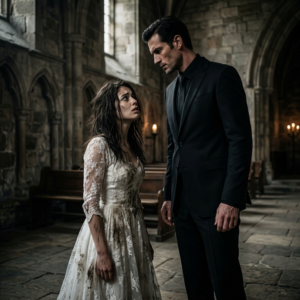
“Table 7 needs attention, Ellie,” Marco hissed, his voice sharp as he brushed past me, balancing a massive tray of appetizers that cost more than my entire monthly rent. “Mr. Richi’s daughter just arrived.”
My stomach tightened violently at the mere mention of that name. Everyone who worked at Bellissimo knew exactly who the Richi family was. They didn’t just own this restaurant; they effectively owned half the neighborhood. They were the kind of people who never showed their faces in public without a very specific reason, and certainly never without a wall of silent, intimidating security.
I grabbed a pitcher of ice water and approached Table 7, keeping my eyes firmly downcast as I’d been relentlessly trained to do. The table occupied the most secluded corner of the restaurant, partially obscured by an ornate, heavy wooden screen. Even the lighting seemed different in that corner—warmer, somehow more forgiving, as if the very air knew it had to flatter its occupants.
“Would you like some water, Miss Richi?” I asked, my voice barely audible above the pianist playing softly in the background. When I finally allowed myself to look up at her, I was struck by how incredibly young she seemed—maybe twenty at the absolute most. She wore a simple, elegant black dress that probably cost more than my entire car. Her dark hair was pulled into a sleek, tight ponytail that emphasized her sharp, porcelain cheekbones.
But it was her eyes that caught me completely off guard. They were wide and darting, scanning the restaurant with an intensity that seemed entirely out of place for someone her age.
“Thank you,” she said, watching me with surgical precision as I poured. She didn’t smile. I noticed she was completely alone at the large, formal table. It was highly unusual for the Richi family, who typically arrived in large groups with at least two men standing at strategic points around them like human shields.
Before I could even begin to wonder about her solitude, the heavy front door of the restaurant opened, and the atmosphere in the room shifted instantly. I didn’t need to turn around to know exactly who had entered. The sudden, rigid stiffening of every single staff member’s spine told me everything I needed to know.
A cold, sharp prickle ran down my neck as the sound of confident, rhythmic footsteps approached. They were unhurried and deliberate, the gait of someone who never needed to rush because the entire world would always wait for him.
The scent reached me first. It was an expensive, masculine cologne with deep notes of cedar and something much darker, more primal. Then came the soft whisper of a perfectly tailored suit—the kind that makes absolutely no sound except when its wearer allows it to.
“You’re early, Sophia,” came a deep voice from directly behind me. It was smooth as aged whiskey, but held a jagged, razor-sharp edge that made my hand tremble, causing the water to slosh dangerously close to the rim of the glass.
I kept my eyes fixed on the water pitcher, but in my peripheral vision, I caught glimpses of him as he moved around the table. He was tall, with dark hair cut precisely, and a heavy watch that caught the dim light as he pulled out his chair. He hadn’t acknowledged my existence, yet I felt utterly suffocated by his overwhelming presence.
“I had nothing better to do,” Sophia replied, her tone carrying a distinct hint of defiance that made me inwardly cringe. No one spoke that way to Mr. Richi—not even his own daughter.
I finished pouring and was about to retreat when Sophia’s hand caught my wrist—a lightning-quick movement that froze me in place. Her touch was light but incredibly insistent. And when my startled eyes finally met hers, she gave me an almost imperceptible shake of her head before quickly releasing me.
I felt Mr. Richi’s attention shift to me for the very first time. The weight of his gaze felt like a physical hand pressing against my skin.
“Is there a problem?” he asked, his voice deceptively soft.
“No, sir,” I replied automatically, my heart hammering so loudly I was certain he could hear the frantic rhythm. “Just… getting Miss Richi a lemon.”
I walked away on legs that threatened to buckle, feeling his eyes tracking my every movement until I disappeared into the safety of the kitchen. I pressed my back against the cool tile wall, trying to steady my jagged breathing.
“You okay, Ellie? You look like you’ve seen a ghost.” It was Jake, one of the busboys, his freckled face filled with genuine concern as he loaded dirty dishes into the industrial washer.
“I’m fine,” I lied, reaching for a small plate and placing a carefully sliced lemon wedge on it. “Just tired.”
But as I prepared to return to Table 7, I noticed something beneath my thumb. A small, tightly folded piece of paper that hadn’t been there a second ago. Sophia must have slipped it into my palm when she grabbed my wrist.
My first instinct was to throw it away, to pretend I’d never felt the paper against my skin. Nothing good could possibly come from getting involved with the Richi family. But curiosity, my eternal, fatal downfall, made me unfold it quickly while my body was angled away from the kitchen doors.
Help me. Not what you think. 11 p.m. Employee exit. Five words that would change absolutely everything. Five words that would destroy the careful, invisible life I’d constructed since leaving home two years ago. Five words I should have ignored.
I refolded the note and tucked it into my bra beneath my shirt, where no one would see it. Then I took a deep breath, straightened my shoulders, and carried the lemon back to Table 7.
When I placed it on the table, Sophia didn’t look at me, but Mr. Richi did—he really looked at me for the first time. His eyes were the same deep, rich brown as his daughter’s, but where hers had seemed frightened, his were calculating, almost amused.
He was younger than I’d expected—perhaps mid-thirties—with the kind of face that was handsome in a harsh, unforgiving way, defined by sharp angles and controlled intensity.
“What’s your name?” he asked, the question stopping me in my tracks.
“Ellie, sir. Ellie Monroe.” My voice sounded strange to my own ears—too high, too nervous.
He nodded slightly, as if he were filing this information away in a permanent cabinet. “How long have you worked here, Ellie Monroe?”
“Six months, sir.”
He studied me for a moment longer than was comfortable. “Bring us the wine list, please.”
I nodded and hurried away, feeling as though I’d just been dismissed from an interrogation I hadn’t realized I was currently having. As I retrieved the leather-bound wine list, I saw Marco watching me with a confusing mixture of curiosity and concern.
“Be careful,” he whispered as I passed him. “Table 7 is asking for you specifically now.”
CHAPTER 2: THE MIDNIGHT EXIT
The rest of their dinner passed in a agonizing blur of tension. Sophia barely touched her food, while Mr. Richi ate methodically, his movements precise and controlled. They spoke very little, and when they did, it was in hushed, melodic Italian that I couldn’t understand.
But I felt the electric tension between them, thick and suffocating, like the air right before a violent storm. I served them with my eyes down, my hands steady only through sheer, exhausting force of will.
Each time I approached the table, I felt Mr. Richi’s gaze tracking my movements with an intensity that made my skin prickle. It wasn’t with fear, exactly, though that was certainly part of it. There was something else there, something I refused to acknowledge.
At 10:30, they finally finished their meal. Mr. Richi paid in cash—a thick stack of bills that he didn’t even bother to count—and left a tip that made my eyes widen. As they stood to leave, Sophia dropped her napkin, and when I bent to retrieve it, she whispered one word: “Please.”
Then they were gone, followed by a man I hadn’t noticed before—large, silent, with the unmistakable, heavy bulge of a weapon beneath his tailored jacket.
The restaurant seemed to collectively exhale, returning to normal as if waking from a deep spell. I watched the clock for the next half hour, my mind racing. I could just go home. I could pretend none of this had happened.
I had an early class tomorrow at the community college where I was slowly, painfully working toward a nursing degree. I had a life—small and struggling as it was—that I’d built from nothing after leaving my alcoholic father’s house.
But that whispered please echoed in my head.
And perhaps it was my own history of unanswered pleas for help—of doors that never opened when I desperately needed them to—that made my decision for me.
At 10:55, I told Marco I wasn’t feeling well and needed to leave early. He looked skeptical but didn’t argue. I changed out of my uniform in the small staff bathroom, pulling on my worn jeans and a faded blue sweater—clothes that instantly transformed me from a professional server back into a “nobody.”
The employee exit was at the back of the restaurant, down a narrow hallway past the dry storage. I pushed the door open at exactly 11:00, stepping into the freezing cold night air of the alley behind Bellissimo.
At first, I thought I was alone, and a wash of relief mingled with disappointment in my chest. Then a shadow moved near the dumpster, and Sophia Richi stepped into the pale glow of the security light. She’d exchanged her elegant dress for jeans and a hoodie, her hair now covered by a baseball cap. Without the makeup and fine clothes, she looked even younger.
“You came,” she said, sounding genuinely surprised.
“What do you want?” I asked, keeping my distance, suddenly aware of how foolish this was.
“I need your help,” she said, glancing nervously toward the street. “My father…”
She never finished the sentence. Headlights suddenly flooded the alley, blinding us both. A sleek, black car had pulled up, completely blocking the exit. Before I could react, the back door opened, and Mr. Richi stepped out. His face was a mask of cold, lethal fury that made my blood freeze.
Behind him emerged the same large man I’d seen earlier, his hand now resting openly on his holstered gun.
“Sophia,” Mr. Richi said, his voice terrifyingly calm as he approached us. “You disappoint me.”
Then his eyes shifted to me, and I felt pinned in place like a butterfly in a collection. “And you, Ellie Monroe. You have made a very, very serious mistake.”
The security light caught the dark, dangerous gleam in his eyes. It wasn’t just anger; it was something possessive, almost hungry. In that moment, I realized I’d stumbled into something far more dangerous than a simple family disagreement. I’d stumbled into a world I might never escape.
Time seemed to stretch and distort in the narrow alley. The cold brick wall pressed against my back as I instinctively retreated. My escape was cut off by a second man who had materialized behind me. The smell of rotting vegetables from the dumpster mingled with the sharp, acidic tang of fear in my nostrils.
“Father, please,” Sophia said, stepping slightly in front of me. “She has nothing to do with this. She’s just a waitress.”
Mr. Richi’s laugh was soft, almost gentle, but it sent a violent chill down my spine. “A waitress who decided to meet my daughter in secret after hours? A waitress who accepted a note, who conspired behind my back?”
His eyes never left mine as he spoke. “No, I think Ellie here has chosen to involve herself quite deliberately.”
“I didn’t!” I started to protest, but the words died in my throat as he raised his hand slightly.
“Do not insult my intelligence,” he said. “It never ends well.”
He turned to his daughter, switching to Italian, his voice harder now. Sophia responded, her words tumbling out rapidly, desperately. I couldn’t understand what they were saying, but the power dynamic was unmistakable. A king tolerating temporary insubordination from a subject.
The large man, the bodyguard, I realized, kept his eyes on me, his expression blank but watchful. I was calculating my chances of running when Mr. Richi switched back to English.
“Get in the car, Sophia,” he said. It wasn’t a request.
“No.” Her voice shook, but she stood her ground. “I won’t go back. I can’t live like this anymore.”
Something dangerous flashed across her father’s face.
“We will not have this conversation here,” he said, each word precise and clipped. He nodded to the bodyguard, who moved toward Sophia.
“Don’t touch her!” I said before I could stop myself.
Three pairs of eyes turned to me, and I immediately regretted speaking. Mr. Richi’s expression shifted from anger to something more complicated. Surprise, perhaps, and a calculating interest that made me even more uncomfortable.
“You have courage,” he said quietly. “Misplaced, but interesting nonetheless.”
He stepped closer. Close enough that I could smell that cedar cologne again. Close enough that I had to tilt my head back to maintain eye contact.
“What exactly did my daughter tell you, Ellie Monroe?”
“Nothing,” I said truthfully. “She just asked for help. That’s all.”
He studied me, looking for deception. “And you agreed without knowing what kind of help? Without knowing anything about her situation? Why?”
The question caught me off guard. Why had I come? I barely knew Sophia Richi. Meeting her could cost me my job, or worse, as I was now discovering.
“Because she asked,” I finally said. “She said, ‘Please.’ And I know what it’s like to be trapped.”
Something unreadable passed across his face. For a moment, I thought I saw a flicker of respect, quickly replaced by his previous coldness.
“Antonio,” he said to the bodyguard. “Escort my daughter to the car.”
This time, Sophia didn’t resist. Her shoulders slumped in defeat as Antonio gently but firmly took her arm. As she passed me, she whispered, “I’m sorry.”
Then she was gone, guided into the back of the sleek black car, leaving me alone with Mr. Richi and the second guard blocking the alley exit.
CHAPTER 5: THE PRICE OF COURAGE
“What happens now?” I asked, trying to keep the violent tremor from my voice.
Mr. Richi studied me for a long, agonizing moment. “That depends entirely on you,” he said finally. “Tell me, Ellie Monroe, do you know who I am beyond a restaurant owner?”
I swallowed hard. Everyone in this part of the city knew the rumors about the Richi family—about their connections, about the businesses that served as fronts for other, darker activities. I’d deliberately avoided learning the details. Information was dangerous in a world like theirs.
“I know enough to be afraid,” I admitted.
A ghost of a smile touched his lips. “Good. Fear is appropriate, but perhaps incomplete.”
He reached into his suit pocket, and I flinched involuntarily, earning another almost-smile from him. But he only withdrew a business card, which he held out to me.
I hesitated before taking it, careful not to let our fingers touch. The card was heavy, expensive stock, with just a name and phone number embossed in dark ink: Mateo Richi. “My daughter believes she needs rescuing,” he said, his voice softening almost imperceptibly. “She is young, dramatic, sheltered. What she doesn’t understand is that the world I keep her from is infinitely more dangerous than the one I’ve created for her.”
“But why keep her prisoner?” The words slipped out before I could stop them.
His eyes flashed dangerously. “Is that what she told you? That she’s a prisoner?”
“She didn’t have to,” I replied, finding a courage I didn’t know I possessed. “I saw her face. I heard how she spoke to you.”
Mateo Richi fell silent, regarding me with renewed interest. The alley suddenly felt too small, too intimate. I became acutely aware of how close he was standing, of how the shadows played across the sharp, lethal lines of his face.
“You have courage,” he said quietly. “Misplaced, but interesting nonetheless.”
He stepped closer. Close enough that I could smell the cedar. “What exactly did my daughter tell you, Ellie Monroe?”
“Nothing,” I said truthfully. “Just that she needed help. She said she wanted to get away to contact her mother’s family in Boston.”
Mateo’s expression darkened. “That’s not an escape. That’s a death sentence. Her mother’s family are civilians. They have no protection, no understanding of the world Sophia comes from. They’d be sitting ducks for anyone who would use her to get to me.”
The clinical way he described the threat made my stomach turn.
“You’re not doing this to protect her,” I said. “You’re doing this to maintain your own power.”
He looked at me with something approaching respect. “Every choice I make is to keep her alive.”
“And if I refuse to play along?”
He smiled, a real smile that transformed his face and somehow made him more frightening, not less. “I think you’re smart enough to realize that’s not an option.”
He gestured toward the alley exit. “It’s late. My driver will take you home. Don’t be late for your shift tomorrow.”
The car ride home was a blur. I was shaking uncontrollably, feeling like a puppet who had just realized the strings were tied to a monster.
When I reached my small apartment, I locked the door and slid the chain into place, though it felt like paper. I paced the floor, Mateo’s business card burning in my hand.
I was officially in way too deep.
CHAPTER 6: THE EMPRESS OF THE EMPIRE
Three months later, I walked into the private dining room of Bellissimo. I was no longer the frightened waitress who had stuttered over water orders. I was the Assistant Manager, wearing a tailored charcoal suit and a confidence that silenced the room.
Sophia Richi was sitting at Table 7, but she wasn’t alone. She was with Diego Vasquez.
They spoke easily together without the suffocating tension that had characterized her interactions with her father. It wasn’t love—not yet—but it was respect. A foundation that might build into something genuine with time.
Mateo Richi caught my eye from across the restaurant. He raised his wine glass slightly in a silent, commanding acknowledgement.
My own relationship with Mateo had evolved slowly, carefully. We held dinners where we talked of art rather than family business. We shared quiet evenings where I studied while he worked. Each of us respecting the others’ boundaries. Each of us learning the complex, terrifying territory of trust.
I was still taking nursing classes. Still working toward the future I’d planned. But that future now seemed infinitely wider, richer with possibility. I was no longer invisible.
As I moved through the restaurant, I thought of that first night when Sophia had slipped a note into my palm. Help me. Such a simple request, yet it had changed every single thing. It had opened doors I never knew existed, had drawn me into a world I never expected to belong in.
I was no longer a prisoner or a possession. I was a bridge. A catalyst for change.
I realized then that Mateo wasn’t the monster I had once feared. He was a man who had lost everything and built a fortress to protect the one thing he had left.
And in that fortress, I had finally found a place where I was truly seen.
Life is a series of doorways. You never know which one leads to your empire until you have the courage to walk through.
Disclaimer : This content may be created by AI for entertainment purposes. Any resemblance to real persons, events, or places is coincidental.






