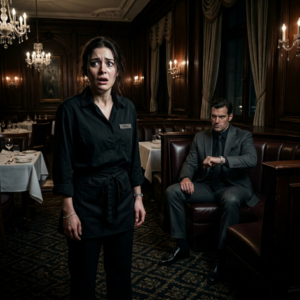
The moment the impeccably dressed stranger ordered the entire dining room cleared, Sarah’s heart hammered against her ribs like a trapped bird. But it wasn’t the sudden silence that terrified her—it was the way his dark eyes locked onto her pulse point, recognizing the impossible secret she wore on her skin.
The Scent Of A Hidden History
Sarah’s shift at Montgomery’s began like every other Wednesday evening. She slipped through the heavy metal doors of the service entrance exactly fourteen minutes before the establishment opened its doors to the city’s elite. The humid, heavy air of the street was instantly replaced by the biting, clinical chill of the restaurant’s industrial air conditioning.
She pulled her dark hair into a tight, unforgiving bun. Her fingers trembled slightly as she secured it with a pearl pin, the cold metal pressing against her scalp. It was the same pin her mother, Carol, had given her seven years ago, back when Carol’s hands were steady enough to fasten small buttons.
The black server’s uniform hung loose on Sarah’s frame these days. It wasn’t vanity or illness that kept her thin, but the quiet, grinding poverty of working sixty-hour weeks. Her tips and hourly wage were immediately swallowed by the exorbitant monthly fees at Clearview Assisted Living, a sanitized fortress thirty minutes outside the city.
That morning, the smell of industrial bleach and pure, unfiltered sorrow had greeted her at the facility’s doors. Sarah maintained a rigid schedule of visits, anchoring herself to the belief that consistency was the last real promise she could offer her fading mother. Carol had been briefly lucid that day, her eyes tracking Sarah with a heartbreaking mixture of recognition and profound distance.
They had sat together in the sterile common room, the fluorescent lights buzzing like angry hornets overhead. Carol’s thin, paper-like fingers worked endlessly at the hem of her cardigan, searching for a phantom task to anchor her mind to the present moment. Sarah watched those trembling hands, her heart twisting with a familiar, suffocating guilt.
“You work too hard,” Carol had whispered, the guilt flickering behind her fading eyes. She knew, somewhere deep in the labyrinth of her deteriorating mind, that her continued comfort required her daughter’s total sacrifice. Sarah had forced a tight smile, assuring her mother it was fine, though the crushing weight of their reality lived right beneath her ribs.
By the time Sarah stepped onto the restaurant floor, the kitchen was already a symphony of clanging steel and shouting cooks. Mark, the head chef with a volatile temper and a prestigious New York pedigree, didn’t bother to look up from his immaculate prep station. Sarah accepted his disdain as a permanent fixture of her reality, no different than gravity holding her feet to the floor.
Before tying her apron, Sarah reached into the back of her rusted metal locker and pulled out a small, velvet-wrapped pouch. Inside was a heavy crystal bottle, its facets cut with such precise, old-world craftsmanship that it felt entirely alien in the grease-stained employee locker room. It was the last physical connection she had to her grandmother, Valerie, and the strange, cryptic words she had spoken on her deathbed.
Valerie had pressed the cold crystal into Sarah’s palm just hours before the cancer finally pulled her under. “When someone recognizes this, you’ll understand things,” her grandmother had rasped, her grip shockingly tight. “About your family… about why I kept you safe.”
Sarah had never understood those words, but tonight, an inexplicable instinct guided her hand. She dabbed the amber liquid onto her wrists and the hollow of her throat. The scent was an intoxicating paradox—warm cedar, aged leather, and a dark, nameless flower that seemed to shift and reorganize its notes with every breath she took.
The Empty Dining Room And The Stranger
By six in the evening, Montgomery’s was a theater of clinking wine glasses and hushed, powerful conversations. Sarah moved through her section with a dancer’s automatic grace, pouring water at precise angles and reciting specials with a practiced, hollow smile. The restaurant was a place where the wealthy came to perform their status, and she was merely part of the stage dressing.
The rhythm of the evening shattered when Mark marched out of the kitchen, his face tight with unusual tension. He pointed a grease-stained finger toward the isolated, shadowy corner booth overlooking the street. “Table nine wants the room to himself,” the chef hissed, his voice dropping to a fearful whisper. “Don’t ask questions. Just do exactly what he says.”
Sarah turned her gaze toward the corner, her breath catching in her throat. The man seated in the velvet booth radiated the kind of absolute, terrifying stillness that only apex predators possess. He wore a perfectly tailored charcoal suit that cost more than her car, and his dark, slicked-back hair framed a jawline that looked carved from unforgiving stone.
He wasn’t simply looking around the room; he was cataloging every exit, every face, every potential weakness. When Sarah reluctantly approached with her notepad, his dark eyes snapped to her, absorbing the light around them. The atmospheric pressure in the room seemed to plummet, the ambient noise of the restaurant fading into a distant, underwater hum.
The scent of her grandmother’s perfume reached him before she even opened her mouth. Sarah watched, paralyzed, as the man’s entire body went rigid, his knuckles turning stark white as he gripped the edge of the mahogany table. His eyes closed for a fraction of a second, absorbing the complex notes of amber and leather like a physical blow to the chest.
“I need the dining room cleared,” he said. His voice was low, laced with an untraceable European accent, carrying the absolute authority of a man who never had to repeat a command. “Everyone leaves. Now.”
Sarah froze, her professional smile faltering as panic clawed at her throat. “Sir, I don’t understand,” she stammered, looking around frantically for her manager. But before she could signal for help, the man’s gaze locked onto hers with terrifying intensity.
“Everyone leaves except you,” he commanded, his voice dropping to a dangerous, gravelly whisper. Within seconds, the manager was ushering furious, bewildered patrons out the doors, compensating their meals with frantic apologies. The kitchen staff vanished, leaving Sarah utterly alone in the cavernous, eerily silent dining room with a man she had never met.
At this moment, anyone would have run for the exit, abandoning the job and the mystery. But Sarah was rooted to the spot by a dangerous curiosity. Would you have stayed?
He rose from the booth with deliberate, terrifying slowness, towering over her by several inches. “Where did you get this?” he demanded, his voice thick with an emotion that bordered on absolute desperation. “The perfume. Where did it come from?”
“It was my grandmother’s,” Sarah whispered, her voice trembling in the vast, empty room. “Valerie. Valerie Smith. She gave it to me before she died.”
The name struck the man like physical violence. He staggered back a half-step, dragging a shaking hand across his mouth as he turned toward the rain-streaked window. The streetlights cast harsh, golden shadows across his face, revealing a man who was struggling to draw oxygen into his lungs.
“She had dark blue eyes,” he murmured to the glass, his voice cracking under the weight of a decades-old ghost. “And her hands shook when she was thinking hard. I didn’t see it at first, but looking at you now… you have her exact bone structure.”
Sarah took a defensive step backward, her pulse roaring in her ears. “I think you have me confused with someone else,” she pleaded, her mind racing for an escape route. But the man turned back, his dark eyes glistening with unshed tears that he fiercely refused to let fall.
He told her to sit, and his tone wasn’t a threat, but a plea. He introduced himself as David Miller, and the story that poured from his lips began to systematically dismantle everything Sarah thought she knew about her life. He wasn’t a stranger. He was the brother of the man Valerie had married and fled from decades ago. David explained that her mother, Carol, was the unacknowledged daughter of the Miller family—a family deeply, violently entrenched in organized crime. Valerie had run to protect her unborn child from a life built on blood and illegal money. The perfume wasn’t just a scent; it was a custom signature created by David’s grandmother, Isabelle, meant to serve as a homing beacon for the family they had lost.
“You can walk out that door right now and pretend this never happened,” David said softly, placing a heavy, embossed business card on the table between them. “Or you can call this number tomorrow, and I will give you the protection and the truth you’ve been denied your entire life.”
A Midnight Descent Into The Shadows
Sarah drove home in a daze, her ancient car rattling against the slick, rain-washed Miami streets. The glowing numbers of her dashboard clock mocked her as the hours stretched into the deep, unforgiving middle of the night. She sat on her faded apartment sofa, the glow of her laptop screen illuminating the terrified exhaustion etched into her face.
Her fingers flew across the keyboard, plunging into digital archives and obscure public records. Every search for David Miller returned chilling, vague articles about “alleged syndicates,” “money laundering,” and “ongoing federal investigations.” There were no clear photos, no formal charges, just the terrifying shadow of a man who operated entirely above the law.
She dug deeper, searching for her grandmother’s maiden name, piecing together a fractured timeline of brief marriages, sudden disappearances, and suspicious, unsolved deaths connected to the Miller empire. By four in the morning, her eyes burned, and her notebook was filled with a sprawling, terrifying web of connections that confirmed every impossible word David had spoken.
Just as she was about to slam the laptop shut, a notification pinged in the dead silence of her apartment. It was an email from an encrypted address, containing only three sentences. It praised her investigative skills but warned her that the real truth couldn’t be found online, commanding her to call the number at exactly ten o’clock.
He had been watching her digital footprint in real-time. The absolute violation of her privacy sent a fresh wave of ice through her veins, sweeping away her exhaustion and replacing it with pure, adrenaline-fueled clarity. She wasn’t just investigating a crime family; she was already caught in their web.
At precisely ten o’clock, her finger hovered over her phone screen. Her rational mind screamed at her to pack a bag, grab her mother from the facility, and disappear into the sprawling anonymity of the country. Instead, she pressed the green call button, her breath hitching as David answered on the very first ring.
Twenty minutes later, a sleek, heavily tinted town car idled outside her crumbling apartment building. The driver, a severe woman with silver hair, opened the door in total silence. Sarah slid into the leather interior, the heavy doors locking with a solid, definitive thud that felt like a prison cell sealing shut.
The estate was a fortress hidden in plain sight, tucked behind wrought-iron gates and massive, manicured hedges that blocked out the rest of the world. Inside, the mansion was aggressively understated—no gaudy gold, just priceless original art, rare books, and the quiet, oppressive hum of limitless wealth. David was waiting for her in a sprawling study that smelled faintly of cigar smoke and aged paper.
He didn’t waste time on pleasantries. He laid out the brutal, unvarnished reality of the Miller family’s criminal enterprise—the extortion, the shadow economies, the violence that kept their empire intact. “Your grandmother made a choice to protect your mother,” David told her, his voice devoid of judgment. “But you chose to put that perfume on. You signaled us. And now, you are my responsibility.”
Sarah felt the room spin. The scent of the perfume on her skin, once a comforting embrace from her grandmother, now felt like a permanent, invisible brand. David offered her access to their resources, promising to cover Carol’s mounting medical bills in full, asking for nothing in return but her willingness to finally know her own blood.
She was trading her hard-won independence for a golden cage, accepting help from a man whose hands were undeniably stained with blood. If the price was your family’s survival and comfort, would you make the same dark trade?
The Golden Cage And The Federal Agents
Two weeks later, the illusion of Sarah’s normal life shattered completely. She was clocking out of the restaurant, her feet aching and her mind miles away, when two individuals in sharp, cheap suits blocked her path to the exit. They flashed gold shields—Agents Morrison and Park of the Federal Bureau of Investigation.
“We want to talk about David Miller,” Agent Morrison said, her eyes scanning Sarah with clinical, deeply intrusive precision. They knew about the evacuated dining room. They knew about the whispered conversation. They were hunting for leverage, and they had pinpointed Sarah as the weak link in David’s impenetrable armor.
Sarah’s throat went bone-dry. The fluorescent lights of the employee hallway buzzed loudly as she weighed her entire future in the span of three seconds. “He ordered wine,” Sarah lied smoothly, her voice a flat, deadpan mask of retail exhaustion. “I served it. He left. I don’t know anything else.”
The agents pushed, their tones shifting from friendly concern to veiled threats about complicity and obstruction of justice. But Sarah held her ground, retreating into the invisible shell she had built over years of customer service. When they finally left, handing her a card with a condescending smile, her legs nearly gave out.
Before she even reached her car, her phone vibrated in her pocket. “You handled them perfectly,” David’s voice came through the speaker, calm and terrifyingly omniscient. He knew exactly what had just happened, proving that his invisible net of protection was already suffocatingly tight around her.
“By lying to the FBI, you just made a choice,” David warned her, his tone heavy with consequence. “You crossed a line, Sarah. You protected me, which means you are now a target for them. I can’t let you stay out in the open anymore.”
The next day, Sarah found herself sitting across from Rose, David’s fiercely loyal, sharp-eyed lieutenant, inside the heavily guarded mansion. Rose slid a sleek, black folder across the mahogany table. It was an offer of employment—a position in a private, highly advanced medical laboratory funded entirely by David’s clean, legitimate shell corporations.
The salary was triple what she made at the restaurant, enough to immediately upgrade Carol to private, round-the-clock palliative care. But Rose made the hidden cost explicitly clear: accepting the job meant officially embedding herself into the Miller family’s ecosystem. It meant her life would forever run parallel to organized crime, shielding her from the FBI but tying her fate to a syndicate.
Sarah signed the contract without a word. Within a week, she had moved out of her decaying apartment and into a stunning, heavily secured townhouse in a quiet, upscale neighborhood. The laboratory was sterile, cutting-edge, and populated by brilliant technicians who never, ever asked questions about where their funding came from.
She visited Carol on Saturday, finding her mother resting in a private, sunlit suite that smelled of fresh lilies instead of bleach. The guilt of how she was paying for it gnawed at Sarah’s conscience, but watching her mother smile without the shadow of pain made the moral compromise taste less bitter. She had sold her soul, but she had bought her mother’s peace.
She was actively protecting a criminal empire to shield her own flesh and blood. Where do you draw the line between desperate loyalty and willing complicity?
The Anchor In The Black Water
Months bled into each other, and Sarah’s integration into David’s dark, opulent world became dangerously comfortable. She attended private, lavish dinners where ruthless men and women discussed international logistics in coded, terrifyingly polite language. She learned to read the silence between their words, recognizing the hidden threats and shifting alliances of the underworld.
Frank Gordon, an ambitious, sharply handsome underboss, began directing predatory, calculating attention toward her during these dinners. He complimented her intelligence, his smiles never quite reaching his cold, assessing eyes. He saw her not as a person, but as a strategic asset—a direct, vulnerable emotional tether to David that could be exploited for power.
David crushed Frank’s ambitions with a single, softly spoken threat across a crystal-laden dining table. Later that night, in the privacy of his study, David finally let his impenetrable mask slip. He confessed that keeping his distance from her was becoming impossible, that the biological tie of family was blurring into a fierce, overwhelming romantic devotion he had never anticipated.
“If you let Frank in, he will use you to destroy me,” David warned, his dark eyes burning into hers. “But if you stay with me, I will burn the world down to keep you safe. I can’t offer you a normal life, Sarah. I can only offer you absolute loyalty.”
They agreed to step back, to give the terrifying emotional gravity between them time to settle. But distance was a fragile illusion when every aspect of Sarah’s life—her home, her mother’s care, her physical safety—was meticulously orchestrated by David’s invisible hand.
The breaking point arrived on a suffocating, rainless Tuesday in April. The call from the facility brought Sarah to her knees in the middle of the laboratory. Carol had suffered a sudden, catastrophic decline, slipping violently into a terminal phase that no amount of dirty money or advanced medicine could reverse.
Sarah sat in the darkened hospital room, listening to the shallow, ragged rhythm of her mother’s breathing. She felt entirely unanchored, drifting in a vast, terrifying ocean of impending grief. Her fingers moved mechanically, dialing David’s number without conscious thought, her desperate need for his presence overriding every logical boundary they had set.
He arrived in under forty minutes, sweeping into the clinical room like a shadow. He didn’t offer empty platitudes or hollow comforts. David simply sat heavily in the chair beside her, his massive presence absorbing the crushing weight of her terror. In the dark, silent room, Sarah finally broke, sobbing into his shoulder as he held her together with quiet, unyielding strength.
Days later, when Carol found a brief, final window of profound lucidity, David took Sarah away from the city. They boarded a small, unmarked boat at a private marina, cutting through the pitch-black ocean until the glittering skyline of Miami was nothing but a distant, insignificant memory. The engine cut, leaving them floating in total, echoing silence under a canopy of harsh white stars.
David turned to her, the ocean wind whipping at his dark coat. He reached into his pocket and produced a small, velvet box. Inside rested a delicate, priceless gold chain, holding a tiny crystal pendant filled with the original, amber-colored perfume Isabelle had crafted decades ago.
“I am not asking you to marry me, because signing papers in my world is a death sentence,” David said, his voice raw with an vulnerability that belonged only to her. “I am asking you to claim this. I am asking you to accept that despite the blood, despite the crimes, you choose to stay in the dark with me.”
Sarah stared at the golden pendant, the amber liquid trapping the history of three generations of women who had run from this exact life. She reached out, her fingers trembling as they brushed against David’s warm skin. She didn’t want to run anymore. She didn’t want to be a victim of circumstance, hiding in the shadows of a history she didn’t write.
“Yes,” she whispered, her voice carrying over the crashing waves. “Yes to all of it.”
When David kissed her, the collision of their worlds felt absolute and irreversible. He fastened the heavy gold chain around her neck, the crystal pendant settling hot against her collarbone. The scent of ancient cedar and nameless flowers rose into the salty night air, binding them together in a legacy of impossible choices.
They returned to the facility just as the sun began to paint the Miami sky in violent strokes of orange and bruised purple. Carol saw the necklace resting against her daughter’s skin, and a quiet, profound peace finally settled over the dying woman’s face. She looked at the man who commanded a criminal empire, and saw only the shield that would protect her child when she was gone.
Two months later, Carol passed away quietly in her sleep. Sarah stood on the massive balcony of David’s estate, looking out over the glittering, corrupt city that now belonged to them both. She touched the crystal pendant at her throat, feeling the heavy, beautiful weight of the golden cage she had willingly locked herself inside.
The greatest tragedies in life aren’t the mistakes we make by accident, but the dark, terrifying choices we make on purpose to protect the ones we love. Sarah surrendered her freedom and her innocence to a world built on violence, all to buy her mother a peaceful end.
If you were backed into a corner, watching your family slip away in a cold, sterile room… would you have the strength to walk away from the devil’s money? Or would you put on the necklace and step into the dark? Drop your brutally honest thoughts in the comments below—I want to know where you draw the line.
Disclaimer : This content may be created by AI for entertainment purposes. Any resemblance to real persons, events, or places is coincidental.






