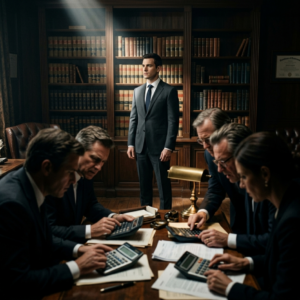
I stood in the corner of the mahogany-paneled law office, a bottle of expensive wine in my hand, watching my family mentally divide a $20 million fortune before the body was even cold. My Aunt Veronica was already clutching a calculator, and Uncle Randall was whispering about property taxes on a mansion he hadn’t yet inherited. For twenty-eight years, I had been the “ghost” at every holiday dinner—the dropout, the “computer kid,” the failure.
They had spent decades stepping around me to hug the “successful” cousins, but as the attorney cleared his throat to read Grandmother Iris’s final words, the air in the room suddenly turned ice-cold. “To my beloved family,” the lawyer began, his voice echoing in the sudden, sharp silence, “I leave you exactly what you gave me in my final years.” Veronica’s pen stopped mid-air. Randall’s smirk flickered. They didn’t know that while they were busy “networking” and ignoring the woman who built their empire, I was the only one holding her hand every Tuesday night. By the time the sun set that day, the social hierarchy my family had worshipped for generations was about to be burned to the ground, and the “black sheep” was the one holding the match.
Chapter 1: The Social Hierarchy of Shadows
For twenty-eight years, I existed in the periphery of the Patterson family. We were a clan built on titles: MDs, JDs, and MBAs. At our massive Sunday dinners, my Uncle Randall would beam as he introduced his children. “This is my nephew, Theo, the doctor, and my daughter, Ava, the lawyer.” His eyes would then slide right past me like I was a piece of unremarkable furniture.
My crime was simple but unforgivable in their eyes: I had dropped out of law school in my second year. In a family that valued prestige over profit, my decision to start a tech company, CloudSync Solutions, branded me a permanent failure. It didn’t matter that by age twenty-five, I was pulling in seven figures annually and employing fifteen people. To them, I was just “playing with websites.”
At Christmas, I was relegated to the kids’ table. My seat was permanently wedged between a seven-year-old and a high chair, while my younger cousins sipped Bordeaux and discussed their “real” careers. At weddings, I was the designated photographer, asked to step out of the frame so they could get “just the family” shots.
“Whatever happened to Quinn?” Aunt Veronica would ask my mother at the table, discussing my life in the third person while I sat three feet away.
“Oh, he’s still doing that computer thing,” Mom would reply with a dismissive wave, as if she were shooing away a fly. I kept showing up, driven by a pathetic hope that one day, they would see me. That one day, I would belong. But the only person who truly saw me was the woman they were all waiting to die.
Chapter 2: Tuesdays at Sunset Manor
While the rest of the family treated Grandmother Iris like a chore, I treated her like a hero. Every Tuesday at 6:00 PM, I walked through the automatic doors of Sunset Manor. The facility always smelled of industrial disinfectant and faded memories, but Iris’s room was a sanctuary.
I’d bring a small cooler of homemade chocolate chip cookies—the recipe she’d taught me when I was twelve. The nurses knew me by name. They’d announce “Quinn’s here for Mrs. Patterson” over the intercom, and I could hear the genuine warmth in their voices. They knew more about my business than my own parents did.
During our chess games, Iris’s weathered hands would move pieces with a precision that belied her ninety-three years. “Tell me about the cloud storage thing again,” she’d say. I’d explain server infrastructure and client acquisition, and her eyes would light up.
She was the one who told me the real history of the family. She had built the Patterson construction business from a single pickup truck in 1952. “Everyone said a woman couldn’t run a construction company,” she’d whisper with a mischievous glint. “I made more money than any of their husbands ever did.”
She saw herself in me—the stubbornness, the drive, the refusal to follow a path she didn’t choose. When I landed a $2.4 million contract, she gripped my hand with surprising strength. “That’s empire-building money, Quinn. Don’t let anyone convince you it’s not.”
Chapter 3: The Vultures Gather
When Iris passed, the family’s true colors were revealed in a single group text from my mother: Mom passed this afternoon. Funeral arrangements TBD. No phone call. No shared grief. Just a notification, like a change in dinner plans.
The will reading was held at Morrison and Associates. The office was a temple of old money—mahogany, leather, and heavy silence. Aunt Veronica had arrived with a leather portfolio and a calculator. Ava was on her phone, favoriting luxury cars she assumed she’d be buying by lunchtime.
They calculated the estate at $20 million: the Victorian mansion, the investment portfolios, and the construction business. Split twelve ways, everyone would be a millionaire. They were already spending money that hadn’t been gifted to them yet.
Attorney Morrison cleared his throat. The “boiler-plate” legalities went by in a blur, and then he reached the section that would change our lives forever.
“To my daughter Veronica, who visited me twice in five years and forgot my last three birthdays: I leave my disappointment and best wishes for your future endeavors.”
The room went deathly silent. You could hear the hum of the air conditioning. Veronica’s face turned a translucent shade of white.
“To my son Randall, who sent flowers once a year but couldn’t remember which grandchildren belonged to which parents during our phone calls: I leave my profound sadness at your choices.”
The lawyer didn’t stop. He listed the cousins, Theo, Ava, and Finn, leaving them “the same attention and care you showed me, which is to say none whatsoever.” Then, his voice softened.
“To my grandson Quinn, who held my hand every Tuesday for six years… I leave everything else.”
Chapter 4: The Basement Safe
The room exploded. Shouts of “undue influence” and “mental incompetency” rattled the framed diplomas on the walls. Randall’s face was an alarming shade of crimson. “We’ll contest this! This is elder abuse!” he roared.
But Morrison was prepared. He laid out folders containing medical evaluations, cognitive assessments, and psychiatric consultations from the last six months. Iris had undergone extensive testing to prove she was of sound mind.
Then came the killing blow. Morrison adjusted his glasses. “Mrs. Patterson also requested I inform you that any attempt to contest this will shall result in the immediate release of certain financial records she maintained… including documentation of unpaid loans and tax irregularities.”
The fight drained out of them instantly. They weren’t just disinherited; they were exposed.
Morrison handed me a thick envelope marked For Quinn’s Eyes Only. Inside, Iris had written: “I’ve been watching this family for 93 years. I know who everyone is. They’ll come for you now, Quinn. They’ll try every guilt trip in the book. Be ready.”
She also gave me a tip: the combination to the safe in the basement of the construction company was my birthday in reverse. “I think you’ll find some interesting reading about certain family members’ business loans that were never repaid,” she’d added in a postscript.
Chapter 5: The Returns of the King
The phone calls started before I reached my car. My phone became a vibrator of false affection.
“Quinn, honey, we need to talk. Family dinner tonight?” – Aunt Veronica. “Congrats on the inheritance, man. Drinks on me?” – Cousin Theo.
I decided to go to the dinner at Randall’s house. I wanted to see what desperation looked like on the people who had treated me like a ghost for three decades.
The atmosphere was unrecognizable. For the first time in my life, every face turned toward me the moment I entered. No one stepped around me. No one ignored my wine.
Randall guided me to the head of the table—the patriarch’s seat. “We were just talking about how proud we are of you,” he said with exaggerated ceremony.
Theo chimed in, “I always knew you were a genius. Remember when you built that computer? I always supported you.” I stared at him. “You called it a waste of time and broke it on purpose, Theo.” His smile faltered for a fraction of a second before reassembling. “Kids, right? We didn’t understand your brilliance.”
Then came the pitch. They wanted to form a “Family Trust.” They wanted to “pool” the inheritance for everyone’s benefit to help me manage the “overwhelming responsibility.”
“You’re absolutely right,” I said, leaning back in the seat of power. “Money shouldn’t divide families. In fact, I’ve learned so much about family this week.”
I pulled out my phone. For years, I had been recording family conversations—not out of malice, but to figure out why I was failing socially. I pressed play.
Veronica’s voice filled the room: “He’s just so awkward and pathetic… what does Quinn have to show for himself? Some silly website business that’ll probably fail.”
Then Randall’s voice: “The kid’s delusional. When he comes crawling back to reality, maybe I’ll throw him some manual labor to teach him humility.”
The silence that followed was deafening. I stood up. “For six years, I watched Grandmother Iris look at the door every Tuesday, hoping one of you would visit. I made excuses for you. I told her you were busy. But she wasn’t stupid. She knew.”
I walked to the door. “I’m giving you exactly what you gave me all these years,” I said, pausing at the threshold. “Nothing.”
Chapter 6: The House of Cards Collapses
The aftermath was swift and brutal. Within three months, the family’s “mediocre excellence” was exposed for what it really was: a house of cards built on debt and expectations.
Aunt Veronica lost her house. She had been maxing out credit cards for years, banking on an inheritance that never came. The foreclosure notice was posted on a Tuesday—the same day I used to visit Iris.
Uncle Randall’s restaurant went under. He had expanded too aggressively, counting on the estate money to cover his high-interest loans.
Theo’s engagement fell apart. It turned out his fiancé was more interested in the Patterson fortune than a pediatric residency salary.
My parents made one final attempt at my office. “Money doesn’t matter, Quinn. We just want our son back,” my mother sobbed.
“Where was that love when I graduated? Or when I started my business?” I asked, not looking up from my desk. I opened a drawer and handed my father a check for $500. “That’s the total you spent on my birthday gifts over the last decade. Consider us even.”
The Final Reflection: The Price of Presence
It’s been three years since that will reading. I turned the Patterson mansion into a community center—the Iris Patterson Center—where kids who feel like “black sheep” can learn tech and business for free. I kept the construction company running, honoring the empire she built from a pickup truck.
I ran into my cousin Ava recently. She was working three jobs, living in a studio she could barely afford. For the first time, she didn’t look at me with pity. She looked at me with remorse. “We were jealous, Quinn,” she admitted, crying into a coffee shop napkin. “You were the only one who was real, and we punished you for it.”
I bought her coffee, but I didn’t offer her a check. Some things have to be earned.
Grandmother Iris taught me the most valuable lesson of all: Presence is the only currency that matters. You can’t buy a legacy, and you can’t demand a seat at a table you didn’t help build.
If you’re the person currently sitting at the “kids table” of your own life, remember this: the hand that feeds is a gift, not a debt. And sometimes, the black sheep isn’t lost—it’s just found a better flock.
At this moment, anyone would have shared the money just to stop the fighting, but Quinn chose to honor the woman who actually loved him. Would you?
Disclaimer : This content may be created by AI for entertainment purposes. Any resemblance to real persons, events, or places is coincidental.






