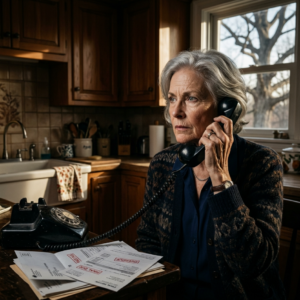
The morning light filtered through the bare oak branches in the backyard, casting long, skeletal shadows across the lawn Gerald would never rake again. I was standing at the kitchen sink, the lukewarm water rinsing out my second cup of coffee, when the phone rang—a shrill, demanding sound that felt like a violation of my newfound silence.
I knew it was her before I even looked at the screen; Amanda always called at 9:00 AM when she had an agenda to push. She had no idea that tucked away in a locked drawer in the study was a deed to thirty-two acres of lavender fields in France, signed and sealed a week before her father’s funeral.
“Mother,” Amanda’s voice cut through the line, sharp and clinical. She only used “Mother” when she was about to treat me like a problem that needed solving.
“Michael and I have been talking, and we think it’s time we sat down and made some serious decisions about your future.” I dried my hands slowly, staring at the pale band of skin on my finger where my wedding ring had lived for thirty-one years.
I let the silence stretch, listening to the rhythm of my own breathing, realizing that for the first time in my life, I didn’t have to apologize for the quiet. My daughter was about to try and sell my house out from under me, but I had already planned my escape to a life she couldn’t even imagine.
Chapter 1: The Realtor and the Vinyl Cushion
Amanda didn’t wait for a greeting before she launched into the logistics of my “liquidation.” She spoke about my four-bedroom house as if it were a liability, a sprawling museum of a life she was eager to archive.
“Daddy’s medical bills alone… I mean, I don’t even want to think about what you’re dealing with financially right now,” she sighed, her “concern” dripping with the subtext of her own needs. Outside, a cardinal landed on the bird feeder Gerald had built—the one Amanda used to mock as a “kindergarten craft project.”
I walked to the kitchen table and sat in Gerald’s chair, the vinyl cushion still slightly flattened in the shape of him. It felt like a betrayal to even listen to her plan to erase his presence from this neighborhood.
“Amanda, Michael and I have been talking to a realtor, Jessica—you remember her? She thinks we could list at 425 easily,” she continued, her voice gaining momentum. “That would give you enough to live in that senior community off Route 12, and Michael and I think… well, it would make sense to help us out with Ryan’s tuition at Cornell.”
The audacity of it hung in the air like the smell of something burning. My husband had been in the ground for five weeks, and his daughter was already counting the coins from his estate to pay for a life she and her husband Michael had mismanaged.
“Helping?” I repeated, the word tasting like ash. Amanda didn’t miss a beat, warning me that if I waited until spring, I could lose $20,000 in market value.
I thought about the stone farmhouse with the blue shutters in the Luberon Valley, the one I had flown to see in secret while Gerald was still in the hospital. I had told him I was visiting a cousin, and he had smiled, his skin papery and dry, telling me to “have fun, sweetheart.”
Chapter 2: The Secret Stashed in Provence
While my children viewed me as a “construction project awaiting permits,” I had been building a fortress of independence. The inheritance from my mother, quietly invested for twenty-six years, and my own pension as a nurse practitioner had never been part of the family ledger.
I had bought the farm alone, with my own money, because I knew this moment would come. I knew that once Gerald was gone, they would try to put me somewhere “small,” somewhere they could visit twice a year on their own terms.
I stood up and walked to Gerald’s study, the floorboards creaking under my feet like familiar voices. I unlocked the bottom drawer and pulled out the folder marked Provence in my own handwriting.
Inside was a letter I had written to myself six months ago, a manifesto of a woman refusing to be erased. “You owe these children your love,” I had written. “You do not owe them your erasure.”
I sat at the desk where Gerald used to pay the bills and made a mental list of everything I would take and everything I would leave behind. My hands were perfectly steady.
I called my attorney, Deline Arseno, a woman Gerald had chosen specifically because “she doesn’t take any nonsense.” She confirmed the legal reality: the house, the accounts, and the French farm were mine alone.
“Amanda has a realtor scheduled for a walkthrough Tuesday,” I told her. Deline’s laugh was sharp and unsympathetic. “She doesn’t have a walkthrough; she has the audacity to imagine one. There’s a significant difference.”
Chapter 3: Serene Fury and One-Way Tickets
I spent the next three days in a state of serene fury, moving through the house like a ghost of the woman I used to be. I packed Gerald’s favorite blue and gray flannel shirt into my suitcase, leaving his books on the shelves for the family who would eventually rent our home.
I would not sell this house under the pressure of my daughter’s greed. I would rent it, keep the foundation of my marriage intact, and use the income to support my life in a village called Roussillon.
My son, Michael, called that Sunday evening, his voice sounding small and tired, the way it did before he married a woman who didn’t believe in softness. “Mom, Amanda told me she talked to you… the house is a lot, and we worry about you.”
“Do you, Michael?” I asked, my voice as cold as the November air. “When was the last time you drove the four hours out here to visit your father while he was dying?”
The silence on his end was so complete I could hear the clock ticking in his kitchen. He tried to make excuses—work, his wife Teresa, the twins’ schedules—but I stopped him.
“You have full, busy lives, and I respect that,” I said. “So I find it fascinating that you and your sister have suddenly found the time to rearrange mine.”
“I’m leaving next Wednesday, Michael. I bought a lavender farm in France six months ago. I’m going to live there.” I told him everything—the thirty-two acres, the stone house from 1847, the kitchen that catches the morning light.
He didn’t speak for a long time. When he finally did, he asked if I would come back for holidays or the twins’ birthdays. “Maybe,” I replied. “When I’m ready, and only if the visits are about seeing each other, not about convincing me to be someone smaller than I am.”
Chapter 4: The Tuesday Walkthrough
Amanda arrived on Monday evening, moving up the schedule because of her “realtor’s availability.” She stood on my porch with Jessica, the realtor who was clutching a clipboard and looking like she desperately wanted to be anywhere else.
I opened the door wearing my good blue sweater and a shade of lipstick I hadn’t touched since my last anniversary. “Hello, Amanda. Jessica, I presume?”
Amanda tried to brush past me, but I blocked the doorway. “Amanda, step inside. Jessica, you will need to wait in the car.”
The realtor made the smartest decision of her professional life and retreated down the steps with a small wave. I led my daughter into the living room, but I remained standing.
“The house is not for sale,” I told her, my voice echoing in the foyer. “It will never be for sale while I’m alive. On Wednesday, I am flying to France to live on a property I purchased months ago.”
Amanda’s face seemed to slide like wet paint. “What are you talking about? You’re my mother!”
“Yes, I am your mother,” I countered. “I am not your bank. I am not your insurance policy. I am not your retirement plan. I am a whole woman, and I will not be your solution.”
She tried every expression in her arsenal—tears, anger, the wounded daughter, the reasonable adult. None of them fit anymore. The mother who would have softened at her touch had already checked out.
“Fine,” she spat, walking toward the door. “Go to France. Have your midlife crisis thirty years late. I hope it’s everything you dreamed of.”
I watched her car pull away, and for the first time in forty-two years, I felt like I had set down a suitcase I had been carrying since the day Michael was born. I did not cry; I simply breathed.
Chapter 5: The Purple Fields of Roussillon
I flew out of Dulles on a Wednesday morning, watching the Atlantic seaboard fall away beneath the clouds. I thought about the girl I had been at twenty-three, the one who wanted to see Provence before she married a good man and started a family.
Marseille smelled of sea salt, diesel, and a green scent I couldn’t quite name. Sylvie, the daughter of the woman who sold me the farm, met me in a rattling Peugeot and drove me north through vineyards and umbrella pines.
The farmhouse was a sanctuary of stone walls as thick as a man’s forearm and shutters the color of the summer sky. Sylvie had stocked the pantry with fresh bread and wine, leaving a note: “Welcome home, mon amie.”
The days that followed were a symphony of small things—learning the names of neighbors like Pascal and Marie-Clare at the cheese shop, and Henri, the retired teacher who helped me with my “terrible” French.
I wrote letters every week—to Michael, to my granddaughter Hannah, and even to Amanda. I didn’t expect a reply from my daughter; I wrote them for the record, a testament that I had not given up on her, even if I had given up on her demands.
In December, Hannah arrived, bursting into tears the moment she saw me on the platform in Avignon. She stayed for three weeks, learning to make goat cheese pastries and walking the dormant lavender rows in the winter mist.
“Grandma, Dad’s going to be okay,” she told me over a fire on Christmas Eve. “But Aunt Amanda… I don’t know.”
“It has to be okay with me,” I said, watching the sparks fly up the chimney. “The alternative was letting her rearrange my life to avoid the discomfort of her own. I did that for forty-two years. I’m not doing it anymore.”
Chapter 6: The Cornell Connection
In February, an email finally arrived from Amanda. It was short and bruised. She admitted she was still angry, but that Hannah had shown her pictures of the farm. “I don’t know when I will be ready to talk,” she wrote.
I didn’t push. I simply wrote back: “Thank you. Take whatever time you need. The letters will keep coming.”
Then, in April, she sent a photograph of my grandson Ryan in front of his dorm at Cornell. He was holding a sign that said: “Grandma, Mom told me about your farm. Send lavender. Love, Rye.”
I laughed out loud for the first time in six months. I shipped a bundle of last year’s dried lavender to Ithaca the very next morning.
July arrived, and the Luberon Valley turned a violent, beautiful shade of purple. The air was so thick with the scent of lavender I could almost taste it.
Michael flew over for ten days, standing in the fields at sunset and weeping. “Mom, I understand now,” he whispered, his shoulders shaking. “I’m sorry it took me this long to see you.”
“It took you exactly as long as it needed to take, sweetheart,” I told him, holding his hand. “Your father sees this place. I’m sure of it.”
On the last night of his visit, as the sun turned the hills the color of apricots and old bronze, my phone rang. It was Amanda.
“Mom… I don’t know how to do this,” she sobbed. I stepped out onto the stone terrace, the warmth of the day still radiating from the ground. “Then just talk. We don’t have to fix anything tonight. Just talk.”
The Universal Truth of the Lavender Farm
She told me she had been seeing a therapist, that Michael had made her go. She had been thinking about what I said that night—about refusing to be her “solution.”
“I’m so sorry,” she whispered across four thousand miles. “I think I knew I was being horrible, but I didn’t believe I deserved your love if I couldn’t earn it with something… a house, a check, a sacrifice.”
“That’s the thing about love, Amanda,” I said, watching the stars come out over the valley where my grandmother was born. “The real kind? You don’t earn it. You just receive it. And if you’re lucky, eventually you learn how.”
I stood on that terrace long after we hung up, realized that I had finally finished the work Gerald and I had started decades ago. I had finally raised my children to see me as a person.
At this moment, anyone would have stayed in that four-bedroom house and let their children’s needs consume them, but Sarah chose the purple fields. Would you?
The Grand Finale
I am 68 years old, and my life is just beginning. I am not a burden, and I am certainly not a bank. I am a woman who remembered her own name in the middle of a November storm.
If you are currently feeling like a retirement plan for the people you love, I want you to look at your own “oak tree” in the backyard. You don’t have to rake the leaves forever.
There is a stone farmhouse waiting for you somewhere—maybe it’s a hobby, a new city, or just the courage to say “no.” It is not too late. It is never too late to reclaim the light in your own kitchen.
What would you do if your family tried to decide your future for you? Would you have the courage to buy a one-way ticket to your own life, or would you stay to keep the peace?
Tell me in the comments where you’re watching from and what your “Provence” would look like. If this story touched your heart, share it with a woman who needs to remember she’s allowed to be whole.
Disclaimer : This content may be created by AI for entertainment purposes. Any resemblance to real persons, events, or places is coincidental.






