The Turbulence of Healing: A Doctor, a Don, and a Desperate Deal
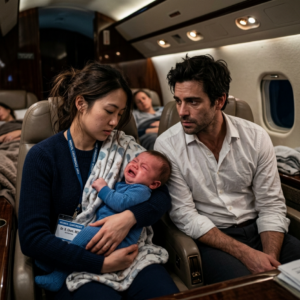
Seat 23B smelled like recycled air and the stale perfume of whoever had flown this route before me. I pressed my forehead against the scratched, cold oval window, watching Chicago’s sprawling skyline shrink into insignificance beneath us as Flight 2847 climbed into the turbulent afternoon clouds. Three exhausting days of intensive pediatric conferences had left my mind oversaturated with complex data about infant development milestones. My body craved a deep, dreamless sleep that stubbornly refused to come on this cramped, uncomfortable flight back to Boston.
The crying started exactly twenty minutes after takeoff.
At first, it was just annoying background noise, the kind every frequent flier begrudgingly learns to tune out. But this wasn’t the typical fussy, tired baby sound. This was distress. It was raw, escalating, and visceral—the kind of pure agony that made my professional pediatric instincts kick in violently before my exhausted brain could command them to rest. I straightened abruptly in my narrow seat, craning my neck to see past the heavy blue curtain separating the cramped economy cabin from first class.
“Ma’am, please remain seated. We’re still experiencing turbulence.” The flight attendant’s voice was polite but rigidly firm as she hurried past my row, her hand gripping the overhead bins for balance.
I sank back into the uncomfortable upholstery, my fingers drumming an anxious rhythm against the plastic armrest. The crying continued relentlessly, climbing in pitch and sheer desperation. Thirty agonizing minutes stretched into forty. Passengers around me shifted uncomfortably; some pressed noise-canceling earbuds deeper into their canals, while others shot openly annoyed, hostile glances toward the front of the aircraft. But I couldn’t stop listening. I couldn’t stop professionally analyzing the acoustic pattern. The cry possessed a specific, alarming quality—rhythmic, intense, and laced with the kind of full-body tension that spoke of genuine, physical pain rather than simple environmental discomfort.
Colic. Severe, unrelenting colic, by the sound of it.
When the seatbelt sign finally chimed off with a soft ding, I unbuckled my belt before I had fully decided to get involved. My legs carried me swiftly up the narrow aisle while my rational mind frantically listed all the excellent reasons this was absolutely none of my business. I’d just spent seventy-two grueling hours discussing complex medical cases with top colleagues from across the country. I was officially off duty. This wasn’t my patient, it wasn’t my problem, and it certainly wasn’t my responsibility.
The senior flight attendant stationed near the front galley looked entirely ready to intercept my progress, but I quickly held up my conference badge, still securely clipped to the strap of my canvas bag.
“I’m a pediatrician,” I stated firmly. “That baby sounds like it might need an immediate medical assessment.”
Her professional, plastic smile cracked slightly, genuine relief bleeding through the facade. “The passenger has refused our assistance multiple times, doctor, but you are more than welcome to try.”
She pulled back the heavy curtain, and I got my first clear, unobstructed view of the chaos.
Chapter I: First Class Distress
First class held perhaps a dozen plush, oversized seats, most occupied by wealthy business travelers who were studiously, aggressively ignoring the loud disruption unfolding in row two.
The man desperately holding the screaming infant looked as though he had just been dragged through a war zone. His expensive white dress shirt was wrinkled beyond any hope of salvation, the sleeves hastily rolled up past his elbows to reveal strong forearms corded tightly with stress. Dark, disheveled hair fell across his forehead, and even from several feet away, I could clearly see the profound, bone-deep exhaustion carved into the sharp lines of his face. But it was his eyes that physically stopped me in my tracks—dark brown, almost black, and filled with a frantic desperation so raw and vulnerable it made my own chest tighten in sympathy.
“Sir?” I approached his seat slowly, keeping my voice intentionally gentle and non-threatening. “I’m Dr. Foster. I couldn’t help but hear your baby crying. Would you mind if I took a quick look?”
His gaze snapped to mine, and the sheer, predatory intensity in it nearly made me take a step back. For a long, silent moment, he just stared at me, as if trying to calculate whether I was a real person or a cruel hallucination brought on by severe sleep deprivation. The baby, perhaps eight or nine months old, wailed agonizingly against his broad shoulder, little fists clenched tight, his tiny face bright red with the effort of screaming.
“You’re a doctor?” His voice was low, heavily roughened by hours of stress, carrying a distinct accent I couldn’t quite place. Italian, maybe, or something very close to it.
“A pediatrician, actually. I specialize in infant development.” I gestured down to the conference badge resting against my chest. “I just spent the last three days talking about exactly this kind of specific issue.”
Something subtle shifted in his hardened expression—a visible crack in whatever impenetrable wall he’d built around himself and his son.
“Please.”
The single, whispered word carried the heavy, crushing weight of absolute defeat. It was the sound of a powerful man who had tried absolutely everything in his arsenal and completely failed.
I slid smoothly into the empty, luxurious seat directly beside him, my mind already assessing the screaming baby with practiced, clinical eyes. A boy, approximately nine months old, well-nourished, but clearly in extreme physiological distress. The specific cry pattern, the painful way he aggressively pulled his small legs up toward his belly, the angry red flush spreading rapidly down his neck—it all pointed aggressively to one diagnosis.
“May I?” I held out my hands, palms open and waiting. After a painfully long heartbeat of hesitation, the stranger gently transferred the screaming baby into my arms.
The child’s small body was completely rigid with tension. His back was arching painfully, and his abdomen felt distended and rock-hard beneath my gentle, probing palpation.
“What’s his name?” I asked softly.
“Noah.”
“Hi, Noah.” I expertly adjusted his position, turning his tense body onto his left side across my forearm, pressing his rigid belly gently against the flat of my palm. My other hand immediately began moving in slow, deliberate, clockwise circles across his small back. “How long has he been crying exactly like this?”
“Since we boarded. Almost an hour now.” The man’s deep voice cracked slightly with helpless frustration. “The flight attendants kindly tried everything. A warm bottle, a pacifier, walking him up and down the aisle. Absolutely nothing works.”
“Does he have severe episodes like this often?” I continued the gentle, rhythmic massage, slowly feeling the terrible tightness in Noah’s small body begin to fractionally shift.
“Every few days. Sometimes it’s worse.” He scrubbed a heavy, exhausted hand across his face, and I suddenly noticed the incredibly expensive, heavy watch resting on his wrist—the kind of bespoke timepiece that cost more than my annual apartment rent. “The local pediatrician said it was just colic, but I thought he was supposed to naturally grow out of it by this age.”
“Colic typically peaks around six weeks and usually resolves by four months,” I explained calmly, adjusting Noah’s position slightly to apply more targeted, gentle pressure to his lower abdomen. “But some babies suffer from extended, severe cases, especially if there’s an underlying gastrointestinal issue like a food sensitivity.”
The baby’s frantic crying had already begun to noticeably quiet, slowly shifting from desperate, lung-tearing wails to soft, hiccupping whimpers. I continued the specific massage technique, seamlessly adding a subtle, soothing rocking motion, and I vividly felt the exact moment his rigid abdominal muscles finally released their hold.
A small, unmistakable sound of gas passing echoed in the quiet space, and Noah’s crying cut off abruptly, instantly replaced by a stunned, wide-eyed silence.
“What did you do?” The man leaned forward instantly, sheer wonder rapidly replacing the deep exhaustion in his expression.
“It’s a targeted infant massage technique combined with proper anatomical positioning. It physically helps release trapped gas that’s causing him severe pain.” I carefully shifted Noah into an upright position against my shoulder, expertly supporting his heavy head, and patted his back gently until a loud, satisfying burp emerged. “There we go, buddy. That feels much better, doesn’t it?”
Noah made a soft, happy cooing sound, his tiny fist weakly grabbing at the fabric of my shirt. The agonizing tension had completely drained from his little body, leaving him utterly relaxed and heavily drowsy against my chest. I looked up to find his father staring intensely at me with an expression I couldn’t quite read. It was hovering somewhere between profound gratitude and something else—something much more intense, assessing, and surprisingly intimate.
“I don’t understand,” he whispered, staring at my hands. “How did you fix him in two minutes when absolutely nothing else worked?”
“I didn’t fix him. This is only temporary relief, not a medical cure.” I reluctantly, carefully handed Noah back to his father, acutely noting how the man’s entire physical demeanor shifted the exact moment he held his son again. He instantly became both fiercely more protective and strangely more vulnerable. “If he’s having painful episodes this frequently at nine months old, you need to investigate the root cause further. Food allergies are very common culprits. What specific brand of formula are you using?”
He told me the name, and I nodded, mentally filing the crucial information away.
“That specific brand is cow’s milk based. Noah might have a severe sensitivity to the dairy protein. You should immediately talk to his regular pediatrician about switching to a specialized, hypoallergenic formula, and completely eliminating dairy from his diet if you’re supplementing with any solid foods.”
“I’ll call them tomorrow morning.” He looked tenderly down at Noah, who was already drifting peacefully toward sleep, his tiny fingers curled securely against his father’s broad chest. “Thank you. I honestly don’t know how to thank you properly.”
“You just did.” I started to stand up, preparing to return to my cramped seat, but his large hand reached out and caught my wrist gently.
“Please. Let me compensate you financially for your time and expertise.” He reached smoothly for his expensive leather wallet with his free hand, but I immediately pulled my wrist away.
“I don’t accept payment for helping a baby in distress. That’s not who I am or why I do this.” I softened the firm refusal with a slight, reassuring smile. “Just promise me you’ll follow up with his doctor. If the formula change doesn’t help his symptoms within a week, aggressively push for a full allergy panel and possibly a referral to a pediatric gastroenterologist.”
“I will.” He studied my face with those intense, dark eyes, and I felt oddly exposed under his gaze, as if he could see straight through my professional facade to something I hadn’t meant to reveal. “You’re very, very good at this.”
“It’s what I do.” I gestured softly to the now-peaceful, sleeping Noah. “Get some rest while he’s sleeping. And try the massage technique I showed you the next time he has a painful episode. Clockwise circles on the belly, gentle but very firm pressure, left-side lying position to help the gas move through the intestines.”
The plane suddenly jolted, hitting a rough pocket of turbulence, and I quickly grabbed the leather seat back to steady my balance. “I should get back to my seat before we hit more rough air.”
“What’s your name?” The question was incredibly direct, almost commanding and urgent. “Your full name, Dr. Foster.”
“Rachel. Rachel Foster.” I glanced down at the plastic conference badge still hanging from my canvas bag, realizing he could probably read it anyway if he tried. “I work at Boston General Hospital. In the pediatric department.”
Something distinctly flickered in his dark expression—deep satisfaction, perhaps—as if I’d just unknowingly handed him something incredibly valuable.
“Vincent Castrovani. Thank you, Rachel Foster. You genuinely saved me today. You possibly saved my sanity.”
The name Vincent Castrovani meant absolutely nothing to me, but the heavy, deliberate way he said it strongly suggested it should. I offered a small, polite wave to Noah, who was now fully, blissfully asleep, and made my way back through the curtain to the crowded economy section. My assigned seat felt even more cramped and uncomfortable than before, but I couldn’t quite shake the lingering feeling of Vincent’s dark eyes intently following my retreat, nor the heavy weight of his gratitude mixed with something else I couldn’t quite name.
The landing was mercifully smooth. We touched down at Logan Airport just after seven in the evening, and I was rushing through the busy terminal and into a waiting rideshare before the first-class passengers even finished gathering their expensive belongings. My tiny, overpriced apartment in Dorchester waited for me, along with twelve hours of blessed, uninterrupted sleep before my next grueling shift began.
I didn’t look back. I genuinely didn’t think I’d ever see Vincent Castrovani or his sweet son Noah again. It was just another random, strange encounter—one of those brief, intense connections that frequently happen between strangers in transit and dissolve completely the moment they part ways.
I had absolutely no way of knowing that a mere three days later, he would confidently walk into my hospital with deliberate, calculated purpose. That he’d already utilized his vast resources to learn everything about me, from my detailed work history to my private home address. That the exact moment I’d touched his son on that flight, I had unknowingly stepped into a hidden world far more complex and dangerous than anything I could have ever imagined from my cramped window seat in row 23B.
Chapter II: The Hospital Reconnection
Tuesday afternoon’s shift at Boston General was the usual, exhausting brand of controlled chaos. I’d just finished a difficult conversation, carefully explaining complex hydrocephalus treatment options to a pair of terrified, weeping parents, when my plastic pager buzzed aggressively with a new patient intake notification in exam room four.
The digital chart notation was unusually sparse: “Castrovani, Noah. Nine months. Follow-up for severe colic and feeding concerns. Requested Dr. Foster specifically.”
My purposeful steps faltered noticeably in the sterile, brightly lit hallway. Castrovani. The memorable name from the turbulent airplane. The exhausted, desperate father with the screaming baby who had looked at me as if I’d performed a divine miracle with nothing but my bare hands and some basic pediatric knowledge.
But how on earth would he even know exactly when I worked here? I had casually mentioned Boston General during our brief conversation, but physically tracking down one specific, relatively junior doctor in a medical facility of this massive size should have required significantly more than casual, passive effort.
I pushed open the heavy wooden door to exam room four, and there he was.
Vincent Castrovani looked drastically different than he had on the airplane. The wrinkled, sweat-stained desperation had been completely replaced by an aura of composed, absolute control. His dark charcoal suit fit his broad shoulders perfectly, clearly custom-tailored by a master, and his dark hair was styled with deliberate, expensive precision. But those eyes—deep brown, almost black—held the exact same fierce intensity I vividly remembered. They tracked my entrance with laser-like focus, and something about the sheer weight of his attention made my skin prickle with acute awareness.
Noah sat happily on his lap, looking significantly healthier than he had during our traumatic flight. The baby’s round cheeks possessed a healthy pink color now, and his big brown eyes were bright and curious as he enthusiastically gnawed on a yellow rubber giraffe toy.
“Dr. Foster.” Vincent stood up, and the movement was incredibly fluid, almost predatory in its control. “Thank you for making the time to see us.”
“Mr. Castrovani.” I kept my tone strictly professional, moving immediately to thoroughly wash my hands at the small, stainless-steel sink in the corner. “I have to admit, I’m quite surprised to see you here today. How exactly did you find my schedule?”
“You mentioned where you worked.” His smooth response was instantaneous, but it completely failed to answer the implicit question of how he had aggressively bypassed the hospital’s normal intake procedures to request me specifically from among dozens of available, on-call pediatricians. “Noah improved significantly immediately after the flight, but the severe episodes came back aggressively two days later. You were entirely right about needing a much further, detailed investigation.”
I dried my hands meticulously on a paper towel and approached the examination table, letting an eager Noah grab my index finger with his tiny, surprisingly strong fist. His grip was healthy and vital.
“Tell me in detail about the episodes since we last spoke on the plane. Frequency, duration, and what specific events seem to trigger them.”
Vincent described the painful pattern with a level of remarkable, clinical detail highly unusual for a father, meticulously noting times, Noah’s specific physiological reactions to different foods, and exact sleep disturbances. As he spoke, his deep voice filling the small room, I became acutely aware of strange, coordinated movement in the hallway outside. Through the small, wire-reinforced window in the exam room door, I caught distinct glimpses of large men wearing dark suits. They were positioned with unusual, deliberate tactical awareness. They were definitely not hospital medical staff. They were definitely not other anxious patients’ families.
They were security. Private, highly trained security.
“Mr. Castrovani, who exactly are those men standing in the hallway?” I asked, my voice tight.
His handsome expression didn’t change a fraction. “Precautionary measures. I have extensive business interests that require certain… protections.”
The phrasing was incredibly careful—expertly revealing absolutely nothing while simultaneously confirming absolutely everything. This was a man who operated seamlessly in a shadowy world where armed bodyguards were completely normal, where unseen threats were constant enough to demand armed personnel standing guard in a public hospital pediatric ward. I knew, logically, that I should have been much more cautious. I should have politely excused myself, cited a conflict of interest, and requested that one of my senior colleagues take over this unusual case. Instead, I found myself inexplicably more intrigued than frightened.
“I see.” I turned my full medical attention back to Noah, conducting a highly thorough physical examination. His abdomen was still slightly tender in the lower quadrants when I pressed, but the terrifying, rigid tension I had felt on the flight was thankfully absent. “Has he presented with any unexplained rashes? Diarrhea? Any visible blood in his stool?”
“No blood,” Vincent answered promptly. “Some mild diarrhea, a greenish color. He also has a small, patchy rash on his lower back that seems to come and go unpredictably.”
I nodded, the diagnostic pieces clicking together perfectly in my mind. “I strongly suspect he has a specific cow’s milk protein allergy in addition to the standard colic. It’s actually relatively common, but it is very often missed by doctors because the symptoms overlap so much with normal fussy behavior. The standard formula you mentioned on the plane contains complex dairy proteins that his immature digestive system simply cannot process properly.”
Vincent leaned forward slightly in his chair, and I caught the distinct scent of his cologne again—something incredibly expensive with rich notes of cedarwood and dark spice. “How exactly do we fix it?”
“We switch him immediately to a specialized, hypoallergenic formula. It’s the kind where the proteins are already broken down scientifically into much smaller components that his body won’t react negatively to. Within a week, you should see a massive, significant improvement in his comfort.” I pulled out my prescription pad, quickly writing down specific, trusted brands and exact dosage measurements. “But the transition period needs to be monitored very carefully. Babies’ systems can be incredibly sensitive to sudden formula changes.”
“Then monitor it yourself.”
His voice dropped lower, suddenly taking on a commanding quality that strongly suggested he was a man entirely accustomed to getting exactly what he wanted, when he wanted it. “I would like to hire you as Noah’s private, exclusive pediatrician. On a full-time basis. Whatever your current hospital salary is, I will triple it immediately.”
I set down my pen slowly, stunned by the sheer audacity of the offer. “Mr. Castrovani, I genuinely appreciate the generous offer, but I don’t do private, concierge practice. My work here at the hospital specifically serves vulnerable families who can’t normally afford specialized care. That mission matters deeply to me.”
“Name your price.”
“It’s not about the money, sir.”
“Absolutely everything in this world is about money, Dr. Foster.”
He shifted Noah gently to his other strong arm, and the baby reached up to touch his father’s face with complete, unconditional trust. The sweet, innocent gesture softened something profound in Vincent’s hardened face—a fleeting crack in his formidable armor. “My son desperately needs a doctor who truly understands his specific condition. Someone who can actively help him without making him suffer through agonizing trial and error with exhausted clinic doctors who only spend ten rushed minutes per appointment. You helped him in exactly two minutes on a turbulent airplane. Imagine what incredible things you could do with proper, dedicated time and unlimited medical resources.”
The argument was incredibly compelling, pulling at my desire to heal, but something fundamental about this entire situation felt inherently dangerous in ways my rational mind couldn’t quite articulate.
“I’ll make you a professional counter-offer,” I proposed carefully. “Let me come to your home. I will do a complete, comprehensive assessment of Noah’s physical environment, his daily diet, and his routine. One comprehensive, in-depth consultation where I can give you a highly detailed, personalized care plan. After that single visit, you will work exclusively with your regular pediatrician to implement it.”
Vincent considered this compromise silently, his intense gaze never once leaving my face. The heavy scrutiny should have been highly uncomfortable, but instead, it felt strangely, inexplicably intimate, as if he were meticulously cataloging every single detail of my features for later, private reference.
“Fine,” he agreed softly. “But the medical consultation happens at my personal residence, where Noah is most comfortable, and where I can absolutely ensure our privacy.”
Privacy. It was another careful, deliberate word choice that heavily suggested this man’s life involved many dark things that desperately needed to be hidden from public view.
Against every single ounce of common, professional sense I possessed, I agreed. “When?”
“Tonight.”
“I don’t finish my hospital shift until seven o’clock,” I protested.
“I will send a secure car at seven-fifteen.” He pulled a sleek business card from his tailored jacket pocket. The cardstock was incredibly thick and undeniably expensive. It contained only a name and a phone number—no company logo, no corporate title. “Call this secure number the moment you’re ready. The driver will bring you directly to my property.”
Property. Not home, not house. Property.
I took the heavy card, physically feeling the massive weight of the decision settling over my shoulders like a thick blanket. “Just the consultation, Mr. Castrovani. Absolutely nothing more.”
“Of course, Dr. Foster.” Something that might have been dark amusement flickered briefly in his deep eyes. “Nothing more.”
Chapter III: The Fortress of Glass and Stone
The sleek, black Mercedes sedan that picked me up at exactly seven-twenty was immaculate, the driver completely silent and aggressively professional. We drove north from the gritty city for forty minutes, winding smoothly through increasingly affluent, sprawling neighborhoods until we turned sharply onto a private, unmarked road. It was flanked by massive, intimidating iron gates that opened automatically as we approached.
The estate beyond the gates was absolutely stunning—a modern architectural masterpiece of soaring glass and dark stone set securely on what had to be at least ten acres of flawlessly manicured, private grounds.
“Jesus,” I muttered under my breath, pressing my face closer to the tinted window. This wasn’t just wealth. This was old, dynasty-level money.
The luxury car stopped smoothly under a massive, covered portico where Vincent was already waiting, little Noah resting comfortably in his strong arms. He had changed out of his intimidating business suit into dark, casual slacks and a simple white shirt with rolled sleeves, looking simultaneously much more relaxed and somehow infinitely more dangerous. Three large men in dark suits flanked the grand entrance, their positions highly strategic, their attention constantly, aggressively scanning the perimeter.
“Dr. Foster.” He descended the wide stone steps as my car door opened automatically. “Welcome.”
The interior of the property was even more impressive than the formidable exterior. It featured soaring, vaulted ceilings and original, breathtaking artwork that probably cost more than my entire medical school debt. The furniture whispered of bespoke Italian craftsmanship. But what struck me the most profoundly was how genuinely lived-in it felt despite the obvious, overwhelming wealth. Bright plastic baby toys were scattered haphazardly near a designer, white leather sofa. A functional bottle warmer sat incongruously on a priceless marble console table. The stark juxtaposition of messy domestic life existing within this highly secure fortress was jarring.
Vincent led me upstairs to a nursery that belonged on the cover of an elite architectural magazine. It boasted a state-of-the-art, multi-camera baby monitor system, hypoallergenic everything, and a localized temperature control system that probably cost more than my entire car.
I spent ninety focused minutes conducting the most thorough, comprehensive pediatric assessment of my entire career. Vincent watched me from a nearby plush chair, answering every single medical question with absolute precision. He occasionally added sharp observations that proved just how carefully and obsessively he monitored his son’s every waking detail.
“You’re entirely right about the allergy,” I concluded finally, making extensive notes on my digital tablet. “We need to transition him to this specific, specialized formula over the next five days, gradually and carefully mixing it with his current one to avoid a severe digestive shock. I’d also strongly recommend completely eliminating all hidden dairy from any solid foods he tries, starting a high-quality probiotic supplement, and keeping a very detailed, daily food diary.”
“Five days.” Vincent stood up smoothly, moving to stand closely beside me. Up close, I could see he was significantly taller than I’d registered in the exam room, at least six-two, with the kind of broad, muscular build that suggested rigorous, daily physical combat training. “You should stay here. Monitor the transition yourself.”
“Mr. Castrovani—”
“Vincent. Please.”
The sudden, soft intimacy of the request made my breath catch unexpectedly in my throat.
“Vincent, I can write extremely detailed, step-by-step instructions for your nanny or whoever helps with Noah’s daily care,” I offered reasonably.
“I don’t have a nanny. I have an extensive household staff, but I take care of Noah myself.” He paused, and something raw and deeply vulnerable crossed his hardened expression, shattering his mask. “His mother died giving birth to him. Unforeseen medical complications that no one anticipated, terrible choices that had to be made in seconds. For ten long months, it’s been just us.”
The heavy revelation hit me physically harder than it should have. This powerful, incredibly intimidating man was a grieving widower raising his infant son entirely alone, fumbling blindly through the terrifying maze of new parenthood while actively running whatever massive, dark empire required armed guards and fortress-like estates.
“I’m so incredibly sorry for your loss,” I said quietly, my heart aching for him. “But that doesn’t change the fact that I have a demanding job, and heavy responsibilities at the hospital.”
“Three weeks,” he countered immediately. “I will pay you seventy-five thousand dollars. That is more than enough cash to eliminate your student loans completely.”
He said the staggering number casually, as if that life-changing amount of money was utterly insignificant to him.
“You work exclusively with Noah, aggressively monitoring every single aspect of his dietary transition, making absolutely sure he’s truly healthy. After that, we part ways amicably, and you go right back to saving the world one clinic patient at a time.”
Seventy-five thousand dollars. It was absolute freedom. Freedom from the crushing debt that had been suffocating me since medical school—the agonizing monthly payments that constantly forced me to pick up exhausting extra shifts and live in a barely furnished, drafty apartment in one of Boston’s cheaper, less safe neighborhoods. It was tempting. Dangerously, seductively so.
“Two weeks,” I countered, my voice shaking slightly. “And I absolutely keep my hospital shifts, at least on a part-time basis. I have sick patients there who actively depend on me.”
“Two weeks, but you stay here on the property every single night. Noah desperately needs someone available at night when the colic is at its worst. Bringing you back and forth through the city daily is highly impractical and, frankly, unnecessarily risky.”
“Risky how?” I challenged.
His strong jaw tightened slightly. “I have aggressive rivals in my business ventures. Ruthless people who would gladly exploit any perceived weakness. The armed men you saw at the hospital, the security detail here, it is all entirely necessary to my survival. Having you travel repeatedly between unsecure locations creates massive exposure points that are much better avoided.”
The tactical explanation made perfect, logical sense, but something deep about it felt incomplete, like he was telling me just enough of the truth to be convincing while deliberately omitting the crucial, deadly context. Still, the offer was incredibly compelling, and the sweet, vulnerable Noah deserved the best possible medical care during this painful transition.
I looked into his dark eyes, knowing I was stepping off a cliff. “Okay. Two weeks.”
Deep Reflection: The Price of Healing
We often believe that our lives are defined by the grand, sweeping plans we meticulously lay out for ourselves. We go to school, we accumulate debt, we seek stable careers, and we assume the path will remain clear. But the universe is a chaotic place, and true destiny often arrives not with a polite knock, but with the terrifying sound of a screaming child on an airplane.
Rachel Foster thought she was just an exhausted doctor trying to survive her student loans. She believed in the sterile safety of hospital protocols. Vincent Castrovani, a man forged in the violent, unforgiving fires of a dangerous underworld, believed he could control every variable of his existence with money and muscle. But grief and pain are the ultimate equalizers; a mob boss and a pediatrician are both rendered equally powerless when faced with the suffering of an innocent child.
This story is a profound reminder that healing is never a one-way street. When we reach out to comfort another soul—even one belonging to a dangerous stranger—we inadvertently open the heavily guarded doors to our own vulnerabilities. Rachel sought to heal Noah’s physical pain, but in doing so, she stepped into the emotional crossfire of a grieving father who needed healing just as much. The universe doesn’t care about our jurisdictions or our shift schedules; it simply asks if we are brave enough to answer the call when a stranger cries out in the dark.
Have you ever made a split-second decision to help a stranger that ended up completely changing the trajectory of your life? How do you balance the desire to help others with the need to protect yourself? Share your incredible stories of unexpected connections in the comments below.
Disclaimer : This content may be created by AI for entertainment purposes. Any resemblance to real persons, events, or places is coincidental.






