A Paramedic’s Journey From Solitude to a Syndicate’s Heart
Sixteen hours into a grueling double shift, my hands simply refused to stop trembling. It was not merely from fatigue, though I was undeniably running on absolute fumes and the bitter, acidic dregs of breakroom coffee that tasted entirely of burnt rubber. My physical body possessed that distinct, hollow sensation—the profound, aching emptiness that settles deep into the marrow after witnessing too many trauma calls and surviving on far too little sleep. In the cramped, sterile confines of the paramedic locker room, I stripped off my heavy uniform, eagerly trading the weight of the city’s emergencies for the worn comfort of faded denim jeans and a gray t-shirt that had long outlived its best days.
The biting October chill had already managed to seep its way through the porous brick walls of the aging station building. I grabbed my jacket, feeling the sheer weight of being twenty-eight years old, perpetually exhausted, and still relying on a 1998 Ford pickup truck that coughed and sputtered far more than it purred. The engine finally turned over on the third agonizing attempt, and I pulled out of the desolate parking lot at exactly a quarter past eleven in the evening. Most nights, I opted for the brightly lit highway. It added perhaps ten minutes to my commute, but it safely bypassed the sketchy, neglected industrial district on the city’s south side. Tonight, however, the burden of a deeply overdue electric bill weighed heavily on my mind. The final reminder notice had been particularly threatening. Ten minutes saved on the road equated to ten precious minutes I could spend unconscious in my bed instead of gripping a steering wheel.
The drizzle began just two blocks into my ill-fated shortcut. It was a fine, pervasive moisture that felt more like a heavy mist than actual rain—a classic, melancholic hallmark of Chicago in late autumn. The streetlights grew painfully sparse as I navigated deeper into the labyrinth of the warehouse district. It was a ghost town of abandoned manufacturing plants and converted storage facilities that absolutely nobody visited after the sun went down. My dim headlights struggled to cut through the oppressive darkness, illuminating nothing but cracked, uneven pavement and the occasional piece of forgotten trash tumbling aimlessly across the desolate road.
Then, I saw the blinding orange glow.
Chapter I: The Flames of Fate
My foot slammed onto the brake pedal long before my exhausted brain could fully process the visual information flooding my retinas. Forty meters ahead, ferocious flames licked upward into the misty night sky from an overturned sedan. The shattered vehicle rested violently on its roof, resembling some massive, defeated beetle left to burn in the road. Thick, suffocating black smoke churned and mixed with the autumn drizzle, creating a toxic, oily haze that reflected the aggressive light of the fire. The twisted metal still bore a gleaming Mercedes emblem on what remained of its mangled rear panel.
Every single self-preservation instinct I possessed screamed at me to keep the truck moving. I could call it into dispatch, report the location, and drive away safely. This was not my designated jurisdiction. This was not my shift. This was unequivocally not my problem. Yet, I had a personal medical kit resting in the bed of my pickup. It was a bag I had meticulously pieced together myself after relentless departmental budget cuts dictated that we could not always rely on having adequate, life-saving supplies. My trembling fingers reached for my cell phone to dial emergency services.
That was the exact fraction of a second when I heard it.
It was a sound that violently sliced through the deafening, crackling roar of the consuming fire and completely overrode my better judgment: a child was crying.
I was physically out of my truck before I had even made the conscious cognitive decision to move. My personal medical kit was clutched tightly in my right hand, a heavy tactical flashlight gripped in my left. A terrifying wall of physical heat slammed into my body as I sprinted closer to the wreckage. The suffocating stench of raw gasoline aggressively mingling with melting rubber and burning upholstery filled my lungs. The driver’s side of the luxury vehicle was completely crushed inward, the structural integrity utterly obliterated. The man trapped inside was clearly, tragically beyond any human help.
But that desperate, breathless crying was coming from the back seat.
The rear passenger window had spiderwebbed from the catastrophic impact, but the reinforced glass had not shattered completely. Through the choking black smoke and the illuminated web of broken glass, I could barely make out a tiny shape strapped securely into a premium car seat. The boy could not have been more than three years old. He was dressed in pristine clothes that likely cost more than my entire monthly rent payment. He was no longer just crying; he was screaming in absolute, unadulterated terror, his small, fragile hands pulling uselessly at the heavy nylon straps locking him inside a burning tomb.
I had performed vehicle extractions countless times in my career, but never with licking flames inches away. Never entirely alone. And never with a child. The fire was aggressively spreading forward from the compromised engine block, entirely out of control. I knew with sickening certainty that I had minutes, perhaps only seconds, at best.
I dropped the flashlight, grabbed the heavy steel window breaker from my kit, and swung with every ounce of strength remaining in my exhausted body. The reinforced glass exploded inward in a deadly shower of transparent shrapnel. Instantly, a razor-sharp edge bit viciously into the soft flesh of my left palm. Warm blood immediately welled up, spilling over my skin, but I forced my brain to ignore the stinging pain as I thrust my arms through the jagged opening.
The premium car seat utilized a complex five-point safety harness, and the sheer velocity of the impact had jammed the central release mechanism. My blood-slicked fingers fumbled desperately with the melted plastic buckles. I could feel the blistering, unforgiving heat of the approaching fire intensifying against the fabric of my jacket, baking the skin of my back. The little boy had suddenly stopped screaming. He was staring directly at me with wide, luminous, light brown eyes that seemed to practically glow in the flickering firelight. The toxic smoke was growing thicker, burning my throat with every inhalation.
With a final, desperate twist of my bloody fingers, the jammed buckle finally gave way. I hooked my arms under the child and dragged him and the heavy seat backward through the compromised window frame. A massive, jagged shard of remaining glass caught my forearm on the way out, slicing cleanly through the sleeve of my jacket and tearing deeply into the skin underneath. The sudden, hot pain was entirely distant to me. It was utterly unimportant. I had the boy secured tightly against my chest now, pulling his small body free from the plastic seat entirely and stumbling frantically backward on the slick pavement.
Ten seconds later, the vehicle’s fuel tank catastrophically exploded.
The concussive blast wave hit us like a physical freight train, violently knocking us both to the unforgiving ground. I twisted my body instinctively as I fell, deliberately taking the brutal impact on my own shoulder and hip while keeping the small child pressed safely against my chest. My ears rang with a deafening, high-pitched whine from the concussion. When I finally managed to push myself up into a sitting position, the entire Mercedes was fully engulfed in a towering inferno. Nobody could survive that. The man inside, whoever he had been, was gone forever.
The boy in my arms had gone utterly silent, but his light brown eyes were wide open, tracking my face in the darkness. Using the illumination of the roaring fire, I performed a rapid, frantic medical assessment. I checked his pupil dilation, ran my uninjured hand over his limbs feeling for obvious fractures. There was dark bruising forming on his left shoulder where the harness had held him against the violent impact, and minor, superficial abrasions on his soot-stained face. Most importantly, his breathing was clear. There was no terrifying wheezing, no immediate signs of severe smoke inhalation beyond what we had both just desperately coughed up. He had been incredibly, impossibly lucky.
I lifted him into my arms and carried him back toward the safety of my old pickup truck, putting vital distance between us and the unpredictable inferno. My hands were violently shaking now, the massive dump of adrenaline finally catching up with my exhausted nervous system. I set him down gently on the cold metal of my tailgate and wrapped my oversized, torn jacket tightly around his small, trembling frame. He was watching me with an emotional intensity that was highly unusual for such a young child. He was not crying anymore, but he was clearly deep in the throes of psychological shock.
My phone came out on absolute autopilot, my bloodied fingers dialing emergency services even as I kept one firm, reassuring hand on the boy’s shoulder to ensure he didn’t slide off the truck. The emergency dispatcher’s voice sounded tiny and incredibly distant through the persistent ringing in my ears. I rattled off the cross streets, described the chaotic scene, and stated the grim reality of the deceased driver and the surviving child. She began to run through her standard checklist of questions, but I abruptly cut her off. The boy’s small, soot-stained lips were moving. I had to lean down until my ear was inches from his mouth to hear him over the crackling flames.
“Noah,” his voice was barely a trembling whisper. Then, he said it again, finding a fraction more strength. “Noah.”
I asked if that was his name, and he offered a single, solemn nod. Without even realizing I was doing it, I started humming. It was an old, half-remembered lullaby my late mother used to sing to me when the world felt too dark. As the melody vibrated in my chest, Noah’s erratic breathing began to slowly even out, his small, rigid body relaxing incrementally against the cold metal of the truck.
I kept one vigilant eye on the towering fire, ensuring the blazing heat wasn’t spreading to the nearby abandoned structures, and my other eye firmly on the child. The emergency operator was still speaking rapid protocols into my ear when the deep, guttural rumble of approaching engines vibrated through the pavement. They were not fire engines. Not yet, although the distinct wail of city sirens was approaching from the far distance. These engines were entirely different. They were heavier.
Three massive, heavily tinted black SUVs materialized silently out of the industrial darkness, moving with the predatory grace of sharks scenting blood in the water. They moved fast, but with terrifying control. They aggressively formed a tactical perimeter around the burning vehicle and my old pickup truck. Men began pouring out of the doors before the engines had even fully shut off. Armed men. Men wearing immaculate suits and carrying visible, serious firepower, moving with absolute military precision.
Instinctively, I shifted my body, putting myself squarely between the armed strangers and the three-year-old boy, even though my logical mind knew it was entirely useless. My heart, which had just begun to establish a normal rhythm, violently kicked back into overdrive. An older man stepped forward, his hands raised slightly, palms facing outward to show he meant no immediate harm. He was perhaps fifty-five years old, distinguished gray threading elegantly through his dark hair, carrying the unmistakable, disciplined bearing of someone who had spent considerable time in military uniform. His sharp eyes darted from my bloodied face, to Noah, and back again. Something profound shifted in his stoic expression. It was a profound, overwhelming relief, masked quickly by rapid, tactical assessment.
“We’re family,” he stated. His voice was incredibly calm, yet thrumming with urgency, exactly like a professional trying desperately not to spook a wounded, cornered animal. “The boy’s family. There was an attack. We need to secure him immediately.”
I did not move a single muscle. My boots remained planted on the cracked asphalt. I demanded that he prove his identity. He could have easily commanded his men to take Noah by sheer force. They vastly outnumbered me and completely outgunned me, and every single person standing in that misty parking lot knew it. Instead, the older man reached into his tailored jacket, pulled out a smartphone with slow, deliberate, non-threatening movements, and turned the brightly lit screen toward me.
The high-resolution photograph showed the older man standing proudly next to an imposing, devastatingly handsome, tall man in an expensive bespoke suit. Both of them were smiling warmly at the camera. Positioned perfectly between them, cradled securely and lovingly in the suited man’s strong arms, was a baby. It was Noah, perhaps a year or two younger, but undeniably the same child sitting on my tailgate. Noah was leaning around my protective stance now, peering intently at the older man through the smoky darkness. Immediate recognition dawned on his soot-stained, tear-streaked face.
“Tio Serge,” the boy said quietly, a profound trust in his tiny voice.
I looked at the roaring, consuming fire of the burning car. I looked at the grim, armed men forming a wall against the night. I looked at little Noah in his torn, smoke-ruined designer clothes. I looked at the way these highly trained people had materialized out of the shadows long before the city’s emergency services could arrive. Absolutely nothing about this scenario was normal. Absolutely nothing about this was safe. But Noah recognized this man. And whoever had brutally attacked that Mercedes might still be lurking in the dark, waiting to finish the job.
I told them I was coming with them. To the hospital. I needed to make sure the child was properly evaluated and his injuries documented. The man—Sergio, apparently—nodded his head immediately. It was almost too quick, as if he had been entirely expecting the stubborn demand. He gestured respectfully toward the nearest idling SUV. I turned, gently scooped Noah back into my arms, and felt him immediately burrow his small face deeply into my uninjured shoulder.
The interior of the tactical SUV was as obscenely expensive as its menacing exterior suggested. The seats were crafted from buttery, premium leather, and the heavily tinted windows were so dark I could barely perceive the passing streetlights. Built into the console was a highly sophisticated communication system that looked military-grade. Two other silent, imposing men climbed into the vehicle with us. Neither offered a single word to me, but both kept their undivided, hyper-vigilant attention split between the dark windows and their encrypted phones.
During the agonizing twelve-minute drive, I sat in silence, listening as the men communicated rapidly to each other and into their short-wave radios. It was mostly coded, tactical language, but certain chilling phrases broke through my confusion with absolute clarity. Package secure. Route compromised. Cleanup in progress. Boss en route. These men were not merely coordinating a frantic hospital visit for a scared child. They were meticulously moving massive, violent pieces on a complex chessboard I could not even begin to see.
The hospital they expertly navigated us to was not a public hospital. Not in any traditional sense. It was a highly exclusive, private medical facility—the exact kind of hidden, unlisted clinic that catered exclusively to the ultra-wealthy who valued absolute, unquestioned discretion just as highly as life-saving treatment. We did not use the front doors. We entered through a subterranean, secure side entrance. There was no crowded waiting room. There was no tired receptionist demanding insurance cards. There was only a private, sanitized elevator that whisked us upward, opening directly into what closely resembled a five-star luxury hotel suite that just happened to be outfitted with state-of-the-art trauma equipment.
A female doctor, dressed in tailored, impeccably clean scrubs, appeared immediately. She stepped forward and took Noah from my weary arms with practiced, comforting efficiency. She was incredibly gentle, yet profoundly thorough, examining the traumatized boy under bright, focused clinical lights while continuously murmuring soft, melodic reassurances. Noah watched her intently, but he did not cry, which my paramedic training recognized as a very good sign of his psychological resilience.
Sergio stepped closer, his demeanor respectful, and touched my uninjured elbow lightly. He informed me that the boss wanted to thank me personally and was currently on his way. He then gestured for me to allow a nurse to examine my bleeding arm. I opened my mouth, fully prepared to stubbornly argue that I was perfectly fine. That I merely needed official confirmation that Noah was stable, and then I would walk out into the night and return to my solitary life. But as I drew breath, a sudden wave of dizziness washed over me. When I finally looked down, the harsh clinical lights revealed the stark reality: my faded denim jeans were entirely soaked, stained a deep, horrifying crimson from my lacerated hand. I had lost significantly more blood than I had initially calculated.
I was guided gently to an adjacent, equally luxurious room, and I allowed my battered body to sink into a plush, leather chair. A highly trained nurse appeared silently with an array of sterile supplies. I surrendered my shaking, bloody hand to her care, wincing as she meticulously cleaned the wound, applied local anesthetic, and began to stitch the torn flesh back together. She worked in absolute, practiced silence, efficient and entirely professional. Left with nothing but the quiet hum of medical machinery, I found myself staring blankly at the pristine ceiling, wondering what exact kind of dark, dangerous underworld I had just unwittingly walked into.
Chapter II: The Language of Gratitude
When my alarm violently screamed its daily warning at six o’clock the following morning, I seriously, profoundly considered calling in sick for the very first time in three years. My entire body felt as though it had been beaten with hammers. My stitched palm throbbed relentlessly with each rhythmic heartbeat, the dark nylon thread pulling painfully tight against my inflamed skin whenever I absentmindedly flexed my fingers. My shoulder bore a massive, ugly purple bruise forming a dark continent where I had brutally hit the pavement shielding Noah. My back felt as though I had been the one trapped inside the rolling car.
But practical reality is a cruel master. Rent was due in exactly eight days, and I was already staring down a two-hundred-dollar deficit. So, I forced my aching body out of the warm bed, showered with meticulous, agonizing care around my waterproof bandages, and drove to the paramedic station.
My partner, Kevin, took one long, assessing look at my pale face and bandaged arm and raised both of his bushy eyebrows, observing bluntly that I looked like hell. I poured myself a mug of the station’s notoriously terrible coffee and aggressively doctored it with enough artificial cream and processed sugar to render it somewhat drinkable. Kevin casually leaned against the laminate counter and informed me that the police had officially closed the case on the burning car. They were ruling it a mechanical failure, completely ignoring the armored SUVs, the encrypted radios, and the private trauma ward I had witnessed with my own two eyes. He advised me to let it go. It was incredibly sound, logical advice. I should have taken it to heart and buried the memories.
Instead, I spent the entire agonizing shift replaying every single micro-moment in vivid, cinematic detail. Two days later, the first message from the underworld arrived.
I was midway through a chaotic afternoon shift when a specialized courier walked directly into the station, handing over a floral arrangement so massive I had to secure it against my chest with both aching arms. They were pristine white lilies, overwhelmingly fragrant. Tucked carefully amidst the blooms was a simple, heavy-stock card. The message was handwritten in dark ink, employing a script so precise and elegant it belonged in a museum calligraphy exhibit. It read that gratitude eternal could not be expressed in words, but the sender was going to begin trying. It was signed simply: A.C.
The gifts did not stop. They kept arriving, building a silent, overwhelming language of immense power and profound observation. On Monday morning, a specialized coffee delivery inexplicably intercepted me on the sidewalk before I even had the chance to push open the station’s heavy glass doors. It was my exact, highly specific order—an oat milk latte with extra cinnamon, absolutely no sugar—the precise drink I had mentioned merely in passing during that adrenaline-fueled twenty-five-minute car ride at midnight.
Wednesday brought the most staggering shock. Sitting perfectly aligned in the station parking lot was my 1998 Ford pickup. It was not just returned; it was immaculately, professionally detailed, gleaming under the afternoon sun, and boasting a completely full tank of premium gas. Tucked securely under the driver’s side wiper blade was a thick envelope containing my keys and a note explaining that the inspection was long overdue. I popped the rusted hood, my jaw slackening as I stared at brand new, high-performance brake pads and fresh synthetic oil. They had even meticulously replaced my worn-out windshield wipers. By Friday afternoon, another envelope mysteriously appeared in my designated station mailbox containing two premium-tier tickets to the Chicago Symphony Orchestra—an experience I had offhandedly mentioned desperately wanting to see months ago to a random coworker.
Then came Thursday of the second week. The anonymous gifts ceased entirely, because Adrien Castroani decided to step out of the shadows and appear in person.
I had just completed a brutal afternoon shift and was trudging toward my parked truck when I saw him leaning casually against the sleek, polished hood of a black Mercedes sedan. He wore no intimidating suit today. Instead, he was dressed in impeccably tailored dark denim jeans and a crisp, white button-down shirt with the sleeves rolled casually up to his forearms, revealing strong, corded muscles. Without the armor of high-society tailoring, he looked shockingly more human, yet paradoxically, somehow infinitely more dangerous.
My heavy boots faltered on the asphalt, but I forced myself to keep walking. He straightened immediately, his dark eyes locking onto mine with an intensity that made the surrounding parking lot simply vanish. He told me that Noah asked about me every single day, calling me his angel. Adrien withdrew his hand from his back pocket and produced a folded piece of white paper, extending it to me. I unfolded it carefully with my still-healing hand to find a child’s drawing, rendered in violent, heavy strokes of crayon. In the center stood a simple stick figure with wildly colored yellow hair, standing defiantly next to chaotic scribbles of orange and red representing the fire. Hovering protectively above the figure’s head was a bright, deliberate yellow circle—a halo.
My throat tightened so violently and unexpectedly that I had to swallow hard to breathe. Adrien confessed that Noah was struggling with horrific night terrors. He asked if I would be willing to have lunch with them, hoping my physical presence would assure the traumatized child that I was real, and that we were both safe. Every single rational, logical voice inside my head screamed at me to say no, to recognize the fatal peril of associating with this man. But I could not stop looking down at that crayon drawing. I agreed to a lunch in a highly public place.
Saturday arrived draped in a cold, heavy overcast sky. We drove to an elegant, upscale restaurant situated directly on the lakefront, featuring massive floor-to-ceiling glass windows that offered a sweeping, dramatic view of the gray, churning water. Noah was seated securely between us in a booster chair, immediately pulling out a vast array of crayons and an expansive coloring book. The meal progressed with an ease and comfort I had absolutely not anticipated. Noah chattered endlessly about the specific diets of dinosaurs, while Adrien was incredibly attentive to his son without hovering oppressively.
Between managing Noah’s meal, Adrien turned his intense focus on me, asking deep, penetrating questions about my life, my motivations as a paramedic, and the tragic loss of my parents. I found myself opening up, speaking with a vulnerability I usually reserved only for myself. His sharp, handsome features visibly softened as the weight of my words settled over the table. In a moment of raw honesty, Adrien revealed that his wife, Sophia, had been killed two years ago in a car accident—an accident he casually noted had been orchestrated by intentionally sabotaged brakes. The sheer darkness of his reality sent a chilling shiver down my spine.
Noah’s small, heavy head suddenly drooped against my arm halfway through the dessert course, completely exhausted from the excitement. I shifted my body very carefully, adjusting my posture so the sleeping boy could rest his head comfortably against my soft sweater. Adrien watched the two of us across the table, and the expression that crossed his face was intensely complicated—tender, deeply sad, and colored by a fierce, protective yearning.
When the lunch concluded, Adrien insisted on walking me to my apartment door. He asked for permission to text me, promising updates on Noah’s progress. I hesitated, standing on the precipice between my lonely, safe reality and his dark, magnetic world. I relented, and the digital messages began that very evening. Two weeks of consistent messages became small, illuminated windows into each other’s highly guarded lives. The rigid, protective line between mere gratitude and romantic yearning kept blurring with every text, and I kept willingly letting it happen, actively telling myself a comforting lie that it was just friendship.
Chapter III: Shadows in Suits
Exactly three weeks after the night I pulled Noah from that burning wreckage, I received a paramedic dispatch call that violently shattered whatever naive, comforting illusions I had been desperately maintaining about the true nature of Adrien Castroani’s empire.
The urgent dispatch crackled through the ambulance radio reporting a mass shooting at an abandoned warehouse located deep within the industrial district. My blood ran instantly cold. I recognized the specific address immediately; it was the exact same desolate area where I had found Noah trapped in the inferno. We rolled up to a scene that was already completely secured—not by the Chicago Police Department, but by massive men in tailored dark suits forming an impenetrable human perimeter. Cold, assessing eyes ruthlessly tracked our ambulance as we slowly pulled through the barricade.
I followed Kevin inside the cavernous warehouse, my paramedic training taking complete control. A man named Joseph Grimmel sat rigid on a rusted metal folding chair in the absolute center of the vast space, dark, viscous blood seeping continuously between his fingers from a gunshot wound to his right shoulder. While I packed the wound with gauze to control the hemorrhage, my ears actively picked up fragments of tense, hushed conversation from the suited men scattered around the echoing warehouse. They spoke of Albanian syndicates, orchestrated hits, lockdown protocols, and the “Boss.” The violent puzzle pieces I had been ignoring finally snapped together with sickening clarity. Business rivals and territorial disputes were sanitized euphemisms for extreme violence and organized crime.
When my shift finally ended, I went home, stood under a scalding hot shower to wash away the smell of copper blood, and texted Adrien demanding an in-person meeting.
We met the very next afternoon at Millennium Park, an open, public space swarming with tourists. Adrien arrived entirely alone, dressed down in dark jeans and a sleek leather jacket, looking incredibly tired with bruised shadows under his dark eyes. I demanded the brutal, uncompromising truth. I told him I had been at the warehouse, treated his soldier, and overheard the conversations about the Albanians.
Adrien didn’t flinch. He didn’t offer a denial. He looked deeply into my eyes for a long, agonizing moment before explaining the bloody reality of his existence. He detailed how his father had meticulously built an organization over thirty years, controlling territory and offering protection. He confessed the extreme violence required to maintain that empire, explicitly confirming that the attack on his son had been orchestrated by an encroaching Albanian syndicate.
“And now… now you are in terrible danger, too. Just by your association with me,” Adrien confessed, stepping closer, his mask of control slipping to reveal raw terror. He explained that my presence in his phone records and security logs made me a prime target for his enemies. He offered to distance himself from me completely, even though the mere thought of walking away clearly tore him apart.
Overwhelmed and terrified, I asked for time to process the reality of his violent life. I walked away from him in that sprawling, crowded park, my mind spinning violently out of control. I spent the next two excruciating weeks trying to logically convince myself that cutting all ties to the mafia was the smart, rational thing. I aggressively stopped responding to his occasional texts, numbly going through the chaotic, bloody motions of my paramedic life.
But fourteen days of absolute, painful silence ended in terror.
I finished an exhausting night shift and walked out into the desolate, poorly lit hospital parking lot to find two massive, unfamiliar men waiting silently in the shadows by my driver’s side door. They spoke with harsh, guttural accents, demanding specific, tactical information about Adrien Castroani and his son’s exact location. When I feigned ignorance, they lunged. A heavy hand clamped violently over my face, muffling my scream, while the other man twisted my arm savagely behind my back.
I fought back like a feral cat, driving my heavy boot into my attacker’s instep, thrashing wildly. Suddenly, blinding high beams swept aggressively across the dark parking lot. A massive, black, armored SUV took the corner far too fast, bearing down directly on us like a missile. The two Albanian men released their grip and sprinted away into the darkness.
Sergio exploded from the driver’s side, a weapon already drawn, followed quickly by another vehicle carrying Adrien. Adrien looked like an avatar of violence barely contained in a human body, his handsome expression colder and more terrifying than I had ever seen it. He crossed the asphalt and pulled my shaking body directly into his arms. I let him, collapsing against the solid, unbreakable warmth of his chest while the violent shaking in my limbs gradually subsided. He informed me, his voice a low vibration against my ear, that I had been marked by his enemies, and that I was no longer safe in the city. He was taking me with him. I was too exhausted, too terrified, and too incredibly tired of fighting the world alone to argue.
Chapter IV: A Gilded Sanctuary
The heavily fortified mansion situated in Evanston was something pulled directly out of a different, untouchable world. It boasted three massive stories of ancient stone and reinforced glass, secured behind towering, wrought-iron gates and manned security checkpoints. It was a military fortress pretending to be a family home.
The sprawling guest suite they installed me in was physically larger than my entire city apartment, featuring a colossal king-sized bed and a gleaming white marble en-suite bathroom. It was a level of absolute luxury that felt suffocating rather than comfortable—a beautiful, gilded cage. Adrien stubbornly insisted that I continue working my scheduled paramedic shifts to maintain a semblance of my identity, but now, every single shift was trailed by two heavily armed guards sitting in an unmarked, black car.
The long, quiet afternoons locked inside the mansion were infinitely harder, until Noah bounded into my suite clutching a plastic stegosaurus and a stack of coloring books. We spread out comfortably on the plush rug, coloring pictures and building towering block structures. His joyful, innocent presence instantly made the massive space feel significantly less like a high-tech prison cell and much more like an actual home.
The sprawling dinners were surprisingly intimate family affairs. No matter how incredibly late Adrien was forced to work, or how many tense, violent meetings he had scheduled, we would sit together at the polished mahogany dining table, creating a strange, domestic intimacy. The simmering, unspoken attraction between us had been building a heavy pressure since that very first night, and living under the same roof made it utterly impossible to ignore. It lived in the way his large hand would intentionally brush against mine, in the intense, burning way his dark eyes followed my movements.
The emotional pressure finally reached a breaking point when Adrien received urgent intelligence about a planned bombing. He immediately demanded to move me to a highly fortified, rural property located hours away. I completely snapped, yelling at him in his wood-paneled study that I was not a wooden chess piece to be moved around his tactical board. Adrien’s legendary, icy control visibly cracked. He closed the distance between us, confessing with a raw, desperate vulnerability that he couldn’t stop thinking about me, that he wanted me to choose to stay and be a part of his family.
I didn’t answer him with words. I closed the remaining inches of distance between us and pressed my mouth to his. He went completely still for half a second before his strong arms came around my waist like a vice, pulling my body flush against his chest as he kissed me back with a desperate intensity that entirely stole the breath from my lungs. It was raw need and desperate want tangling together in the dark.
As the brutal shadow war with the Albanians worsened, Adrien launched a massive internal investigation to find a suspected mole within his organization. While he initially suspected his top lieutenant, Vincent, I leveraged my medical training to advise him against confirmation bias, urging him to expand the scope of the digital audit. The expanded investigation revealed the heartbreaking truth: the leak was Sarah, the sweet, grandmotherly senior accountant. The Albanians had brutally kidnapped her special-needs son, forcing her to trade operational secrets for his life.
Instead of defaulting to the ruthless, bloody executions his late father would have demanded, Adrien chose absolute mercy. His tactical team successfully extracted the teenage boy from the Albanian safe house. Adrien officially fired Sarah, but quietly established an offshore trust fund to completely cover her son’s specialized medical needs for the rest of his natural life. Standing beside him in the vast library that evening, I witnessed a man fundamentally transforming a violent empire through the sheer, immense power of compassion.
Chapter V: The Shattered Night
With the internal leak permanently sealed, Adrien moved swiftly to end the war. He orchestrated a massive, unprecedented summit with the heads of five other powerful Italian families, proposing a unified coalition to eliminate the Albanian threat. The high-stakes meeting was scheduled for late Saturday evening at an upscale, heavily guarded restaurant located deep in neutral territory.
I stayed securely at home with Noah. The massive stone mansion was locked down tight, secured with a visible detail of ten heavily armed guards. After putting Noah to sleep with his favorite stuffed T-Rex, I retreated to the vast, quiet library. At exactly 10:15 PM, every single light in the massive mansion went dead simultaneously.
Total darkness consumed the room. An oppressive, terrifying silence met my ears instead of the hum of the backup generator. They had planned this assault perfectly, waiting until Adrien and his best men were miles away. The heavy thud of combat boots thundered loudly from the grand foyer below, followed by the sharp, unmistakable crack of shattering glass.
I sprinted frantically to Noah’s room, scooping up his sleeping body, and rushed toward Adrien’s master suite, desperate to access the reinforced panic room. The sophisticated electronic lock was completely dead. Remembering a secret, old-fashioned tunnel hidden behind the wood paneling in Adrien’s walk-in closet, I guided Noah down the steep, narrow stone stairs into the dark abyss, begging him to be incredibly brave and absolutely silent.
Leaving the child safely hidden, I crept back into the hallway to find a working landline. Suddenly, the blinding beams of tactical flashlights sliced through the oppressive darkness. I was spotted. I sprinted back up the grand staircase and ducked into an empty guest suite, slamming the heavy wooden door shut. Remembering Adrien’s strict security protocols, I yanked open the nightstand drawer and pulled out a heavy .38 caliber revolver.
The reinforced deadbolt gave way with a splintering crack, and two massive Albanian soldiers burst aggressively through the splintered frame. I closed my eyes, screamed, and pulled the heavy trigger. The brutal recoil shocked my wrists, and the deafening explosion of the gunshot shattered the air. I missed, but the deafening sound made them pause. My second shot shattered the wooden doorframe near the intruder’s shoulder. Before I could fire a third round, the man charged, violently twisting my wrist backward until agonizing pain shot up my arm, forcing me to drop the weapon.
Rough, calloused hands violently grabbed my arms, dragging my struggling body out of the bedroom and violently hauling me down the grand staircase. The main floor was a scene of absolute chaos. Adrien’s elite security team lay bound with zip-ties on the floor. I was forced violently down onto my knees on the expensive rug.
The Albanian leader, a man with brutal, jagged scars criss-crossing his weathered face, stood over me. He demanded to know exactly where Noah was hiding, threatening a slow, agonizing death if I refused to speak. He backhanded me across the face with brutal, devastating force, filling my mouth with the hot, copper taste of blood. I stayed completely, stubbornly silent, staring defiantly up at him.
Then, brilliant, blinding headlights swept aggressively through the shattered front windows of the mansion. The massive, reinforced front doors exploded violently inward before any of the intruders could take defensive positions.
Adrien came through the splintered doorway like an unstoppable, apocalyptic force of nature. His weapon was drawn and locked on target, flanked by his most lethal men. The Albanian leader panicked, lunging behind me and violently yanking my head back by my hair. I felt the cold, terrifyingly sharp edge of a combat knife press aggressively against the soft skin of my throat. He screamed at Adrien to drop his weapon or watch me die.
Adrien’s handsome face was entirely empty of everything except absolute, cold, lethal intent. His gun remained perfectly steady.
A deafening gunshot tore through the broken front window from an unseen sniper outside. The Albanian leader’s head jerked violently backward in a spray of crimson, and he dropped to the floor without a single sound. The bloody knife clattered harmlessly away from my throat.
Absolute, bloody chaos erupted as Adrien’s elite men engaged the remaining Albanians in brutal close-quarters combat. Adrien reached my side before I had crawled three feet, aggressively pulling my shaking body against his chest while maintaining his raised weapon. I gasped out that Noah was safely hidden in the tunnel. The words seemed to physically break something deep inside of him. He pulled me impossibly closer, burying his face fiercely into my hair.
“I love you,” Adrien cried out, the raw words torn violently from his soul. “I love you, Lauren, and I almost lost you tonight.”
“I love you, too,” I whispered, tears finally spilling over my eyelashes, mixing with the blood on my cheek. He kissed me then, desperate and fierce, in the center of the ruined, bloody living room—a kiss tasting of cordite, overwhelming relief, and an unbreakable promise.
Chapter VI: The Emerald Promise
When the chaos finally settled and the mansion was secured, Sergio retrieved Noah from the dark tunnel. The little boy launched his small body at Adrien, and I found myself enveloped in the middle of a desperate, three-person embrace.
The Albanian leadership was permanently eliminated. The grueling war was finally, definitively over. Standing together in the quiet library, Adrien offered me a free choice: I could return to my old life under his invisible protection, or I could permanently choose to stay as his partner. Looking at the man who had risked everything to save me, and the child who called me his angel, the choice was the easiest I had ever made. I chose them.
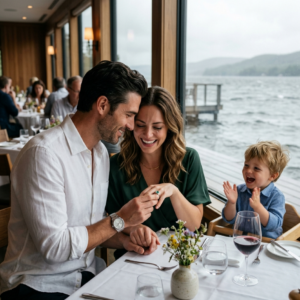
Six months after the violent attack, the three of us sat at our favorite upscale restaurant by the lake. Noah excitedly produced a small, awkwardly wrapped box. Inside was a stunning, square-cut emerald ring surrounded by brilliant diamonds. Adrien explained softly that Noah had insisted on the emerald because it perfectly matched the color of my eyes. He asked me to be his wife, to permanently join his complicated, beautiful family. I said yes with tears streaming down my face.
Seven months later, on a crisp Tuesday afternoon, I found myself driving my SUV to pick up Adrien from his new, legitimate downtown office. Noah sat happily in the back seat, singing a delightfully off-key song about sharks. I stopped at a red light and looked down at my left hand resting casually on the leather steering wheel. The brilliant emerald caught the bright afternoon sun.
I had chosen this complicated life with wide-open eyes. The dangerous, handsome man waiting in the expensive office, and the tiny human loudly singing behind me—they were mine, and I was entirely theirs.
The Beautiful Chaos of Choosing Our Own Family
The human experience is rarely a pristine, linear journey from safety to safety. Sometimes, the most profound love stories are not born in the quiet corners of coffee shops or the orchestrated romance of a blind date; they are forged in the terrifying, chaotic crucible of split-second decisions and burning wreckage. Lauren Mitchell’s journey from a solitary, exhausted paramedic to the fiercely protective matriarch of an underworld dynasty is a testament to the unpredictable nature of belonging.
We often believe that safety is the ultimate goal of existence, that isolating ourselves from the sharp edges of the world is the only way to survive our own private grief. But isolation is merely a different kind of burning. True salvation comes when we cross the barricade, when we reach into the flames for someone else, entirely unaware that their hands will eventually pull us from our own darkness. Family is not always defined by blood or conventional morality. Sometimes, family is the person who holds your hand in the dark, the child who draws you a halo with a crayon, and the terrifying, beautiful realization that you would risk everything to keep them safe.
Have you ever made a split-second decision that fundamentally altered the trajectory of your entire life? Have you ever found your truest family in the most unexpected, chaotic places? Share your powerful stories of unconventional love and resilience in the comments below.
Disclaimer : This content may be created by AI for entertainment purposes. Any resemblance to real persons, events, or places is coincidental.






