How a Vow of Protection Rebuilt a Shattered Life
The air inside the Velvet Lounge always tasted of stale bourbon, cracked vinyl upholstery, and the desperate hopes of transients who came to Miami to forget. For three years, that suffocating atmosphere had been my sanctuary. I was Jessica Turner—a bartender with a steady pour, an unassuming smile, and a past that did not exist. That was the bargain I had struck at nineteen. I traded my identity, my dreams of architecture, and my freedom for a promise of invisibility. Agent Harris of the Federal Bureau of Investigation had looked me in the eyes and promised that if I testified against Viktor Volkov, I would vanish. I was supposed to be a ghost.
But ghosts, I was about to learn, are only invisible until the monsters learn how to see in the dark.
The illusion of my safety began to fracture on a humid Tuesday afternoon. The telephone line crackled with static, a sound that would forever be etched into the architecture of my nightmares. Agent Harris’s voice, usually a steady anchor in the turbulent waters of my witness protection protocol, was clipped and hurried. He spoke of a transfer, of budget restructuring, of a new contact who would reach out within forty-eight hours. Then, the line went dead. The silence that followed was not empty; it was heavy, pregnant with a warning I was too terrified to fully decipher. When the emergency numbers yielded only disconnected tones and full voicemail boxes days later, the quiet hum of survival instinct—the same instinct that had kept me breathing when I saw Viktor Volkov execute a man in a Chicago alley eight years prior—began to scream.
The Storm and the Stranger
The signs of an encroaching predator are rarely cinematic explosions; they are micro-moments of wrongness that accumulate like dust. A black sedan idling for two consecutive nights beneath the flickering streetlamp outside my apartment. A man in the grocery store meticulously studying canned goods without ever placing an item in his basket. The prickling sensation across the nape of my neck during my walk home, prompting me to circle blocks and slip through side entrances. I was a woman holding her breath, waiting for the axe to fall.
Then came the Friday night that shifted the tectonic plates of my existence. The Velvet Lounge was being sold. Marco, the owner whose Greek accent usually carried warmth, announced his departure to a cramped room of employees. A New York investment group was taking over, and their representative was coming to inspect the acquisition. In my world, new ownership meant new scrutiny. It meant visibility.
That evening, Miami delivered a torrential performance. Thunder reverberated through the very foundation of the building, and rain washed the streets clean, deterring all but the most dedicated patrons. I was systematically wiping down the mahogany bar, finding solace in the rhythmic, circular motion, when the heavy oak door swung open.
He walked in, and the atmospheric pressure of the room irrevocably altered.
He was easily over six feet tall, possessing a physical architecture that commanded immediate authority. His dark hair was swept back, wet from the tempest outside, and his charcoal suit draped over broad shoulders with bespoke precision. This was not a man who accidentally wandered into a dive bar to escape the rain. He scanned the dim room with the clinical, surgical precision of a predator cataloging exits, threats, and assets. Then, his dark eyes locked onto me. The assessment lasted exactly three seconds, but beneath the weight of his focus, I felt entirely dismantled.
“Whiskey,” he commanded, his voice a low, resonant baritone layered with a controlled Italian accent. “Neat. Whatever you’d recommend.”
I poured Jameson into a rocks glass, the clink of the ice feeling disproportionately loud in the quiet room. When he slid a crisp hundred-dollar bill across the varnished wood and told me to keep it, the quiet warning bells in my mind crescendoed. He introduced himself as Gabriel Fioraldi. His handshake was firm, radiating a startling warmth, and it lingered for a microsecond too long. In that fleeting contact, I felt the rough calluses on his palm—calluses that contradicted the immaculate tailoring of his suit. He was a man of wealth, but he was also a man who knew violence.
Over the next week, Gabriel became a fixture in the corner booth. He did not drink to excess; he nursed a single glass of whiskey and watched me. He did not watch me with the lecherous intent of the late-night clientele. He watched me as if I were a complex equation he was determined to solve. He noticed my tactical positioning, the way I reflexively guarded my back against the wall, the way I evaluated every soul who crossed the threshold within seconds of their arrival.
“You move differently when you think no one’s watching,” he told me late one night, the space between us charged with an electricity I had spent years avoiding. “You read people like someone who’s been professionally taught threat assessment. Military? Law enforcement? Or witness protection?”
The blade of his intuition sliced cleanly through my carefully constructed facade. I gripped a glass bottle beneath the bar, my knuckles bone-white, ready to fight for a life I barely even wanted anymore. But Gabriel did not strike. He merely offered a warning that Miami was not as safe as people pretended, leaving me alone in the shadows of my own paranoia.
The Velvet Box and the Ultimatum
The absolute collapse of my reality occurred on a Thursday night. The bar was empty, the rain had reduced to a persistent, melancholic drizzle, and Gabriel was waiting under the exterior overhang. I stepped out into the muggy air, my body rigid, my threat-response systems flaring.
Gabriel raised a hand, a gesture of peace that did nothing to lower my heart rate. “Viktor Volkov escaped from federal custody four weeks ago,” he stated.
The words did not just register; they detonated. I gripped the wet brick of the doorframe to keep from collapsing onto the pavement. Gabriel’s voice remained clinically calm as he delivered the devastation: Viktor had already slaughtered two witnesses. Agent Harris, the man who had promised me a boring, unremarkable life, had been murdered three weeks ago—a bullet to the head in his car—after trying to warn me. The disconnected phone lines suddenly made horrifying, bloody sense.
Gabriel Fioraldi, the enigmatic new owner of a dive bar, had not stumbled upon me by chance. He had been tracking me for eight months. The man whose murder I had witnessed at nineteen—Paolo Russo—was Gabriel’s half-brother.
“I need to leave. Now. Tonight,” I whispered, the desperate instinct of the hunted taking over.
But Gabriel stepped closer, his physical presence forming a barrier between me and the night. Running, he explained, was exactly what Viktor anticipated. Viktor had the resources of a global syndicate. But Gabriel had something more potent. He reached into the inner pocket of his charcoal jacket and produced a small, velvet box. He opened it under the dim glow of the streetlamp to reveal a simple, unadorned gold band.
“Marry me,” he said.
The proposition was pure madness. It was medieval. He was offering to cloak me in the absolute, untouchable protection of a mafia alliance. In his father’s world, marriage was a sacred contract. Striking the wife of a Fioraldi meant declaring war on an empire far vastly more powerful than Viktor’s freelance operations. Gabriel was not asking for romance or love. He was offering a strategic alliance, a shield forged in gold and blood.
The true terror, however, arrived the next morning. After Gabriel had driven me home and established a perimeter guard, I sat awake in my apartment, bathed in the harsh glow of my laptop screen, reading the gruesome details of Viktor’s recent kills. As dawn broke, filtering a sickly grey light through the blinds, I found it. Slipped quietly beneath my front door was a white envelope. Inside was a photograph of my nineteen-year-old self, taken on the steps of the Chicago courthouse. A thick, red ‘X’ was drawn violently over my face.
Viktor had been there. While I was inside, agonizing over Gabriel’s proposition, the monster who haunted my dreams had been standing inches away, separated only by a flimsy wooden door. He did not kill me because he wanted me to marinate in my own terror.
I dialed Gabriel’s number with trembling, icy fingers. His response was immediate and absolute. Within three minutes, I was sprinting through the humid morning air to a waiting black SUV. Vincent, Gabriel’s head of security—a man built like a weathered boxer with a scarred eyebrow and piercing eyes—drove me to a secure hotel suite in Coral Gables. I left everything behind. Jessica Turner’s life was officially over.
Vows Exchanged in the Shadows
The transition from a hunted bartender to a mafia wife took exactly seven minutes.
At two o’clock that afternoon, dressed in a conservative navy dress that Vincent had meticulously procured, I stood in a sterile courthouse side-room. The judge, a woman whose face was etched with deep boredom, droned through the legal requirements of matrimony. There were no flowers, no sweeping orchestral music, no joyful tears. There was only the heavy, suffocating reality of survival.
“Do you, Gabriel Luciano Fioraldi, take this woman to be your lawfully wedded wife?”
“I do,” Gabriel answered. There was no hesitation in his voice, no tremor of doubt. He looked at me with an intensity that anchored me to the floorboards.
When it was my turn, I looked up at the man who represented everything I had spent eight years running from. He was dangerous, connected to the criminal underworld, an architect of shadows. Yet, he was the only source of light in my rapidly darkening world. “I do,” I whispered.
Gabriel slid the warm gold band onto my finger. The metal felt heavy, a physical manifestation of a contract that bound my life to his. His lips brushed mine in a brief, chaste kiss that tasted of solemn promises rather than passion.
By three o’clock, I was escorted into his penthouse—an expansive, breathtaking sanctuary encompassing the entire twenty-third floor overlooking Biscayne Bay. Floor-to-ceiling bulletproof windows framed the turquoise waters, bathing the understated, luxurious furniture in natural light. But what struck me most was not the wealth; it was the care. In my private bedroom, folded meticulously over a designer chair, was my grandmother’s quilt. My small collection of books had been arranged on a shelf. Gabriel had ordered his team to retrieve the fragments of my soul that mattered.
“You’re my wife now. Your comfort matters,” he told me, standing in the doorway, respecting my space. He offered me safety—actual, impenetrable safety—and asked for nothing but my cooperation in return.
Over the next three weeks, a delicate, complex choreography developed between us. We were two strangers bound by trauma and necessity, navigating the quiet spaces of the massive penthouse. I learned the sharp angles of his routine: his early morning espresso, his rapid-fire Italian phone calls, the exhaustion that lined his eyes when he returned late at night. I began to make his coffee. I took on legitimate freelance design work he sourced for me. We shared dinners, the silence transforming from a chasm of awkwardness into a bridge of quiet companionship.
One evening, bathed in the silver light of the moon reflecting off the bay, Gabriel asked me about my past. Not the trauma, but the dreams. I confessed my lost love for architecture—how I had wanted to design buildings that manipulated light and human psychology before witness protection stripped away my academic credentials.
Gabriel did not offer pity. He offered a future. He pulled up blueprints of a dilapidated commercial property he had recently acquired and asked for my vision. We spent nights spread across the dining table, sketching redesigns, debating structural flows and atrium light. In those late-night hours, sketching alongside a man who carried the weight of a criminal empire, I felt a piece of my dead soul reignite. He was not just protecting my physical body; he was painstakingly resurrecting my spirit.
The Bait and the Ballroom
The fragile peace shattered on a Thursday morning. A video file arrived on my encrypted phone from an unknown sender. My breath seized as I pressed play. It was grainy footage of Gabriel and me walking out of his building, recorded from an elevated vantage point across the street. The video cut to black with a simple, horrifying message: I know where you sleep, little witness. Protection means nothing when I’m patient.
Viktor had breached the perimeter. He was observing us, calculating weaknesses, waiting for the perfect angle.
When I barged into Gabriel’s office and showed him the footage, the controlled businessman vanished, replaced instantly by the lethal scion of the Fioraldi family. He ordered an immediate lockdown, a total restriction of my movement. But I had spent eight years being a passive victim, a piece of cargo shuttled between safe houses. I refused to cede control again.
“I know Viktor,” I pleaded, standing my ground. “I watched him kill. I studied his mannerisms during the trial. Let me help identify his patterns.”
Gabriel weighed the risk, his dark eyes analyzing my determination. He agreed, under the strict condition of absolute compliance with his security protocols. Together, we poured over Vincent’s intelligence files. I pointed out the tells—the specific tilt of Viktor’s head when calculating risk, his preference for hiring disposable local contractors whose posture gave away their lack of professional polish. We became a tactical unit, true partners in a war for my life.
The breakthrough occurred days later. Vincent’s team tracked a local contractor to a warehouse in Doral, confirming Viktor’s presence. But to authorize a flawless FBI raid, they needed to draw him out, to force him to commit his resources.
The battleground was chosen: a high-profile charity gala at the legendary Fontainebleau Hotel on a Saturday night. I was to be the bait.
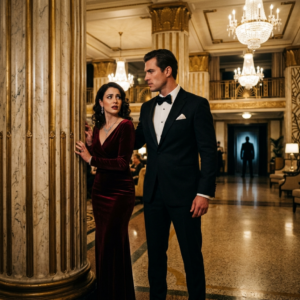
Vincent drilled me relentlessly on evacuation routes, hand signals, and threat responses. When Saturday arrived, I was transformed. I wore a deep, wine-red dress that Gabriel had selected—a garment that moved like liquid and demanded attention without vulnerability. When Gabriel saw me, the air between us thickened, heavy with an admission we had made the night before. We had confessed our feelings. This strategic marriage had mutated into a profound, terrifyingly real love.
“You’re beautiful,” he whispered, his eyes dark with a possessive, tender fear. “Let’s go end this.”
The Fontainebleau ballroom was a masterpiece of Art Deco glamour, glittering with crystal chandeliers and the elite of Miami society. I moved through the crowd with Gabriel’s hand securely at the small of my back, smiling politely, playing the radiant wife, while my eyes systematically scanned the room with a predator’s focus.
Two hours in, I spotted the anomaly. A man near the north entrance, his stance too rigid, his eyes tracking us rather than the event. I tapped my bracelet twice. Vincent’s voice crackled in my invisible earpiece, confirming the target. As the man departed, Gabriel’s security team seamlessly shadowed him.
But my instincts screamed. It was too easy. Viktor Volkov did not make obvious mistakes.
“Gabriel,” I murmured urgently, leaning into him. “That was a decoy. Misdirection.”
Gabriel’s realization was instantaneous. He ordered an immediate evacuation. We moved toward the exit, flanked by Vincent and the security detail in a flawless diamond formation. We were mere yards from the valet station when the air turned to ice.
Standing perfectly still, watching our approach with the patient, cold certainty of a reaper, was Viktor Volkov. He was older, his features weathered, a thin scar visible above his collar. We were twenty feet apart. Eight years of running culminated in this singular, breathless confrontation.
Vincent shoved me violently behind a decorative marble column just as Gabriel positioned his body as a human shield between the assassin and myself. The security perimeter collapsed inward, a lethal net snapping shut. Viktor assessed the overwhelming tactical disadvantage. Shooting me in a heavily guarded hotel lobby meant his immediate death.
He didn’t draw a weapon. Instead, he looked directly into my eyes, offered that same chilling, sociopathic smile from the Chicago alley, and calmly turned away, walking toward the exit. He believed he could simply retreat and try again. He did not know that his retreat was exactly what Gabriel had planned.
The Fall of the Architect of Fear
The aftermath was a blur of tactical precision. We sped back to the penthouse, the silence in the SUV thick with residual adrenaline. Gabriel’s office transformed into a war room. Vincent monitored the tracker placed on Viktor’s support vehicle, confirming his return to the Doral warehouse.
Agent Martinez of the FBI—a woman vetted and proven uncorrupted—arrived at midnight. Gabriel handed over the intelligence, willingly surrendering control of the final strike to ensure the arrest was clean, legal, and permanent.
We sat in the dimly lit living room, the city of Miami glittering below us, waiting for the ghost to be exorcised. At two in the morning, Vincent received the confirmation. The FBI tactical team had breached the warehouse. Viktor Volkov, surrounded and outmaneuvered, surrendered without a fight. The evidence collected at the scene, including detailed surveillance files on me, guaranteed he would spend the remainder of his natural life in a maximum-security federal facility.
The threat was neutralized. The monster was caged.
When dawn broke, casting a brilliant, hopeful light across Biscayne Bay, Gabriel held me. He offered me the ultimate choice. The strategic necessity of our marriage had evaporated. He offered to facilitate an annulment, to fund a completely safe, independent life for me anywhere in the world. He gave me the freedom I had been denied at nineteen.
I looked at the man who had stalked the shadows to keep me in the light. “I choose you,” I told him, pressing my hands to his face. “Not because you’re the safe option, but because you’ve become the person I can’t imagine navigating life without. I love you, Gabriel.”
His fierce, tender kiss sealed a vow that was no longer about survival, but about a shared, brilliant future.
Deep Reflection: The Blueprint of a Chosen Life
The human spirit is not designed to merely survive; it is architected to thrive. For eight years, Jessica Turner existed as a ghost, a sketch of a person hiding in the margins of society. She believed that safety required isolation, that letting anyone close was an invitation to tragedy. But true safety is never found in running away; it is found in planting your feet, facing the darkness, and allowing yourself to trust.
Gabriel and Jessica’s story is a profound testament to the unpredictable nature of salvation. Help often arrives in the garments we fear most. By choosing to step out of the shadows, by weaponizing her trauma to outsmart her abuser, Jessica reclaimed her agency. The transition from a marriage of strategic convenience to a partnership of profound love proves that even in the most sterile, terrifying circumstances, the human heart will reach for connection. They did not just survive the storm; they learned how to build a fortress together in the rain.
Have you ever had to face a fear you spent years running from? How did finding the courage to turn and fight change your life? Share your stories of resilience and unexpected partnerships in the comments below.
Disclaimer : This content may be created by AI for entertainment purposes. Any resemblance to real persons, events, or places is coincidental.






