The Cardinal Rule and the Leaking Heart
I was standing in the absolute center of the nursery on the forbidden third floor, my entire body pulled rigid with a primal, paralyzing fear. The ambient air of the room was climate-controlled to a perfect, sterile warmth, yet a violent shiver rattled through my bones. My cheap, unyielding gray uniform was plastered uncomfortably to my skin, a physical manifestation of my profound failure. Two dark, wet circles were spreading rapidly across my chest, an agonizingly visible and humiliating physical leak of the immense grief I carried every waking second. It was the milk my body stubbornly insisted on making, the biological nourishment my own daughter, Nova, would never have the chance to drink. In my arms, little Nico Belandi was latched to me. His tiny, desperate mouth worked with a fervent, frantic energy that had systematically shattered my heart into dust. His thin, agonizing wails, which had echoed through the cavernous mansion for six uninterrupted hours, had finally softened into a fragile quiet. The only sounds remaining in the vast space were his gasping grunts and the wet, rhythmic sound of a starving infant finally swallowing life-saving nourishment.
Then, the heavy walnut door was thrown open. It crashed against the interior wall with a concussive boom that sounded exactly like a gunshot in the hushed environment. I flinched violently, pulling Nico tighter against my damp chest, my maternal instinct overriding my terror. Luca Belandi stood perfectly framed in the doorway, a terrifying storm of tightly controlled fury. He was the youngest mafia boss in the blood-soaked history of Chicago, a man whose name was only ever whispered in the city’s darkest shadows. And he was staring directly at his lowly housemaid, the invisible woman who scrubbed his marble floors, who had just brazenly broken his ultimate cardinal rule. His eyes were not merely dark; they were fathomless, resembling polished obsidian knives that promised immediate violence. He was impeccably dressed in a pitch-black, custom-tailored suit that seemed to physically absorb all the ambient light in the nursery, making the soft, imported pearl-gray paint on the walls look cheap and washed out.
Behind him loomed two bodyguards, men who resembled mountains of muscle and malice, their sudden presence instantly sucking the breathable oxygen from the room. One of them, a hulking man possessing a thick, bullish neck and a cruel, pale scar jaggedly running across his jawline, lunged aggressively forward. His massive hand vanished completely inside his dark suit jacket, reaching for cold steel. His voice was a guttural growl, thick with disbelief and lethal rage, demanding to know what I was doing. The words tore out of my own throat before my brain could stop them. They were raw, shaking with absolute terror, yet they carried the undeniable, absolute authority of a mother protecting a child. I commanded the scarred man not to move, warning him that his violence would terrify the baby. The scarred mountain of a man froze instantly, his eyes wide with shock at my audacity.
Luca Belandi did not shift his stance, but he lifted one perfectly manicured, powerful hand barely a single inch. It was a microscopic movement, yet it was more than enough. The scarred guard stepped back immediately, his face contorting into a mask of profound confusion. Inside my chest, my heart was a desperate, trapped bird, beating against my fragile ribs with such traumatic force I genuinely believed it might break through the bone. I knew exactly what this meant. I was a twenty-seven-year-old, deeply indebted widow from the impoverished South Side of Chicago. Being violently fired and thrown onto the street was the absolute best-case scenario. People who actively crossed Luca Belandi, individuals who dared to invade his private, heavily guarded, and forbidden spaces, did not just lose their jobs. They usually just disappeared into the dark, churning waters of Lake Michigan.
The Ghost in the Gray Uniform
My presence in this opulent nightmare felt like a lifetime ago, though the calendar dictated it had only been a few grueling months. My descent into this world started, as everything truly terrible and life-altering in my existence seemed to, with money—or, more precisely, the suffocating, desperate lack of it. The medical bills from Nova’s prolonged, agonizing hospitalization had become an insurmountable mountain of sterile, white, aggressively printed paper that had effectively buried me alive. They were stacked precariously high on my tiny, peeling kitchen table in my drafty South Side apartment, radiating the sharp, chemical smell of printer ink and impossible, terrifying numbers. Tens of thousands of dollars stared back at me, a constant reminder that the American medical system harbors absolutely no empathy for human grief; it operates strictly on cold, hard payment schedules. I had been working myself to the bone, holding down two exhausting jobs, scrubbing floors in a soulless downtown office building by night and serving bitter, scalding coffee to impatient commuters by day, and yet I was still violently drowning in debt.
It was in this desperate state that I heard about the Belandi job. A friend of a friend possessed a fleeting connection to an underground domestic staffing agency. She had leaned in close, her eyes wide with a thrilling, genuine fear, whispering that they paid entirely in untraceable cash. She warned me that the money was incredibly lucrative, but the cost was complete sensory deprivation: I must see nothing, I must hear nothing. It was exceptional pay strictly exchanged for exceptional, unbreakable silence. In my hollowed-out state of mourning, I frankly did not care if I was sweeping the soot from the devil’s personal hearth. I desperately needed that cash. I needed to bury those suffocating hospital bills with the same finality that I had been forced to bury my infant daughter.
My initial interview was entirely devoid of Luca Belandi. Powerful, dangerous men of his immense stature do not conduct mundane interviews with the household cleaning staff. Instead, I met Matteo. He was the Consigliere, the chief adviser and strategic mind behind the empire, although I remained entirely ignorant of that specific, lethal mafia terminology at the time. He was chillingly polite, impeccably dressed in a charcoal suit that undoubtedly cost more than the unreliable car I drove to get there. Matteo looked at me with eyes that lacked any recognizable human warmth; they were high-tech scanners, meticulously measuring my net worth, my absolute reliability, and my potential for catastrophic trouble. He asked me virtually nothing about my floor-scrubbing techniques. Instead, his inquiries were deeply personal and probing. He asked if I had any surviving family located in Chicago. I answered truthfully, staring blankly at his polished mahogany desk, telling him no, not anymore. He then asked, his voice smooth and unyielding, if I was reliable. I looked up into those scanner eyes and told him the ultimate truth: I was completely, utterly desperate. He must have recognized the immense, controllable value in a woman with nothing left to lose. He hired me instantly.
Matteo personally conducted the initial tour of the first two sprawling floors of the mansion, his incredibly expensive, polished leather shoes making absolutely no sound as he glided across the imported Italian marble. He concluded the brief, strictly geographical orientation in the massive, echoing, intimidatingly grand main hall. His voice was as smooth and final as a polished gravestone when he outlined my exact territorial boundaries. He raised a long, impeccably manicured finger, pointing it deliberately toward the grand, sweeping, cinematic staircase that spiraled upward into the heavily shadowed upper levels of the fortress. He issued a command that was not a mere professional suggestion, but a terrifying edict. Under no circumstances whatsoever was I permitted to ascend to the third floor.
The Architecture of Silence and Pain
I quickly learned that the Belandi mansion was not merely a structure of wood, stone, and glass; the house itself functioned as a brooding, intimidating character in my daily existence. It felt significantly less like a human home and entirely more like a beautiful, unimaginably cold, and impenetrable fortress strategically perched right on the jagged edge of Lake Michigan. The entire rear wall of the expansive main living area was constructed of massive, seamless panes of reinforced glass, stretching dramatically from the polished hardwood floor to the soaring twenty-foot ceiling. This transparent barrier offered a breathtaking, yet terrifyingly exposed, view of the vast, churning, violently unpredictable expanse of gray and green water. It was undeniably stunning, capturing the brutal beauty of the elements, but standing before it left me feeling entirely vulnerable, as if the lake itself might reach through and drag me down.
During one of my solitary late-night cleaning shifts, I accidentally glimpsed highly classified security diagrams carelessly left out on a heavy oak desk while the systems were undergoing a routine digital check. The intricate map of the sprawling property was densely covered in intersecting red and blue lines indicating high-definition cameras, motion sensors, and complex tactical escape routes. My eyes were immediately drawn to a prominent, thick, steel-lined rectangular box drawn precisely on the forbidden third floor, situated intimately near the nursery wing. It was clearly marked as a reinforced safe room, a chilling architectural detail that sent a profound, freezing shudder right down my spine, reminding me exactly what kind of violent men I was working for.
Luca Belandi himself existed in my daily routine as an elusive, terrifying ghost. For the first several grueling weeks of my employment, I only ever encountered the physical evidence of his existence, the lingering, potent traces he left behind in the silent wake of his nights. I would meticulously dust and polish his massive, dark-wood, intimidating study late at night, hours after he had abandoned it for sleep or business. The heavy air inside the room would still be incredibly thick with the distinct, expensive, aromatic smell of his imported cigars, intertwining with the sharp, acidic, bitter aroma of freshly brewed, strong espresso. He possessed a rigid, specific habit; he always left one small, delicate white porcelain cup resting exactly in the center of his massive desk, completely drained, leaving only a dark, granular sludge sitting at the bottom.
Occasionally, usually when the hour had grown exceptionally late and the entire mansion was swallowed by a heavy, oppressive silence, I would be on my hands and knees finishing the downstairs marble floors, and I would hear the sudden, haunting notes of the grand piano. It was never a complete, joyful song. It consisted solely of fractured, emotional fragments. Sometimes, he played dark, furiously angry, dissonant chords that possessed such immense power they literally seemed to violently shake the solid walls around me. Other nights, the music shifted into a high, incredibly thin, delicate melody that was so achingly, profoundly sad that it made the center of my own chest physically hurt in sympathy.
The Biological Betrayal and the Midnight Miracle
Then there was the matter of my own deeply private, intensely humiliating, biological hell. It is a profoundly cruel, unfeeling joke perpetrated by human biology. The grief I experienced for Nova was incredibly sharp, deeply mental, and existed as a constant, burning ache localized entirely in my soul. But my physical body operated independently, entirely on its own stupid, stubborn, biological schedule. Every cell within me still fiercely believed I was a nursing mother. I would be scrubbing a tile floor with harsh chemicals or carefully washing delicate, imported crystal glasses in the vast kitchen, and without warning, I would feel the familiar, deeply unwelcome, electrical tingling sensation. This would be immediately followed by the sudden, heavy, hot rush of milk descending into my breasts. Panic would seize me, forcing me to drop whatever cleaning implement I held and sprint frantically down the long hallway to the tiny, cramped staff bathroom. There, I would stare into the cheap mirror, my uniform visibly soaked, tears composed of pure, unadulterated humiliation and helpless rage furiously stinging my eyes. I was leaking a miracle into the sterile sink. I was uselessly wasting the exact, precious nourishment that my Nova had desperately needed to survive.
This agonizing biological torture coincided with the terrifying whispers surrounding the new Belandi heir, little Nico. The entire sprawling mansion had been placed on an even higher, more suffocating level of alert since his birth. The heavily armed perimeter guards grew visibly more tense, their hands resting closer to their holstered weapons. The hushed, frightened whispers among the staff had begun precisely two weeks ago. The infant was sick. It was not merely the standard, exhausting fussiness of a newborn; it was a dangerous, life-threatening sickness. I repeatedly witnessed Dr. Patel, the highly esteemed, incredibly expensive private pediatrician, rushing frantically in and out of the heavy front doors. He was a deeply educated man of modern science, yet his face grew tighter, paler, and more deeply etched with profound frustration after every single agonizing visit. He was clearly, undeniably losing this battle for the infant’s life.
The culmination of this nightmare was today’s crying. It had commenced in the morning, around ten o’clock, initially sounding like a normal, demanding cry from a fussy newborn. However, the sound did not taper off. It relentlessly escalated in volume and intensity. By noon, the cry had transformed into a thin, vibrating, panicked shriek that seemed to effortlessly cut right through the incredibly thick, soundproofed walls of the mansion. By four o’clock in the afternoon, the horrific noise no longer even resembled a human sound. It resonated exactly like a small, helpless animal caught agonizingly in the jagged teeth of a steel trap. It was the raw, unending, horrifying sound of pure, unadulterated physical agony. I was currently stationed on my hands and knees in the massive kitchen, furiously scrubbing the stained grout between the expensive floor tiles, attempting to drown out the noise with physical labor. The entire three-story fortress of glass and stone was literally vibrating with this one, tiny, tortured sound. He had been screaming without a single pause for six solid hours.
I simply could not endure the psychological torture for one more second. I stood up abruptly, my legs shaking violently beneath me, abandoning my scrub brush in the soapy water. I walked out of the kitchen, my heart pounding a frantic, deafening drumbeat directly against my ribs. I systematically bypassed Matteo in the grand main hall, ignoring his physical attempt to block my path and his smooth, threatening voice ordering me back to my mundane duties. I forcefully pushed directly past his tailored arm, utilizing a mother’s fierce adrenaline. I ascended the grand, forbidden staircase, taking the steps two at a time, my cheap, rubber-soled shoes remaining entirely silent on the thick, luxurious carpet runner.
I reached the heavy nursery door. The professional nurse currently on duty was huddled pathetically in the far corner of the opulent room, her hands clamped desperately over her ears, her entire body shaking as she sobbed uncontrollably. Nico was lying in his custom-built, polished walnut crib, his tiny face a terrifying, deeply unnatural shade of purple-red. His small limbs were entirely rigid with pain, and his mouth was stretched open in a horrifying, unending, silent shriek because he possessed absolutely no air left in his fragile lungs to vocalize the sound. I did not experience a single microsecond of hesitation. I leaned over the rich wood and scooped his rigid, feverish body into my arms. His skin was alarmingly hot, deeply damp with a terrified sweat. I sat heavily in the plush, velvet rocking chair situated in the corner, unbuttoned the top of my restrictive, cheap gray uniform, and instinctively performed the only life-saving action my leaking, grieving body could provide.
The Shift in Power and the Silence That Followed
This profoundly desperate act of defiance brought me back to the current, suffocating reality of Luca Belandi staring down at me, his son quietly nursing at my breast. Luca moved with the terrifying, entirely silent grace of a seasoned apex predator. He reached back smoothly, his intense, calculating gaze absolutely never leaving my face for a fraction of a second, and quietly, deliberately pushed the heavy nursery door closed. The heavy metal latch clicked shut with a sharp, definitive sound of finality that effectively sealed the three of us together inside the room. The mountainous guards were instantly gone, their aggressive presence erased. The physical dimensions of the massive room felt as though they rapidly shrank around us. The silence that instantly followed the closing of the door was immense and terrifying. It was heavy, highly electric, possessing the exact suffocating, pressurized quiet that exists deep in the ocean precisely one second before something massive, violent, and unseen attacks.
He completely avoided looking at my face. Instead, his dark eyes were intensely fixed upon the exact junction where his tiny, fragile son was actively feeding, directly where my soaked, cheap uniform was bunched uncomfortably against my skin. His strong jawline and aristocratic features were completely unreadable, looking as though they had been coldly carved from hard, unforgiving Italian marble. When he finally chose to speak, his voice was not a loud, commanding shout. It was infinitely worse. It was a deeply textured, incredibly low whisper, a terrifying rumble completely full of tightly controlled, lethal violence that I physically felt vibrate deep inside my very bones. He demanded to know if I understood the absolute gravity of what I was doing.
I forced myself to hold his terrifying gaze. I was shaking with terror, yet I was also fundamentally, undeniably right. In this one specific, microscopic moment in time, my maternal certainty was vastly greater than his immense criminal power. I stated clearly, my voice finally cutting perfectly through the expensive, heavy air of the nursery, that I was saving his son. I watched intently as the tightly coiled muscles in his square jaw worked in a tiny, furious, rhythmic motion. The man was actively, visibly at war with his own internal identity. I could literally see the violent, internal collision: the ruthless mafia boss demanding absolute obedience, the terrified, exhausted father desperate for a solution, the man of unyielding, ironclad rules directly witnessing a chaotic, beautiful biological miracle unfold before his eyes.
The tense, heavy silence aggressively stretched out again, filling the corners of the room, and this time, I intuitively understood that I had to be the one to bridge the gap. The absolute, unvarnished truth was the only viable currency I possessed left to spend in this dangerous transaction. I confessed my name, Aisha Monroe. The words rushed frantically out of my dry mouth, tumbling chaotically over each other. I explained my age, my impoverished background on the South Side, and then I was forced to take a deep, jagged breath. The next part felt exactly like attempting to physically swallow broken glass. I confessed the agonizing truth about my daughter, Nova, and her passing four months prior. I looked down at his sleeping child, feeling his rhythmic breathing, and admitted that my body had stubbornly refused to stop producing milk. It was not a calculated explanation; it was a raw, deeply personal confession of my own tragedy.
Luca Belandi stared at me intensely for a duration of time that felt equivalent to a full, agonizing calendar year. The sheer, mathematical calculation visible in his dark eyes was entirely cold and profoundly terrifying. He was actively, mentally reassessing the entire geopolitical landscape of his household. He was deliberately choosing to no longer view me as the invisible, disposable help who scrubbed the dirt from his toilets. He was actively calculating my new existence as something vastly more complex: a medical asset, a potential security threat, a deeply dangerous, undeniable biological necessity for the survival of his bloodline. He finally asked me, his voice stripped completely bare of all its previous menace, entirely raw and exhausted, what exactly I wanted in exchange for this miracle.
He fully expected a massive, greedy price tag. In his violent world, everyone wanted money, armed protection, a brand-new luxury car, a deed to a house. He fully expected me to ruthlessly leverage this deeply vulnerable moment for my own maximum financial gain. I simply shook my head, executing a small, incredibly tired, defeated movement. I looked directly down at his child, watching the baby’s tiny chest rising and falling in a steady, beautifully healthy rhythm. I whispered the purest, most profound truth I had ever vocalized: I wanted absolutely nothing, only for the child to no longer experience agony. That profound, selfless answer completely shattered the pressurized tension in the room, the emotional impact landing exactly like a heavy stone violently thrown into a perfectly silent, still pond. Luca broke a lifetime of ironclad, violent rules, giving one sharp, decisive nod, and commanded me in a gravelly whisper to continue. As the heavy door softly clicked shut behind him, the paralyzing terror began to slowly fade away, rapidly replaced by a strange, humming, terrifying clarity. Sitting in that opulent, pearl-gray nursery, holding a mafia boss’s sleeping son, I knew with absolute, unshakable certainty that both of our lives had just been violently, permanently altered forever.
The Threat of the Syndicate and the Detective in the Crowd
My impulsive, life-saving actions fundamentally rewrote the architecture of my existence. I was rapidly moved from the damp, oppressive basement quarters into an expansive, luxurious guest suite situated directly on the forbidden third floor. My cheap gray uniform was permanently discarded, replaced by soft, exceptionally expensive cotton clothing specifically provided for my ultimate comfort. I was no longer an invisible housemaid; I had seamlessly transitioned into a highly valued prisoner, an absolute necessity, a living, breathing medical prescription carefully measured out in strict three-hour increments. I meticulously maintained a small, simple clinical notebook, documenting every single feeding, exactly as I had obsessively done for my lost Nova. It was a desperately needed, clinical detachment that effectively prevented my immense grief from entirely swallowing me whole in the quiet, isolated bubble of the nursery.
However, while the mansion had descended into a peaceful quiet, the ruthless world spinning aggressively outside the fortified walls had not. The vicious paparazzi and dangerous underground gossip blogs had been aggressively sniffing around the highly fortified Belandi compound ever since the tragic, sudden death of Isabella and the highly anticipated birth of the fragile heir. The sudden, absolute silence emanating from the estate was now viewed as being infinitely more suspicious than the constant stream of medical ambulances had been. Cruel, anonymous whispers began to aggressively circulate online on the darkest, most vile corners of the internet. Horrifying headlines speculated about the baby’s weakness, suggesting that rival crime syndicates were taking strategic note of Luca’s distraction.
The true, lethal danger materialized directly inside the fortress walls. One afternoon, while retrieving my clinical notebook, I discovered a small, terrifyingly specific, folded piece of paper deliberately placed upon my neatly folded laundry. It consisted of just four chilling words, meticulously cut from random magazine letters and pasted onto blank cardstock: “Stay off the third floor.” My blood instantly ran freezing cold, turning to absolute ice in my veins. This terrifying message did not originate from the rival Rinaldi syndicate lurking outside. This was a direct, localized threat from an internal, unknown enemy—someone with unfettered physical access to my private, secure suite. Someone deeply entrenched within the household violently hated exactly what I had rapidly become.
The external pressure compounded exponentially when I was granted a brief, heavily guarded reprieve to visit the Lincoln Square Farmers Market, escorted by a silent, massive guard named Leo. Amidst the overwhelming blast of colorful noise, the vibrant scent of fresh peaches, and the damp, earthy aroma of vegetables, a plain, mousy woman deliberately bumped forcefully into my shoulder. As I attempted to stabilize myself, her hand clamped onto my arm with a surprisingly aggressive, iron grip. She leaned in, her voice low, urgent, and terrifyingly clear, identifying herself as Detective Aaron Walsh of the Chicago Police Department’s Human Trafficking Unit. She vehemently accused the Rinaldi syndicate of moving trafficked humans through the ports, directly challenging Luca Belandi’s supposed complicity. When my fierce, protective instinct flared and I blurted out that Luca had explicitly refused their horrific deal, her sharp eyes instantly locked onto mine. Realizing my massive, dangerous slip of the tongue, I attempted to flee, but she seamlessly slipped a small, hard, heavy burner phone directly into the pocket of my jeans, urging me to become an informant before vanishing completely into the dense, swirling crowd.
The Siege of the Glass Fortress
The fragile, carefully constructed peace of the third floor violently detonated just after midnight. The disruption was not heralded by a soft, polite chime, but by a shrieking, ear-piercing, mechanical wail that forcefully ripped me from a light, uneasy sleep. A pulsing, aggressive red strobe light mounted high on the nursery wall began to flash with a terrifying, rhythmic intensity, bathing the room in the color of blood. Matteo’s strained, adrenaline-fueled voice violently crackled through the wall-mounted intercom, urgently screaming about a multi-point breach, a Code Red, and ordering me to secure the baby in the safe room immediately. Relying entirely on pure adrenaline and maternal instinct, I grabbed a terrified, screaming Nico, tightly wrapping him in a thick blanket, and slung the heavy emergency go-bag over my shaking shoulder.
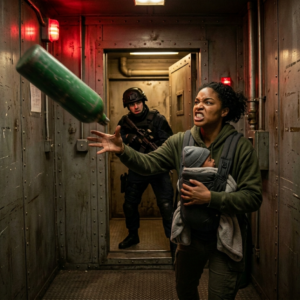
I sprinted down the red-lit hallway, aggressively slamming my palm against the specific piece of decorative wooden molding to reveal the massive, thick gray steel door. As I frantically punched the memorized numeric code into the keypad, the heavy, rhythmic pounding of tactical boots echoed violently up the service stairs. This was not the familiar cadence of Luca’s security detail. A massive man entirely clad in black tactical combat gear, his face completely obscured by a dark ski mask, rounded the corner, his heavy weapon raised and pointed directly at my chest. I possessed exactly one second of time before he ended our lives. Relying on a desperate, hysterical survival instinct, I aggressively reached into the heavy go-bag and firmly grasped the small, heavy, solid metal emergency oxygen canister. Screaming a raw, unrecognizable battle cry, I violently hurled the heavy metal cylinder directly at his masked head with every single ounce of strength my shaking arms possessed.
The desperate projectile did not hit him cleanly, but it forced him to violently flinch and defensively raise his arm, the metal tank clanging harmlessly but loudly against the expensive wallpaper. That single, microscopic second of human hesitation was exactly the lifeline I required. I scrambled frantically inside the dark safe room, physically slamming my palm down onto the massive red button. The heavy steel door hissed shut with incredible pneumatic force, followed by the definitive, echoing, terrifyingly final clanks of the massive magnetic bolts violently shooting into place.
Inside the small, windowless, heavily fortified steel box, the only illumination came from a small, low-level light and the glowing, black-and-white screen of a security monitor directly displaying the main staircase. My blood froze completely as I watched the silent, grainy feed. Luca Belandi, dressed only in a black t-shirt and loose sweatpants, was intensely crouched behind a shattered marble pillar, a handgun gripped tightly in his right hand. He was completely alone, violently exchanging rapid gunfire with a squad of heavily armed mercenaries advancing systematically up the stairs. He was physically holding the entire third floor entirely by himself, strategically buying me the precious seconds needed to survive. Nico’s cries rapidly escalated into panicked, gasping wheezes, his fragile lungs struggling in the pressurized air. Desperate, I ripped open my shirt, placing his bare, cold chest directly against my own sweating skin, desperately attempting to regulate his breathing through primal, skin-to-skin contact while singing a shaking, off-key gospel hymn of rescue.
Through the grainy monitor, I horrifically witnessed a bullet violently graze Luca’s left hand, the impact tearing his flesh. Yet, he did not vocalize a cry; he merely switched his weapon to his bleeding hand and continued firing with relentless, terrifying precision. Remembering the burner phone, my shaking, bloodless fingers dialed Detective Walsh, desperately trading the highly classified location of the Rinaldi syndicate’s Calumet River warehouse in exchange for immediate tactical intervention. The claustrophobic minutes dragged into a suffocating eternity until the definitive, metallic tap-tap-tap code echoed against the steel door. It hissed open to reveal Luca, completely covered in plaster dust, sweat, and dark blood, his face a horrifying mask of pure, primal, violent exhaustion. I sat him down heavily on the metal bench, retrieving the medical kit, and meticulously, silently stitched the torn flesh of the mafia boss’s hand back together, our intertwined roles laid completely bare in the violent aftermath.
The Legacy of Light
The brutal, failed siege of the mansion acted as a profound, violent catalyst that fundamentally reshaped the architecture of the entire city. The desperate, anonymous tip I had provided to Detective Walsh resulted in the largest, most successful human trafficking bust in the complex history of Chicago. Elena Raldi, a woman who had once been Luca’s childhood friend before the toxic corruption of their violent world transformed her into a ruthless, bitter rival, was publicly paraded across national news networks in heavy metal handcuffs. The sprawling Belandi mansion was methodically and expensively rebuilt, transitioning from a beautiful, vulnerable home into an impenetrable, bulletproof fortress of reinforced polymer and advanced biometric security protocols.
I was no longer considered a temporary consultant or a disposable piece of the help. In his quiet, gunpowder-scented study, Luca presented me with a thick, leather-bound document—a legally binding, lifetime protection agreement officially securing me under the formidable umbrella of the Belandi family. I was appointed the official Pediatric Care Manager, complete with an astronomical salary and a comprehensive, fully funded university scholarship to finally complete my registered nursing license. The final, undeniable seal of my total acceptance came not from a legal contract, but from the stern, stoic Mrs. Alvarez, who silently pressed a worn, simple gold ring into my palm, whispering through unshed tears that I was now eternally considered famiglia.
It has been exactly one full year since the snow began to fall on the private beach, the same night Luca presented me with his grandmother’s deep red ruby, asking me not to sign a contract, but to fundamentally build a life alongside him. I am currently standing on the sun-drenched balcony of the third floor, a specific location that once represented my absolute imprisonment and now simply functions as my cherished home. The gentle, warm wind blowing off Lake Michigan carries the vibrant scent of summer. Nico, now a sturdy, incredibly loud fourteen-month-old toddler, babbles happily at my feet in a chaotic, beautiful mixture of English and Sicilian dialect. I laugh softly, resting my hand gently upon my own highly rounded belly, feeling the strong, sudden, reassuring kick of our unborn daughter.
The profound grief that once completely defined my existence has dramatically shifted its shape. Utilizing the vast financial resources provided by Luca, I founded the Nova Fund, an initiative that provides critical, life-saving respiratory equipment and sterile breast milk to impoverished mothers on the South Side. Luca, having finally stepped completely out of the violent shadows that defined his legacy, utilized the seized assets of the dismantled Rinaldi empire to construct a massive, state-of-the-art maternal health wing at the public hospital. Carved elegantly in heavy marble over the grand glass entrance are the names of our profound losses: The Nova and Isabella Center. Our immense, shared grief is no longer buried silently in the cold ground; it stands tall and proud, built into a massive foundation of public care for the entire city to witness. We did not foolishly attempt to outrun the surrounding darkness of our complex lives; instead, we simply chose to forcefully, defiantly light a brilliant, unextinguishable lamp directly inside of it.
If this story resonated with you, I would love to hear your thoughts! Where in the world are you reading this from, and what was your favorite moment of Aisha’s incredible journey? Leave a comment below so we can share our experiences!
Disclaimer : This content may be created by AI for entertainment purposes. Any resemblance to real persons, events, or places is coincidental.






