When a Father Discovered the Architects of His Own Erasure
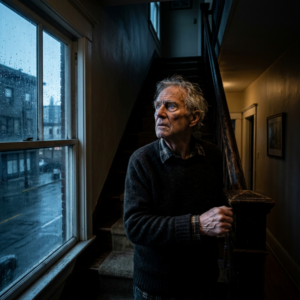
The air in the quiet Seattle suburb was thick with the comforting, aromatic scent of sage, butter, and roasting turkey. For George Mason, Thanksgiving was more than a holiday; it was a sacred ritual of memory and stability. For forty years, he had presided over this kitchen, the heart of a home he had built with his late wife, Marie. At 11:30 AM, precisely on schedule, the bird went into the oven. Outside, the characteristic Pacific Northwest rain streaked the glass in silver patterns, a peaceful backdrop to what George assumed would be a standard family afternoon.
But peace is a fragile thing, often shattered not by a blow, but by a whisper.
When the doorbell chimed two hours before the scheduled arrival of guests, George felt a flicker of confusion. Wiping his hands on a flour-dusted towel, he peered through the frosted glass of the front door. The silhouettes were unmistakable: his daughter, Emma, and her husband, Mark. They stood on the porch with wide, rehearsed smiles, looking like a portrait of filial devotion. Yet, as the door swung open, the “surprise” they offered felt heavy, laden with an unspoken agenda that George could sense but not yet name. This was the beginning of a cold war for the very ground George stood upon—a battle for the walls that held his life’s work.
Chapter 1: The Shadow in the Hallway
Emma moved into the house with a frantic, artificial energy. She hovered over the kitchen island, her eyes darting across the familiar countertops, shifting spoons and bowls as if trying to re-organize her father’s reality in real-time. “So, Dad, how long do you roast a turkey this size?” she asked, her voice pitched in a key of forced cheerfulness. George, ever the architect of precision, answered simply: “Three and a half hours.”
While Emma kept George anchored in the kitchen with nervous chatter about stuffing safety and cranberry sauce recipes, Mark made his move. Claiming the “long drive from Queen Anne” had caught up with him, he headed upstairs. George watched him go, a subtle instinct tightening his chest. The house was not cold, despite Emma’s insistence on keeping her coat on, claiming a chill that didn’t exist.
Then, the floorboards spoke.
George’s hand froze on the carving knife. He knew the sounds of his house like the notes of a familiar song. The creaks emanating from the ceiling were not coming from the restroom. They were coming from the hallway. Then came the unmistakable click-clack of a closet door being opened and closed—not by a guest, but by an inspector. Overhead, the heavy footsteps of a man measuring his territory echoed down to the kitchen, where Emma’s voice grew louder, faster, desperately trying to drown out the sound of her husband’s intrusion into George’s private sanctuary.
Chapter 2: Every Word a Shard of Glass
Propelled by a quiet, mounting dread, George moved toward the stairs. He climbed them with the practiced silence of a man who had lived in the same space for decades, each step a soft complaint beneath his weight. Near the landing, he stopped. The voices drifted down from the master bedroom, low and conspiratorial, slicing through the festive atmosphere of the day like a serrated blade.
“Three bedrooms, huge basement. It’s perfect,” Mark’s voice rang out, devoid of the forced respect he showed downstairs. “Plenty of space for your workshop, Dad. We’ll move in once the old man is settled. He has no clue.”
A second voice—Mark’s father, Porter—replied with a laugh that made George’s stomach turn. “And that nursing home’s cheap. 3,200 a month. Once we’re not paying rent, we’ll be fine.”
George stood paralyzed on the stairs, his knuckles turning white as he gripped the banister. The world tilted. His home, the repository of his memories with Marie, the walls that had seen Emma’s first steps and his own quiet aging, was being appraised like a carcass. He was being treated as an obstacle to be “settled” so that his son-in-law’s parents could move into his life. The betrayal was not just financial; it was existential. They were planning his erasure while the turkey he was cooking for them sizzled in the oven below.
Chapter 3: The Architecture of Silence
A sickening, crystalline calm settled over George Mason. The rage was there, but it was cold, buried deep beneath the discipline of an architect. He descended the stairs as silently as he had climbed them, returning to the kitchen where Emma was holding a wine glass up to the light, her face a mask of pale anxiety.
“Find what you needed?” she asked, her eyes searching his for any sign of the truth. “Changed my mind,” George replied, his voice a flat line. “Table’s fine as it is.”
The rest of the evening was a masterclass in psychological theater. Mark returned downstairs, settling into a dining chair with the entitled air of a king occupying a throne he hadn’t earned. He praised the crown molding and the way the light fell across the table, his compliments sounding more like a real estate appraisal than a guest’s gratitude. “Ever think about simplifying, George?” he asked casually between bites of turkey. “A smaller place, less to maintain. There are great communities for seniors.”
George watched them. He saw the way Mark’s hand brushed Emma’s under the table—a secret signal of triumph. He saw the rehearsed warmth in Emma’s eyes. He saw the “collapsing structure” of his family, and like any good architect, he realized that when a building is beyond repair, you don’t renovate. You demolish.
Chapter 4: Project Freedom and the Library of Truth
When the door finally clicked shut behind them that night, the silence of the house felt different. It wasn’t the peaceful silence of a holiday’s end; it was the heavy silence of an empty battlefield. George walked through the rooms—the living room, the basement, the attic—and he could almost see the ghosts of Mark’s parents hanging their curtains, moving Marie’s things into the trash.
He didn’t sleep. He sat at the kitchen table until the clock glowed with the early hours of morning, his cold coffee a bitter companion. “The old man has no clue,” they had said. George leaned into the darkness. Oh, he had a clue now. He remembered the sacrifices he had made as a single father, every mortgage check signed with pride, every repair done with his own hands.
By Friday afternoon, the grief had hardened into a sharp, functional tool. When Emma called to “check in,” noting that he seemed “tired” and “slow,” George played the part. He stirred his coffee and let his voice trail off. He was setting the stage.
He began his own quiet research at the public library on Market Street, sitting under the hum of fluorescent lights where no one knew his name. He studied Washington State Property Law with the focus of a man designing his final masterpiece. He learned the power of the “sole owner.” No signatures needed. No permissions required. No warnings necessary. He met with David Rhodes, a lawyer whose office smelled of lemon polish and the absolute certainty of the law. “They can’t stop you,” David told him. “They can’t even slow you down.”
Chapter 5: The Performance of a Lifetime
December arrived with a gray, Seattle gloom that George used to his advantage. He began “Phase One: Play Weak.” He let the mail pile up on the counter, leaving bills unopened where Emma would see them. He left the Christmas tree in its box, hanging a single, crooked strand of lights across the mantle. He moved slower when they visited, pausing halfway up the stairs to rub his back and sigh.
He watched the silent triumph in their eyes. At dinner, he would stop mid-sentence, asking, “What was I saying again?” He mentioned the furnace made a “strange noise” and complained about the cost of maintenance. He was feeding them the narrative they so desperately wanted to believe: the “old man” was failing.
When Mark and Emma finally moved in for the kill, sliding a brochure for “Sunrise Meadows Senior Living” across the table, George looked at the monthly cost: $3,200. The exact number he had heard on the stairs. He nodded slowly, feigning a weary acceptance. “Maybe it’s time,” he whispered.
The relief on their faces was a physical thing, a radiant glow of greed masquerading as concern. “We’ll take care of the house for you, Dad,” Mark said, leaning back. “No problem.” George smiled an unreadable smile. “Of course you will.”
Chapter 6: The Great Erasure Reversed
The plan moved from paper to reality with the clinical efficiency of a closing contract. While Mark and Emma were busy measuring his rooms and making renovation plans, George was meeting with Mary Chan, a real estate agent who specialized in “quiet” sales. He began moving his life into a storage unit in Georgetown—photographs, Marie’s keepsakes, the important papers. He was stripping the house of its soul before they could strip it of its deed.
By the time April 15th arrived, George stood at the title company. With a steady hand, he signed the final documents, selling the house to a young couple for $850,000—all cash. The “Notice to Vacate” was signed alongside the sale.
The climax of George’s “Project Freedom” came not with a shout, but with a letter.
Mark and Emma had already moved Mark’s parents into the Ballard house, believing the “residence agreement” they had George sign was their ticket to a free life. They were hanging curtains, arguing over paint colors, and boasting to friends about “settling the old man.” When the certified mail arrived, Mark tossed it on the counter, pouring a celebratory coffee before opening it.
The color drained from his face as the words “Notice to Vacate” and “Property Sold” glared back at him. George Mason was the seller. The buyer was a stranger. And they had 30 days to disappear.
Chapter 7: The Sunset of a New Life
The collapse was total. Mark stormed Sunrise Meadows only to find that George Mason had never been a resident. He had never even checked in. George had vanished into a clean, sun-filled condo near the lake, a place they didn’t know existed.
In a final meeting at a downtown cafe, Emma sat across from her father, weeping. “I’m still your daughter,” she pleaded, claiming the plan was all Mark’s idea. George looked at her—not with hatred, but with a profound, detached clarity.
“You didn’t just plan to take my house, Emma,” he said softly, placing a five-dollar bill on the table for his coffee. “You planned to erase me. You made your choice. Now you live with it.”
As George walked away, leaving her broken at the table, he stepped out into the summer sun. He hadn’t sought revenge; he had simply refused to be a victim of a war he never started. He had protected his history by reclaiming his future.
Reflection: The Boundaries of Love and Respect
George Mason’s story serves as a chilling reminder that the greatest betrayals often come from those who claim to care for us the most. It highlights the importance of maintaining one’s autonomy and the reality that “family” is defined by actions, not just blood. George didn’t just save his house; he saved his dignity.
Have you ever felt someone was trying to “manage” your life for their own benefit? How did you reclaim your power? Share your stories of standing tall in the comments below.
Disclaimer : This content may be created by AI for entertainment purposes. Any resemblance to real persons, events, or places is coincidental.






