The Haunting Legacy of Hong Kong’s Most Infamous Apartment 16
In the heart of Hong Kong’s New Territories, amidst the bustling industrial rhythm of Kwai Chung—one of the world’s most significant container ports—stands a relic of 1970s architecture known as the Lai King Estate. To a casual observer, the 25-story concrete monolith is merely a dense residential block, a testament to the city’s desperate need for housing. However, as the sun dips below the horizon and the humid air settles over the corridors, the residents of the third floor walk a little faster. They avoid looking at a particular stretch of wall—a smooth, windowless expanse of brick and cement that shouldn’t be there.
This is the site of Apartment 16, a residence so saturated with tragedy and supernatural phenomena that the government was eventually forced to erase it from existence, sealing its doors with masonry to quiet the echoes of a nightmare.
The Ghostly Echoes of a Caged Memory
The legend of the “Secret Room” began long after the physical doors were removed. Before the bricks were laid, the apartment was a revolving door for the brave and the skeptical. Local lore tells of an elderly woman who moved in, dismissing the rumors of a “haunted house” as mere superstition. She believed that a pure heart feared no shadows. Yet, within days, the silence of her nights was shattered by the sound of rhythmic, agonizing moans emanating from the hallway. Objects in her living room would drift across the floor as if moved by invisible hands. She fled in less than a month, leaving her belongings behind.
She was followed by three robust, young men—skeptics who laughed at the tales of ghosts. Their laughter died on the first night. They reported an inexplicable, soul-crushing dread that gripped them the moment the lights went out. They, too, surrendered the lease in weeks. As the apartment sat vacant, the heavy iron gates remained locked, but the neighbors began to witness the impossible. They heard the sharp click-clack of high-heeled shoes pacing the corridor at midnight. They heard the muffled sounds of two young women arguing behind the steel, followed by heart-wrenching sobbing. Shadowy figures were seen flickering through the walls, and the heavy door would occasionally stand wide open, revealing a pitch-black interior that felt colder than the Hong Kong winter.
The Tuesday Tragedy: A Family Shattered
The supernatural phenomena were not birthed from thin air; they were the scars of a horrific bloodbath that occurred on Tuesday, May 8, 1984. The home was occupied by the Leung family: 53-year-old Yeung Wai-kwan, a hardworking school janitor; her eldest daughter, 22-year-old Leung Suet-see, a bright secretary who had graduated from a prestigious English college; and the youngest, 18-year-old high schooler Leung Suet-yan.
The family had been struggling to find their footing since the passing of the father a year prior. Suet-see had stepped up, becoming the emotional and financial pillar for her mother and sister. But their peace was shattered by a man named Ip Siu-man. Ip was a former member of the Hong Kong Police Force’s Mobile Unit, a man whose life was a series of disciplined failures and violent outbursts.
The relationship between Suet-see and Ip was a volatile cocktail of obsession and control. While Ip’s parents adored Suet-see, her own parents saw the darkness in him—the “Fat Boy” neighbor who had a penchant for domestic violence. Ip had already been fired from the police force for disciplinary issues. His jealousy was a physical weight; he once brutally assaulted a man simply for speaking to Suet-see. The final straw for the Leung family came when Ip lured the mother and younger sister away with a fake hospital emergency, only for them to return and find him holding Suet-see captive in a state of undress, her mouth gagged with cloth.
The Midnight Kneeling and the Final Breath
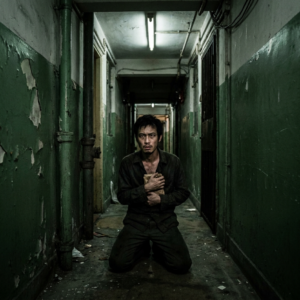
On that fateful May evening, the humidity was rising. Neighbors found Ip Siu-man kneeling outside Apartment 16, his face a mask of tears, whispering Suet-see’s name in a rhythmic, terrifying chant. He was begging for forgiveness, a performance that lasted for hours. When Suet-see returned home under police escort, she delivered a final, stinging ultimatum: “I will never forgive you. If you don’t leave, I will expose your crimes to the world.”
The police, viewing it as a standard domestic dispute, escorted Ip away. They believed the situation was defused. They were wrong. Thirty minutes later, as the mother opened the door to check the hallway, she found Ip back in his original kneeling position, like a gargoyle waiting for the dark. He lunged, seizing the mother as a hostage. He screamed through the door that he would kill her if the daughters didn’t open up.
In a desperate act of love, Suet-see threw the door open to save her mother. What followed was a demonic frenzy. Ip Siu-man, wielding a 20-centimeter blade, descended upon the sisters. He slashed the throat of the younger Suet-yan first, then turned his blade toward Suet-see. The mother was stabbed multiple times before she managed to scramble into the kitchen. Ip’s own parents stood in the hallway, paralyzed by a cowardice so profound they neither called for help nor intervened. They simply watched their son transform into a butcher, then quietly took a taxi home.
The Legal Battle and the “No Tears” Provocation
By the time medical teams arrived, the hallway was a river of crimson. The two sisters were pronounced dead shortly after arriving at Princess Margaret Hospital. Their mother, miraculously, survived after a month in intensive care. Ip Siu-man was arrested at 2:00 AM the following morning. He didn’t resist; the fire in him had burned out, leaving only ash.
In the high-profile trial that followed, Ip attempted to downgrade his charge to manslaughter. His defense hinged on a single phrase Suet-see had uttered: “Even if you die, I won’t shed a single tear.” He claimed this “provocation” caused him to lose control. However, the court saw through the facade. The judge noted that Ip had left, gone to the bathroom to compose himself, and returned with a weapon. This was not a moment of passion; it was a calculated execution. Ip was sentenced to death, a sentence later commuted to life imprisonment as Hong Kong moved away from capital punishment.
The physical killer was behind bars, but the apartment remained “alive.” The rumors of the two sisters’ spirits seeking justice became so pervasive that the housing authority could no longer find tenants. The surrounding neighbors, driven to the brink of madness by the sound of phantom televisions and splashing water behind the locked door, moved out in droves.
The Eternal Silence of the Brick Wall
Today, if you visit the third floor of the Lai King Estate, you will find a wall that defies logic. Where Apartment 16 and 17 once stood, there is now a solid, seamless barrier of brick and cement. The authorities claimed the space was converted into an “electrical meter room,” but the residents know the truth. They believe the wall wasn’t built to house machinery; it was built to entomb a haunting.
Even now, decades later, the “Number One Haunted House in Hong Kong” continues to claim headlines. In 2012, shadows were seen darting into the sealed area. In 2014 and 2018, tragic suicides occurred on the rooftop of the building, with local whispers suggesting the “spirits of the sisters” had drawn the victims to the edge. Whether it is the power of suggestion or a genuine rift in the fabric of the world, the story of Apartment 16 serves as a grim reminder of how obsession can turn a home into a tomb, and how some tragedies are too heavy for the earth to ever truly bury.
Deep Reflection: The Weight of What We Leave Behind
The story of the Leung sisters is more than a ghost story; it is a tragedy of missed warnings and the terrifying reality of domestic obsession. It asks us to look at the “sealed rooms” in our own lives—the traumas we try to brick over rather than face. True peace for the residents of Lai King may never come as long as the memory of that Tuesday night lingers in the concrete.
Have you ever felt a “cold spot” in a place with a dark history? Do you believe a physical space can “record” a tragedy? Share your thoughts below.
Disclaimer : This content may be created by AI for entertainment purposes. Any resemblance to real persons, events, or places is coincidental.






