A Chilling Encounter with the Mirror of Karma
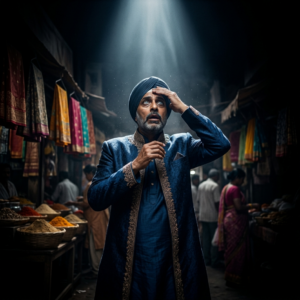
Deep within the ancient philosophy of the East lies a concept that many claim to understand, yet few truly feel. It is called Karma—the cosmic law of cause and effect, the spiritual ledger where every action, whispered word, and hidden thought is meticulously recorded across the tapestry of time. We often think of Karma as a distant judge, but what if Karma walked beside us on the street every day, wearing the face of the very people we look down upon?
This is the narrative of a man who believed he was a master of the universe. He was a man of immense intellect, a “genius” of spiritual theory who could explain the mechanics of the soul but lacked the warmth of a human heart. He walked through life with his chin tilted upward, his eyes scanning the world not for beauty, but for validation of his own superiority. He was a man trapped in the ivory tower of his own mind, a prisoner of pride who understood the “how” of life but had entirely forgotten the “why.”
The Arrogance of the Spiritual Scholar
The sun beat down on a bustling city street, casting long, sharp shadows that mirrored the man’s own rigid perspective. He watched the world pass by like a scientist observing specimens under a microscope. To him, the suffering of others was not a call to action, but a mathematical equation already solved.
He saw a man with only one leg, hopping with rhythmic, exhausting effort down the cobblestones. The scholar didn’t feel a pang of empathy; he didn’t offer a steadying hand. Instead, a cold, smug thought crystallized in his mind: “Ah, look at this creature. He must have kicked a holy man in his past life. This stump is simply the physical manifestation of his ancient cruelty.” He felt satisfied. In his head, the world was orderly. The victim deserved the pain, and the scholar, being whole, was clearly a “better” soul.
To understand the weight of this arrogance, we must look at the hidden threads of time. If we were to peel back the veil and travel centuries into the past, we would find a high-walled courtyard. There, a younger version of the one-legged man stood as a powerful guard. Before him knelt a peaceful, defenseless sage. With a sneer of absolute power, the guard raised his heavy boot and struck the holy man, laughing as the sage tumbled into the dust. The guard thought he had won. He didn’t realize that in that moment, he had planted a seed in the garden of his future—a seed that would grow into the hopping man on the street.
The scholar knew the theory of this, but he used it as a weapon of judgment rather than a bridge of compassion.
The Beggar and the Theft of the Soul
A few blocks later, the scholar encountered a beggar woman. She sat against a crumbling brick wall, her clothes tattered and her hair matted with dust. As he approached, she extended her hands—arms that ended in rounded, fingerless stumps. Her voice was a fragile rasp: “Please, sir… do you have anything to spare? Just enough for a piece of bread?”
The scholar’s eyes flickered to her hands and immediately darted away. He quickened his pace, his cloak billowing behind him like a barrier. “I bet she used to be a thief,” he whispered to himself, safe in the silence of his thoughts. “Losing her fingers is her Karma. Why should I interfere with the universe’s justice? To help her would be to defy the law.”
Again, the invisible gears of time reveal a hidden truth. In a past life, this woman had been a master pickpocket in a crowded marketplace. She had watched an honest laborer, a man who had worked months to earn enough to feed his starving children, tuck a heavy purse into his belt. With a deft, heartless flick of her fingers, she had stolen that lifeblood. She had celebrated her “easy” victory while a father wept in despair, his children going to bed hungry. The curse of that father—“May the hands that stole my children’s food be rendered useless”—had traveled across lifetimes.
The scholar was right about the cause, but he was tragically wrong about the response. He saw the “criminal” in the beggar, but he failed to see the “God” in the woman.
The Blind Man and the Laughter of Truth
The turning point of his life arrived when he saw a blind man. The man was fumbling near a set of steep, treacherous stone steps. His white cane tapped erratically against the edges, searching for a path he could not see. He was dangerously close to the edge.
The scholar stood still, watching the blind man struggle. He felt a familiar surge of pride. “Of course,” he thought. “He refused to see something important in his past. Now, the darkness he chose then has become the darkness he inhabits now. He is merely receiving what he asked for.”
Suddenly, the blind man stopped. He didn’t fall. He turned his head—not toward the stairs, but directly toward the scholar. His sightless eyes seemed to pierce right through the scholar’s physical form. Then, he began to laugh. It wasn’t a bitter laugh; it was a joyful, booming sound that echoed off the surrounding walls.
“You are too funny!” the blind man shouted, his voice ringing with an uncanny authority.
The scholar was paralyzed. “How… how do you know where I am? You can’t see anything.”
The blind man smiled, a serene expression that made the scholar feel suddenly small. “My eyes are closed, but my heart is wide open. Your ‘Third Eye’ is blind, my friend, because you are stuck in the prison of your own head.”
A Chilling Encounter with Intuition
The scholar approached the blind man, his heart pounding with an unfamiliar rhythm. “Why did you laugh at me? What is so funny?”
“You were right,” the blind man said, his voice dropping to a gentle, knowing tone. “I am blind because I refused to see the suffering of others in my past life. I chose to look away when I should have looked toward. I asked for this darkness so that I could finally learn to see with my soul.”
He paused, and his “gaze” seemed to grow even more intense. “But you… you are making the exact same mistake I made. You are judging. You are not helping. You are using the ‘Truth’ to keep your heart cold.”
The scholar felt a cold sweat break across his brow. “I don’t understand…”
“Just like me,” the blind man continued, “you refuse to see the simple things you can do to help. In fact, in our last life, we were in the same family. I was the one with the power, and you were the one who had problems. I refused to see how I could help you then. Now, the roles have shifted. You are wholeness and I am brokenness. And yet, you are choosing the same path of indifference.”
The Moment the World Went Black
The blind man’s voice became a whisper of cosmic weight. “My friend, the truth is you are already blind. You just don’t know it yet.”
In that instant, as if a curtain had been dropped over the sun, the scholar’s vision shattered. His eyes were wide open, staring at the steps, the street, and the blind man, but everything turned to an absolute, terrifying blackness.
“Oh my God!” he screamed, his hands flying to his face. “I can’t see! I’m blind! Everything is gone!”
He rubbed his eyes until they were red, blinking frantically, but the world remained a void. He fell to his knees on the very cobblestones where he had just stood in judgment. The weight of his own pride crushed him. “I judged them,” he sobbed into the darkness. “I thought I was better because I didn’t have their struggles. I used Karma as an excuse to be heartless.”
The blind man’s hand reached out, finding the scholar’s shoulder with unerring accuracy. “You have the greatest struggle of all now,” the blind man said softly. “You must struggle with yourself. You must conquer the mind that thinks it knows everything and open the heart that knows nothing but love.”
The Longest Journey: From the Head to the Heart
Kneeling in the dirt, stripped of his intellectual armor, the scholar finally broke. “I’ll do anything,” he pleaded. “I will change. I will help everyone. I will open my heart and see every living being with a loving eye. Please, let me see again!”
“Bravo,” the blind man said, and the scholar could hear the smile in his voice. “I had to stay blind for a whole lifetime to learn this. I hope you can learn it in a single moment.”
Slowly, the darkness began to recede. First came a dull gray, then a burst of golden light, and finally, the vibrant colors of the street returned. The scholar looked at his hands, then at the steps, and finally at the blind man. Tears of genuine gratitude—not pride—streamed down his face.
“Thank you,” the scholar whispered. “A few minutes ago, I thought you were just a blind man. Now I see that it is I who was blind. You see more than I ever could.”
From that day forward, the scholar was gone. In his place was a man of action. He didn’t just study meditation; he practiced the meditation of kindness. Every morning, he bowed his head in prayer, not to a distant God, but to the spirit that lived within every person he met.
Whenever a mean or judging thought entered his mind, he would stop and physically change his direction. He became the first person to offer a hand to the hopping man. He became the one who sat with the fingerless beggar and shared a meal. He understood finally that the law of Karma isn’t a reason to look down—it’s the ultimate reason to reach out.
Deep Reflection: The Universal Mirror
This story serves as a profound reminder that our perception of the world is often a mirror of our own internal state. Arrogance blinds us to the divinity in others, while compassion provides the only lens through which we can truly see the truth. The scholar’s journey is one we all must take: the “longest journey in the world”—the twelve inches from the head to the heart.
Karma is not about punishment; it is about the evolution of the soul. When we use spiritual knowledge to judge others, we create a new, darker Karma for ourselves. But when we use our wholeness to support the brokenness of others, we heal the collective spirit of humanity.
Call to Action:
The next time you see someone having a bad day, or someone whose life seems “broken” in a way yours is not, remember the blind man. Don’t look for a reason to judge; look for a way to love. Give them a smile, say something kind, or offer a simple hand of help.
What is one thing you have been “refusing to see” in your own life or community? Share your thoughts and your journey from the head to the heart in the comments below. Let us learn to see together.
Disclaimer : This content may be created by AI for entertainment purposes. Any resemblance to real persons, events, or places is coincidental.






